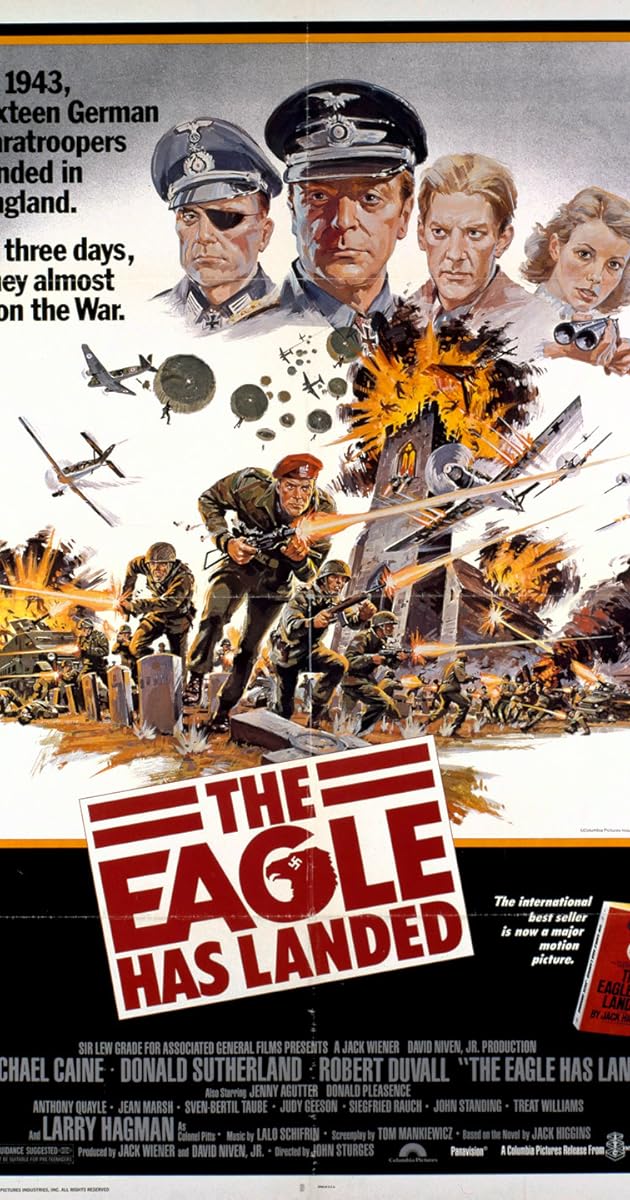
Image result for the EAgle has landed

My father took me to The Eagle Has Landed in 1976, and I of course loved it.   John Sturges (The Great Escape) can make a solid  war picture and this one was smart, cynical, compelling and the last one he directed.

As I watched it again last weekend, I imagined this script landing on some hotshot Hollywood moguls’ desk today.

First pages, not so bad.  The war is going poorly for the Nazis and they are looking into a plan to kidnap Churchill. 

Okay, so far so good.

The plan is dropped on an armless  Nazi with an eye patch.  No, not Tom, Cruise as Von Stauffenberg in Valkyrie.  That film is 30 years and a Bryan Singer sex scandal away.

This armless, eyeless Nazi is played by Robert Duvall.  And whoa!  In what he thought was a moment of whim on the part of Hitler, it turns out that the plan is feasible and the game is afoot.

So feasible that Duvall scours the records for the perfect German unit to take on the task of posing as a Polish outfit in a northern English town until Churchill arrives, when he can be snatched.  Who does he find?

Michael Caine, and his close-knit commandos, who have been kicking ass and becoming more and more embittered on the Eastern front.

But Duvall needs more; he needs two boots on the ground in the little town before the “Polish” troops arrive.  Enter . . . Donald Sutherland, an Irishman who hates the English so much he’s in league with the Nazis.

Okay.  It seems like a lot of money to be throwing at the bad guys. 

Who is the hero?

Larry Hagman?  J.R EWING?

Well, no, but Hagman does play the American commander on the ground in the quaint English town.  He’s no hero.  He’s more like John Larroquette in Stripes, a martinet wannabe who craves combat badly.  Hagman is incompetent, Caine’s men repel his frontal assault with ease, and he dies in such an ignominious manner, it’s almost comic.

Oh good.  There’s a young Treat Williams and Jeff Conaway.  Good looking American GIs who . . . . hmmmmmm, these guys have no lines!  They barely even register!!

Wait, are you telling me . . . . the leads are all Nazis!!???

Yup.

In 1976, this is how Hollywood got past this inconvenient cast.  First, they made Duvall erudite and resigned, as well as armless and eyeless, and they had him present the opportunity to grab Churchill as an opportunity to sue for peace.

As for Caine, as he and his men are shipped back from the Eastern Front, they meet an SS unit rounding  up Jews at a railroad junction.  Out of sheer frustration, Caine assaults the SS commander, assists in the escape attempt of a Jewish woman, and for his troubles his men are all cashiered and consigned to tasks that will eventually result in all their deaths.  Did Caine revolt because he was torn over the Holocaust?  Well, no.  In his own words, “I have nothing for or against Jews, personally. But I’ve seen too many men die for cause, to watch a young girl be killed for sport!”

Okay.  Good enough for the Bicentennial.

And Sutherland?  Well, he’s humanized because his beef is about Ireland, not that icky master race stuff, and he’s quick with a drink and the brogue and he’s so charming, Jenny Agutter falls in love with him instantly (really, the weakest part of the picture because he’s too old for her, it’s too immediate, and what she does for her “love” is so extreme it just doesn’t pass the smell test).

Solid flick, clearly of its time.  Triggerocity at about an 8 out of 10. On Amazon.

p15073018_v_v8_aa

From Lauren Greenfield, the writer/director of The Queen of Versailles, this documentary tries to be both an anthropological study and photo-journalistic essay of wealth. We are introduced to rich people in LA who get cosmetic surgery for their dogs, rappers in Atlanta who litter strip clubs with currency, porn stars who hope to emulate Kim Kardashian, escorts and limo company execs who sell the veneer of being rich for an evening or an assignation, and a whole host of ostentatious sellers and buyers.

The stories aren’t necessarily new. Excess is a strong component of who we are and coupled with the desire to judge, the sneering at folks who are the most brazen and gosh while we engage in miniaturized versions of their sins is damn near a national past time.

The director’s own revelation of being a small part of it, a gawky teen at a tony LA high school dropped off a block from school so her peers wouldn’t see the car her father drove (and he’s a doctor!), suggests we should trust her as a narrator.  But Greenfield can’t hold a line. She eventually muddles the message, at one point, confusing excess with being a workaholic, a cheap and errant way to shoehorn her own story into the feature.  It’s a bad fit, and her interrogation of her ambitious mother and bright son in the service of the subject is off-putting.

Still, the film eventually crashes when it morphs from a broad review of wealth culture to wild individual stories followed by a “where are they now?” coda that feels every bit as exploitative as the society the director is attempting to depict.

The documentary is also peppered by lofty, laughable socio-political commentary from Chris Hedges, a dummy extraordinaire whose platitudes are in stark contrast to the film’s more understated tenor. The picture is best in presentation, not catechism.

Hedges, however, does scratch an itch: “It’s kind of like the end of Rome . . . Societies accrue their greatest wealth at the time of their death.”

We shall see!  On Amazon.

E7F37A5D-79A5-4BD3-805B-E7F98B533CA4.jpeg

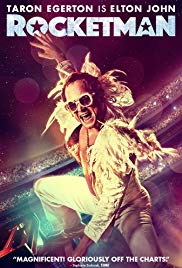
The first half is a blast. Following the model of Across the Universe, director Dexter Fletcher incorporates Elton John’s music into boffo biographical song and dance numbers (the movie takes the current model and reverses it; it is ready made for Broadway), and Taron Egerton is winning as our shy, brilliant, budding rock star. The depiction of his rise is light, whimsical and fun.

But the second half of the movie, much like the middle third of John’s life, is a bummer. The choreographed song and dance numbers give way to trippy, psychedelics that are not only a drag, but repetitive and tiring.  John drinks, drugs, orgies, wears more and more ridiculous outfits and goes lower and lower, much like your eyelids.

It ends precocious, as John confronts his annoyingly minor demons (overbearing mother, distant father, not-as-advertised first lover)  in a rehab group therapy.

Not quite where a film-goer wants to end up, even if it worked out for John.

Klute' Dramatizes the Exploitation of Women | Cinema Faith

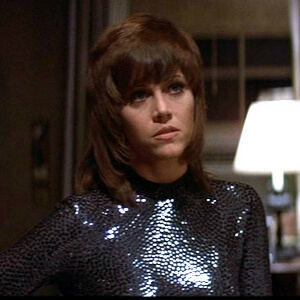
Alan Pakula’s sexual thriller is still a little jarring in its frankness, even today.  In the age of “sex tape as career move”, very little can astound or shock, but Jane Fonda’s electric and vulnerable turn as a call girl hunted by a killer gives the viewer entrée not only into the precariousness of her world, but in her own vulnerability.  She plays Bree Daniels, a struggling actress who considers her sexual exchanges mini-dramas, where she gets control, something she clearly needs desperately, even if it is self-destructive.  When we see her in action, she’s powerful and pitiable, all the while exhibiting how effective and alluring a good call girl can be.

Daniels is saved on more than one occasion by a laconic John Klute (Donald Sutherland), a police officer turned p.i. who is investigating the disappearance of a businessman who may or may not be her stalker.  Naturally, they develop a relationship.

Pakula (The Parallax View, All the President’s Men) has a keen eye for the shadows and menace in otherwise humdrum, pedestrian environs.  He also has great patience, which results in very understated, moving scenes, such as when Fonda flips through the catalogue of homicide photos of dead prostitutes, and her character and the viewer see her face in all of them.  The scenes where Fonda attempts to seduce Sutherland in order to establish control are similarly subtle, and Pakula places you directly in the dilemma of not wanting to be played but being enticed all the same.

There are problems.  Fonda is so good (she won Best Actress) I thought the scenes of her in therapy were unnecessary.  She’s strong in them, but she’s better expressing her foibles and fears in the context of the story.   As the detective, Sutherland runs into the opposite problem.  He is fully unexplored, a quiet mechanism for Fonda’s growth and nothing more.  I  wanted to know more about him.  Not tons, but something.

Still, this a very strong picture that holds up well, especially given the subject matter.

Post image

Very, very long (6 hours in total for the two films), but not altogether terrible and without giving anything away, at least they put some bodies on the block, thus limiting later franchise movies solely to origin stories.  Quippy, and visually much more satisfying than a lot of these movies.  Also, Thor in a fat suit is pretty funny, and melding The Hulk and Bruce Banner (now, he can wear the right size pants all the time)?  Inspired.

Still, when all is said and done, the whole things turns on Superman reverse circling the earth to go back in time.  They just couldn’t use him because he’s not a Marvel character.  Also, the concept for the second film is the same as HBO’s The Leftovers.

Image result for American Animals

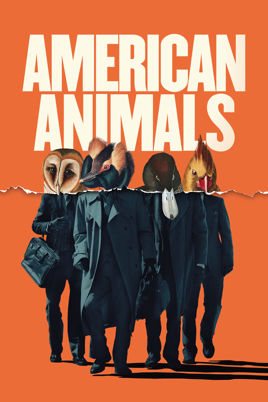
First time feature writer/director Bart Layton’s true story of four Kentucky college kids who decide to steal rare books from the archives of Transylvania University is a gem.  At root, it’s a heist picture, but this is no Oceans 4.  Layton hilariously juxtaposes the theft in the minds of the boys with the much less smooth, cool and seamless aborted and actual boosts.  Layton also captures the ennui and disassociation of the kids, which has them yearning not so much for the money but for an authentic experience, a stamp.  He does not sugarcoat their selfishness, or make “woe to the disaffected suburban affluent” excuses.  Instead, he makes what seems rather incredible understandable, if perplexing.

Layton’s approach is phlegmatic and innovative without being showy.  His vision of the inertia and isolation of the boys melds perfectly with their amenability to the caper.  He films their surroundings darkly, sparsely and uninviting.  While everyone else seems to be communing just fine, they are off-kilter, uncomfortable.

I can’t believe Layton doesn’t have a promising future in Hollywood.  I only hope he isn’t immediately jammed into The Avengers: Super Mega-Explosion.  My only nit is the failure to properly account for the motivations of two of the four conspirators, most egregiously, with the last addition to the group.  The short-shrift given the characters was noticeable and a little distracting.

The film owes a debt to Richard Linklater’s Bernie in its use of interviews of the actual participants, but rather than high comic recollections from the would-be thieves and gentle reproaches from their family and friends, he captures the criminals as reflective, remorseful and even grasping to explain how they got to their deed.  As for the families, they are disheartened and confused, not enamored of their band of merry kids now that time has passed.

Layton saves his best interview for last, that of the librarian who is most directly and viscerally affected by the robbery.  You can interpret her state of mind in many ways, but she has been affected by the experience, and in what is the film’s best message, her pain seems permanently etched on the faces of the quartet.

Image result for Once Upon a A time in Hollywood [poster

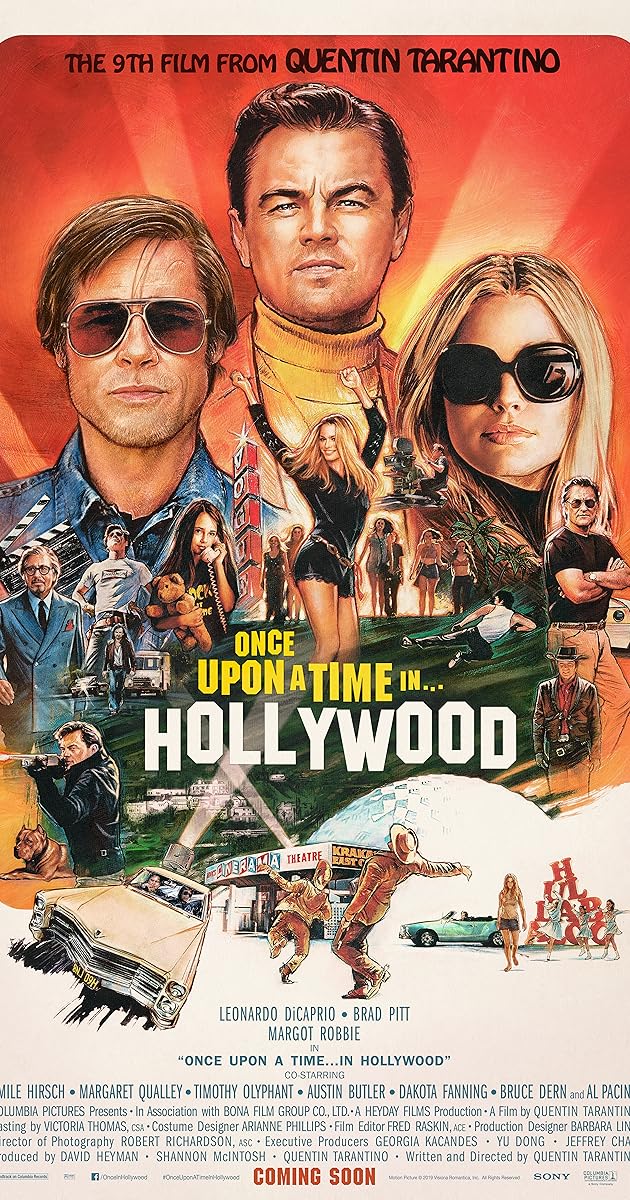
Twenty minutes in, my brother whispered to me, “I don’t know if this is going to be a good movie, but it’s a beautifully curated movie.”  He was dead on.  Quentin Tarantino doesn’t just re-create the look of 1969 Hollywood, he does it in a manner that somehow straddles classic homage and the hazy recollection of a local.  The town seems both wondrous and pedestrian.  Never were neon lights for Taco Bell or the Musso and Frank Grill so compelling.

Tarantino places a fading movie star and his stunt man/go-fer (Leonardo DiCaprio and Brad Pitt) in the midst of this mesmerizing visual portrait, the former playing an “almost made it” leading man reduced to working for cameos during “pilot season” and the latter his loyal companion.  And wouldn’t you know it, DiCaprio lives next to none other than Roman Polanksi and Sharon Tate, and hey, who was that scraggly hippie who skulked by the other day?

The film could have been cutesy or overly reverential, and when the likes of Steve McQueen, Bruce Lee and Mama Cass make appearances, I’ll admit, I was apprehensive.  But their scenes are both fun and important.  They assist in Tarantino’s portrait of Tinseltown as a much larger Mayberry, where everyone knows each other just to say howdy, but a lot of those everyones are someone.

Enmeshed in the slow-building run-up to the tragedy seared in our national consciousness (I don’t know about you, but when I was a kid I devoured Vincent Bugliosi’s “Helter Skelter”, and somehow, those white cut-outs of the bodies on Cielo Drive were more horrifying than any actual murder photo) are the stories of DiCaprio, who has lost his swagger and is negotiating his way down; Pitt, a man with a notorious reputation necessarily affixed to the fading star; and Tate (Margot Robbie), the ingénue representing the audience, agog at the magic around her and so excited about her future she can barely contain herself.  There is not a minute of their stories that isn’t engaging, and Tarantino leisurely walks them though the company town.

This is also Tarantino’s funniest film.  His dialogue has always been crackling, but he has moved on from bravura speeches and cool pop culture references, instead writing much more measured and subtle, with real heartfelt exchanges (his last film, The Hateful Eight, was a quantum leap in his maturity as a writer).  And while excess is Tarantino’s hallmark, and often his downfall, you may not believe me, but this picture is an exercise in restraint.

I would like to say more, but I don’t want to spoil anything or preview one of the more enjoyable movies I have seen in years.   Go now.

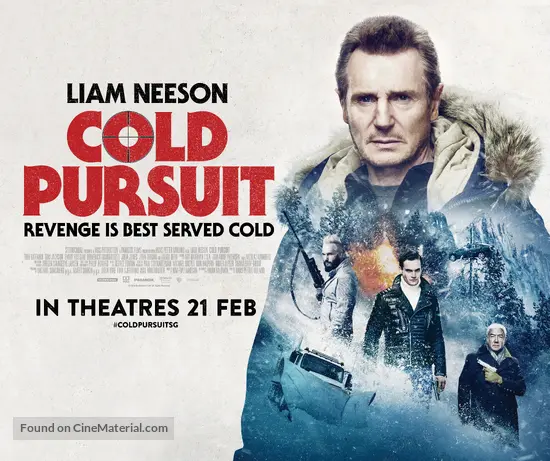
Image result for cold pursuit

I love these movies.  Almost as much as Denzel Washington’s Equalizer movies.  More so than the John Wick flicks.  The structure appeals to me.  Somebody does something awful to the family or friends of our hero, and he goes injudiciously, satisfyingly nuts.  Better, there is no nuance.  The bad people are awful.  Unequivocally grotesque.  In the latest Equalizer II, a group of entitled rich boys, in a swank apartment, just drugged, date raped, and filmed an intern.  Lucky for me, the Lyft driver they called to pick her up was Denzel, who got to whip this punk’s ass.

theequalizermovie's GIFs on Tenor

Awesome, right?

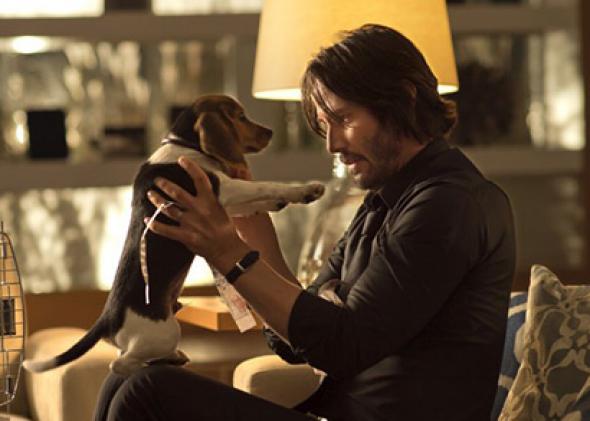
In John Wick, the bad guys didn’t even kill Keanu’s family member.  They killed his puppy!  But not just any puppy.  It was a puppy delivered to him by his wife, who had just died of cancer.

Keanu Reeves action movie John Wick, reviewed.

Death toll for one puppy?  Seventy-seven.

Unlike Wick, Liam Neeson isn’t a numbers junkie.  But he’s still pretty lethal, as we found out in Taken, when Serbs or Croats or whoever it is from Eastern Europe you can still use as bad guys without the Anti-Defamation League up your ass took his daughter to sell her to sex traffickers.  So, Neeson, a former Special Forces, CIA, Green Beret, SEAL type (I dunno), uses his “very particular set of skills” to get her back.

In this flick, Neeson is a dude who plows the roads of snow.  That’s it.  That’s his “particular set of skills.”

No matter.  His son is offed by the Denver syndicate within, oh, six minutes.  Neeson has it sussed out in about 13 minutes, and then, he works his way up the chain, killing dudes, until he gets to the top (his wife, Laura Dern, leaves him somewhere early, which gets her out of the way for more killing).

The flick is occasionally satisfying, but as directed by Hans Petter Moland, it has some delusions of being arty.  The retribution-fest is interrupted by falderol about a local Indian syndicate who got crossed by our bad guy, with sadness expressed at the rape of the land by ski resort.

Boring!  More bodies, please.

So, this is meh.  A few decent lines, an okay villain, but not enough corpses and a little too much chatter.

Available at Redbox and soon to cable.

Image result for Obit movie

A charming, old-fashioned documentary about the obituary writers who work for The New York Times, the picture is a tight and compelling look at a particular craft, revealed in interviews with the craftsmen.

I love obituaries from the Times, and there is a certain sadness in watching picture documenting an art form whose biological clock is ticking.  Their work is substantial, and it is a treat to see them tell us about what they do and how they go about it.  But it is bittersweet, because the dusk approaches.

I only had one criticism.  While the obit writers freely regale us with their worst errors, the tricks of the trade, and the challenges of an often-time sensitive endeavor, director Vanessa Gould never inquires too deeply.  For example, we hear about the conflict of deaths (Farrah Fawcett passing the same day as Michael Jackson) but nary a word as to how these writers deal with figures with controversial pasts (I would love to have had the obit writer discuss the decisions he made with Jackson’s piece).  Also missing is whether famous folks who die have pressure exerted on their behalf by their handlers and/or family.

Still, a fascinating documentary.  Available on DVD (I still get one a month from Netflix).


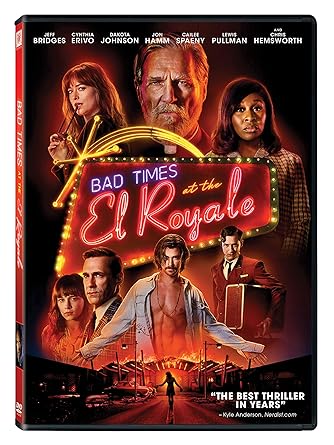
Image result for el royale

The first half of this Tarantinoesque Key Largo is pretty good.  Four strangers (Jon Hamm, Jeff Bridges, Cynthia Erivo and Dakota Johnson) show up at a past-its-prime, resort hotel in the Nevada/California mountains, the kind of place where Sammy, Judy and Frank might have swung back in the day.  They all have a story, which we learn in flashbacks, some of which are more compelling than others.  Their destinies collide explosively.

I was worried the film would be too kitschy and cool, too mannered, but it manages to keep a lid on it for long enough to be engaging.  Other problems keep it from being unequivocally good.  For one, Dakota Johnson barely even registers.  She’s undeniably attractive but as a shotgun-toting Alabaman on the run from her better looking Charles Manson (Chris Hemsworth), she’s as convincing as Melania Trump.   Worse, Hemsworth tries to chew scenery, but the best he can do is ape Val Kilmer in The Doors (I guess all Svengalis from the late 60s had that lizard lope).  To cement his powers of persuasion, we get a flashback to Hemsworth preaching to his hippie flock, and let’s just say, he’s more Jim Nabors than Jones or Morrison.

Erivo is very good, but she’s a singer as a character and in real life.  Writer-director Drew Goddard (The Cabin in the Woods) feels compelled to have her perpetually employing the pipes, an unnecessary distraction.

On HBO.  Fine if you got nothing else going on.