Archive

5 stars

Life is Beautiful (La vita è bella) – Film Review | Ashley Manning

Roberto Begnini’s Academy Ward-winning fable is in two parts.  First, the love-at-first-sight courtship of a sweet and funny man and a beautiful schoolteacher, followed by a tale of a father’s love for his wife and son and the lengths to which he will go to spare them the cruelty of a Nazi concentration camp.  Both halves of the film seamlessly meld, and the picture travels a road from sunny to tense to dire, with Begnini at the heart, lending dignity as he dances faster and faster.

Begnini’s film is neither historically accurate or particularly reality-based.  Indeed, the half of the film occurring in the concentration camp could have taken place over a period of months, weeks or days, and Begnini’s character essentially creates a daily circus to shield his boy from the horrors that surround them, behavior not even Colonel Kilnk would have allowed.  For this reason, Life is Beautiful came in for criticism from some quarters who believe that a Holocaust movie should not necessarily be the backdrop for a comedy, however bittersweet, and/or that Begnini trivializes and historically mutated the reality of Italian Jews during World War II.

Nuts.  The overarching theme of the film is a father’s attempt to protect his son from death, both physical and spiritual, effectively conveyed in a respectful manner.  Complaints of inaccuracy or improper tone are misplaced and rigid, as if there is some politically correct blueprint for a Holocaust film.  Conservative film reviewer John  Podhoretz recently followed this line, attacking the latest X-Men movie – which traces Magneto’s powers and philosophy to his treatment at the hands of the Nazis – thusly: “Genocide and supernatural powers don’t mix”.

Nuts to him too.

Shoah has been made.  So too Schindler’s List and The Wansee Conference. Go see them, I implore you, and make your own judgments (and while you are at it, check out Enemies, A Love Story, which actually mines a Holocaust survivor’s post-trauma love triangle for a couple of chuckles).  But don’t stilt artistic vision in the name of grim devotion to past horror.

These criticisms smack of paternalistic preaching that might make The Catholic Standard proud.  Tarantino and Stone “glorify” and thus perpetuate violence.  Lolita makes child molestation all the more probable.  And Begnini’s work, according to Slate‘s David Edelstein, similarly offends: “Imagine Harpo Marx giving the hot foot to a pompous official, who takes out a machine gun and blows him away: That’s how cheap Benigni’s hash of farce and tragedy is.  It’s a gas, all right.”

Edelstein earned his “I’m A Sensitive Keeper of the Grim Tenor of Concentration Camp Flicks” ribbon.  And with that award goes a free ticket to Showtime’s offering, The Devil’s Arithmetic – Kirsten Dunst is transported from modern day history class, where she passes notes and ignores the teacher’s recitation of the the extermination, to a WWII-era Poland.   Or The Twilight Zone, where Vic Morrow’s modern day bigot was carted off in a train headed, presumably, to Treblinka.

Controversy aside, the film begins in brilliant color but mutes to near-black and white as the story continues its necessarily sorrowful pace.  I can say little about the direction as my eye was trained on Begnini.  His performance as an unserious man at the most serious of times mirrors Chaplin (another person we could criticize – how dare he benefit from physical comedy while aping the creator of the concentration camp, Adolf Hitler). His carefree and whimsy is tested as he becomes separated from a rich life, his wife is torn from him, and every day becomes a struggle to personally survive and protect his son.  Everyone else is quite good and the son is particularly affecting (the Italians get me every time – see Cinema Paradiso).

Paul Thomas Anderson’s opus chronicles the American porn industry in the late 70s via the story of a loose family of weaklings, caught up in the speed, confusion and excitement of sex, drugs and fleeting fame in the bleaching sun of Los Angeles (Anderson took some license here, as the porn industry started in San Francisco and NYC, but his film requires that feel of promise and wasteland that is LA).

The patriarch is porn director Jack Horner (Burt Reynolds), and the story revolves around his LA retreat, a gaudy ranch-styled haven for his coterie of misfits.  There are the young rejects: porn star and mother Amber Waves (Julianne Moore), her teen charge Rollergirl (Heather Graham), studs Reed Rothschild (John C. Reilly) and Buck Swope (Don Cheadle) and lesser stars Jessie St. Vincent (Melora Walters) and Becky Barnett (Nicole Ari Parker); the film crew (William H. Macy, Ricky Jay and Phillip Seymour Hoffman); the money men, The Colonel (Robert Ridgely) and Floyd  Gondolli (Phillip Baker Hall); and a host of hanger-ons (club owner Luis Guzman and troublemaker Thomas Jane).

Boogie Nights GIFs | Tenor

Into this world comes Mark Wahlberg, a young kid who works at Guzman’s nightclub and comes to the attention of porn director Horner after Rollergirl has an encounter with him and reports back his massive endowment.  Horner offers the boy a place in the family.  Wahlberg becomes Dirk Diggler, porn superstar, escaping from a toxic home to the warm embrace of pseudo-stardom in fuck films.  In the world of porn, he finds acceptance, friendship and a certain form of celebrity.

Diggler is based on famed porn star John Holmes, and while Anderson doesn’t take Dirk Diggler down Holmes’s exact path of The Wonderland Murders and AIDS, the trip tracks close enough.  Hubris and drugs take Diggler from the safety of Horner and his new family to the street, where he ends up turning tricks, beaten by punks, desperate to score drugs and nearly murdered by a psychotic drug dealer (Alfred Molina).

To a person, these people are none-too-bright, but they cleave together in a life that mirrors celebrity, though it is gaudy and flimsy, glitz on the cheap.  They briefly flourish in a fantasy world within a fantasy world, where their work is deemed art, and their talent is certified as genuine.  Despite the self-delusion, Anderson shows how the family actually provides support to these outcasts never found elsewhere.

The film is visually audacious and features several flowing scenes without a cut for long stretches, including a 3 minute opening scene which introduces most of the characters.  Anderson’s filming of two separate parties at the Horner house is boundless and reminiscent of Altman’s opening scene in The Player as well as Scorcese’s casino scenes in Casino.  The effect meshes with Wahlberg’s entrance on the scene, as he steps into a world where he is the golden child.  You see the wonder – beautiful young people drugs, a swimming pool! and despite better instincts, you become intoxicated along with Dirk.

The screenplay by Anderson is authentic and resonant, evoking David Mamet, but without the showiness.  A prime example is the discussion between Horner and Floyd Gondolli on the changing business of porn:

The music by Michael Penn is evocative of the time as well, and the cuts chosen for each scene are spot on, from Andrew Gold’s “Lonely Boy” (revealing Amber Waves as a mother) to the Beach Boys “God Only Knows” providing the coda for the characters, to “Sister Christian”, which now serves as a sinister song, as used in the film’s most harrowing scene, much like “Stuck in the Middle with You” after Reservoir Dogs.

Finally, the performances are uniformly stellar.  Julianne Moore was nominated for best supporting actress (she was beat out by Kim Basinger in LA Confidential, a great film and a fine performance, but still, Moore was robbed).  Burt Reynolds was also nominated and rightly so.  Interestingly, after seeing a rough cut of the movie, Reynolds fired his agent for casting him in Boogie Nights, but Burt’s artistic choices have never been stellar.  Wahlberg stands out, exuding the perfect blend of charm, wonder, cluelessness and want.  Anderson is lucky Leonardo DiCaprio turned down the role to work on a little picture called Titanic.  DiCaprio’s a fine actor, but he’s a little too savvy and wary.  Wahlberg was perfectly open, trusting and innocent.  The scene where his mother berates him as worthless and stupid, forcing him out of the house, is heart-wrenching.

This is a classic film of America sprawl, ascent, decay, and fall.  One of my favorites and one of the top 20 ever made.

Walter Hill is a workmanlike director.   He makes some decent and intriguing films (The Warriors, Southern Comfort, Geronimo), and a fair amount of bad ones (Red Heat, Last Man Standing, Extreme Prejudice) and good or bad, the pictures are little more than macho shoot ’em ups where brawn and bullets win the day.  Hill’s commercial pinnacle was probably 48 Hours, the buddy-cop film that vaulted Eddie Murphy into the stratosphere.

The Long Riders is his masterpiece.   The story of the James-Younger (and Miller) gang, Hill cast the Keaches as Frank and Jesse James, the Carradines as the three Youngers, and the Quaids as the Millers (he also throws in the Guest brothers as the duo who eventually shoot Jesse).  It comes off not in least bit gimicky.  Hill comfortably alternates the mythic and the mundane about the brothers, and there is a naturalness to the interplay between the men that makes every scene easy and true.  Brothers in life portray convincingly as brothers in film.

Hill also provides a rich facsimile of Peckinpah-style screen violence, while setting forth a keen depiction of rural tradition and family loyalty . His scenes in the Missouri woods, while the gang hides out, are well-crafted and authentic, his Texas bar fight by Bowie knife is inspired Western legend, and the Northfield, Minnesota bank debacle is unforgettably haunting.  Hill shoots high speed escape by horse interspersed with slow-motion shots of the gang being shot up, commensurate with an eerily slow-soundtrack that purports to track the actual bullet and its impact above the slooooooow distorted sounds of hoof beats, screams, horse whinnies, and thuds. The scene is bravura, a milestone in action filmmaking.

The tensions between the gang, and the brothers, are summed up in the woods outside of Northfield, where Frank and Jesse -w who can move – and the Youngers, who are too shot up to escape, say their bitter yet still faithful farewells, most of it non-verbally.

The best feature is Pamela Reed as Belle Starr.  She steals the movie from the brothers, presenting as of the time.  Reed is not beautiful by a long shot, but her strength is undeniably alluring.  Her exchanges with Robert Carradine are memorable, especially the second one, as she sits, dressed to the nines on her carriage in the street, uninvited to a Younger wedding.

I love this picture because it has one foot in the myth of the West and another in its grimy, brutal reality, it is at once entirely unsentimental and yet, through the understated depictions of the family, moving.

You Can Count on Me (2000)

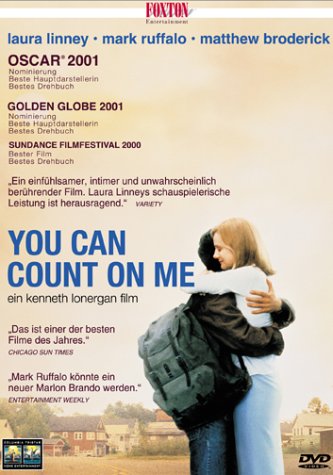
In 2000, writer-director Ken Lonergan had just come off of making the estimable The Adventures of Rocky and Bullwinkle.  His follow-up, You Can Count on Me, is one of the strongest written and acted family dramas ever made.  Go figure.

Laura Linney and Mark Ruffalo are siblings whose parents died in a car accident when they were children (I’d say 8 and 11).  Once that fact is established (with a sparse care that should be required viewing for all writers of family drama), we see them as adults.  Linney is divorced with an 8 year old son, and she lives in her parent’s house and works in her upstate New York hometown.  Ruffalo is an irresponsible drifter who comes home to visit.  Both are not emotionally crippled, but they are certainly products of the trauma, the communication of which is never overt.  We get no long, laborious revelations or speeches, no explosive healings or verbal re-opening of old wounds.  These people are hurt, but aren’t we all?  Lonergan subordinates the pain to the hard truth that they have to live their lives like the rest of us.

Linney’s pain can be seen in how she prepares for her brother’s return, in her desire for order in all things, and in her penchant for the reckless (as long as such recklessness is papered over by a seemingly staid conservative existence).  Ruffalo, on the other hand, just floats in and out of situations.  Linney’s son (another in a long line of Culkins) is a bridge between the siblings.

There are few lessons learned.  But the beauty and pain of family is perfectly expressed throughout.  Better, You Can Count On Me eschews stock secondary characters, infusing each (Linney’s boss Matthew Broderick, her minister, her boyfriend, her ex-husband, the town sheriff) with actual distinguishing qualities and natural impulses.  The film takes the time to linger on the emotional registers of these people in reaction to Linney and Ruffalo, as opposed to simply having them act in a standard fashion to further amplify the angst of the leads.

The original music is haunting cello and the soundtrack features a heavy dose of roots rock, alt-country and Americana (Steve Earle, Marah, and my favorite unsung band, The V-Roys).

Forum | It's all kicking off at the border already by Garyjack | Swansea  Independent

Zulu was released in 1964 (the year of my birth) and runs pretty regularly on both The History Channel and Turner Classic Movies.  Starring Stanley Baker (Lt. Chard) and Michael Caine (Lt. Bromhead) as two late 19th century British Army officers, the picture dramatizes the 1879 battle of Rorke’s Drift in the Natal province during the Anglo-Zulu war. 

At Rorke’s Drift, a contingent of 150 British soldiers was trapped in a converted mission station they were garrisoning as a supply base and hospital.  A British army column of 1,200 men had been massacred by an overwhelming force of Zulus at Isandhlwana earlier in the day.  The Zulus moved on the mission station.  The film chronicles the frenzied defense of the mission by the tiny contingent against 4,000 Zulus.  At end, the Rorke’s Drift defense resulted in 11 Victoria Crosses, the most ever awarded for an action in one day.

The film is memorable for several reasons, including gripping close-action battle photography, sweeping and memorable vistas of the African landscape (most of the film was shot on location in South Africa), the tight scripting of at least 20 supporting characters, and the adult handling of the culture clash between Brit and Zulu with no intrusive moral lessonry.  This is a movie about these men in this battle at this time, not about the big bad white man exploiting the proud, wise, noble black man.  This is not to say the blacklisted screenwriter Cy Endfield completely ignores the culture clash, as is evidenced by a back-and-forth between Caine and a Boer co-defender (Adendorff) as Caine maligns the natives assisting the Brits:

Lieutenant Gonville Bromhead: Damn the levies man… Cowardly blacks!

Adendorff: What the hell do you mean “cowardly blacks?” They died on your side, didn’t they? And who the hell do you think is coming to wipe out your little command? The Grenadier Guards?

Endfield has a little to say about geopolitics as well:

Bromhead: Well done, Adendorff, we’ll make an Englishman of you yet!

Adendorff: No, thanks. I’m a Boer. The Zulus are the enemies of my blood. What are you doing here?

Bromhead: You don’t object to our help, I hope?

Adendorff: It all depends on what you damned English want for it, afterwards.

The back-and-forth between Baker and Caine is also subtle and well-crafted.  Caine is a patrician but junior in commission by a month.  Baker, a newcomer to the garrison sent to build a bridge, is an engineer and apparently lower born, so Caine is not at all happy about being usurped and particularly resentful of being second-in-command:

Bromhead: [mounted, crossing stream] Hot work?

Lieutenant John Chard: [kneeling in stream] Damned hot work.

Bromhead: Still, the river cooled you off a bit though, eh?
[pause]

Bromhead: Who are you?

Lieutenant John Chard: John Chard, Royal Engineers.

Bromhead: Bromhead. 24th. That’s my post… up there.
[points into middle distance]

Bromhead: You’ve come down from the column?

Lieutenant John Chard: That’s right. They want a bridge across the river.

Bromhead: Who said you could use my men?

Lieutenant John Chard: They were sitting around on their backsides, doing nothing.

Bromhead: Rather you asked first, old boy.

Lieutenant John Chard: I was told that their officer was out hunting.

Bromhead: Err… yes.
[spurs on horse]

Bromhead: I’ll tell my man to clean your kit.

Lieutenant John Chard: Don’t bother!

Bromhead: No bother… I’m not offering to clean it myself! Still, a chap ought to look smart in front of the men, don’t you think? Well chin-chin… do carry on with your mud pies.

As their situation presents itself, they join together in the heroic defense.

The picture is also aided by a memorably thundering John Barry score.

Next time you see it on television, try and catch it, and you’ll be treated to a taut classic.  My favorite line is after the first wave of Zulu warriors is repelled by the Brits, and Caine says, “60!, we got at least 60 wouldn’t you say?” and another character wryly replies “That leaves only 3,940.”

A crime family, one of the five that runs New York post World War II, negotiates the fall of its patriarch, the aging Don Corelone (Marlon Brando), and the transfer of power to the son who was supposed to the family’s representative in the legitimate world, Michael (Al Pacino). Francis Ford Coppola takes Mario Puzo’s potboiler and creates a rich, operatic, and layered crime saga.  As the film opens, it depicts the family’s strong ties to the old world of loyalty and blood with the marriage of the Don’s daughter (Talia Shire), and economic introduction of the hierarchy of the family: hot-headed oldest son Sonny (James Caan), sensitive and simple middle son (John Cazale), the adopted chief advisor son Tom (Robert Duvall) and Michael, who introduces his love Kay (Diane Keaton) to his family, all the while explaining that he is not them.  Indeed, he is in uniform, having distinguished himself in World War II. The disconnect is beautifully evoked in the back-and-forth between the primal Sonny and the advanced Michael.

What follows is the inevitable slow decline of the family as Michael is corrupted and deformed, becoming a Sonny, but with a perverted, soul-sapping sense of “blood” and “family.”

The casting is flawless and given the later body of work of the players, it may be the strongest ensemble in film history. Brando won best actor, and Pacino, Caan and Duvall were nominated for best supporting actor. Other character actors are brilliant in smaller but integral roles, like Richard Castellana and Abe Vigoda as the Don’s chief lieutenants; Al Letieri as a rival who tries to get the Don to bankroll him in the future of drugs; Sterling Hayden as a crooked NYC police captain who serves as Letieri’s guard; and John Marley as the Hollywood mogul and Alex Rocco as the Vegas founder who won’t bend to the desire of the Corleone family until they are made offers that cannot be refused.

Perhaps the best of the bunch is Cazale as the weak, disturbed Freddo. Cazale died of lung cancer after only five films, but what a career: The Godfather, The Godfather II, Dog Day Afternoon, The Conversation, and his last film, The Deer Hunter. If you have not seen it, I strongly recommend the documentary on Cazale, I Knew it Was You.

Mob stories are difficult to resist.  The allure of the criminal life, with its excess, dizzying violence and the seductive freedom to do whatever one pleases without retribution, makes for captivating viewing. The Ray Liotta character in Goodfellas is emblematic of the theme; he was intoxicated by the life and ended up being just an every day schmo, a schlub. The Sopranos melded soap opera and commentary on the modern that, while overpraised, was consistently sharp and engaging. But, oh, the moments when Tony does the things we all wish we could do. Like all mob figures in the movies and TV, the draw is the freedom and the power, consequences of the ethos over time be damned!

The Godfather, however, works as both Shakespearian tragedy and pulp. While providing a seamless criminal power struggle and family drama, Coppola articulates the creeping rot.  The degradation comes in many forms, but Pacino’s haunting performance exhibits it best in Michael.  He starts as a fresh face, canny, even altruistic, but determined to be separate.  Yet, by the end of the film, Michael is hollow, almost physically transformed, as if he has been poisoned slowly by an internal disease.  It’s an incredible turn, solitary and meticulous, so utterly different from the excess of what would come later in Scarface and Scent of a Woman.

The look of the film is stunning, perfectly attuned to the material. Gordon Willis’s cinematography is classic nostalgia.  Willis shoots in a darker hue as the story becomes more ominous and sinister.  Martin Scorsese has called it a trick so influential that “every director of photography over the last 40 years owes [Willis] the greatest debt for changing the style completely.”  The art direction is also noteworthy.  Whether it is an art deco bar that serves as the meeting ground where an enforcer is offed or the sumptuous estate of a problematic Hollywood mogul, every setting feels timeless.  Coppola is also crafty, shooting old New York tightly (his budget was not huge).  Nonetheless, iconic wide shots (a Long Island expressway and causeway, a Times Square street) make up for the lack of sweep.

For enthusiasts, Mark Seal’s book is a must read:

Leave the Gun, Take the Cannoli: The Epic Story of the Making of The  Godfather by Mark Seal

The film is no. 2 on AFI’s top 100. It should be no. 3, after The Godfather, Part II.

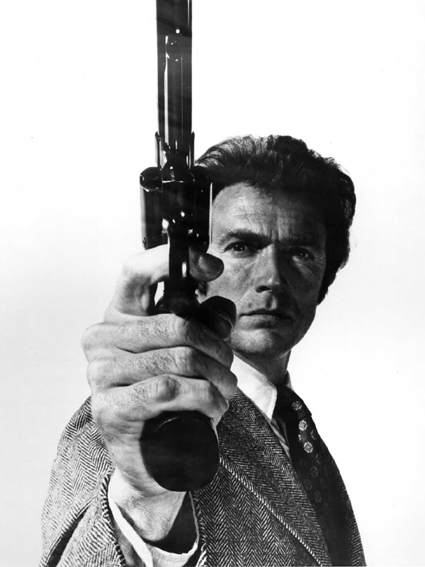
Harry Callahan (Clint Eastwood) is a no-nonsense detective in 1970s San Francisco, where the political correctness is thick, Miranda-warning era sensitized bureaucrats rule, and crooks are coddled (every thug in Dirty Harry has the sneering, arrogance of a punk who knows that the law is on his side). The baddest guy in a sea of bad guys is the film’s facsimile of the Zodiac Killer, a vicious beatnik with Woodstock hair, an army fatigue jacket and a peace symbol on his belt buckle. Callahan is called in to help with the case.  He is immediately accosted by the D.A. for his excessive brutality.

District Attorney Rothko: You’re lucky I’m not indicting you for assault with intent to commit murder.

Callahan: What?

District Attorney Rothko: Where the hell does it say that you’ve got a right to kick down doors, torture suspects, deny medical attention and legal counsel? Where have you been? Does Escobedo ring a bell? Miranda? I mean, you must have heard of the Fourth Amendment. What I’m saying is that man had rights.

Harry Callahan: Well, I’m all broken up over that man’s rights!

In fighting with the mayor – who wants to give in to the killer’s demands – Callahan is blunt and dismissive.

Mayor: I don’t want any more trouble like you had last year in the Fillmore district. Understand? That’s my policy.

Harry: Yeah, well, when an adult male is chasing a female with intent to commit rape, I shoot the bastard. That’s my policy.

Mayor: Intent? How did you establish that?

Harry: Well a naked man is chasing a woman through an alley with a butcher’s knife and a hard-on, I figure he isn’t out collecting for the Red Cross.

Even in his ultimate scene, where he mocks one of three hold-up men, Callahan embodies the rugged conservative fantasy of turned-tables and frontier justice.

Harry: Ah Ah, I know what you’re thinking. Did he fire six shots or only five? Well, to tell you the truth, in all this excitement, I’ve kinda lost track myself. But being as this is a .44 Magnum, the most powerful handgun in the world, and would blow your head clean off, you’ve got to ask yourself one question: ‘Do I feel lucky?’ Well, do ya punk?

Punk. He’s a punk. Not a suspect. Not a person. Not a downtrodden, misunderstood product of an uncaring society.

Paul Newman was offered the film, but legend has it he was nervous about its politics, and suggested Eastwood for the part. Great suggestion. Eastwood has commented on Dirty Harry that “It’s not about a man who stands for violence, it’s about a man who can’t understand society tolerating violence.” Pauline Kael called the film “fascist.” This is, however, the same Pauline Kael who was stunned when McGovern lost in 1972, saying “I live in a rather special world. I only know one person who voted for Nixon.”

Politics aside, this is an excellent picture. Eastwood is mythic, the story moves, the San Francisco locale is used to great advantage, and the killer is truly frightening.

The Lion King's original ending was just too dark for the remake
There is a natural order to the jungle. Animals routinely slaughtered by lions accept their fate in the circle of life and, in fact, trek miles to bow at the birth of one who will one day be their new chief slaughterer – Simba. But Simba has an uncle, Scar, who has been passed over by Simba’s birth. So Scar implicates the son in the death of the father (Mufasa), while making a pact with the rapacious, vicious hyenas. The father is killed. Simba must flee after he is designated for murder. Scar rules, ravishing the land. The land dies, not because of the slaughter – that’s the natural order of things – but because Scar is lazy and a glutton and he allows the hyenas to kill without economic management. The lions respect the royal line, and do their hunting, however unhappily, at Scar’s command.

And Simba? He leaves, finds a warthog and a meerkat, and lives the bohemian lifestyle. He becomes a vegetarian. He lives a life bereft of responsibility. He is away from weighty decisions. He is personally, individually, happy. Hakuna matata, is his “Turn on, tune in, drop out.”

But soon, his old love (to whom he was promised to be betrothed in an arranged fashion as a cub) finds him, and asks him to return. Simba refuses. He is angry. She has intruded upon his summer of love. “You don’t know anything about me or what I’ve been through” he snarls, as only a self-possessed individualist/narcissist can snarl.

Next, Rafiki, the religious leader of the tribe, finds Simba, and conjures up the ghost of Mufasa, who reminds Simba that he is more than some San Francisco hippie- he is royalty. “Remember who you are” the ghost intones. Simba returns to the pride, confronts Scar, and gives him a choice – be banished or die. Scar blames the hyenas, feigns cowardice and lunges at Simba. Simba dashes Scar over a cliff, to his death (Scar does not die, but injured, is set upon by the hyenas who overheard his attempt to foist responsibility for the coup and ensuing disaster on them).

Simba assumes the throne. His well-placed meerkat and warthog pal are exempted from slaughter as they now sit in his court. He is served by the same majordomo bird who served his father. The films ends with the birth of a new king, and the same animals traveling to give that king – their soon-to-be killer in the great circle of life – their fealty.

Oh, were Disney thus today!

This movie is so good that AFI’s ranking of 94 is an embarrasment (Forrest Gump is rated almost 20 slots higher). From the moment of Ray Liotta’s first voice-over line (I don’t think there is more effective voice-over work in any film ever) to the maniacal, miserable fall, Scorsese chronicles the mob as fantasy to the crime as reality from Liotta’s boyhood to Witness Protection schlub. In re-viewing, here are my thoughts on what makes Goodfellas the greatest crime picture ever made.

The camera-work. The sheer audacity of Scorcese’s tracking shots make their counterparts in The Player and Boogie Nights seem gimmicky.  Scorcese goes on without an edit, not as flourish, but to introduce the cast of mob characters and their life  The uninterrupted trip of Liotta getting into a nightclub speaks volumes about the life – the excitement of his date (Lorraine Bracco) as they are being guided to the best table in the house is shared by the audience.  As we take the trip with Bracco, we are introduced to the glitz during a seemless dreamy waltz.  This is the difference between Spike Lee silliness (floating characters) and skill with purpose.

The Feel.  It looks and sounds right in every respect, from the kitschy Tiki bars to the outlandishly tacky apartments and home to the ghastly look of the mobster wives to the diners and late night drives.   Better, Scorsese, as always, picks the right song for each trip.

Liotta, Pesci and DeNiro, especially Pesci. Liotta, like us, is the outsider, though he is effortlessly conscripted.  Still, he plays Henry Hill as a shade removed from the crazy of DeNiro and Pesci.  He’s a brute but he is not an innate killer.  Thus we are capable of remaining empathetic.  Robert De Niro also keeps vestiges of humanity, though in fact, he is only one notch below Joe Pesci in terms of sociopathy. Pesci, however, is the most honest character and the heart of the picture.  He is a killer, his code is barbaric and his emotions uncontrolled. Which means that he can beat you near to death and comfortably have a meal right after.

Authenticity. The best example of this is not in the look or the sets or the music, but rather, in Scorcese’s portrayal of the easy violence, which one assumes he knows from his roots and/or from working with writer and former Mafia journalist Nicholas Pileggi. No better example is when Pesci comes back to kill the “made” guy (Scorsese and The Sopranos regular Frank Vincent) for busting his balls.  We know Pesci is going to snap, but the moment Pesci attacks him, De Niro jumps in viciously to assist, no hesitation. De Niro knows that killing the guy is stupid. In fact, De Niro was calming Pesci down earlier in the evening, trying to smooth things over. But the attack sets him off like a shark smelling blood, and he instinctively jumps in to rip the guy’s head apart. He’s an animal in a feeding frenzy.

Scorsese’s Casino is actually a deeper film about the Mob, but Goodfellas is the landmark, a precursor to the humor of The Sopranos and an obliteration of the operatic grandiosity of the life left to us by The Godfather.


Being John Malkovich.  Spike Jonez’ masterpiece was the best film of 1999.  But what was most surprising is how well this erstwhile director of some great music videos (“Sabotage” by the Beastie Boyz and Weezer’s “Buddy Holly” are prime examples of Jonze at his peak, making gold in the craphouse that is music video by riffing off of 70s television) managed to keep a true line for all 112 minutes.  The film blends physical comedy, greed, lust, existentialism, and celebrity in perfect parts, and it offers several of the more finely realized comic scenes in years.  Moreover, the performances of John Cusack, John Malkovich, Catherine Keener, and Cameron Diaz are all strong and witty.  Keener is especially effective as a remorseless sexual capitalist.  Mary Kay Place and Orson Bean also turn in unique and hilarious supporting performances.

The film is explainable, but I recommend against reading in-depth treatments of the plot, not because some great, dark secret will spoil the film for you, but rather, because the film is so audacious in content and presentation that prior explication could stifle the enjoyment.  Suffice it to say that the title pretty much explains it.  It is Jonez’ “Alice in Wonderland” and it is a work of genius.