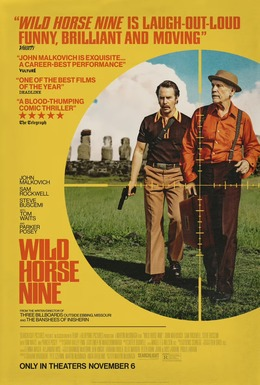
While undermining the Allende government in Chile, dying CIA operative (John Malkovich) threatens the Agency with a memoir that will implicate it in any number of global transgressions. As a final wish, he travels to Easter Island with fellow operative and best friend (Sam Rockwell), who is there to mind Malkovich, thwart his memoir, and manage his increasingly erratic behavior. He’s also in tow to make the best of his friend’s last days.
As usual, Martin McDonagh’s crackling, clever dialogue meshes beautifully with his crime story. The result is another literate, naturalistic black comedy, along the lines of Seven Psychopaths, In Bruges, Three Billboards, and The Banshees of Inisherin. McDonagh has always presented his characters with a certain discordant humanity, given the dark elements of their milieus, but his emphasis has always landed on the absurdly comic. Through Malkovich and Rockwell, McDonagh introduces true depth of feeling. Whereas a stoic Brendan Gleeson rejects a confused Colin Farrell in Banshees, happy to cut pieces off his body to be rid of him, here, as much as Malkovich pushes Rockwell away, his steadfast friend won’t allow it, evincing a loving loyalty that is truly beautiful.
And what a performance from Malkovich, who masterfully delivers McDonagh’s banter. Malkovich seamlessly alternates between anger and acceptance, regret and stubborn self-regard, fear and honorable submission, all the while fighting off a failing memory and the paranoia of his situation and occupation. I laughed repeatedly at his sneering reference to “the big heads” of the island, and his dissertation on the correlation of a nation’s politics with the quality of its cheese was gut-busting. But then, suddenly, he is deeply moving in the poignancy of his demise as he trades condemnation for introspection and cynical fatalism for kindness. Malkovich’s turn is brilliant, as Oscar worthy as anything I’ve seen.
I rarely read other reviews after seeing a film, but I did want to get some feedback on how other critics evaluated the political import of this picture, which I found to be a mere convenient fit for a deeper human story. I ran across your standard idiot fare (“An indictment of the way power is abused in all corners of the globe, the ease with which totalitarian systems become something that’s impossible to escape or rebel against”; “a film that shakes its fist at how dictatorships and fascist governments casually take away rights and human life”) from wags who probably believe in their marrow that the CIA killed JFK.
Kevin Maher from the UK Times, however, encapsulates it best: “There are dashes of anti-fascist polemic sprinkled throughout, but the feeling that lingers longest, and which marks out the movie for greatness, is its cheery, sweary embrace of mortality and the inevitable end of us all.”
Best film of the year.