Archive

Monthly Archives: June 2026

I recently watched a documentary on the estimable Sidney Lumet and ran across one of his later films on one of my streaming queues. Q&A is a New York City potboiler about an idealistic and ambitious young assistant district attorney (Timothy Hutton) and his quarry, a corrupt, enigmatic detective (Nick Nolte). The film opens with Nolte executing a perp and planting a gun. Hutton is brought in by the district attorney (Patrick O’Neal) to investigate the shooting.  It is clear from the outset that Hutton is supposed to play ball and not dig too deep. Hutton is more than happy to perform the task.

Then Hutton has lunch with an old mentor (Lee Richards). Hutton tells Richards that O’Neal is tough but fair, and decisive.

Richards, who once worked with O’Neal, does not tell Hutton to be wary. Rather, he tells him that O’Neal is a prick, a racist and an anti-Semite who manufactures evidence to put people in the electric chair. He also tells Hutton a story. In one case, O’Neal went to go witness one of the black defendants he railroaded “fry” at Sing Sing, and when he came back to the DA’s office, he crowed about it, telling the other lawyers that he sure hoped that the guy was guilty. Hardy har!

“Fuck him. Now and forever,” says Richards. 

To this, Hutton eats his corned beef sandwich. He does not object. He does not ask any questions. He does not say to his mentor, “Come on. You must be exaggerating.”  He just eats. 

Then Richards tells Hutton that the case he drew is all wrong, suggesting that Nolte must’ve planted a gun, because the decedent never carried a .45, only a .32. 

More chewing of corned beef.  Ho hum.

That is when I turned this intolerably stupid film off.

22 minutes in. 

We already know from the outset that Nolte is dirty, and now we know that the district attorney is even dirtier and everyone knows Nolte is dirty.

At 22 minutes, we also know that the script is dogshit and the Hutton character may have been lobotomized.

On Tubi.
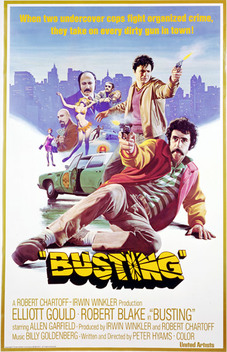
Like Walter Hill, Peter Hyams is a workmanlike director with several efficient and entertaining movies under his belt. Capricorn One, Outlander, and Narrow Margin are crisp commercial fare with occasional flair. While Hyams does not have a masterpiece in his oeuvre, unlike Hill (The Long Riders), after watching this flawed debut, you feel one was in there.

Busting tracks its’ early buddy cop kin, Freebie and the Bean, but swaps out the verbose and frenetic James Caan and Alan Arkin for the dour and focused Elliott Gould and Robert Blake. The latter are two LA vice detectives who are becoming disillusioned with the pointlessness of rousting massage parlors, gay bars and porno shops. They become obsessed with a corrupt crime lord (Alan Garfield) who thwarts their work by paying off the cops, politicians, and judges.

It’s an uneven picture, sometimes quietly comic, then discordantly violent. The camera work, however, is superb. In particular, a stunning extended foot chase shootout through Grand Central Market at night. The dolly shot was filmed decades before the pool scene in Boogie Nights and the nightclub scene in Goodfellas and was made all the more difficult because the leads flow, dodge and weave through dozens of terrified extras screaming and crouching as bullets whiz about. The scene is not an anomaly. Hyams has a deft feel and eye that portended a more illustrious career.

Other notes. 

Gould is an LA detective who wears a Washington Redskins winter hat, which is cool. 

As with Freebie and the Bean, if they showed this politically incorrect picture at Oberlin, the student body would revolt.

The movie is also said to have been the inspiration for Starsky and Hutch

During the shootout, Hyams does things often ignored in such scenes. People fall. An innocent bystander get shot. And lo and behold, both Blake and Gould reload their revolvers. 

Quentin Tarantino’s take:

On Amazon. 

My daughter has been keeping an eye out for special screenings of older films, and Sunday, we went out to Tyson’s Corner to see Mike Nichols’ adaptation of La Cage au Folles, The Birdcage.

The film is a classic combination of crack timing, unrestrained joy, and comedic generosity. If you haven’t seen it (and it is currently on any number of streaming services, including Netflix), you are engaging in unnecessary self-neglect.

Since it is a well-known classic, I’ll just offer a few observations.

1. It is a crime no one was nominated from the picture. Not the uproarious Nathan Lane, the surprisingly canny Gene Hackman (who was just coming into his own as a comic force after the prior years’ Get Shorty), or the gut-busting Hank Azaria, the butler who can neither cook nor walk in shoes. Not even …

2. Robin Williams, who plays well-off character as the straight man, allowing Lane to fill the zany and manic spaces he normally occupies. Williams is the glue. Sure, he is funny, but he’s largely setting up everyone else, and in the rare moments of genuine drama (which are smartly short and tender), he packs a wallop.

3.  The set-up is ingenious. The daughter (Calista Flockhart) of a scandal-escaping conservative moral majoritarian senator (Hackman) falls in love with the son (Dan Futterman) of a gay couple who own and perform at a South Beach drag club (Williams and Lane). At the behest of the smitten son, Williams and Lane try to tone down their gayness and play as straight, conservative Greek diplomats (Williams the father, and Lane, the uncle) while entertaining the senator and his wife (Diane Wiest) for dinner. In the wrong hands, that same set-up could portend a preachy lesson-fest that has a few yuks, but Nichols (or rather, his longtime collaborator, screenwriter Elaine May) is having none of that. May is about the laughs and any zingers are broadly comic, more cultural than political, and woven tightly in the larger bit. Her bon mots never get in the way of the physical comedy, they enhance it.

Case in point.

Wonderful picture.