Archive

5 stars

EBFDF7B9-9AE9-4195-8CD8-70BF9A2C66AB
Any film where the director kicks the Jesuitical screenwriter off set because the latter wants the film to be unequivocal in its conclusion that God triumphs over Satan is bound to be unique. As that screenwriter William Peter Blatty observed:

Like so many Catholics, I’ve had so many little battles of wavering faith over the course of my life. And I was going through one at that time. And when I heard about this case and read the details, that seemed so compelling. I thought, my God, if someone were to investigate this and authenticate it, what a tremendous boost to faith it would be. I thought, someday I would like to see that happen. You know, I would like to do it . . . the research into it affected me. And the novel, it very much strengthened my faith.

Director William Friedken had other ideas.

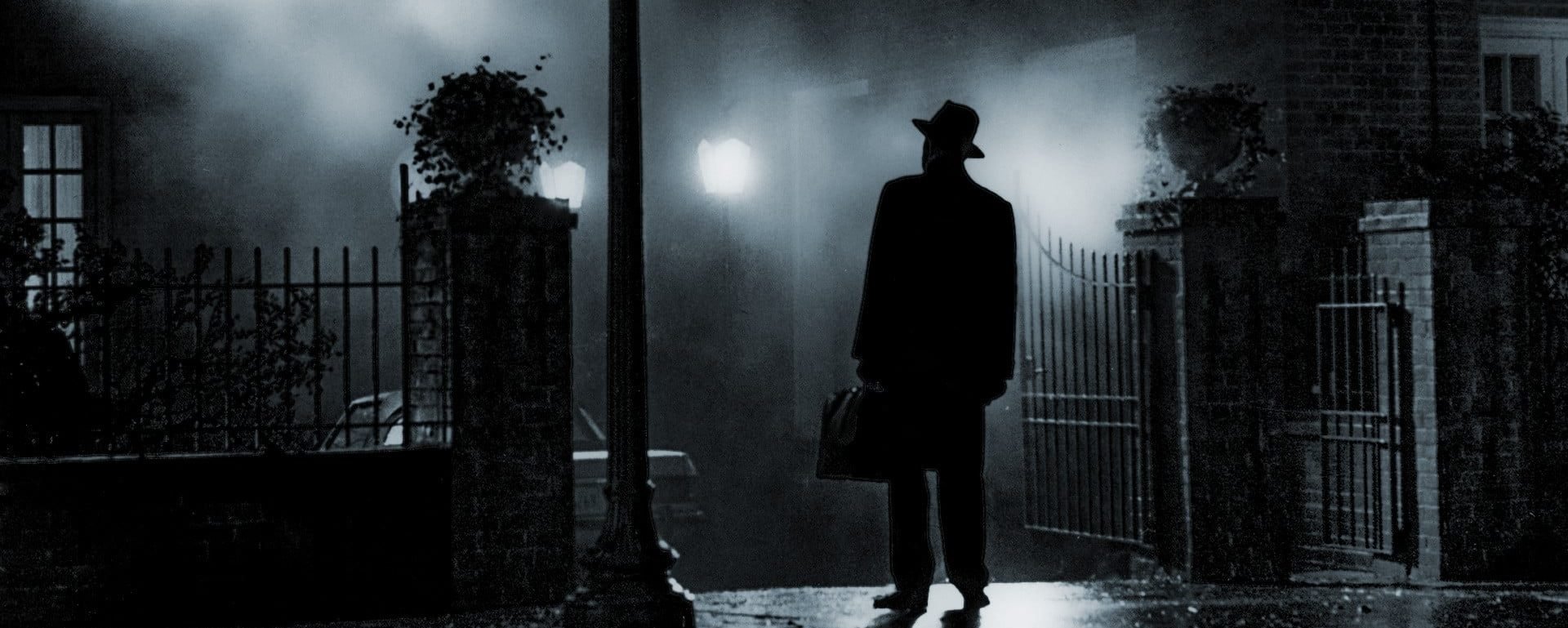
The film opens near an archaeological dig in Iraq. There, Friedken depicts a harsh and poverty-stricken world, where the blind are led by starving children, a widow grieves inconsolably, people work in small foundries like toilers in a fiery, oppressive Hell, and Father Merrin (Max Von Sydow) receives a sign that he will soon be meeting Satan.  We are then transported to Washington, D.C., where another priest – Father Karras (Jason Miller) – is in a modern Hell.  He is counselor to unsure and shaken Catholic priests.  He tells one, “There’s not a day in my life when I don’t feel like a fraud.” To another, “I think I’ve lost my faith.”  Karras’ mother is in her own nightmare, 1970s New York City.  She needs care, she lives in a slum, and Karras is wracked with guilt over her abandonment.

Friedken masterfully portrays the connection between a society sick by sin and the infestation of one little girl, Regan McNeil (Linda Blair), the daughter of a Hollywood actress (Ellen Burstyn) filming on location in D.C.  As Regan’s personality changes, she undergoes rigorous medical procedures (an arteriogram and a pneumoenchephalogram, to name two) that are graphic and invasive, as well as psychological probing (way before its time, the film has a doctor extolling the virtues of Ritalin).  Her father forgets to call her on her birthday, pointing up the damage of divorce.  Regan is alone and left to play by herself and eventually, an imaginary friend, in a foreign town and a rented townhouse.  She is the quintessential “modern” child.

Other characters are also on the point of a knife.  Father Karras nears breakdown after the death of his mother yet he continues to counsel other priests sick at heart and doubting of faith. The director of Burstyn’s “film in the film” (Jack MacGowran) is a lonely drunk cursed by memories of the Holocaust who scathingly brands Burstyn’s housekeeper of Germanic descent a closet Nazi.  Everything and everyone seem rife with wrong and discomfort, raw and vulnerable. Von Sydow is nothing less than a condemned man, awaiting his confrontation with Satan and dependent on nitroglycerin pills for his ailing heart. 

As Regan descends into the throes of possession, Friedken and Blatty smartly turn the world on its head: the physicians, once cocky, can offer Burstyn only the Jesuits, but only because a symbol of God might suggest salvation to Regan, the idea of faith, of course, being ridiculous. And when Regan talks to Karras (himself an Ivy League trained psychologist), the priest immediately sends her back to the doctors and recommends the child’s institutionalization. This is what modernity does when confronted by evil – denies it or locks it away. Friedken’s reservations aside, Blatty gets his morality play.

But it’s a morality play encased in a thrill ride. When the nature of Regan’s torment can no longer denied, and her abuse progresses, Friedken uses all means at his disposal to discomfort the viewer, from the foul, such as the vomit and green goo and the masturbation-with-crucifix (Blair had a stunt double who was used in the disturbing sexual scenes, for those who may have been wondering – double or no, it is still quite a shock to see a little girl utter the abomination “Let Jesus fu** you, let him fu** you”) to the subtle (the use of subliminal cuts, as when Father Karras dreams of his mother and sees a death mask and then, the same mask is overlaid on Regan’s face during the exorcism).  Friedken also had the set dropped to below freezing by placing a restaurant air conditioner across the top of the set, which he then ran all night. The effect on the actors is stunning – their fear is enhanced by physical cold and the steam of breath is another frightening component.

Understandably, Blatty fretted over Friedken’s depictions: “A large section of the audience probably came because something that shocking and vulgar could be seen on the American screen. Bill Friedken always said that would be the case; that they would come to see the little girl masturbate with the crucifix . . . At the time I didn’t believe it; I thought he was destroying the film. But when I perceived that he was absolutely right, I thought it was terribly depressing.”

Friedken, however, is not only a showman, he’s a damn good one. He sets one spooky scene after another, constantly tracking his characters slowly in a manner that feels as if they being enveloped … by something. Burstyn’s walk home from a film shoot in Georgetown, where she witnesses Karras furtively counseling one priest and then passes two nuns with the wind whipping their garb, lends an eerie sense of the foreign and the what is to come.  Much of the camera work is elegant tracking and slow zooms, soon to be punctuated by the occasional hand-held jolt (mostly, when characters are rushing to Regan’s room). The effect lulls the viewer, making the terror – when it occurs – all the more shocking.

Friedken understood that the spinning head was important but not as important as verisimilitude: “It’s set in the real world, with characters who are portrayed as humanly possible. So I think that the fact the story is portrayed realistically is what disturbs people about the events in it.”

The performances are poignantly measured, just on the edge of documentary. The film should be a Hollywood treatise on the exposition of minor characters. Blair is sweet and gentle as needs be, until – with the help of a stunt double, the guttural voice of Merecedes MacCambridge and various pulleys – she transforms convincingly into a leering, goading demon. Burstyn presents as a pampered star and mother at the end of her rope, but she grows to a hardened, more simple warrior. Von Sydow is appropriately ghostly as the doomed Father Merrin. McGowran and Lee J. Cobb are memorable as the murder victim and the murder policeman. Cobb’s gentle interrogations of Karras and McNeil are the kind of quiet respites necessary for such a tense film. Cobb also represents the skeptic and a rebuttal to any sense of despair. He is, after all, steeped in the evil that men do.  But he is also kind and supportive, looking for an autograph from Burstyn and a friend in Miller. His supporting performance is one of my favorites in all of film.

 The great turn, however, belongs to Miller (a playwright who succumbed to drink and never really did much as an actor after The Exorcist). His is a tortured existence, filled with doubt. His trepidation shows in his eyes. Physically, Miller plays as a man who fears his weakness is obvious to all, so he shrinks into himself so as not to be noticed. Merrin and Karras act like a men who know Satan is looking for them. The difference is that Merrin knows what is coming and solemnly accepts it. Karras thinks he can hide, and that is why he is so compelling. Friedken almost always films Miller hunched over, or huddled in talk, or sitting down, or crouched, or in a crowd, accentuating his need to be anonymous.

In the end, despite the tension between  Friedken and Blatty, the latter need not have worried. The film is a clear triumph of good over evil.  To save Regan, Karras defies the devil, “Come into me! Come into me!” The devil obliges, and for a moment, it looks as if Satan/Karras will kill Regan. Karras, however, summons his faith and hurls himself out of the window. He is given last rites, and later, a recovered Regan (having no memory or the possession) sees a priest and kisses him.

The Exorcist is a great popcorn flick but also a cinematic declaration that palpable, defined evil exists. It is an ultimate rejection of moral relativism, a harsh check on modern mores and technological advances. It is also, despite its slick sophistication, religious.  After all, you cannot really find “good” or “justification” or “well, sure . . . but” in Satan. There is no bargain, even as Burstyn asks a herd of befuddled doctors “You’re telling me that I should take my daughter to a witch doctor?” The answer is, yes, there is no modern skate or help for you. And Friedken, the carnival barker, effectively shows you just how frightening and insidiously entertaining Satan can be.

A closing note: Blatty wrote The Exorcist many years after attending Georgetown University in Washington, D.C.  One of his inspirations was newspaper reports of a real life exorcism of a boy in Mt. Rainier, Maryland.  That boy went to my high school, and you can read about his story here — http://www.strangemag.com/exorcistpage1.html  Enjoy.

The Straight Story movie review (1999) | Roger Ebert

David Lynch’s masterpiece is Blue Velvet, but the film produces near physical discomfort, much like Darren Aronofsky pictures, so it serves as a poor exemplar of his work.  Like Paul Thomas Anderson’s Magnolia, Lynch’s Mullholland Drive vied to be one of the finest first halves of a film ever made.  Then, inevitably, it became laughably obtuse and the whole thing unraveled.

That was in 2001 and since then, it’s been all shorts and documentaries for Lynch.  But before Mullholland Drive, Lynch directed his strongest film, a simple story about Alvin Straight (Richard Farnsworth)  who takes his ride-on lawn mower to visit his dying brother (Straight’s eyes are poor and he cannot drive a car) in Mt. Zion, Wisconsin.  The trip is 300 miles.

Lynch’s film is a testament to the small town communities of the Midwest.  Straight encounters nothing but kindness, empathy and assistance, none of it treacly or condescending or self-congratulatory.  As nicely put by Roger Ebert, “Lynch’s film is a lyrical beauty, and I cannot remember a picture more true to regular folk.”

There is a scene where Straight shares a beer with a man (Wiley Harker) in a bar.  They acknowledge their World War II service and then go to a place that evokes the horror they both encountered.  The scene is deeply delivered and is one of the most profoundly moving exchanges I’ve ever seen on film.

Farnsworth was deservedly nominated for an Academy Award for best actor.  Sadly, he was suffering from terminal bone cancer during the shooting of this film and he took his own life a year later at his ranch in New Mexico.  He could not have chosen a better epitaph than this film.

Certain films transcend criticism because of the place they hold in the national consciousness.  Saving Private Ryan is a forceful, indelible picture with opening and closing battle scenes so visceral I found myself ducking in the theater as a complete stranger in the seat next to me gripped my arm.  Shorn of the opening Omaha beach sequence and the fight for the town of Ramell, the film is just north of pedestrian.  Robert Rodat’s script is functional but hokey (the constant banter over Tom Hanks’ occupation is an example).  The characters – the intellectual, the caring medic, the goombah, the Southern, bible-loving sniper, the New Yahker, the Jew – are unrealistic archetypes.  The John Williams score is just so much syrup.

Who cares?  The picture means more than its parts and speaks to a certain time and sacrifice.     Every American high school kid should be forced to watch the damn thing the next time they bitch about the trials and tribulations of their lives.

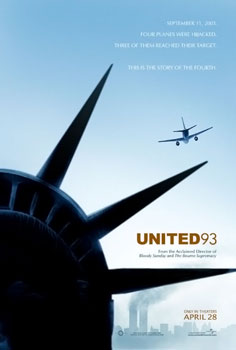
In many ways, 9-11 was much like the day American soldiers alit from their Higgins boats onto Omaha.  We were wholly unprepared for the savagery of the attack, we reeled at its success, and then brave and innovative heroes, ordinary citizens all, adapted, driving one of the planes meant to decapitate the government into a field in Shanksville, saving the lives of hundred and perhaps thousands of others.  Paul Greengrass’s film depicting that day, however, suffers no flaws and accordingly, does not need to transcend criticism.

Greengrass made his mark with a style blending documentary and drama in his depiction of a 1972 Irish civil rights protest march and subsequent massacre by British troops, Bloody Sunday.  As in that film, in United 93, Greengrass keeps us just over the shoulders of the military authorities, the air traffic control personnel, and the passengers of United 93 as the horror of what is occurring dawns on them, paralysis sets in, and then the process of acceptance and adaptation commences.  We’re there, but we are not, and we feel thankful for both the intimacy and the remove.

The casting is brilliant.  A decision was made to use actors who are familiar but who are not stars.   You know you’ve seen many of these people, but they do not bring any recognizable persona, so they feel real.  For the passengers on the plane, Greengrass went out of his way to cast actors who looked like the person they were playing.  Moreover, he wanted people who had a tie to the project.  As explained by Greengrass, “What we did on this film was to gather together an extraordinary array of people wanting to get this film right, aircrew from United Airlines, pilots, the families of the people who were onboard, who gave us a sense of what their family member might have done given the type of person he or she was in any given situation; controllers and members of the military. We had a lot of expertise that in the end allows you to get a good sense of the general shape of events.”

Finally, Greengrass at no point indulges in communicating a larger message.  In Saving Private Ryan, Spielberg, as always, just couldn’t trust his audience.  He had to have Hanks tell Matt Damon “Earn it” even though the story was told skillfully enough to leave it unsaid.  Greengrass is a neutral, not in the ideological struggle of 9-11, but in the explication of evaluating these people at this critical time.  The result, for me, was a clearer vision of just how extraordinary the acts of heroism were.


Rocky is Not a Sports Story (But Wow, What a Love Story). | elephant journal

Sylvester Stallone wrote this gem and wisely insisted on starring (possible replacing, if you can imagine, Ryan O’Neal, Burt Reynolds or Robert Redford), leading to many more Rocky movies, and some Rambos, and a dozen other mumbling portrayals.  Say what you will about what it spawned, but Rocky is near flawless.

Rocky is a busted up club fighter living in the bleak hell that is mid 70s Philadelphia. He’s a sweet guy, but he is an admitted bum, getting a fight every few weeks and paying the rent by collecting for a local loan shark. We meet Rocky after a sixth round knockout of another bum nets him $40, and he’s just been unceremoniously evicted from his gym by its manager, Burgess Meredith. His best friend is a meat packing cretin (Burt Young) who lives with his paralyzingly shy sister (Talia Shire), who Rocky is sweet on. Rocky’s fortunes change, however, when the champion, a Muhammad Ali figure named Apollo Creed (Carl Weathers), has a ranked contender drop out from a well-promoted fight. Creed fixes on a gimmick – give a nobody – the “EYE-talion Stallion” – a shot at the title.

This is often heralded as the quintessential boxing movie, but boxing is secondary to a moving, beautiful love story between Shire and Stallone, and the portrayal of a Philadelphia so cruel and cold that Rocky seems like its only validation.

Shire is so withdrawn, a character taunts Rocky, suggesting she is “retarded.” She is not, but she is painfully muted. Rocky’s persistence, and the innate sweetness in him, pulls her out. The scenes of their first encounters, and particularly, the scene where he takes her on a first date, are realistic, poignant and heart wrenching. As they come together, you can see that each provides the other a confidence and support they’d never known. Stallone and Shire share a haunting chemistry of losers, and their story really is the movie.

As is the city. Director John Avildsen uses the gritty corners and grimy haunts of poor and working class Philly and the verisimilitude contributes heavily to the drama. Rocky lives in a hell, where folks sit on the cold streets, trash is strewn everywhere, and it is not enough to ignore someone – you must abuse them. So, Rocky’s loan shark boss has a driver who mocks Rocky mercilessly. When Rocky tries to tell a neighborhood girl to get off the streets or she’ll get a “rep,” she responds, “Screw you, creepo” and when he is kicked out of his gym, Burgess Meredith humiliates him publicly.

Of course, when Rocky gets his shot, Meredith, hat in hand, comes to help. The result is one of the most beautiful scenes in Hollywood history:

The picture received 10 Oscar nominations, including ones for Stallone, Shire and Meredith, and it deservedly won Best Picture.

The only fault is the fight itself, which is hampered by fighters who look buff and have some moves (Weathers simulates a nice stinging jab), but unrealistically degenerates into a clumsy brawl. While Avildsen does the best he can with the budget (a mere $1 million shot in less than a month), his interspersing of stock arena footage cannot save the fact that the Rocky-Apollo fight looks very small indeed, and you can see empty seats in the background of various shots of the fighters.  Given the budget and the quick pace of filming, these weaknesses are easily overlooked.

Image result for Roadhouse

A small town is run by the ruthless Ben Gazarra, who shakes down the local businesses to support his decadent lifestyle.  He lives in the gaudiest mansion, and he is surrounded by a thick, loyal squad of yokel goons.  He also has a few 80s trashy blondes in his coterie, like Julie Michaels–

Image result for Roadhouse Julie Michaels

Interesting note on Julie.  Roadhouse was her debut.  In her subsequent roles, these were the names of her characters:  Naran Anie, Professor, Professor (uncredited), Accident Victim, Accident Victim (uncredited), Sandy, Mom, French Patron (uncredited), California Blonde, California Blonde (uncredited), Pedestrian, Female Bar Patron #2, Barrista, Fashion Show Patron, Florist, Slutty Woman, Female Fan, Julie Mermaid mother, Harem Girl (uncredited), Groupie (uncredited), Female Club Goer, Maggie, Woman on Bike, Laundry Wife, Marilyn Monroe #2, Catherine Moore, Caitlin’s Sister, Frat Girl, Woman (uncredited), Vampire, Jane (uncredited), Catherine, Tami, Sillicate UC, Cage Dancer, Agent Elizabeth Marcus, Susan, Irene, Waitress, Waitress (uncredited), Amy Cutler, Freight Train, Susie Q, Cinnamon.

I digress.

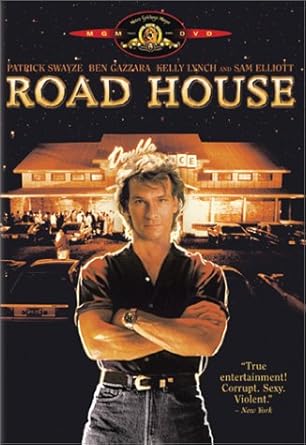
One business won’t knuckle under to Gazarra – The Double Deuce.  Instead, bar owner Kevin Tighe calls in a zen master bouncer with a degree in philosophy (not joking – the script references that the professional bouncer has a degree in philosophy from NYU). That bouncer is Dalton (Patrick Swayze) who stands up to Gazarra, calls in a bouncer compadre (Sam Elliott), cleans up the bar and the town and says all of the following:

“Pain don’t hurt.”

“Nobody ever wins a fight.”

“My way… or the highway.”

“All you have to do is follow three simple rules. One, never underestimate your opponent. Expect the unexpected. Two, take it outside. Never start anything inside the bar unless it’s absolutely necessary. And three, be nice.”

“Take the biggest guy in the world, shatter his knee and he’ll drop like a stone.”

“You’re too stupid to have a good time.”

“It’ll get worse before it gets better.”

Roadhouse also features Kelly Lynch, the emergency room physician who patches Dalton up.

The year this picture came out, she was in Drugstore Cowboy. I wonder which film she is most proud of?  Regardless, I’ve had stitches like 5 times and there’s never a Kelly Lynch at the emergency room.  Ever.

By now, Roadhouse has become a cult classic, but when I saw it, I knew it was something special taken at face value, no sniggering. To this day, I can’t stop watching it.  It’s an awful film, and the inquiry should end there, but there is such earnestness in the effort that at 2 am, having just had 5 beers and a half bag of gummy bears, when Swayze says

“I want you to be nice until it’s time to not be nice.”

I’m like, “Hell, yea. Dalton. That’s some heavvy ass shi**!”

And now, every punch in the face in the movie!

Otto Preminger skillfully presents Allen Drury’s Pulitzer Prize winning political potboiler (published in 1959), the story of  a senatorial nomination (Henry Fonda, who is tapped to be Secretary of State)  gone bad under the weight of McCarthyite tactics, vicious blackmail, and a dying president.  The story is intricate, but Preminger, ever the pro, handles it with ease.  For example, if there is an issue of senatorial procedure, it is cleared up in a clever discussion with foreign tourists, who receive a crisp and unobtrusive explanation as to parliamentary procedure and the role of the vice president in American government.

It is decidedly not an all-star cast, but it is a very good one.  Franchot Tone, as the tough and dissipated president, wields his waning power with as much vigor as he can muster.  He has a wonderful scene where first he tries to smooth-talk the chair of the subcommittee handling the nomination (Don Murray) into reporting it out and when the senator does not budge, his flash of anger is actually a little terrifying.  Walter Pidgeon plays the Senate Majority leader, tasked with shepherding the nomination through, and Charles Laughton hams it up wonderfully as the Strom Thurmonesque senator who opposes the nominee.  Lew Ayres, as the in-over-his-head vice president, is a perfect combination of insecure and decent.

Having been born in Washington, D.C., the shots of the nation’s capitol in a more innocent and uncluttered time are worth the viewing in and of themselves.  And look close, because Will Geer (Grandpa Walton) plays the Senate minority leader and Betty White also has a role in that august body.

Image result for advise and consent betty white

With only five films to his credit (Metropolitan, Barcelona, The Last Days of Disco, Damsels in Distress, Love & Friendship) and all but one of them in the same milieu (upper class young people in comedies of manners), Whit Stillman is overlooked in discussions of  great American filmmakers who are still working.  This despite the fact that Stillman has written and directed all five of his films, and all have been critically acclaimed.  

Barcelona, Stillman’s second picture, reprises two actors from Metropolitan as different characters.  Taylor Nichols plays Ted, a neurotic salesman in 1980s Barcelona. Chris Eigeman plays his cousin, Fred, a naval officer and freeloader sent ahead of the Sixth Fleet in the midst of a wave of anti-Americanism.  Both negotiate their acrimonious relationship, borne of childhood injuries inflicted by Eigeman, a truly obnoxious sort who as a visitor begins to stink after a day (unlike, as Nichols observes, the fish who takes three).  They discuss religion, women, anti-Americanism, sales, history and shaving, all the while falling in and out and in love with various Catalan women.

Nobody writes quite like Stillman. His dialogue is distinct and erudite, but his characters have such a surface forthrightness that what could seem contrived comes out as wholly honest and fresh. Stillman is particularly impressive in presenting a funny, incisive culture clash between the mildly ugly Americans and the bemused, mildly antagonistic Spanish. Both treat each other as curious, and even hostile interactions over politics are amusing and revealing.

Again, Stillman has no bad films on his resume’,  a rare honor.  Paul Thomas Anderson comes close. Though the second half of Magnolia is bad, the sheer perfection of the first half of that film and its overall audacity generally gets him a pass, but The Master is a long, very hard slog.  Scorsese is a great, but Gangs of New York and Shutter Island are very, very bad films, and his later sycophantic rock documentaries are downright embarrassing.  Coppola has some late career dreck (Jack, The Rainmaker) and have you even heard of his last three efforts (Youth Without Youth, Tetro, Twixt)?  Eastwood has his share of humdrum work (J. Edgar, Bloodwork, Space Cowboys).  Try as I might to suggest otherwise, Wes Anderson’s The Life Aquatic is haphazard at best.  Even the Coens, David Fincher, Gus van Sant, David O. Russell, Richard Linklater, and Steve Soderbergh have at least one dog (see A Serious Man, Alien3, Psycho, I Heart Huckabees, Bad News Bears, Solaris).

Woody Allen is closer to Stillman in style but Allen also makes some really horrific pictures (less so now that he’s not acting in them as much), redeeming himself with a great surprise just when you’ve written him off.  Take this list of Allen movies – Hollywood Ending (2002), Anything Else (2003) and Melinda and Melinda (2004).  All pretty bad.  Ballgame, right?  But then, Allen offers a smart Hitchcockian crime movie, Match Point (2005), and he is resurrected.  Two more sh** sandwiches follow in 2006 and 2007 (Scoop, Cassandra’s Dream), but in 2008, Allen comes off the canvas again with the charming and seductive Vicky Christina Barcelona.  And last year, after another pair of clunkers (Whatever Works, You Will Meet a Tall Dark Stranger), the best original screenplay Oscar goes to Allen for Midnight in Paris, a movie I hated, but I defer to the Academy. 

Stillman deserves better.

Moonrise Kingdom

Wes Anderson’s Moonrise Kingdom is the best film of the year and the best of Anderson’s career.  Anderson writes and directs fables, where child-like adults attempt to grapple with the expectations of a grown-up world.  In Bottle Rocket, Owen Wilson’s Dignan wants to be a mythical man of the big heist, not a Texas service worker.  In Rushmore, Bill Murray wants to be young again, to erase his choices and capture a tenth of the wonder and promise of Jason Schwartzman’s Max Fischer.  Gene Hackman’s Royal Tenenbaum won’t grow up but demands the fealty of a family he has abandoned and when it is not forthcoming, he fakes a fatal illness to win them back.  In all of Anderson’s films, the protagonists are stubbornly fleeing from responsibility while demanding the respect accorded responsible people, creating funny and bittersweet scenarios.

Anderson also creates beautiful love stories between those who cannot be together.  Luke Wilson falls immediately in love with the motel worker in Bottle Rocket, yet she cannot speak English. In Rushmore, neither Murray or Schwartzman can have the love of their life, as Murray is too old and Scwartzman too young, and in The Royal Tenenbaums, Gwyneth Paltrow is loved by childhood friend Owen Wilson, who aspires only to be a Tenenbaum; stepbrother Luke Wilson, who exiles himself to lessen the pain; and her husband, Murray, who can only analyze her.  In The Life Aquatic, Murray cannot be with Cate Blanchett, as she sees his b.s. and realizes he can never shed it.  In all his films, Anderson shows us the absurdity of love but he never mocks it or gives in to cynicism.

At root, all Anderson’s films are children’s films for adults, up to and including The Fantastic Mr. Fox.  Moonrise Kingdom is similar but has as its leads two children who meet in the summer of 1964, fall in love and defiantly plan an escape from the confines of their New England island in the summer of 1965.  The girl (Kara Hayward) is the troubled daughter of emotionally estranged lawyers Frances McDormand and Murray.  The boy (Jared Gilman) is an unpopular orphan attending scout camp under the supervision of Edward Norton.  In pursuit are McDormand, Norton and Murray as well as the entire scout troop (a moveable, hilarious “Lord of the Flies” troupe), island police chief Bruce Willis, Tilda Swinton (who has come to retrieve the boy so he can be sent to reform school) and Schwartzman, who is helping the young lovers on the lam (he’s the King Rat of the scout camp).  The film is charming, comic, and often beautiful.  It brings back the childhood moments of a first kiss, escape and adventure.  The scenes between Hayward and Gilman are poignantly funny and then almost heartbreaking, but Anderson also gives us tender scenes between Murray and McDormand as they confront their distance; Willis and the boy as the former explains his loneliness; and Norton and his tape recorder, as he confesses his inadequacies in scoutmaster logs.

The picture features many of Anderson’s touches, including an inspired soundtrack (courtesy of Devo’s Mark Mothersbaugh), a set that presents as a stage play (as in Rushmore, the movie contains an actual stage play), and a narrator (Bob Balaban), though unlike Alec Baldwin in The Royal Tenenbaums, Balaban is on-screen delivering a funny turn as a documentarian.

What transpires is an exciting children’s adventure that will have the same effect on you the adventure book you read under covers with the aid of a flashlight and may transport you to some magical moment in your childhood.  It speaks to those who had a backwoods fort, summer camp spook stories, a secret love to whom you sent letters without a single “LOL” or “OMG”, hidden treasure or, if you were lucky, all of the above.