Archive

Genre

Image result for fury

A traditional war picture depicting the harrowing experiences of an American tank unit at the close of World War II, this white-knuckle drama alternates between the well-trodden verisimilitude of Band of Brothers and Saving Private Ryan and the cynical outlook of The Thin Red Line and Flags of Our Fathers. Brad Pitt commands a tank crew that includes Shia LaBeouf (the religious gunner), Jon Bernthal (the profane Southerner), Michael Pena (the sly Mexican) and Logan Lerman (the baby-faced clerk/typist accidentally assigned to the unit). Lerman undergoes a baptism by fire, as Pitt attempts to de-sensitize him on the fly in an effort to make him more effective. This includes light beatings, a few sermons and, eventually, much worse. That pretty much does the trick, and the rest of the film consists of the unit taking on two missions, both of which are visually audacious and nerve-wracking. In particular, the battle between three under-matched Sherman tanks and a Tiger tank is a thing of beauty.

Writer/director David Ayer (End of Watch) occasionally veers into the hackneyed, but the actors elevate the material with a cohesion that seems genuine. They actually feel like a unit cramped together for three years, especially when they engage in everyday banter, such as “best job I ever had.” Ayer also writes a haunting scene where Pitt and Lerman spend a quiet meal with two German women, only to have the rest of the crew bluster in angrily to join them, a reminder of their grotesque existence.

One the downside, Steven Price’s score is bizarre and bombastic, better suited to a Lord of the Rings pic than a grim war film.  The final battle scene is also a bit too protracted and incredible, at odds with the grimy realism of what preceded it.

This is a solid picture and one I was surprised was made (the budget was over $60 million but at last count, it had grossed over $80 million domestic and over $200 million total).  Apparently, there’s an audience for this kind of story (unless Pitt still has that kind of box office juice).
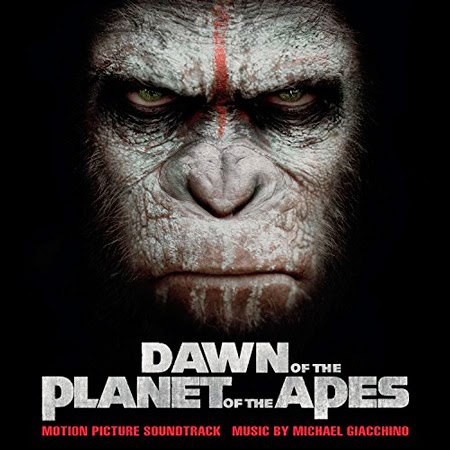
Better than its predecessor, for a couple of reasons: the perfunctory heartless, nasty corporation is not in the mix, the film is not saddled with the herculean task of presenting James Franco as a scientist, and we spend more time with the apes than the humans. The apes, led by Caesar (Andy Serkus), are decidedly more interesting, having created a thriving, peaceful colony outside of San Francisco. Since this sequel is set only 10 years after the apes escaped their Bay area zoo at exactly the moment mankind became afflicted with a disastrous plague, it appears the simians got right down to the nasty, because there are a shitload of monkeys hiding out in Muir Woods.  But man comes a calling . . .

Photo Gallery - Inherent Vice - Inherent Vice Movie Poster

Paul Thomas Anderson’s (Boogie Nights, Punch Drunk Love) private investigator noir evokes Robert Altman’s The Long Goodbye, but instead of Elliot Gould as Phillip Marlowe-meets-Jeff Bridges’ “The Dude”, Joaquin Phoenix is all 1970 Southern California hippie, all the time, so “out there” he has to keep a notepad with one word reminders to stay focused. The result is a detective yarn, but through the eyes of a stoner, in parts scintillating and in parts frustrating. If you approach the picture traditionally, you’ll find yourself trying to connect the dots of a plot that seemingly fuses murder, real estate, the FBI, the Las Vegas mob and a drug trade that profits from its customers on the front end and back. However, Phoenix is our guide on this trip (there is no scene without him), and he is unreliable. Two couples walked out of the theater during this movie, and while the thought never occurred to me, I could see it occurring to others. Anderson has a nice cheat at work here: the byzantine plot has promise, but rigor is unnecessary when viewed through the eyes of a doper. When you shake your head, you’re a square and not in on the joke. When you go with the flow, it’s a little tiresome, and at 148 minutes, even boring.

Anderson’s movies look fabulous, and this is no exception. His sundrenched beach LA is almost mystical, and his re-creation of Manson-era, Southern California weirdness is vivid. The picture can also be very funny, with nice contributions from Josh Brolin as a straight-laced, psychologically fragile LAPD detective, and Martin Short as an electric, drug-snorting dentist.  Katherine Waterston, as the femme fatale and the only character who seems to ground the picture, is a revelation, mesmerizing and completely believable as the woman who could penetrate even Phoenix’s lazy, listless existence.

Rottentomatoes.com critics gave this picture a 70%, with only a 57% from the audience. There may be a lesson there.  Even though Anderson is an auteur commodity, he should consider getting back into traditional storytelling. His last two films –The Master and this – have been beautifully shot and acted yet uninvolving and disaffecting.  Phoenix is presented to us as an archetype in both films, without backstory or motivation. As such, it’s hard to care, and that’s a problem.

A beautiful film, lovingly rendered by Richard Linklater, who has an affinity for passage of time and coming of age stories.  His Julie Delpy-Ethan Hawke Before trio of films similarly plumbed a relationship over the years and Dazed and Confused is perhaps the best coming of age film ever made. Shot a short period of every year over a 12 year period, Linklater presents the life of a family (Patricia Arquette, Ethan Hawke, son Ellar Coltrane and daughter Lorelie Linklater) from 2002 through 2013.  We see the kids grow up before our eyes, as well as mother Arquette through two post-Hawke relationships and father Hawke through maturation from free spirit, bohemian divorcee’ to a more grounded, traditional man, with a second wife and child.  The exchanges are utterly believable and poignant, in particular, those between Coltrane and Hawke. The leads, with an exception below, are very good, and the authenticity of the endeavor is enhanced by their restrained performances.  Linklater’s treatment of the transient characters – Arquette’s two troubled husbands, the boy’s high school teacher and boss at work, and the others who comprise his support group – is deft and even-handed.  Missing are the histrionics of most any family drama or the easy lessons and dawnings that infect the coming of age genre.

There are two problems with the picture, neither insignificant nor crippling. First, unlike Hawke, who appears to have meticulously studied his character as a changing being, Arquette is static in her role as the boy’s mother. Some of this is attributable to the stolid nature of her character, but when, as Coltrane is about to depart for college, she breaks, Arquette doesn’t have the chops to deliver the scene, and what Linklater has her deliver – a surprising, almost narcissistic “what about me?” plea – is atonal and off-putting.  The film is also too long. The last stretch, covering the son’s high school and entry to college, traverses from languid to drowsy.

Still, a deserved Best Picture nominee and groundbreaking in its production.  As Linklater noted in a recent interview, “you talk to business people, and they couldn’t get their heads around it. They were like, ‘What? We can’t see any of the film before it’s finished? And we don’t get our money back for 13 years?’ All of that makes people insecure . . . The idea that an executive at a company anywhere in this business would green-light it and still be there 12 years later – that’s a statistical anomaly. So if a film like this never gets made again it’ll be for those reasons.”

Amazon.com: Snowpiercer: Movies & TV

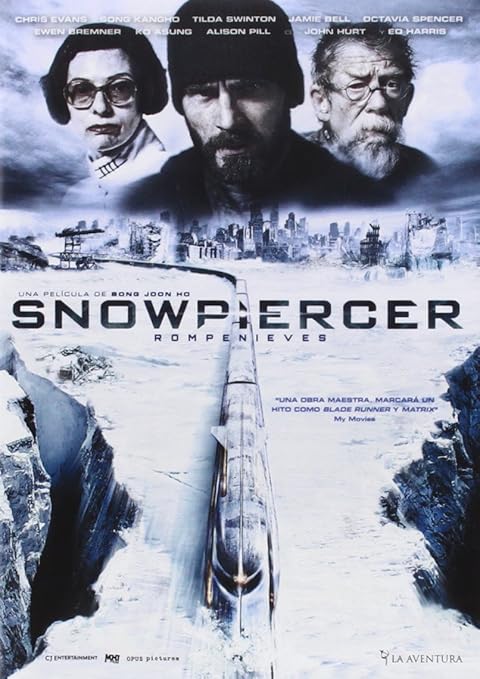
Mankind is threatened by global warming, and in an effort to turn the tide, introduces a cooling agent into the atmosphere. A deep freeze results and the only survivors live on a train run on perpetual motion that circles the earth, said train having been developed by a prescient bazillionaire (Ed Harris). The poor, led by Chris Evans (Captain America), eat mushy protein bars in the last car, while the rich are pampered with sushi, drugs, saunas and opulence in the front. Evans leads a revolt and the proletariat move from car to car to get control.

This is high concept, ambitious dystopia, but it is also unsubtle, mostly ridiculous, high concept dystopia, inadequately explained (a perpetual motion train?) and saddled with an unwieldy end (Harris shows up, like the wizard behind the curtain, to explain all). I’m all for ambition, but this is several trestles too far.

The film also contains a simplistic Have v. Have Nots political theme, which probably accounts for its appearance on so many top ten lists. For an example of the film tickling the right funny bone, one need go no further than The San Francisco Chronicle’s Mick LaSalle and his juvenile conclusion: “It’s a film that, in its own peculiar way, forces viewers to question their values and ask themselves how much they’re willing to sacrifice for a functioning society, and how much is too much.” If it takes the likes of Snowpiercer to force LaSalle to question his own values, I’m surprised he didn’t join a monastery after The Hunger Games.

The picture is also unwisely reliant on Evans, who lacks the gravitas of a dark, brooding action hero and the chops to handle the big, tortured soliloquy at the end. We’re supposed to be dazzled, but like most products of graphic novels, it’s a slick, empty endeavor with a few interesting parts. Tilda Swinton is also very funny as a bucktoothed toady for Harris.

The Trip to Italy - Movies on Google Play

Michael Winterbottom’s The Trip was a charming buddy flick/travelogue through the north of Britain, though these buddies (Steve Coogan and Rob Brydon) are British comedians and master impersonators (I still can’t decide who does the best Michael Caine).  I couldn’t imagine the first film lending itself to a sequel.  I was wrong.  The Trip to Italy is derived from a TV show on BBC Two, like the first film, and it is every bit as funny.  Though the banter of Coogan and Brydon is a tad staler, what comes through in their uncanny ability to riff is a deep affection, all set in the beauty of Italy from Liguria to Rome to Capri to Naples.  Winterbottom also grounds the characters with occasional but insightful reference to their domestic lives.

I confess I laughed much harder than my wife, which reminded me of a funny scene from Knocked Up.

The back and forth between Coogan and Brydon is only a bit more highbrow, but what they are engaging in is not so much conversation as a mixture of shit-giving, competition, and entertainment comprised of variations on old themes and bits.  Their discourse eschews any quiet moment, rejects a detour into anything serious, is decidedly male and, I suspect, has a very short shelf life for females, who, let’s face it, are more highly evolved.

Still, this is funny shit . . .


image

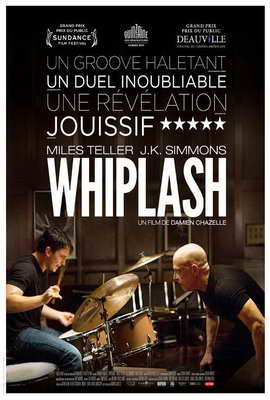
The best film in what has been a very strong year, writer-director Damien Chazell’s story of a 19-year-old jazz drummer (Miles Teller) and his relationship with his driven jazz teacher, played by J.K. Simmons, is flawlessly delivered and thought-provoking. Teller aspires to be the next Buddy Rich, and matriculates at the best music school in the country.  Simmons chooses him to join his ensemble, a stepping stone to greatness but also, an invitation to the meat grinder of abuse handed out by the demanding, mercurial instructor.

The story avoids every pitfall and expected plot turn of a feature film, yet it is not contrary for the sake of it. You can count on two hands the places a more pedestrian picture would take you, and the resolutions it would offer, but in service of a better narrative, Whiplash rejects the certainty of the tried and true, instead allowing the audience to come to their own conclusions.

The film is also about something, exploring the nature of greatness and what is necessary to achieve it; the limits of drive and the intersection of ego and cause; the meaning of teaching; and the changes and struggles between nature and nurture, raising children, molding character and demanding perfection. At one point, Simmons remarks, “There are no two words in the English language more harmful than good job,” and while that may play well to the instincts of some, he is such a flawed deliverer of the message, the audience is forced to question such an ethos knowing it will be practiced by such people.  I saw the film with my wife, my college-age daughter, and my high school-age son, and we talked about it – and I’m confident will continue to do so – for some time.

The film is evenhanded, a trait best represented in its depiction of minor characters. In a family dinner scene, Teller’s family, who appear casually condescending towards his achievements, are also perfectly decent, pushing back at his obnoxious “tortured artist” routine with annoyance but also concern and patience.  When Teller is approached by an attorney who represents a student allegedly harmed by Simmons’ practices, she does not lick her chops.

The picture is also stunningly confident, an achievement made even more impressive by its 19 day shooting schedule and $3.1 million budget.  Clint Eastwood released a film about music earlier this year, and he should have consulted Chazell about how to make Jersey Boys less static, less turgid. Whiplash is loaded with musical numbers played by stationary figures, but the camera riffs along with notes, constantly in motion, and like the art form it dramatizes, it is inventive and surprising.

I can’t commend the performances of Teller and Simmons enough.  They are both entirely natural and convincing, Teller conveying the conflicting hubris and hesitation of an ambitious yet shy young man, Simmons the grandiosity and brutality of the committed, brilliant instructor, inspiring one minute, petty the next.

Finally, Chazell has done something that is very rare in film. I suppose there are some folks who see Gladiator and think, “Hmmm. Roman history looks interesting. I might take a look into that.” But not many. Conversely, by his own depiction of the music, and the dramatization of love for it through the eyes of Teller and Simmons, I’m confident that many people who see Whiplash will one day look back at it as their entrée to jazz. That may be my enthusiasm for the picture talking (I’m not a jazz enthusiast myself), but I’m sticking with it.

The Monuments Men (2014) - IMDb

Full disclosure – I came in late, but I saw enough of this obvious, treacly, hackneyed, preachy pile of cornpone to feel safe that I didn’t miss the good part. Hitler is destroying all of Europe’s art. The Monuments Men, each and every one a gentle soul borne of devotion to those things that ennoble us, arrive in Europe to stop him. In the process, they say things like: “You can wipe out an entire generation, you can burn their homes to the ground and somehow they’ll still find their way back. But if you destroy their history, you destroy their achievements and it’s as if they never existed. That’s what Hitler wants and that’s exactly what we are fighting for” and “Who would make sure that the statue of David is still standing or the Mona Lisa is still smiling? Who will protect her?”

It’s not hard to figure what director and co-writer George Clooney was aiming for, an inspiring, old-fashioned period piece that trumpets the virtues of humanity in a world mired in barbarism, updated to include a little wit.  Call it “Band of Oceans 14.”

Clooney fails utterly.  Every character is stock, and the film feels untethered, veering wildly from the cornily comic to the embarrassingly sentimental (the deaths of Downton Abbey master Hugh Bonneville and Jean Judarin from The Artist are laughably operatic).  Bill Murray and Bob Balaban go for some night air, meet a scared German boy-soldier and share a cigarette with him.  Makes you think, right?  Then, Matt Damon, a member of the mission to save the art, steps on a land mine, prompting Clooney to quip, “Why d’you do something like that?”  And then Elliot Gould and Brad Pitt show up and they all have a drink at The Bellagio.

Clooney took a very interesting story and made it a bunch of hooey. Turns out Hitler didn’t order the destruction of art. Now, is Hitler the kind of historical character you actually need to lie about to make him look worse? I submit he is not. But this manifest picture isn’t taking any chances.

image

Very funny, very raw, often insightful comedy written and directed by Chris Rock. Rock stars as a facsimile of himself, a Hollywood success straight out of the mean streets of NYC, returned home on the eve of his made-for-Bravo wedding to a reality star (Gabrielle Union) and the opening of his shot at a serious film after making his fortune in broad comedies (the most successful of which is the Hammy the Bear series, which delivers a running joke, as everywhere Rock goes, you hear “hey, Hammy!”). Four years sober, Rock is accompanied on his return by a New York Times reporter (Rosario Dawson).  A convincing love story ensues as Rock opens up to her about his rise, fall, fears and regrets.

The film starts off a bit choppy, mainly due to the fact that Rock has to carry most if it. Rock has a winning smile and a wicked perceptivity, but he carries the armor and remove of a lot of comics, so his manner is a bit stiff, forestalling investment. But soon, Rock gets in his element, as he is surrounded by a dozen very good comics to play off. He loosens up in the second half, which allows him to reach deeper to connect with Dawson.

Rock borrows liberally from Judd Apatow’s Funny People and evokes Woody Allen’s chatty vibe (Rock’s back and forth with Dawson on the real reason for Martin Luther King’s assassination is alone worth the ticket and emblematic of their clever repartee) but he also writes strong, emotional moments which resonate stronger and longer than the gags, in particular, Rock’s reconnection with his father.


There is trouble in the North Pole. Santa (Jim Broadbent) is listless and bored, barely phoning it in.  His oldest son and heir (Hugh Laurie) has digitized and corporatized Christmas, while his predecessor (Bill Nighy), retired, undermines him at every turn, dreaming of a return to glory.  His youngest son (James MacAvoy) has the spirit but lacks any discernible skill. When a gift from Santa goes undelivered, the fissures of this dysfunctional royal family emerge.

The computer animation is expert, the story enjoyable for kids and adults alike, and it’s even slyly subversive.  Santa Nighy is a misogynist, Laurie’s male elf assistant appears to have a crush on him, and the elves who man the North Pole have a denizen-of-Jonestown quality (so much so that the film threatens a mass elf suicide at the end).