Archive

Comedy

Related image

Wes Anderson makes highly detailed, whimsical and richly textured children’s stories for adults, films that evoke an old picture book or model train set from our youth.

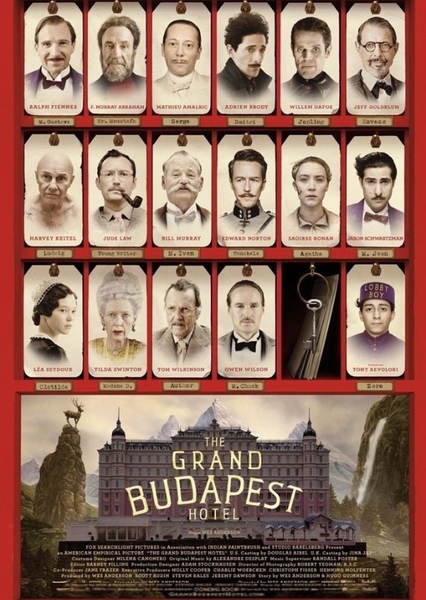
The Grand Budapest Hotel is in that same vein, a colorful story about the concierge of a once majestic property (Ralph Fiennes) and his efforts to tutor a protégé (Toni Revolore).

Here, Anderson accentuates the stylish (the scenery approximates toy furniture) and emphasizes the screwball.  Missing, however, are the moments of true human connection that punctuate his earlier works, the moment in Rushmore when Jason Schwartzman shows his hurt feelings or introduces his father, or in Moonrise Kingdom, when the children kiss or Edward Norton reveals his fears of failure as a scout master, or even in The Life Aquatic, when Bill Murray tries to woo Cate Blanchett.

Grand Budapest is Anderson’s non-animated The Fantastic Mr. Fox, a fantastic film,  So too this film, but it’s Anderson’s least affecting picture.

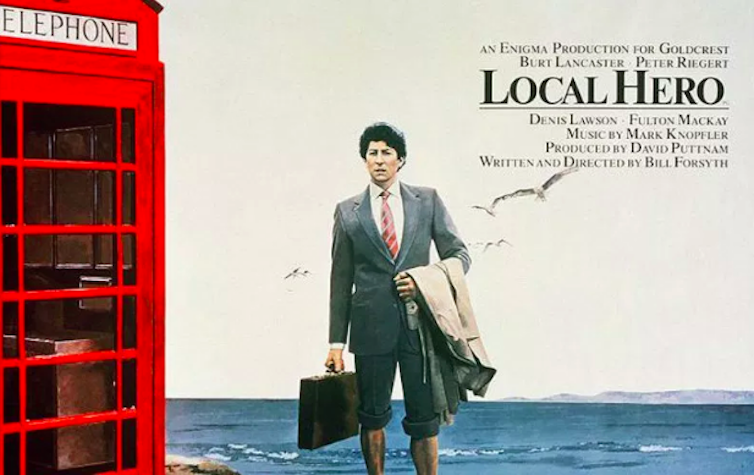
Local Hero at 35: turning Hollywood's greatest Scottish film into a musical

Writer/director Bill Forsyth was born in Glasgow so he was well-positioned to create this love letter to Scotland. Big oil executive Peter Riegert, who lives a precise, antiseptic and singular life in Houston (he prefers to do deals at arm’s length – “I’m a telefax man”) is sent to a small fishing community in Scotland to buy up the land for a new refinery site. Before his journey, the company’s quirky owner and amateur astronomer, Burt Lancaster, enlists Riegert to canvass the skies in search of a comet. Riegert finds a quaint, simpler life that slowly transforms him from uptight businessman to wistful boy, entranced by the scenery, pace and wonder of the coast.  The charm of the film is embodied in the village, in the film’s quieter moments, and as it infatuates Riegert, so too the audience.

There are so many good things about this picture it’s hard to catalogue them all. Riegert manages to be deadpan yet earnest, never once lapsing into sarcasm or condescension, and Forsyth writes him in a manner that never requires an explanation of or ode to his disquiet. The villagers are not schmaltzy local yokels, with a song in their heart and a lesson to impart.  Rather, they are a slightly cynical bunch who received intel on the purchase and they – like anyone – lust for the big payoff.  As Forsyth has acknowledged, “I don’t want you to think there was some deliberate message. You talk about the plot, but was there one? I mean, people can look back and say, oh, this was all an early one about the environment or whatever, but it didn’t happen that way, or if it did it was accidental. I’m not political, either in film or personally, and I don’t really do plot, and certainly don’t aim to broadcast a ‘message’. I suppose I like to tell stories. And if I’m writing a film, and don’t really have a plot, then you have to fill the screen with something, so I try to do so with characters, incidents.”

The picture features an impossibly young Peter Capaldi (In the Loop, World War Z), hilarious as Riegert’s liaison.  His high dudgeon when the town’s cook serves him an injured rabbit he has saved from a road injury is priceless.  Mark Knopfler also contributes a restrained, moody score that melds his guitar licks with a little-80s Vangelis synthesizer.

Apparently, Forsyth only got a few bites at the apple in Hollywood, the last one being a poorly reviewed Robin Williams vehicle, Being Human.  It’s a shame.  Forsyth was interviewed by The Guardian in 2008, which correctly called Local Hero “one of the quiet must-see little masterpieces of British cinema.” 

The Coen Brothers have taken many stabs at comedy, with varying results. On the plus side, Raising Arizona is a wild, human cartoon, with performances by Holly Hunter and Nick Cage approximating Claymation; Intolerable Cruelty an amusing facsimile of a screwball comedy; and The Big Lebowski a whimsical, goofy trip. The Ladykillers however, was a dud, The Hudsucker Proxy an ornate mess, and A Serious Man too self-loathing to support interest, much less humor.

The best of the bunch, by far, is 2008’s Burn After Reading, a crisp, tight ensemble that melds madcap and cloak-and-dagger. The story is too elaborate to capsule, but the tale – intersecting vanity, intrigue, the CIA and personal fitness – is almost besides the point. The actors could have let the serpentine twists carry the day, but to a person, they invest silly characters with pathos and even gravitas.  George Clooney’s philandering everyman goes from loathsome to sympathetic and is almost admirable in his pathological ardor. John Malkovich’s rage-filled civil servant stands in for all us “surrounded by idiots”, especially when we are introduced to his brittle, scheming, focused wife (Tilda Swinton). Frances McDormand’s novice blackmailer is annoyingly hilarious yet almost tragic in her desperate fights for companionship and against the ravages of time. And Brad Pitt, as her dim but lovable accomplice, should have been nominated for Best Supporting Actor. There is not a scene he doesn’t steal, and the one where he must contend with a maniacal Malkovich is one for the ages.

“You think that’s a Schwinn.”


22 Jump Street Review | Vanity Fair

Not as funny as the first one, mainly because it is too self referential and a great deal messier, but plenty funny anyhow. The plot is the same – Channing Tatum and Jonah Hill have to crack a drug ring, only this time, they’re at college. Highlights include Hill’s turn as a Hispanic gang member and later, his impromptu def jam poetry performance at a coffee house, as well as Channing’s bromance with the college quarterback. For better or worse, and mainly better, these guys may be the next Benny and Hope. Downsides include too much Ice Cube and a surprisingly leaden performance from the usually hilarious Jillian Bell (Workaholics, East Bound and Down). You could see this in the theater and get your money’s worth or wait for video and enjoy all the more with the extra $25 in your pocket.

I normally watch this during the holidays, but it is now on the HBO rotation, and I’ve been enjoying it in segments. Based on Nick Hornby’s novel (Hornby was also one of the screenwriters), this is a fine story of a charming but vacuous and intentionally isolated rich guy (Will, played by Hugh Grant) who corrals a neighborhood boy into playing his son in the hopes it will impress a romantic target. He is soon brought into the boy’s world, against all his selfish instincts.

This is a very funny film.  The comedic set pieces (including a harrowing talent show, the death of a park swan, and awkward support groups) are masterful.  The narrative is punctuated by voiceovers from Marcus or Will, and their observations are either hilarious or sentimental. The message is A Christmas Carol – no man is an island, and we are defined by how we treat each other, but for every sweet note, there is an arch counterpoint. My favorite is Will’s voiceover upon meeting Marcus’s earthy, liberal, disapproving mother, Fiona (Toni Collette) over lunch, where he lords his non-vegan ways by ordering steak while, in his mind, deriding her Yeti-like sweater.

About a Boy – 5 stars | filmvetter

Grant is usually reliant on an affected, stammering, faux-shy schtick (his performances in Notting Hill and Love Actually are of this stripe; cloying and relentlessly puppydog). But here, he’s pretty much a dick, playing Will as someone who enjoys a relationship only to the extent it provides him an opportunity or the solace of being kind-hearted. Once there is heavy lifting, he is out, as Grant explains:

Grant is really quite good in the role, especially upon the realization that he is worth nothing in this world. Nicholas Hoult plays Marcus with a sweet perseverance that never once smacks of child-actor manipulation, and Collette is truly vulnerable as Marcus’ crunchy, depressed mother, who is oblivious to the needs of Marcus, his desperation to save her, and the burdens she places on his shoulders.

It’s also heartening to know that poor, sweet Marcus

has grown up to date

Justice.

Anchorman 2's Ron Burgundy: Five Funniest Viral Marketing Stunts - Variety

Seemingly improvised throughout, the sequel is alternately lazy and uproarious, but by the end, more the former. The Channel 4 news gang (Will Ferrell, Steve Carell, David Koechner, and Paul Rudd) have reunited, moving from San Diego to New York City, to take the helm of the graveyard shift on the first 24 hour cable news channel. Soon, Ferrell’s Ron Burgundy is back on top, discarding his friends, cementing his fall (he is even stricken blind), only to return triumphant.

In the first film, Ferrell’s bosses (Fred Willard and SNL alum Chris Parnell) held their own as comedians, contributing to the fun. Ferrell’s new boss is the sassy, Pam Grieresque Meagan Good, who is placed in the film for a painful scene where Ferrell visits her family and tries to “act street.” She’s not funny, but she’s not alone.  Harrison Ford, Drake, Kanye West, Tina Fey, Amy Poehler, Jim Carrey, Sacha Baron Cohen and others appear, most for a reprise of the first film’s news team rumble, but the melee is woefully disappointing. Gone are the unexpected trident and grenade, the scores from Star Trek and West Side Story, replaced by celebrities who just wanted in. Sure, Ford turning into a werewolf is pretty cool, and who doesn’t laugh at an unexpected minotaur, but these guys aren’t very funny.  And Liam Neeson and Marion Cottilard? Zzzzzzzzzzzzzz. Will Smith?  He wasn’t even funny in The Fresh Prince of Bel Air. Even Vince Vaughn’s return as Wes Mantooth is a little dull. Speaking of dull, Kristen Wiig as Steve Carell’s love interest is Sominex.

Director Adam McKay also tries to deliver a lesson about the degradation of the news. He usually appends his simplistic political tracts to the end of his goofy movies, so you could walk out of The Other Guys or The Campaign while the credits rolled and he lamented Wall Street greed or the Citizens United decision.

Other bits fare better, including Ferrell’s interactions with his young son and his bottle feeding of a baby shark; Carell’s panic at the loss of his legs on a green screen; and especially, the news team’s smoking of crack on the air.

Alexander Payne’s black-and-white portrait of a geriatric mid-westerner (Bruce Dern) intent on getting from Montana to Nebraska to collect a sham $1 million sweepstakes prize is patient, lyrical and loving.  The film evokes David Lynch’s The Straight Story in its pathos, but it also contains a wry sense of humor, largely provided by Dern’s suffering younger son (SNL alum Will Forte) and his brutal, loudmouth but ultimately protective wife (June Squibb)  Lesser films would have played up the wackiness of the extended family, who now believe Dern is flush and are making their claims, or they would have provided Dern the platform to release his Korean war demons or his crushed dreams to his son on their journey.  There is none of that easy bull here.  Instead, Payne presents an authentic portrait of a stoic rural family (Dern seems to have 7 brothers, all of whom watch the NFL with nary a quiver) steeled by time and want, with the very true message that most people don’t really know much about their parents, and that their pasts grow more foreign to us every day.  This film is a lesson in restraint, and Payne (The Descendants, Sideways, Election, Citizen Ruth) has cemented his place as a writer/director with a unique, American voice.

Jason Bateman’s directorial debut is bracingly cynical and consistently funny. Bateman stars as a jerk who has found the loophole that allows him to enter and win kids’ spelling bees, making it all the way to the nationally televised (on PBS) Golden Quill finals. On the way, he torments the journalist covering/funding his story (Kathryn Hahn), the competition director (Allison Janney), its founder (Phillip Baker Hall) and various parents, but he also befriends a young competitor (the wide-eyed and charming Rohan Chand). At just under 90 minutes, it never nears wearing out its welcome, and Bateman’s hand is steady. There are a few flat notes. Rachael Harris reprises her role from The Hangover as another repressed, psychotic type, and again, her performance is too much (as is her comeuppance). Bateman’s engagement with his child’s competitors is brutally funny, but his treatment of one girl, while a testament to his commitment, is perhaps too painful to endure. These, however, are minor problems. Bateman has depth beyond being a mere crank, and Chand’s insouciance blends perfectly with his deadpan amorality.

Robert Altman’s send-up of Hollywood process and morality opens with an audacious 7 minute, no-cut scene that is a primer on economical, fluid exposition. We meet most of our characters, including the studio’s no. 2, the writer’s executive, Griffin Mill (Tim Robbins), and the tone is set.  Unfortunately, Altman cannot fulfill the promise of his introduction. Robbins’s star is falling and he is also being threatened via postcard by a writer he has brushed off. Unnerved, he sets up a meet with who he believes to be his stalker, accidentally kills him and then falls in love with the writer’s girlfriend (Greta Scacchi). The murder is implausible and the heat-of-the-moment relationship unconvincing (a love scene with Robbins and Scaachi is not so much hot as uncomfortable). Robbins is way too mannered and standoffish to elicit empathy, and the film swerves artlessly from suspenseful to broadly comic (Whoopi Goldberg is very funny as the investigating detective, but she’s too funny).

On the plus sides, we are treated to a whirlwind tour of LA, and Altman makes sure it is populated by just about every star, young or old, he can get his hands on. Also, the lingo of the pitch meetings can be very funny:

“It’s a TV star who goes on a safari.”

“A TV star in a motion picture?”

“A TV star played by a movie star.”

“A movie star playing a TV star.”

“Michelle, Bette, Lily.”

“Dolly Parton would be good.”

“I like Goldie.”

“Great, because we have a relationship.”

“Goldie goes to Africa.”

“She’s found by this tribe.”

“- of small people.”

“She’s found and they worship her.”

“It’s like The Gods Must Be Crazy.”

“except the coke bottle is an actress.”

“Right. It’s Out of Africa.”

“meets Pretty Woman.”

Still, the script is rather gentle on the town, and it never really succeeds as a thriller or a satire. In fact, the movie could have been done without any reference to the murder at all, which, ultimately, drags it down. The Player falls into the category of Movies You Thought Were Better at the Time (Altman was nominated as Best Director, as was Michael Tolkin for the script)

Shorter than The Wolf of Wall Street by 41 minutes, David O. Russell’s American Hustle felt longer and more ridiculous by a good stretch. Loosely based on the Abscam bribery stings of the late 1970s, Russell introduces four purportedly colorful characters: portly, combed-over con man Christian Bale; his sexy mistress and partner in crime Amy Adams; his loony wife Jennifer Lawrence; and a hyper aggressive, curly headed FBI agent Bradley Cooper. Cooper nails Bale and Adams, forces them to entrap others (including Jeremy Renner, as a New Jersey mayor desperate for development funds), a love triangle ensues, and after countless zooms, swift pans and other frenetic camera shots utilized primarily to divert our attention from the banal, repetitive script, we reach a tacked on and unconvincing resolution.

The closest thing to a character is Bale, and his performance is the only reason to see the picture. Unfortunately, he plays a man desperately juggling knives, and it feels as if he’s doing just that masking this thin script. Lawrence plays a decent wacky shrew, and the soundtrack has a few fun numbers from the 70s (I’ve always been a sucker for Steely Dan’s Dirty Work). That’s all of the good.

The bad is really bad, starting first with the preposterous characters played by Adams and Cooper. Unlike with Bale, Russell (who co-wrote) doesn’t bother to give us any sense of where these two came from. She is an impossibly sensuous cypher, in a 70s Enjoli perfume commercial sort of way. Cooper is so manic it suggests severe chemical imbalance, as if his character in Russell’s Silver Linings Playbook got a job in law enforcement. While these two concoctions flirt, and even disco dance (because this is the 70s), the aimless story plods along.

There are other problems. Who could keep a mere fraudster imprisoned for three days without access to a lawyer just to soften her up? Why would you cast Louis C.K. in a supporting role when he’s already demonstrated in one of his sitcom episodes the silliness of having stand-up comics dramatically act? How can a script this talky lack one memorable exchange? Where is this fucking film going and will it never end? Why is Lawrence singing “Live and Let Die” to the camera as she dusts? Does Russell really think he can get by on stealing that Paul Thomas Anderson trick and his camera work, kitschy 70s fashion and hairdos, a few well chosen tunes and the same cast from his last two films?

The answer to the last question is a 93% rating on rottentomatoes and 10 Oscar nominations. Only two are deserved: Bale and Hair.