Archive

Comedy

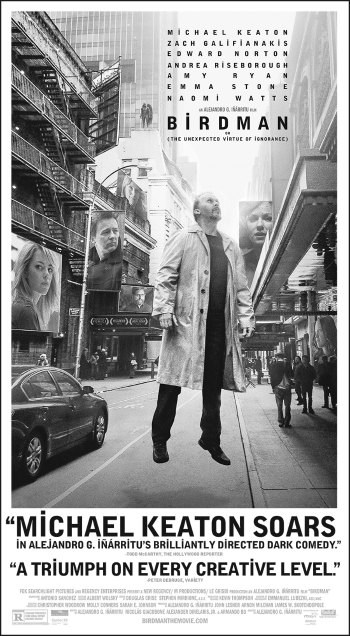
Birdman is so visually audacious you almost lose focus on its engrossing performances, cutting sense of humor and ambitious breadth. It is Rope on meth, tracking, almost hounding, with very few cuts, our tortured protagonist (Michael Keaton) in, through and around Broadway’s St. James Theater as he seeks to revive an acting career defined by his iconic role as a movie superhero. His fortune and name are on the line, and he is beset on all sides by family (fresh out of rehab daughter Emma Stone, ex-wife Amy Ryan), his jittery manager (Zack Galifianakis), his needy female co-stars (Andrea Riseborough, Naomi Watts), his antagonistic male co-star (Edward Norton) and a vicious and even more antagonistic New York Times reviewer (Lindsey Duncan).

One other character gives him some trouble as well.  His alter ego, who at first is a voice in his head but soon appears in person, telling him that all this stage acting bullshit is just that, he needs to get his ass back in a Birdman movie, and he must “shave off that pathetic goatee. Get some surgery. Sixty’s the new thirty, motherfucker!”

Director Alejandro Gonzalez Inarritu collaborated with three others on the play-within-a-play script, which is a satirical series of verbal jousts on the topics of sex, relationships, acting, the stage versus Hollywood, machismo, art versus commerce and the impact of social media.  The clashes between Keaton and Norton (sell-out v. artiste’) and Keaton and Duncan (the sell-out virus stinking up the hallowed stages of Broadway v. the Lord Protector of those stages) are particularly sharp, but the entire screenplay is chock full of gems.  My favorite is Keaton explain how he is holding up under the strain:  “”I’m broke, I’m not sleeping and this play keeps hitting me in the balls with a tiny little hammer.”

The frenetic, adrenaline rush style of the film heightens the tension (the cinematographer, Emmanuel Lubetzki, was the mastermind behind the dizzying tracking shot in Children of Men). The manic shooting makes the performances all the more impressive.  Keaton is superb.  His early trademark (ironically, before he became Batman) was a fevered, riffing style of acting, which could be spellbinding or just exhausting.  Older and more world-weary, Keaton internalizes his frenzy, struggling to bottle it in just as he struggles to keep Birdman at bay.  It’s a riveting turn.  Everyone else is excellent, and Norton deserves special mention.  As an actor with a history of being temperamental, Norton’s performance as a condescending, difficult, self-loathing actor is canny and knowing.  He damn near steals the film, which again, mirrors what is going on in the story.

Gonzalez Inarritu also gives the actors a great deal of space.  In Boogie Nights, Paul Thomas Anderson filmed a solid chunk of a drug deal going bad solely on the face of Mark Wahlberg.  The effect was powerful because in Wahlberg’s eyes, the audience could register the disaster unfolding before him.  Whenever I think of that classic film, I first remember that scene.  Of all the memorable parts of Birdman, there is a scene when Stone lashes out at her father, purposefully trying to hurt him.  In one of the few times the camera isn’t moving, Gonzalez Inarritu holds on Stone’s face as she delivers the cut and then as she sees its effect.  It’s a captivating moment in a film full of them.

Thus far, the best film I’ve seen all year.
image

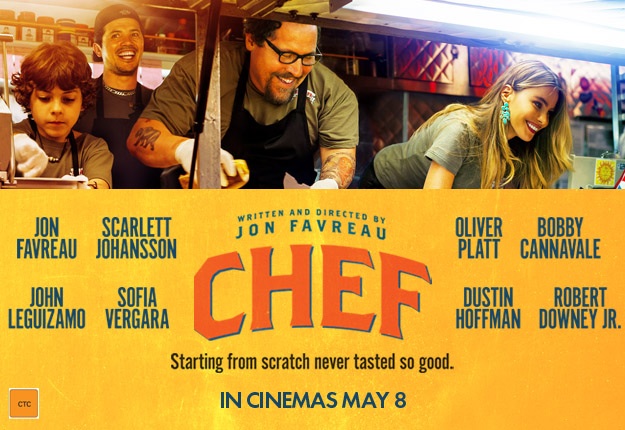
There’s not much to this Jon Favreau film, and it certainly doesn’t break new ground, but it is a charming, dare I say “feel good” comedy about a chef (Favreau) who stumbles spectacularly via the internet and Twitter (one of the funniest memes in the film is Favreau’s cluelessness about social media) and makes a comeback with a food truck. Favreau clearly has great fondness and respect for the subject matter and the loving depiction of cooking is one of several strengths of the film. Others include an enviable supporting cast (Scarlett Johansson, John Leguizamo, Sofia Vergara, Robert Downey Jr., Oliver Platt, Bobby Cannavale and Dustin Hoffman) and an unexpectedly moving but understated father-son dynamic between Favreau and his 10 year old, Percy (Emjay Anthony), worked out on a road trip.

image

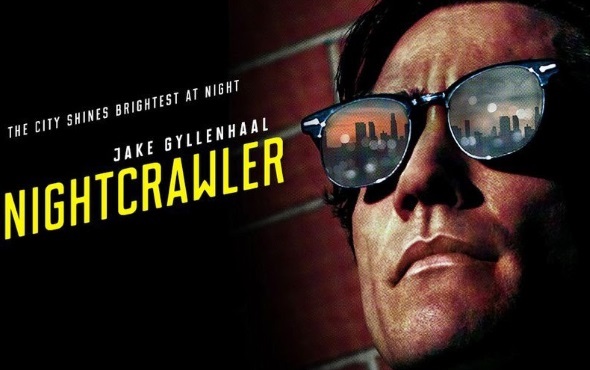
A clever black comedy that emphasizes story over a message (“if it leads it bleeds”), Nightcrawler works in large part to Jake Gyllenhaal’s riveting performance as an aspiring freelance videographer who haunts LA at night, capturing its brutality for sale to local TV news. Gyllenhaal is a mixture of King of Comedy‘s Rupert Pupkin, Rushmore‘s Max Fischer, and Jim Carrey’s Cable Guy, a driven cipher who spouts business motivational doctrine and relentlessly pushes further and further over the line of acceptable journalistic practices in capturing people in crisis or even death throes. You guiltily root for him because he is so compelling and his Dale Carnegie pitch, even unmoored from any concept of morality, comes off as an earnest entrepreneurial pitch. But by the end of the film, a series of tense crime scenes invaded by Gyllenhaal, his philosophy is both corrupting and lethal. He makes it bleed even more that it otherwise would, and as a result, he excels.

It’s a simple tale, well told, but there isn’t a lot to this picture other than Gyllenhaal, who exudes a real inner force (while his character is certainly different, I kept coming back to De Niro in Taxi Driver). He has two co-stars; Renee Russo, a hard-bitten struggling TV producer whose star rises with Gyllenhaal’s footage, and LA at night, which writer director Dan Gilroy shoots as a haunted ghost land of deserted streets and foggy canyons. Gilroy is a longtime writer of pretty bad films (Freejack, Two for the Money, Real Steel), but he directs this thriller with pace and verve.

image

A romantic comedy set around an abortion requires a deft hand, and there are times when first time writer-director Gillian Robespierre navigates her lead, sweet but spoiled comedian and former SNL alum Jenny Slate, into some questionable waters. Slate is a comic, a regular at a Williamsburg club, who has a one night stand with seemingly buttoned up Jake Lacy. Her “thing” as both a stand up and as a potential mate is to be self revelatory and outrageous, and so we get a full helping of bon mots about vaginal yeast, farts and the like. That can be a little trying, as is Slate’s callous treatment of Lacy.

But it works. Slate is very good, exhibiting the in-between status of a grown woman trying to live her own life and the little girl still vulnerable and attached (financially and emotionally) to her divorced parents. Slate is very much modeled after Lena Dunham’s Hannah Horvath from Girls, with, thankfully, precious little of Horvath’s navel-gazing excess. But when Slate gives voice to her fear and confusion, she is natural and sympathetic.  Conversely, when Horvath is flat on her back on on the canvas, you most always feel pretty happy about it.  Lacy is also quite touching as the gentle and confused hook-up who warms Slate’s butter pats and brings flowers to Planned Parenthood.  He knows that among the smart set, the joke may be on him, but he’s game and his backhand is effective.

While I’m not sure if Robespierre meant for Slate to be only kind of funny, that works as well, because it feels real. She seems like a young comic, still working on material up until the moment she takes the stage, and that contributes to the verisimilitude of her circumstances.

This could have been arch and maybe even preachy. Gaby Hoffman, as Slate’s roommate, comes close to giving a stemwinder against the Supreme Court and society’s “patriarchy” but she is blunted by Slate’s giggles and a mild pushback from a gay friend who retorts, politics aside, that he would want to know if he got someone pregnant.

No matter the edgy subject matter, the end is syrupy sweet and hopeful, paying homage to the rom-com rules.

The Family Stone - Wikipedia

My August: Osage County review elicited an email from my friend and mentee, Xmastime:

worse than this steaming turd

My reply:  “Nothing is worse than that steaming turd.   Osage is a standard, Southern shoutfest, with as much authenticity as Hee HawThe Family Stone, however, is a pat-its-own-back paen to womyn, disabled homosexuals, showy profanity by people wearing flannel, and New England flintiness.  The cancer ravaging Diane Keaton couldn’t come fast enough.  I am pleased to say that its writer director didn’t get another project until 6 years after The Family Stone and that was a Selena Gomez joint.  Justice.”

image
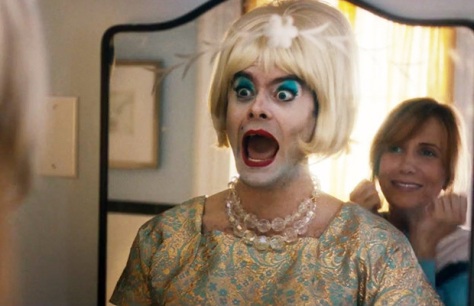
When the two major characters of a film attempt suicide in the first scene, by the end of the picture, you’re not supposed to regret their lack of success. The Skeleton Twins is a ragged, cloying, mannered dramedy starring entirely-out-of-their-depth SNL alums Kristen Wiig and Bill Hader as estranged siblings brought together by near tragedy. Wiig is utterly lost here, and all her tics and quivers cannot make up for substance. Hader is a little better, if a facsimile of a gayer Sean Hayes from Will & Grace is the aim.

The siblings are the children of tragedy, their father a suicide and their mother a hackneyed New Age narcissist introduced only to make her children seem noble. They are presented to us as seeming losers who have lost their way and their special bond on the rocky road of life. They come alive in a weirdly incestuous routine of replaying bits and hijinks from their childhood, and the watching (particularly, a drawn out stoned scene featuring Wiig’s HI-larious flatulence and a lip-synch duet brazenly stolen from Bridesmaids, sans humor) is cringeworthy. These two are as likely to be siblings as Olivier and Midler, but as foreign as they seem, the real problem is that they are fundamentally disinteresting to anyone but each other. It’s like spending an evening with two dull people who constantly crack each other up with reference to inside jokes and childhood excesses (burps, farts, hopes and dreams). Um. Check please.

As for the story, it is a lurching mess, serving primarily to highlight ridiculous and arty visuals, such as a slow dance in Halloween costumes that is finger-down-your-throat precious. When nothing happens (the film feels interminable), a character says or does something clunky and overt, and we slog forward. One example: Wiig is unhappy in her marriage to Luke Wilson and surreptitiously takes birth control pills while they are “trying” to get pregnant. Hader tips Wilson off after a HI-larious scene where hetero Wilson takes homo Hader rock climbing, which is funny because . . . gay. The clue? Sometimes my sister hid things when we were kids. And off Wilson goes to find the pills in a basket of decorative soaps.

An awful hipster picture with nary an authentic moment in it. Makes Zach Braff seem like Cassavettes.

Image result for Saving Mr Banks

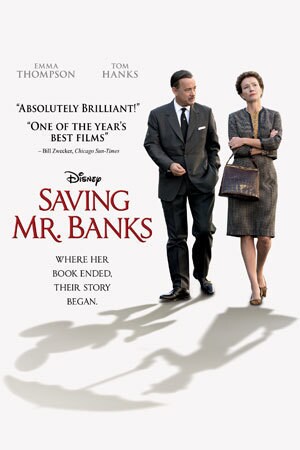
The writer of the Mary Poppins books, P.L. Travers, was apparently such a pain in the ass that, according to her grandchildren, she “died loving no one and with no one loving her.” As played by Emma Thompson, Travers more than fits this bill as she is whisked to Hollywood against her better instincts to be wooed by Walt Disney (Tom Hanks) in an effort to adapt her stories to the screen. Travers’ prickliness and exactitude with Disney and his team (Bradley Whitford, Jason Schwartzmann and B.J. Novak, all very good here) is the best part of the film. Unfortunately, director John Lee Hancock (The Blind Side) keeps interrupting the best part with flashbacks to Travers’ childhood, and in particular, her relationship with her whimsical, alcoholic father (Colin Farrell).

I understand the juxtaposition. The audience is supposed to learn what has embittered this awful woman. But you really don’t care (she’s such a witch that motivation is irrelevant), and you also begin to resent the interruption of the more interesting creation of a film.

Worse, the technique is cloying, leading to a sugary-sweet ending that has Disney melting the ice encasing Travers’ heart. In reality, Disney and Travers ended their relationship in acrimonious fashion, with Disney fed up with her stubborn nature, and Travers so offended she refused any further association between the company and her books. The disharmony is alluded to in the film, but it is near-blotted out by Travers’ copious tears as she undergoes a sort of catharsis at Grauman’s Chinese Theater.

Those were actually tears of fury.  From Travers herself:  “As chalk is to cheese, so is the film to the book. Tears ran down my cheeks because it was all so distorted. I was so shocked I felt that I would never write—let alone smile—again!”

Image result for barton fink

There’s not a scene in this Coen Brothers film I don’t like, and the story of a Clifford Odets-esque playwright’s (John Turtorro) introduction to the oily world of Hollywood is both visually striking and thematically ambitious.  But no matter the film’s look or intriguing interpretations (the mind of the writer, the dangers of solitude, the corruption of money), by the end, you feel trifled with, as if you watched a parlor trick perpetrated by a cast of broad, comic actors (John Goodman, John Mahoney, Michael Lerner) for no greater purpose than the goof.  Like The Hudsucker Proxy and Miller’s Crossing, Barton Fink has its joys, but the feel is sterile and your investment unrewarded.

Martin Scorsese’s surreal nightmare of one man’s (Griffin Dunne) ill-advised late-night trip into lower Manhattan is painfully funny and, at times, genuinely unsettling. Dunne is beset by a quintent of quirky, if not outright dangerous females (Roseanna Arquette, Linda Fiorentino, Teri Garr, Catherine O’Hara and Verna Bloom), a fact that will one day be Exhibit X in his anticipated trial for misogyny.  His torture is lovingly photographed by Michael Ballhaus, giving SoHo’s grimy exterior a dream-like quality (and there is no greater horror than being hunted by a mob that has commandeered a Mister Softee truck).

Dunne is very good and much like Steve Carell, except he’s not burdened at all by the imprint of a long-running character, and where Carell is childlike and vulnerable, Dunne is sympathetic, but sexually opportunistic.

Bonus: if anyone asks you, “What movie casts the parents from Home Alone, one of whom went to filmvetter’s high school?”, now you know.

When Rain Man came out, I enjoyed it, but soon came to sour on the film for its easy emotional manipulation and an affected star turn by Dustin Hoffman. I didn’t credit Hoffman the prescience of Robert Downey Jr. in Tropic Thunder (“never go full retard”) and found Hoffman’s portrayal of an autistic adult unsubtle and obvious. Perhaps had I waited until Al Pacino’s blind rampage in Scent of a Woman, I would have been more forgiving.

Pauline Kael called it “a piece of wet kitsch” and I can’t say I could have disagreed. Rain Man has always maintained a spot in the pantheon of overpraised domestic drama Oscar winners that, I assumed, would age very ungracefully (see Forrest Gump, American Beauty, Crash).

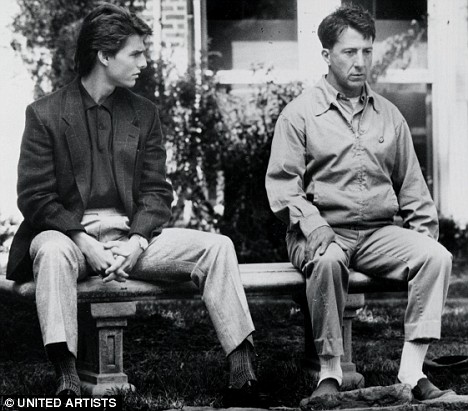
Rain Man has hit the schedule on my pay movie channels, and yes, it is emotionally manipulative and yes, it does sport some of the more annoying hallmarks of the 80s (a Hans Zimmer synthesized score that would put him on the map, a few too many montage scenes, a gorgeous and pointless female lead, Valeria Golino, who came and went). But Hoffman’s performance as a hidden older brother to Tom Cruise (Cruise learns of him upon their wealthy father’s death and “kidnaps” him to have an edge in getting his share of the will) is very strong. What unfortunately became represented by cute catchphrases (“I’m an excellent driver”, “10 minutes to Wapner”) is actually a canny, deep portrayal of a tortured soul, and director Barry Levinson never really lets you forget the dangers that lie therein. Much like Bradley Cooper in Silver Linings Playbook, Hoffman is endearing until he is terrifying, and at exactly the moment Spielberg would have inserted treacle, Levinson has Hoffman explode again.

Tom Cruise is even better in his role as Hoffman’s wheeler-dealer, LA smooth brother, Ray. His frustration with Hoffman is communal. His entire performance is a study in anger at Hoffman, not for being denied his loving company or for being shut out by his father, but because Hoffman is an annoying lunatic. “I know you’re in there somewhere,” he screams, and while he undergoes change in his time with the afflicted Hoffman, he does not become redeemed so much as educated.

The film is also very, very funny, perhaps too much so for our times. I can imagine grievance groups objecting to the use of an autistic adult for chuckles, but the screenwriters’ (Barry Morrow and Ronald Bass, the former of whom, like Golino, pretty much disappeared after this film) don’t pull many punches and the exchanges between Hoffman and Cruise are often brutally comic: