Archive

Rating

Image result for Andrew Sweet photography miami

A retrospective of Miami Beach partially through the lens of photographers Andrew Sweet and Gary Monroe. This documentary is an interesting and economical time capsule of post war life there, as it became the haven for elderly Jews, eventually giving way to the Mariel influx, the drug wars and accompanying crime, with gentrification delivering the coup de grace. Joyous, poignant and a little depressing. A little uneven but definitely worthwhile.

On Netflix.

Another sweeping war epic from my past, along with Waterloo and Zulu, this one introduced me to the “stiff upper lip” Brit.  Unlike those films, this picture just doesn’t hold up at all.  Directed by Guy Hamilton (who had a much better time of it with four Bond films), the film is overly reliant on air battles that perhaps seemed impressive at the time, but now, are flat, difficult to comprehend (you rarely know which character is in which plane) and without drama.   Worse, what happens on the ground is remarkably staid and uninvolving.

It is, however, loaded with the cream of British actors (Michael Caine, Michael Redgrave, Ralph Richardson, Trevor Howard, Laurence Olivier, Christopher Plummer, Edward Fox and Robert Shaw, to name a few), and of particular note, it features a strikingly handsome Ian McShane, who aged into the craggy, rough Al Swearengen of Deadwood.  You can see what Emmanuelle’s Sylvia Kristal saw in him.

Battle of Britain: Ian McShane's RAF Uniforms » BAMF Style

Image result for They shall Not grow old

Many museums offer documentary films covering the subject matter of the locale and event they memorialize.  The last one I saw was at the Holocaust Museum in a small alcove theater where you could get a respite from the vast tragedy to watch a short, continuously run film (the one I saw was about a particular figure and her trek from liberation to Israel).  At Antietam, a similar re-enactment film runs, explaining the day of battle, narrated by, I am almost certain, James Earl Jones.

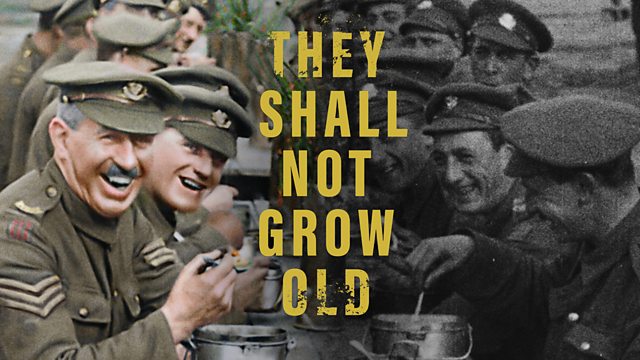
At the outset, They Shall Not Be Forgotten, Peter Jackson’s documentary about the British experience in World War I, has the same feel.  It is simple black-and-white footage overlaid with the voices of those who fought the war recounting their experiences.  There are, however, critical and moving differences.

First, about one fourth of the way in, the black-and-white film comes to life in color, as Jackson has painstakingly restored over 100 hours of footage from the Imperial War Museum.  Jackson even employed lip-readers to approximate what was said by the men in the footage, giving the sense of a sound recording.  The effect is as if ghosts were revealed in the restoration.

Second, the memories are culled from 600 hours of interviews of 200 Great War veterans, who remain anonymous and speak of the every day experience rather than their role in the titanic struggle.  There are no names, and no battle or locale is identified.  You follow no particular individual, though you can discern the British voice in all its forms.  As such, you feel the collective experience without the shackles of a linear, fact-driven recitation.

Jackson’s film is also a generational memorial.  These men haven’t been educated in the ways of individualism and introspection and as you hear from them, you can glean a reluctance to speak, a “what is all the fuss?” mien.  This countenance rarely cracks, even as the horrors of the war pile up in their reminiscing.

As with Apollo 11, there is no historian or pundit or wag telling you what it all means.  These are the unvarnished recollections of men who would have been forgotten more quickly were it not for Jackson’s contribution.   A must watch and a cultural treasure.

B05CE3EC-FDC5-4D44-8E8B-5F6EAE29E3D8

Comprised solely of contemporaneous archival footage updated via high resolution digital scans, there is no commentary or exposition for this documentary of the moon landing mission. It is contemplative and, at times, spellbinding, but can also be somewhat sterile. Still, rather than the standard commentators whinging on about the greater significance, I’ll take it. HBO is currently running a two part documentary on Muhammad Ali that is similar in approach – all archival footage and no commentary – and it too is very good. I hope this is a trend.

47D368E8-C68E-4DA6-AB80-143CC9B34937

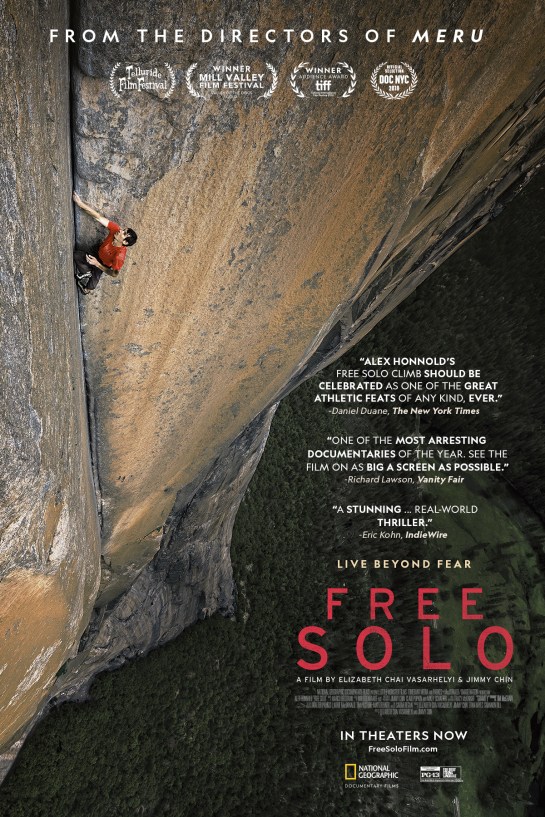
The subject of free soloing (climbing sheer face of rock with no rope) is compelling, more so for me because I didn’t even know it was a thing until I saw this movie.  You travel with Alex Sonnold as he attempts the greatest climb of his life, the 900 meter El Capitan in Yellowstone, which seems particularly reckless in that he’s just weeks off a sprained ankle.

The climb is gripping. The psychological portrait of the climber less so. He appears to be a bit disassociative, almost numb, which lessens your investment in him.  For example, he has the cutest damn girlfriend you’ve ever seen, and she’s clearly crazy about him. As such, his risks in the face of such riches would seem casually cruel if he weren’t a bit of a deadened weirdo.

Indeed, the film is about Alex doing something that may well kill him (free soloists die pretty regularly) and voluntarily having it filmed.   The pre-bout navel-gazing (his family never hugged or used the word “love”) and awkward, searching exchanges with his documentarians feel like artificial injections to elicit empathy. They are only so effective.

Would this be tolerable if he was more human, more flesh and bone?  Should that matter?  Should I feel bad that the movie feels long when it has offered me a “he lives or he dies” finale?

My ethical quandaries aside,  watch this on the biggest TV you have.  The visuals are stunning and the achievement monumental.

Image result for cell block 99

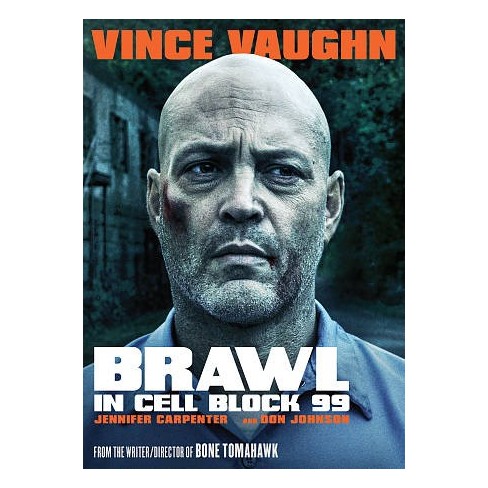
What to make of this film?  It starts off medium cool, with Vince Vaughn playing a rigid, introverted ex-addict and drug dealer trying to stay on the straight-and-arrow.  His temper is volcanic yet weirdly controlled – when he wants to kill his cheating wife (Jennifer Carpenter), he distances himself from her, maintaining an almost chivalric honoring of her being, and then dismantles her car with his bare hands.  He then comes into the house and they have a believably fruitful and mature discussion about where their relationship is headed.

When circumstances force him back into dealing, things go south, and he has to do a stretch in prison, leaving the pregnant Carpenter and their unborn daughter behind.  And then shit gets nuts, as the film shifts from sober prison fare to gonzo 70s grindhouse slaughter-fest.  Vaughn is transferred from a medium security facility, where he meets his mentor and  counselor in what threatens to be a film about his therapeutic journey from there on out, to a maximum security haunted house run by Don Johnson, a cheroot chewing warden straight out of the most lurid of comic books.

The dissonance is jarring, but it doesn’t turn you off.  You stay on the ride, happily, as it gets crazier and crazier.

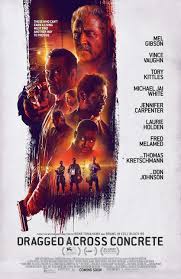
Vaughn is really quite good, but people forget that before he took on the comic galoot character, he was trotted out as a believable villain (Psycho, Domestic Disturbance).  He has done mainly straight drama of late, from the execrably written Season 2 of True Detective to the stock sergeant in Hacksaw Ridge to the recent Dragged Across Concrete (written and directed by the writer-director of this picture,  S. Craig Zahler).  Here, he’s in total command and damn chilling.

Zahler knows what he’s doing behind the camera, but one wonders – to what end? I hope he rises above his pulpy material before he gets lost in it.

Currently on Amazon.


Image result for Private life

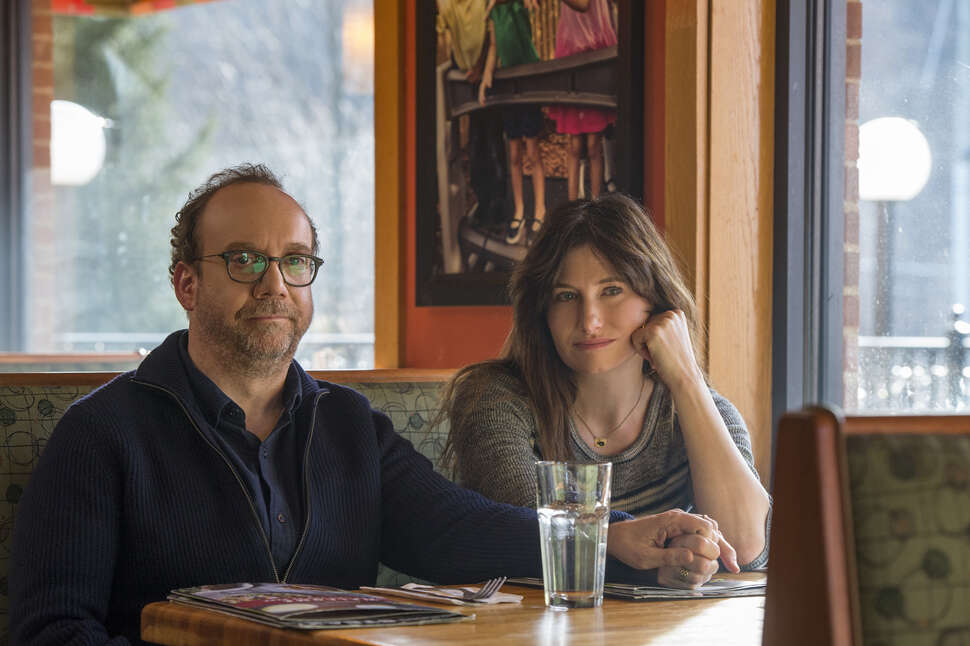
Writer-director Tamara Jenkins’ (The Savages, Slums of Beverly Hills) story of a driven couple (Kathryn Hahn and Paul Giamatti) struggling to have a child of their own is alternately heartbreaking and frustrating.  We see the two put through the wringer of in-vitro fertilization and surrogate scams, poked and prodded in clinics while investigated as to suitability for placement, and all of it voluntary,  a critical focus of the film, because rather than a “poor us” weeper, we see them as in many ways masochistic.

The couple is often unsympathetic, as their singular desire creates a fair amount of collateral damage.   They also suffer bouts of self-loathing as the fabric of their relationship is torn (a scene where Giamatti broaches whether he even wants a baby is piercing).  But when it gets bad for the two, Jenkins gives us a glimpse of who they were – and perhaps still can be – before their primal quest.

Eventually, the intercession of a sweet and guileless niece (Kayli Carter, who has the same commanding presence as Shailene Woodley in The Descendants and Jennifer Lawrence in Winter’s Bone) helps to remind them of the wages of their desperation.

Sometimes a tad talky and quaint, but for the most part, very strong.  On Netflix.

Image result for Operation Finale

Chris Weitz’s (About a Boy) largely faithful recreation of the capture of Adolph Eichmann is sober, competent and a little dull.  Peter Malkin (Oscar Isaac) is the focus of a several member Israeli infiltration team sent to grab Eichmann (Ben Kingsley) from Argentina and covertly spirit him away to Israel for trial.  All well and good, even if the film drags until they actually get to South America.  When on the ground, the film picks up, but there really isn’t much to the operation.  They jump Eichmann at night as he gets off his bus and keep him in a safe house, where his removal is delayed for several days, thus allowing Isaac (whose sister, niece and nephew were killed in the Holocaust, which we see in flashback) to engage the monster in an effort to get his signed consent to extradition.  The best part of the picture is Kingsley, who conveys Eichmann’s urbane precision and amorality in equal parts.  But there isn’t much to the exchange.   Isaac seems too much the professional to be flustered by the engagement, and Weitz is too cautious in the opportunity.

Perhaps sensing the film’s lethargy, Weitz adds a fictional Argo-like race to the airport, but it lacks any real punch.

A perfectly inoffensive picture.  Wait until it’s free and you have little in the way of alternative entertainment options


D63D4F6A-7EC1-493E-A2E0-52D923FCE904

I had the misfortune of catching half of Cate Blanchett’s fun, sumptuous and engaging Elizabeth recently. The comparison makes this turdfest even more unbearable.

Sairose Ronan is fiery, wild eyed, and indignant as Mary Queen of Scots, perpetually perturbed and always speechifying.  Margot Robbie is her nemesis Elizabeth, but Robbie appears way out her depth. She acts like she’s in a high school production.

The performances, however, are the least of this picture’s woes.

The script is charmless and dull. Intrigue has no deftness. People just argue briefly, declare and then act.

The lone battle scene is so badly handled, you don’t know what the hell is happening.  It presents like kids playing war in the backyard.

The script is also obsessed with its feminist hot take, particularly with Mary, who is put-upon by a man’s world and way ahead of the curve.  Mary’s ladies in waiting are like The View, and Mary is forced to rape her homosexual husband (very unconvincingly) to have an heir.  John Knox inveighs against Mary, not because she was a Catholic, but because she was a damnable woman who enjoyed sins of the flesh (he calls her “whore of Babylon”, “strumpet” and “harlot” in one speech).  We even get to see Mary menstruate.

Elizabeth gets in on the act as well, hectoring her male advisors with “we could do well worse” than Mary as queen and bemoaning Mary’s fate with “How cruel men are.”

Girl power, apparently, trumps Power power.

Indeed, when they eventually meet, there is no enmity. Just a couple of gals dishing on inequity, the glass ceiling and the unfairness of it all.

Until Mary gets wild-eyed and entitled and the girl power card loses its oomph.

Then, bitches get stitches and Mary is locked away, eventually to be beheaded.

The writer secures revenge in the post-script, however, lording Mary’s fertility over Elizabeth’s mere 44 year reign.

Modernity infects this dog in many other ways. When Mary’s gay attendant stops just short of breaking into a show tune, and pulls himself up short, the modern and reformed Catholic soothes him with a “be whoever you wish to be with us” (when he sleeps with Mary’s husband, kneels before her and begs for forgiveness, she soothes him again – “you have not betrayed your nature”).  Before battle, she assures one of her Protestant soldiers that should they die, they will all see the same God.

Best line. “I will not become a lady Henry VIII dispensing husbands as he did wives.“

A massive bag of crap. And no fun!

1BE80664-A59C-438D-94BE-1558746C7053

Finally got a chance to see this. It’s bad. Green Book bad.

It starts as a mildly amusing, slick sit-comish comedy structured on a ridiculous premise – in the 1970s, black Colorado cop Ron Stallworth (John David Washington) calls the KKK to join up, and they are eager to have him, so after first contact, he has to use his white partner (Adam Driver) for face-to-face meetings, which creates unnecessarily close shaves.

Why not have Driver simply make the calls and handle the meets?

The answer is – wacky hijinx!  And there’s plenty of that.

Eventually, the funny gets less funny and the picture lapses into an absurdist procedural punctuated by overt, earnest philosophical discussions that would make kids in an Oberlin coffee house roll their eyes.  

Perhaps sensing the lightness of the fare and his own elapsing clock, Lee goes heavy at the end, utilizing actual footage from the Nazi rally in Charlottesville.  It’s like appending pictures of James Meredith’s shooting at the end of a poignant Different Strokes.

It’s a cheap ploy that seeks to elevate the zany caper that preceded it to serious statement.  Worse, as pointed out by Boots Riley, director of the infinitely better Sorry to Bother You, Lee’s film is based on a true story, and a less convenient aspect of that story might be that the real Stallworth was infiltrating black organizations to their detriment.

Ah well.  

You gotta’ give it to Lee, though. He knows his audience and he oversauced this goose good. Heck, he almost pulled it off. 

Alas, Oscar found another cheesy race fable to take home the gold. 

Curses!