Archive

5 stars

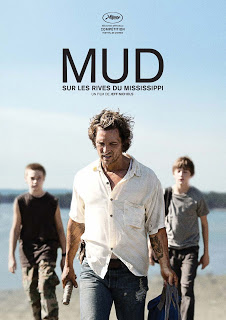
The excellence of writer/director Jeff Nichols’ Mud lies in its authenticity, confidence and reserve. As I watched this coming-of-age story about two boys, Ellis (Tye Sheridan) and Neckbone (Jacob Loffland), both of poorer Arkansas stock, and their involvement with a fugitive (Matthew McConaughey), I couldn’t shake what the film wasn’t – maudlin, simplistic or heavy-handed (i.e., like the template for so many “coming-of-age” stories about young boys, Stand by Me). While those two films have the Huck Finn story in their DNA, that’s where the comparison ends. Stand by Me needed a narrator to tell you what was of import and what was not in the adventures of their young male characters, and by the end of it, you felt thoroughly manipulated. Mud, however, requires no such crutch. The symbol of what is a man and father, what the divorce of his parents means to a boy, what young love is, and the heart of friendship, is depicted in a lifelike, piercing way. There is a wonderful scene where Loffland’s uncle, played by Michael Shannon, tries to impart some wisdom to Ellis, explaining in a deft but allegorical manner how Ellis needed to stay out of trouble and the nature of his responsibility to Neckbone, who is both a rock and a natural born follower. When Neckbone asks Ellis what they were talking about, Ellis shrugs and replies, “I don’t know.”

The performances are almost completely spot on, and Sheridan and Loffland should be shoo-ins for best actor and best supporting actor, but I’m certain they will be overlooked. That’s a shame, because they are at the ages where pure naturalism (for example, Quvenzhane Wallis in last year’s Beasts of the Southern Wild) cannot carry the day. These boys are making intuitive choices. Their interplay alone is mature and steady, and Sheridan’s scenes with a would-be girlfriend are heart wrenching. They will evoke your best friend from childhood, and you won’t need Richard Dreyfus intoning, “he was my best friend from childhood.”

McConaughey, who has bouts of phoning in roles with a quick smirk and a lazy drawl, delivers a much deeper performance here as the outlaw, desperate not only to escape the law but to reconnect with his true love (Reese Witherspoon). Nearly every other supporting character – from the rigid, recluse Sam Shepard to Ellis’s parents (Ray McKinnon and Sarah Paulsen), to Shannon (whose three scenes damn near steal the movie) – contributes in an effective, understated manner. If there is a weakness, it is Witherspoon, and she was not bad, she was just a little outclassed.

Nichols (Take Shelter) shoots the Mississippi River as a dream, and when the boys are on or traveling to and from the island where McConaughey is holed up, the feel is very Terence Malick. But when the boys are back home or amongst the townies, the look is bleached and tacky, further emphasizing the juice they get from their adventure.

Another kudo – when Hollywood deals with the non-urban, at its worst, you get a grotesque caricature, and at best, you merely get a sort of condescending ennobling, the hick version of “the magical negro” (usually wrapped up in a “you’re better than this place, Willie!”). There is none of that here. Instead, Nichols has written rounded, grounded, real characters.

It is perhaps unfair to use this picture as a club against Stand by Me. To the positive, it ranks up there with the equally excellent Sling Blade and One False Move and is thus far the best film of 2013.

I recently saw a filmumentary” on Jaws and realized I had not reviewed the greatest summer movie ever made, an astonishing, deep blend of adventure, terror, and action, communicated by Stephen Spielberg’s great eye, the deft casting of three disparate principal actors, and a John Williams score that evokes fear and exhilaration.

Spielberg at the advent of Jaws was hardly a wunderkind. Like William Friedken before The French Connection, Spielberg had a pedestrian resume’ — a Columbo, a few TV movies and an okay feature (Sugarland Express). With a production plagued by everything from the mechanical failures of the shark to the tax problems of star Robert Shaw (if he spent more than a certain amount of time in the U.S. he would face a tax liability, so he was flown to Canada on his days off), Spielberg took Peter Benchley’s piece of summer pulp and fashioned a moving, ingenious film, evident from the opening scene credits, which give us a shark’s point of view in what is the still and peaceful deep, an image followed by the jarring, horrifying massacre of the shark’s first victim, alone, at night, where none of us ever want to be.

Like Friedken in The Exorcist, who prefaces the introduction of the demon in the child only after an hour of exposition, Spielberg waits quite some time to show us the shark in full, making what is happening beneath the water all the more frightening. Indeed, when we see the second fatality (a little boy on a raft), it is from the vantage point of a beachcomber lazing in his chair, a brief, violent act that immediately makes the viewer question, “what the hell was that?”

After Spielberg stuns the audience, he introduces them to poor Chief Brody (Roy Scheider), a landlubber from New York who marshals for the summer town of Amity, As the bodies pile up, it is Brody who succumbs to the pressure of the townsfolk dependent on summer dollars, only to be shamed by his malleability. Emboldened and in need of reclamation, Brody is assisted by the articulate and passionate wisecracker, oceanographer Matt Hooper (Richard Dreyfus) and old salt Quint (Robert Shaw). The former wants the scientific find of the century, the latter is a modern Ahab, seeking his white whale, as explained in the famous scene written not by screenwriters Benchley and Carl Gottlieb (a comic writer who presumably penned some of the very funny exchanges in the picture) , but John Milius (writer of Dirty Harry, Apocalypse Now and creator of HBO’s fantastic Rome).

The experience of the three men from their separate vantage points, with their different motives and backgrounds, is the fuel of this picture, not the shark. As good as Milius’ Indianapolis speech is, or Shaw’s monologue to the town leaders opened by his nails on a chalkboard, the scene where Shaw’s grit runs up against Dreyfus’s privilege and Scheider’s quiet authority is better:

                                     HOOPER
                         You’re going to need an extra hand…

               Quint turns to see this new voice, and starts walking towards
               him.

                                     BRODY
                         This is Matt Hooper…

                                     QUINT
                         I know who he is…

                                     BRODY
                         He’s from the Oceanographic Institute.

                                     HOOPER
                         I’ve been to sea since I was 12.

                         I’ve crewed three Trans-pacs —

                                     QUINT
                         Transplants?

                                     HOOPER
                         — and an America’s Cup Trials…

                                     QUINT
                         I’m not talking about day sailing or

                         pleasure boating. I’m talking about
                         working for a living. Sharking.

                                     HOOPER
                         And I’m not talking about hooking

                         some poor dogfish or sand shark. I’m
                         talking about a Great White.

                                     QUINT
                         Are you now. I know about porkers in

                         the water —
                              (throws him some rope)
                         Here. Tie me a sheepshank.

               Hooper ties the knot effortlessly.

                                     HOOPER
                         I don’t need to pass basic seamanship.

                                     QUINT
                         Let me see your hands…

               He takes Hooper’s hands in his own big bloody fists, and
               feels them as he talks.

                                     QUINT
                         Ha. City hands. You been counting

                         money. If you had a $5000 net and
                         $2000 worth of fish in it, and along
                         comes Mr. White, and makes it look
                         like a kiddy scissors class has gone
                         to work on it and made paper dolls.
                         If you’d ever worked for a living,
                         you’d know what that means.

                                     HOOPER
                         Look, I don’t need to hear any of

                         this working class hero crap. Some
                         party boat skipper who’s killed a
                         few sharks…

                                     BRODY
                              (interrupting)

                         Hey. Knock it off. I don’t want to
                         have to listen to this while we’re
                         out there…

                                     QUINT
                         What do you mean ‘We…?’

                                     BRODY
                         It’s my charter. My party.

                                     QUINT
                         All right, Commissioner. But when

                         we’re on my ship, I am Master, Mate
                         and Pilot. And I want him…
                              (indicates Hooper)
                         …along for ballast.

                                     BRODY
                         You got it.

During shooting, Shaw rode Dreyfus very hard, making fun of everything from his star status, stature and his ethnicity.  Any hostility was used to great effect on-screen.

As good as these three actors are, they are more than ably supported by Lorraine Gary (as Brody’s wife), Murray Hamilton (as the oily mayor) and a boatload of locals who lend the film a great air of authenticity.  Again, kudos to the script, because it allows dignity for Hamilton in the aftermath of his grave error, when, shaken at the hospital, he says to Brody, “Martin . . . my kids were in that water too.”

Finally, Williams’ score is a mixture of dread and adventure, the simplicity of dark repetition (“duh, nuh . . duh, nuh . . . dun dun dun dun dun dun dun”) followed by a near-swashbuckling romp as the men seek their quarry.

I never tire of this film and always find some new marvel or nuance when I watch it.  If only the Hollywood shit that is shoveled in summer these days could sport 1/10 of the chops of Jaws, the town wouldn’t be losing its shirt.

Image result for Assassination of Jesse James

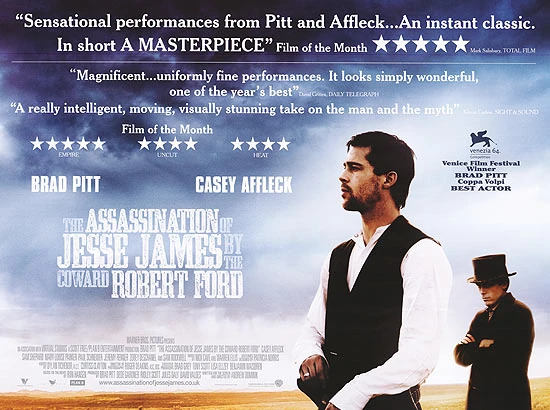
Andrew Dominic’s moody, elegiac picture melds Terence Malick’s imagery from Days of Heaven and Walter Hill’s sense of time in The Long Riders. As Ford, Casey Affleck is mesmerizing, and Brad Pitt’s depiction of James as a manic-depressive sociopath is chilling. Their performances are enhanced by Dominic’s sweeping, beautiful vistas (the film drew an Oscar nod for best cinematography) and a mournful score courtesy of Nick Cave and Warren Ellis.

A $30 million western without a single shootout (at least, one involving Jesse James) is destined to make a mere $3 million back domestic, but this film is more about hero worship, fame-seeking and insecurity than the violent exploits of the James gang. Affleck, who was nominated for best supporting actor, subtly communicates living in the shadow of Jesse James, traversing the path from awe for a legend, to anger over his idol’s coldness and indifference, to maturation and resolve as James becomes more suspicious, mercurial and dangerous. Ford’s likening of himself to James in the great killer’s presence, which can be found below, is startling in its honesty and vulnerability.

Affleck and Pitt receive strong support, including Jeremy Renner and Paul Schneider as feuding gang members, but as ever, Sam Rockwell near steals the picture as Charlie Ford, playing dumb but in truth, whipsmart and canny. Garret Dilahunt (Deadwood) is also resonant as a doomed and dim Ed Miller.

Upon first review, I wrote, “a glaring fault is an unnecessary voice over narrative, the voice being similar to that of David McCullough. The effect is redundancy and a PBS/History Channel vibe.”  I also gently criticized the picture on its length.  I recently saw it again and I was wrong on both counts.  The voice over is not obtrusive nor is it merely aping what is happening on screen.  Rather, it enhances the film’s tragic nature (this is a ghostly western and a movie about one of the first celebrity screw-ups) with an explanation as to how it fits historically and personally.  And I was sorry to see it end no matter how long it ran.

This is a unique, accomplished period piece.

Unbreakable (2000) - IMDb
It is a testament to M. Night Shyamalan’s clout after The Sixth Sense that he could get such a deliberate and meditative film made. Bruce Willis is a Philadelphia security guard, an ex-jock in a crumbling marriage with Robin Wright. His son is overly attached to him, sensing in his father something special and perhaps dangerous. After Willis emerges from a horrific train wreck as the sole survivor, with nary a scratch, the son’s suspicions are confirmed by the appearance of a comic book aficionado (Samuel L. Jackson) who leads Willis to a great revelation. It’s an old movie, but to discuss it further substantively would be an injustice. Before Shyamalan became a slave to big twists and reveals that became increasingly ridiculous, from aliens who invade earth but for whom water is acid (Signs) to an eco-counterattack where trees make people commit suicide (The Happening), he could deliver some truly effective codas, and Unbreakable contains my favorite.

Great ending aside, the story is original and sophisticated, Shyamalan’s Philly locales are lovingly chosen and spooky, Willis is the perfect choice for a regular Joe who soon learns he is anything but, and Jackson projects brilliant obsession. The penultimate scene, where Willis tests his new incarnation, is one of the more frightening I’ve ever seen.

The studio and Shyamalan had to have been disappointed by the latter’s sophomore effort. While it did very well overseas, its domestic gross exceeded budget by only $15 million compared to The Sixth Sense‘s $250 million. But Shyamalan had to know that such a painstaking, personal film would not garner an expanding mass audience, even if the studio didn’t.

Silver Linings Playbook,' Directed by David O. Russell - The New York Times

David O. Russell (Three Kings, The Fighter) has written and directed a special drama/romance, made all the better by a flawless ensemble. Bradley Cooper is just out of an 8 month court ordered stint in a psychiatric ward after having found his wife in the shower with her lover and beating the hell out of the former. Cooper is also bipolar. Under police supervision and ensconced in the Philadelphia home of his OCD, Philadelphia Eagle fanatic, bookie father (Robert De Niro) and supportive mother (Jackie Weaver), Cooper plots his way back into his wife’s heart, enlisting the help of a neighbor (Jennifer Lawrence) who has a few not insubstantial psychiatric and familial problems of her own. Unfortunately, he does this while forswearing the medications that will keep him on an even keel.

The film seamlessly portrays the pressure and effect of mental illness on a family with the Herculean effort of love and commitment it takes to manage it. Intertwined is a beautiful, engaging love story.

Cooper is rightly nominated for Best Actor. His performance is riveting, and no easy feat.  He presents a character plagued by demons, trying to hold them back, while leveling off to actually grow. As I walked out of the theater, my estimation of Cooper as merely a more electric Ryan Reynolds was erased, and Daniel Day Lewis’s turn as Lincoln seemed humdrum in comparison.

Jennifer Lawrence, also nominated, also wows. She is wounded and in crisis, and as she reaches for Cooper, her desperation and need are palpable. De Niro, who I wrongly suspected might have been nominated for best supporting actor as a nod to his overall body of work, is touchingly desperate as a father who carries his own mental disability as well as the weight of failing his son. Last, but certainly not least, the film’s fourth nominee Jackie Weaver plays Cooper’s mother lovingly while communicating the weariness of someone who has been required to hold a tenuous family together. The rest of the cast is also very funny, especially a portly Chris Tucker, who plays a patient from the psychiatric ward with a penchant for self-furlough.

This is a tough film to make. Mental illness does not lend itself either to yuks or romance, and without Russell’s deft hand, it could easily have been offensive, pat and/or schmaltzy. Cooper’s outbursts are funny, but that is because he’s a funny character whose disability has removed his filter. But Russell does not sugarcoat the illness, and when Cooper is manic, we are scared for him and those around him. Lawrence is also hard, mercurial and often tough to take, and normally, she would have been the whore with a heart of gold. In fact, her damage requires Cooper’s strength and the two share a strong chemistry.

To be able to construct a sweet, original romance from such stuff is both an achievement and a damning indictment of almost all romantic comedies/dramedies that have so little to say about people. This is the best movie of the year.

Zero Dark Thirty True Story: Everything The Movie Changed & Left Out

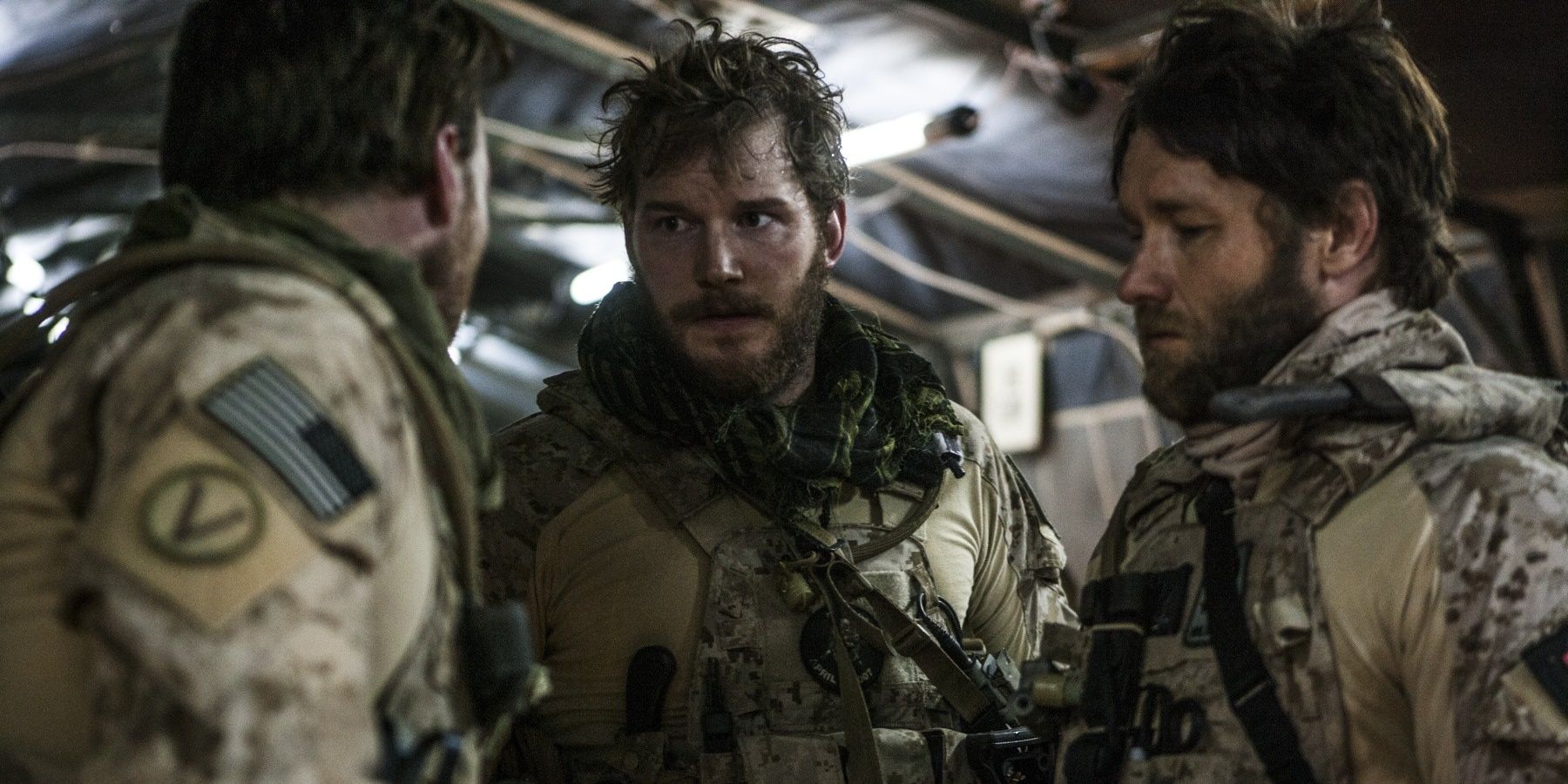
In The Hurt Locker, Kathryn Bigelow exhibited an expert feel for the milieu of a bomb disposal team in early post-Saddam Iraq. While her depiction of the mechanics of the team was the subject of debate, the desolation and immediacy of her scenarios was spot on, evoking the overburdened and overwhelmed sensibility of better-equipped invading/liberating armies since the time of the Romans. What kept The Hurt Locker from being a great film was the simplistic protagonist, Jeremy Renner, a danger freak and little more, with whom we were required to spend too much time.

In Zero Dark Thirty, Bigelow again utilizes a simplistic heroine, CIA officer Jessica Chastain, whose entire persona is a relentless “get bin Laden” zeal. Fortunately, the story Bigelow is telling is an intricate intelligence bureaucracy procedural and Chastain is progressively morphed from the driver of the story to an observer. To her credit, she remains disciplined and does not stray from the confines of her role. Chastain is emblematic of the effort and the desire to fight al Qaeda and eliminate its leader, and the film has refreshingly little interest in what makes her tick, her relationship with men, etc . . . the story is quite enough. This film is much like United 93, authentic, thoughtful, and gripping, even though we know the end.

Two other aspects make this picture extraordinary. First, it deals with politics in a subtle yet effective manner, opening with a clutter of 911 calls on 9-11, which creates the urgency necessary to begin the story, and acknowledging certain political realities (the failure of the CIA on WMD, the changing domestic political tenor on enhanced interrogation, and the Obama administration’s moves with regard to same) without gettng bogged down in their import or advocating for any particular position.

Second, of some controversy, Bigelow shows torture.  Torture assuredly occurred and was also assuredly of value in the war against al Qaeda. Just ask new National Security Advisor John Brennan: “There has been a lot of information that has come out from these interrogation procedures that the agency has in fact used against the real hard-core terrorists. It has saved lives.” The histrionic attacks on Bigelow’s film because it merely shows torture demonstrate the exact false and forced narrative that Zero Dark Thirty eschews. It is depressing that Bigelow had to actually say, “”Experts disagree sharply on the facts and particulars of the intelligence hunt, and doubtlessly that debate will continue. As for what I personally believe, which has been the subject of inquiries, accusations and speculation, I think Usama bin Laden was found due to ingenious detective work. Torture was, however, as we all know, employed in the early years of the hunt. That doesn’t mean it was the key to finding bin Laden. It means it is a part of the story we couldn’t ignore.”

Bigelow’s statement is echoed by Mark Bowden, author of Black Hawk Down: “Torture may be morally wrong, and it may not be the best way to obtain information from detainees, but it played a role in America’s messy, decade-long pursuit of Osama bin Laden, and Zero Dark Thirty is right to portray that fact.”

Juxtapose the statements of Bigelow and Bowden with the criticism of actor and activist David Clennon (“Torture is an appalling crime under any circumstances. ‘Zero’ never acknowledges that torture is immoral and criminal”) and you have the difference between Zero Dark Thirty and the spate of shit message movies that Hollywood churns out every year to show us the right path. The Clennons are terrified. By showing that torture may have gotten certain results, sweet Lord Almighty, we have endorsed torture, which we cannot hope to condemn unless we show it was a masochistic folly of absolutely no intelligence value.

Perhaps we can delete the great line where one interrogator tells Chastain to be careful because the domestic political winds are shifting and she doesn’t want to be “the last one holding a dog collar” and substitute it with, “you know, upon reflection, this stuff we’ve been doing . . . It’s just morally wrong and maybe even criminal.”

Writer/director Martin McDonagh’s first feature is assured, intelligent, and deviously funny.  Two Brit hitmen, Ken and Ray (Brendan Gleeson and Colin Farrell) are exiled to Bruges in Belgium by their crime boss Harry (Ralph Fiennes) after Farrell cocks up his first job (a priest) and accidentally kills an altar boy.  What starts as a languorous wait, with Gleeson fascinated by the history of the town and Farrell bored to tears, becomes tense and edgy after Gleeson is given his next assignment (guess who?) and Farrell becomes more and more despondent over what he has done.  The duo sightsee, drink, do drugs and discuss morality, fate, death, religion, Americans, beer and various and sundry other topics until Fiennes comes to town to force the action.

The three leads are all very good.  Fiennes is a brutal yet charming Cockney, and Gleeson is a stoic solider on the brink of a moral epiphany.  But Farrell’s frenetic, comic-yet-tortured turn is the engine.  He’s barely a man, he’s killed a child, and he is denied any peace, having been placed in “bloody Bruges.”

A taste —

Wes Anderson’s breakout picture centers on Max Fischer (Jason Schwartzman), a sort-of prodigy, son of a barber on scholarship at the tony Rushmore Academy. Rushmore is Fischer’s domain. Not academically but in every extracurricular activity (he is President, Model UN; Founder, Bombardment
Society; Founder, Rushmore Beekeepers; Founder, Max Fischer Players; and Director, Piper Cub Club – 4.5 hours logged, to name a few).

It is natural that Max would claim the winning new teacher (Olivia Williams) as his first love. Fischer, however, finds himself in competition for her affections, first with the rich, dissolute father of
two bratty classmates, Herman Blume (Bill Murray) and then with the ghost of Wiiliams’s dead husband. Max can defeat neither, finds himself expelled, and must rise anew to atone for his selfishness and stupidity.

Following up on the promise of his debut (Bottle Rocket), Anderson made a picture quite unlike anything before it, a blend of the fables of boyhood, the adult cynicism that follows, a beautiful romance, and the tragedy of loss (Williams’ has lost a husband, Fischer his mother), all scored by
British invasion B sides. As with this year’s Moonrise Kingdom, Anderson revels in the adult as child and vice versa. The result is charming and wistful, but also heartfelt. There is something both clever and moving in exchanges where Max is earnest and Blume dry:

Max Fischer: So you were in Vietnam?

Herman Blume: Yeah.

Max Fischer: Were you in the shit?

Herman Blume: Yeah, I was in the shit.

There are numerous bravura scenes, all sharply written (the screenplay was the work of Anderson and Owen Wilson).  Fischer’s first “date” with Williams (he invites Murray as cover and Williams actually brings a real date, Luke Wilson) is an exemplar of Anderson’s melding of the comic and pathos.

Murray’s brief speech to the students of Rushmore is also noteworthy.

You guys have it real easy. I never had it like this where I grew up. But I send my kids here because the fact is you go to one of the best schools in the country: Rushmore. Now, for some of you it doesn’t matter. You were born rich and you’re going to stay rich. But here’s my advice to the rest of you: Take dead aim on the rich boys. Get them in the crosshairs and take them down. Just remember, they can buy anything but they can’t buy backbone. Don’t let them forget it. Thank you.

I also don’t think I’ve ever seen a better-scored film (Scorsese’s Casino, with the extended “Can’t You Hear Me Knocking” is close). Anderson originally wanted the entire soundtrack comprised of Kinks songs, but Mark Mothersbaugh of Devo chose a variety of classic-sounding, if not classic,
tunes. The effect is nostalgiac but a little unfamiliar, which tracks nicely with the whimsical, sometime sad story. “I Am Waiting” by The Rolling Stones is an example of an early, lesser know track where Jagger’s vocals are not confrontational and modern, but almost earlier century chamber music ala’ “Lady Jane.”  Anderson uses this track in a brilliant changing of seasons montage.  “A Summer Song” by Chad & Jeremy, “The Wind” by Cat Stevens, and “Oh Yoko!” by John Lennon are used in similar, successful fashion.

It’s may seem strange to call this an important film, but it really is.  With it, Anderson emerged on the scene as a unique storyteller.  When he showed the film to Pauline Kael, she loved it but told him, “I genuinely don’t know what to make of this movie” which strikes me as the highest of praise.  It is one of my favorite films.

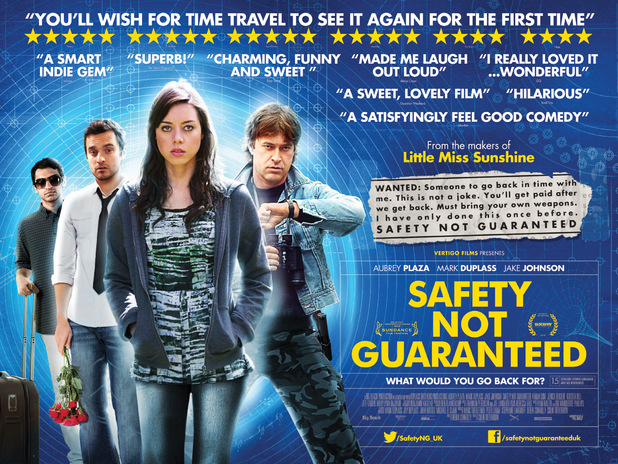
What are the chances I’d see two Mark Duplass movies back-to-back much less one I’d rate a 0 and one I’d rate a 5?  This is a sweet, whipsmart picture about three Seattle magazine employees – two interns (Aubrey Plaza and Karan Soni) and a writer (Jake Johnson) – who go to Northern California to do a piece on a guy (Duplass) who put out an ad to go back in time, looking for a companion.  The writer took the job solely to nail an old high school girlfriend he found on Facebook (Jeneca Bergere).  Plaza is along for the ride and Soni, a geeky Indian techie, only took the internship to round out his resume’.  Plaza becomes intrigued by Duplass, Johnson falls for his target, and it turns out time travel may be possible.

This is a dual story between four people looking to connect.  Duplass bonds with Plaza while Johnson and Soni engage in a mentor-mentee dance.  Best, what seems a goof assignment to write an ironic, hip piece on a quirky dude masks a couple of crises of conscience, place and purpose.

Everybody is excellent, but Johnson is particularly strong as an urban scammer who uses the story as a cover to hook up with a high school flame and realizes how empty he feels in the arms of a real woman.  She asks what he’s doing, he responds that he has an Escalade, she clarifies “no, I meant with your life” and he responds “I just told you.”

When she puts up her guard, points out the error of his idealization, and his fairy tale collapses, he runs to Soni and screams in the geek’s face to get off the Internet, away from his safety bubble and live a life.  Johnson’s character is emblematic of the maturity of the writing.  Normally, he’s the dick, the full-of-himself comic relief.  As a character, it’s an honorable job, ala’ Bradley Cooper in Wedding Crashers.  But Johnson (and really, all the characters) are given more depth in an economical fashion, making a very funny movie poignant and multi-layered.  One of the best films of the year.

It is in vogue to denigrate Will Ferrell, whose excess has long outlived its freshness. He’s slogged into one tiresome, repetitive project after another. Land of the Lost? A one-man show portrayal of George W Bush, The Other Guys, Casa di mi Padre, The Campaign, and soon, a repeat, Anchorman: The Legend Continues. His forays into a successful Jim Carrey-like branch-off started with promise (Stranger than Fiction) but his dramatic weaknesses were apparent in Everything Must Go. His last goofy semi-triumph was Step Brothers, which owed as much to the supporting efforts of the scene-stealing, diabolical Adam Scott and the inspired premise as to Ferrell’s adolescent sincerity as the arrested man-child, Brennan Huff.

Let us not forget, however, that when Ferrell was on a roll, it was an impressive one – Old School, Elf, Anchorman, Wedding Crashers . . . all a variation on the man-child theme, but classics nonetheless.

At the end of Ferrell’s run is Talladega Nights, the last hurrah, but what a hurrah.  Ferrell plays Ricky Bobby, an ignorant, flashy, uber-American NASCAR driver with a hot blonde wife (Leslie Bibb), a loyal race car compadre (John C. Reilly) who loves Ricky so much he happily takes second in every race, two horrific kids (Walker and Texas Ranger) and a gay French nemesis on the track (Sacha Baron Cohen). When Ricky is on top, it looks something like this:

When it all goes to crap after a brutal wreck, Ricky must re-connect with the itinerant father who abandoned him as a child (Gary Cole) and his old-school mother (Jane Lynch). With their help, and the help of a loyal, starstruck flunky (Amy Adams), Ricky regains his mojo and lives the VH1 comeback before our eyes.

The gags are inspired, the back-and-forth (much of which has to be improv, as evidenced by the bloopers in the credits) crackles, almost every supporting character delivers well (Molly Shannon as the boozehound wife of a corporate slime is particularly prime), and the chemistry between Ferrell and Reilly, which was very good in Step Brothers, is undeniable. After Ricky loses his nerve and then all, Cal replaces him, setting up in Ricky’s house and with his wife. But they do miss each other:

It’s uproarious, loaded with gem slogans (“If you ain’t first, you’re last”) and has as much fun as you can have with American excess. Even as silly an endeavor as this could have come off condescending and mean to “those NASCAR types” but Talladega Nights feels wholly respectful even as it goes to town on its target.