Archive

5 stars

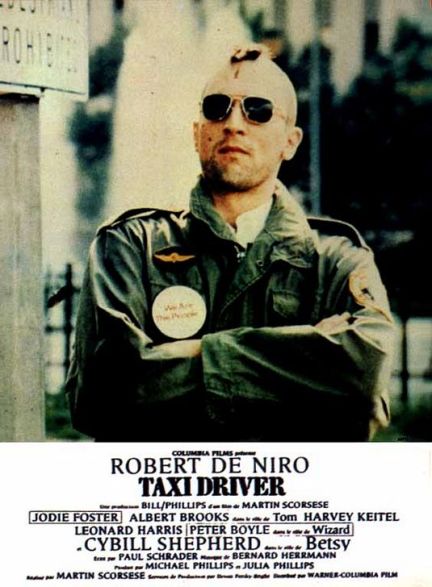
I was surprised to see several things in my recent re-viewing of Martin Scorsese’s classic, including Albert Brooks as the exact same character he has been playing for nearly 40 years; Scorsese himself making a Hitchcockian appearance in the background, but then taking a significant one-scene role as a lunatic in the back of Travis Bickle’s (Robert DeNiro) cab, suggesting he changed his mind about how much time he would spend in front of the camera; and the effectiveness of the score, which was Bernard Herrmann’s last one.

That aside, it holds up as the classic it is considered (47 on AFI’s Top 100). Scorsese’s New York is a modern hell.  He shoots the city so it almost reeks. Steam pulses out of the grates, rot is everywhere and kindness is non-existent (I couldn’t get a fantastic book, “Ladies and Gentlemen, the Bronx is Burning” out of my mind).  The viewer is immediately in kinship with Bickle’s voiceover, “All the animals come out at night – whores, skunk pussies, buggers, queens, fairies, dopers, junkies, sick, venal. Someday a real rain will come and wash all this scum off the streets.” Bickle is a Vietnam vet who can’t sleep and teeters on the edge of sanity. When he falls for a campaign worker (Cybill Shepherd) merely by viewing her through a plate glass window, it seems creepy only until he approaches her, and then there is charm and hope. He is similarly touching with teen prostitute Iris (Jodie Foster), passionately replying to her taunt that he is a square: “Hey, I’m not square, you’re the one that’s square. You’re full of shit, man. What are you talking about? You walk out with those fuckin’ creeps and low-lifes and degenerates out on the streets and you sell your little pussy for peanuts? For some low-life pimp who stands in the hall? And I’m square? You’re the one that’s square, man. I don’t go screwing fuck with a bunch of killers and junkies like you do. You call that bein’ hip? What world are you from?”

But they are from the same world. Bickle is not wired right, he sabotages himself with Shepherd, and soon, he retreats into the mode of a dangerous and unstable assassin, one who has gone from observer of the inferno to an extinguisher. Ahead of its time, Bickle’s would-be John Hinckley gets a Bernie Goetz makeover, cementing Scorsese’s theme that in the jungle, there’s often but a hair between hero and lunatic, moral beacon and dysfunctional threat. Woody Allen’s Blue Jasmine doesn’t seem a natural comparison to Taxi Driver, but in essence, when it ends with Cate Blanchett in rumpled clothes, talking to herself in the park, the directors are exposing the same reality.

The Silence of the Lambs - July 11th, 2020 at Lefty's Drive In!

My son is headed off with his pals to see The Silence of the Lambs tonight, courtesy of AMC theaters’ occasional screenings of older films. I saw it with him a few weeks back and I think he’s looking forward to watching it again in the theater as much as witnessing the reaction of his friends.

Jonathan Demme’s masterpiece is one of the few films that focuses on the serial killer but doesn’t give way to excess. What we know about Hannibal Lecter (Anthony Hopkins) is simple: he is locked up for eating people; he is brilliant and fascinating; and he is lethal. When a serial killer, Buffalo Bill (Ted Levine) starts to plague the Ohio, Pennsylvania, West Virginia area, FBI profiler Jack Crawford (Scott Glen) sends a trainee, Clarice Starling (Jodie Foster), to elicit any advice from Lecter. Starling and Lecter use each other for their own ends, engaging in a thrilling psychological dance that is one part therapy and one part mental combat; she seeks to stop Buffalo Bill while he waits for a slip-up.

The Silence of the Lambs is so well-paced and taut that on occasion, you are near-breathless. There is only one pause in the film’s very serious, unrelenting tone (when Starling is “hit on” by two geek entomologists with whom she is consulting). The pressure is not only from Lecter and Buffalo Bill, but from Starling’s lack of experience, harrowing childhood, and even her gender and diminutive physicality.  The odds seem uncomfortably stacked against her.

The exchanges between Hopkins and Foster are electrifying. You can see just how dangerous Lecter is and near curse yourself for being charmed by him. Yet, you root for the seemingly overmatched Starling, and when she stumbles, you feel the sting of her awkwardness. When Lecter so easily assesses her background and her sexual desires, it is excruciating. Yet Starling comes up to speed and achieves a plausible parity.  Levine is also expert as the tortured, frightening Buffalo Bill, and his transformation to “normal” when he is questioned is a chilling addition to this “monsters among us” story.

The picture is one of only three to win Academy Awards in all the top five categories: Best Picture, Best Actor, Best Actress, Best Director, and Best Writing (Adapted Screenplay), and deservedly so.

There simply hasn’t been a better satire since . . . well, since South Park: Bigger, Longer and Uncut. Matt Stone and Trey Parker carve up American idiocies and icons, and as is their custom, they fear no maven of political correctness nor do they take the easy shot. Of course, they do that sort of thing regularly on South Park, but not with puppets, and not with Broadway-worthy anthems. Offensive on almost every level, from the hilarious spoof of Rent (Lease) and its signature song (“Everybody has AIDS!”) to the jingoistic, red-white-and-blue power chordy

Casting marionette Alec Baldwin as not only the greatest actor ever, but also the head of a subversive Film Actors Guild (yes, F.A.G.) is genius, and if you’ve ever wanted to see the coterie of noxious celebrity dunces portrayed as members of a S.P.E.C.T.R.E.-like organization, only to get their comeuppances in the form of horrifically violent deaths (as marionettes, mind you), you’re in for a special treat.

Susan Sarandon is particularly good:

Apparently, Sean Penn was offended, but Sean Penn was offended when Chris Rock poked fun at Jude Law during the Oscars.

Be warned.  If you supported the ouster of Baldwin from MSNBC because of his homophobic broadsides against paparazzi, or you were hurt and dismayed when that woman on MSNBC made fun of the Mitt Romney family photo, or Rush Limbaugh’s broadsides against just about anyone furrow your brow and get you thinking about “positive action” or “inclusion” and “dialogue”, or the recent South Park where the boys cannot comprehend that anyone would name a psychological condition “Assburgers” made you think, “Where is the FCC in all of this to protect the children?”, this is not the film for you.

Or, it’s a necessity.

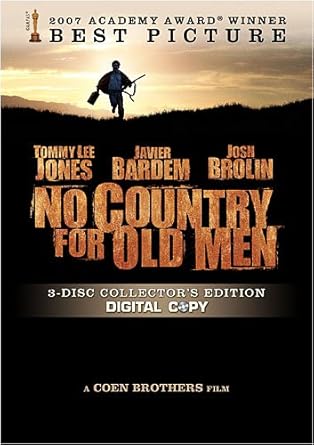
The Coen brothers’ finest film, a gritty, nerve-wracking crime story and an existential horror movie set in the harsh and desperate environs of dusty, bleak Texas.  Josh Brolin takes the wrong money from the wrong drug dealers, victims of a cocaine buy gone bad, after he happens upon their slaughtered bodies while hunting.  Javier Bardem is dispatched by the higher-ups to get it back, killing most everyone he encounters along the way (including rival bounty hunters sent by his employer).  The pacing is taut, the terror near-asphyxiating.   But interwoven in the story is a sense of generational disconnect, rot and the utter bewilderment of an older generation at the brutality and senseless violence of the new.  An observation from a friend is also spot on: “I thought the most important theme in the movie was that older men gradually lose contact with their country, and that this sad fact has nothing to do with the objective reality of what’s happening but is the natural consequence of getting older.”

Set in 1980, the young are depicted as callous and corrupt.  Brolin, shot and desperate to get to Mexico, encounters kids on the border bridge returning to the U.S. after a night of carousing.  He offers to buy a shirt from one of the trio to cover his bleeding, but they quickly demand money, and when he asks for a beer, they want more.  Similarly, at the end of the film, two boys encounter a wounded Bardem and bicker over the share of what he has given them for a shirt.

The Vietnam generation is represented by Brolin and Woody Harrelson, the latter sent to bring Brolin in before Bardem gets to him.  Brolin is not exactly honorable but he still maintains a tie to some principles.  He literally awakes with guilt because he can’t let a dying drug dealer go to his end without water, and it is that charity that brings Bardem his way.  Harrelson, also a Vietnam vet, has a similarly flexible code (he is a killer), but at least there is some code there.  As he says to Brolin about Bardem: “You can’t make a deal with him.  Let me say it again.  Even if you gave him the money he’d still kill you.  There’s no one alive on this planet that’s had even a cross word with him.  They’re all dead.  These are not good odds.  He’s a peculiar man.  You could even say that he has principles.”  When Brolin returns from Mexico, still hobbled but intent on stopping Bardem, a border guard lets him through on the strength of Brolin’s Vietnam service.

Then, there are the old men for whom there is no longer a country.  Tommy Lee Jones and his law enforcement contemporaries just don’t get it.  It’s all gone to hell and a hand basket and while they understand violence, they don’t understand the new violence.  As Jones says, bewildered, reading the paper: “Here last week they found this couple out in California they would rent out rooms to old people and then kill em and bury em in the yard and cash their social security checks.  They’d torture them first, I don’t know why.  Maybe their television set was broke. And this went on until, and here I quote… ‘Neighbors were alerted when a man ran from the premises wearing only a dog collar.’ You can’t make up such a thing as that. I dare you to even try.”

It is not Jones’ world anymore (my favorite Jones musing was from Cormac McCarthy’s book – “She kept on, kept on. Finally told me, said: I don’t like the way this country is headed.  I want my granddaughter to be able to have an abortion.  And I said well ma’am I dont think you got any worries about the way the country is headed.  The way I see it goin’ I dont have much doubt but what she’ll be able to have an abortion.  I’m goin’ to say that not only will she be able to have an abortion, she’ll be able to have you put to sleep.  Which pretty much ended the conversation”).

The film ends with Jones driven to retirement, talking to other older lawmen about what it all means:

Roscoe: It’s all the goddamned money, Ed Tom. The money and the drugs. It’s just goddamned beyond everything. What is it mean? What is it leading to?

Jones: Yes.

Roscoe: If you’d a told me twenty years ago I’d see children walkin the streets of our Texas towns with green hair and bones in their noses I just flat out wouldn’t of believed you.

Jones: Signs and wonders. But I think once you stop hearin’ sir and madam the rest is soon to follow.

Roscoe: It’s the tide. It’s the dismal tide. It is not the one thing.

And the end of the film, Jones has retired (he’s done, “overmatched,” he says) and he sits with an older retired lawman, Barry Corbin, who observes, “All the time you spend tryin to get back what’s been took from you there’s more goin’ out the door.  After a while you just try and get a tourniquet on it.”

And the coda:

Corbin: You’re discouraged.

Jones: I’m… discouraged.

Corbin: You can’t stop what’s comin.  Ain’t all waitin’ on you.

Bardem is what is waiting on us all. Certain, unstoppable, arbitrary death.

This is a beautiful, unrelenting movie, deservedly winning Oscars for best picture and supporting actor for Bardem.

Enough Said is an engaging, touching semi-romantic comedy for adults in the target market of 40 to 60. The trials of Julia Louis-Dreyfus, a middle aged masseuse, do not include keeping the sex drive hot with the advent of a new baby, or struggling with the fact that all of her friends are married while she is not. Rather, she is divorced, working, plagued by her daughter’s move from LA to NY for college, and the hunt for a man has been reduced to a mere occasional flare. But she meets a man, and his ex-wife, and develops a romance with the former and a friendship with the latter, initially ignorant of their connection. She is soon wise and makes the calamitous decision to use intelligence gathered from the ex-wife to evaluate her new partner.

Enough Said is a beautiful epitaph for James Gandolfini as the love interest, who plays a portly middle-age loner in angst over the departure of his own daughter to college with a subtlety and nuance that may well have freed him from the shackles of Tony Soprano once and for all (the Lord works in mysterious ways, and there is no greater example than having Enough Said released after The Incredible Burt Wonderstone).

Louis-Dreyfus is also impressive. There is no questioning her comedic chops (HBO’s Veep shows how effortless she moves in that milieu), but here, she draws deeper, and slowly reveals repressed fear and insecurity. Not in the paroxysm of a self-revelatory banner speech or after undergoing the withering but “true” dressing down of a gal pal in the penultimate act, but in ascending scenes of awkwardness, comfort, quiet resignation as to her actions toward Gandolfini, and then need.

The film also handles secondary characters with maturity. They err and recover, but we are not let off the hook by cartoonish villains or easy marks. This is a bit of a departure for writer-director Nicole Holofcener (Lovely and Amazing, Friends with Money), who was previously very tough on her protagonists and supporting characters in a manner that bordered on condescending. Still, in Friends with Money, Holofcener zeroed in on the casual iciness of an outwardly happy marriage between Catherine Keener and Jason Isaacs and her skill depicting the dynamics of couples has not eroded.

One of the, if not the best film of the year.

Rear Window, or the World's Scariest Bottle Episode – Scriptophobic

I just engaged in a donnybrook of a discussion with a few friends over this film, the primary contention being what it was actually about. It was the kind of exchange only the participants could enjoy, but the spirited debate about the film and Hitchock in general led me to re-watch Rear Window this weekend.

Jimmy Stewart is an adventurous photographer who has a broken leg (but he got the shot of the crashing motor car before it hit him). Cooped up in his New York City apartment, he spends the time peeping on his neighbors across the way (he has a splendid view of their windows and courtyards), and in the process, he begins to suspect one (Raymond Burr) of murdering his wife. He enlists his socialite girlfriend (Grace Kelly), whose marriage entreaties he is fending off, in his investigation, leading to a thrilling conclusion.

The film succeeds on three levels. First, it is a witty comedy, with sharp exchanges between Stewart (the confirmed bachelor and super snooper) and Kelly, as well as Stewart’s health care attendant, the brusque Thelma Ritter. The women are pro-marriage and anti-peeping. As these discussions develop, Stewart enlists them in his monitoring of Burr, and thereby, Kelly “proves” herself to Stewart as something more than a rich, pampered girl. At its best, it plays like a David Ogden Stewart or Ruth Gordon battle of the sexes script.

It is also a love story, initially very light, but when Kelly is in harm’s way, Stewart evinces true passion. Stewart has been lampooned so often (“Zu Zu’s petals!”) that one forgets his ability to communicate depth of emotion, but before those petals, there was his haunting breakdown in Martini’s bar. Also, given the 21 year age disparity, it is surprising Stewart and Kelly manage chemistry, but it’s there.  Indeed, the insane idea of rejecting Grace Kelly is made more comprehensible by Stewart’s cranky maturity.

Finally, this is a meticulous thriller with a few dark overtones. Stewart peeps as a lark, but soon, he is obsessed and a little ashamed.  He sheepishly admits to Kelly that they’re viewing “pretty private stuff going on out there.”  She retorts, “We’re two of the most frightening ghouls I’ve ever known.”  And what they see is generally pretty depressing: a suicidal Ms. Lonelyhearts, a composer in despair, newlyweds from shine to routine. And, of course, a killer, nagged by his wife and driven to extremes. It’s not a happy place, as is shown by one neighbor whose dog, sniffing in the wrong garden, meets an untimely end.

I’ll end with the thoughts of someone more distinguished, David Thomson, from his book The Moment of Psycho: How Alfred Hitchcock Taught America to Love Murder:

Hitchcock knew that a system locked into watching and seeing can misread its surroundings and can even lose its identity and ordinary human sympathies because of the pressure of voyeurism. The voyeurism is so heavy, so forceful, it can smother real human nature. Psycho is the conclusion to a set of films beginning with Rear Window, and for me that is Hitchcock’s best film in that the smile of satisfaction at the end covers without hiding the loneliness that affects real people. Rear Window is a romance, a comedy and a thriller, but a portrait of alienation too. The apartments and windows are screens, of course, but they are traps, or cells – in that entire courtyard no one seems to “know” anyone else; neighborliness has not been invented.

This BBC 5 part mini-series is a taut crime story, lovingly detailed, and anchored by a powerful, understated Gillian Anderson performance. A serial killer is loose on the streets of modern day Belfast and he is targeting professional women of a particular physical type, who he tracks, monitors and then strangles in an elaborate, almost artistic ritual. Stella Gibson (Anderson) is brought in from London to perform a review. When the killer strikes again, she is assigned the case.

This is not a whodunit, as we are introduced to the killer in the first few moments. Instead, The Fall is a meticulous police procedural with a distinct take on Belfast.  Be it the ways of a tough neighborhood, the politics of the investigation or specifics of a crime scene, the feel is assured and authentic.  The characters are also very strong, in particular, the killer (Jamie Dornan).  While he is in no way sympathetic, he is unique in that we see him not only planning and executing his gruesome acts, but as a seemingly loving father and husband, and a conscientious civil servant (of all things, he is a grief counselor). 

The Fall was created by Alan Cubitt, who has credentials as a writer for the Helen Mirren series, Prime Suspect, and at first blush, Anderson’s Gibson and Mirren’s Jane Tennyson have some similarities. They are both Detective Chief Inspectors in a male-dominated profession and they both do not have a significant male others. There is where the similarity ends, as Gibson is in a new environment (the last Prime Suspect was almost a decade ago), one that is more friendly to women, but also one where male expectations and bias evince themselves in a subtler fashion. Anderson’s Gibson is also clearly more reserved and in-control than Mirren’s Tennyson, who was rock-solid on-the-job, but more vulnerable in her private life. Gibson is not vulnerable at all, but she is not brittle or overtly righteous. In many ways, she is a “first” for a female police lead, as male as any officer, certainly stronger and smarter than most, and emotionally detached without lapsing into copycat or bitch. When a married detective with whom she has casually slept with is investigated, and she is questioned as to the liaison in a manner different than a man would endure, she suffers the double-standard with a certain patience before matter-of-factly telling the investigator that the detective’s wife was her lover’s problem, not hers. She also has somewhat of a sexual kink. Not Clint Eastwood in Tightrope kinky, but a kink nonetheless, a true rarity for a female lead.

It’s a great character and Anderson has left a lot to develop.    BBC Two has renewed the series for a second season and I hope Gibson becomes the next Jane Tennyson, who carried us through 7 Prime Suspects.

Available on Netflix streaming.


John Woo is an action hack, a Chinese director of minor renown who came to America and never looked back, making several big concept explosion-fests, like Broken Arrow, Mission Impossible II, Windtalkers (a Pacific theater World War II film that looks as if it was filmed in the Hollywood Hills) and Paycheck, which was once thought to be the coda to Ben Affleck’s career. You can only lose people so much money before you get benched, and Woo’s Windtalker‘s had a worldwide gross of $70 million on a budget of $115 million. Paycheck merely broke even domestically and appears to have signalled the end of the line for Woo.

But Woo left something for us, a ridiculous, giddy gem, to show that he had come to America and contributed. Face/Off stars Nicholas Cage as master terrorist Castor Troy. John Travolta is his Javert, Agent Sean Archer. Archer catches Troy, and puts him in a coma, which is fair play given that Troy murdered Archer’s young son. But Troy planted a bomb somewhere in LA before sleeping his deep sleep, and only Troy’s brother Pollox (Alessandra Nivola) knows the location of the bomb.

What to do?

Well, you surgically remove the face of Castor Troy, put it on Sean Archer, Archer goes into the super-max prison where Pollox is housed and elicits the whereabouts of the explosive. Duh.

Except, when Archer is in prison with Troy’s face, Troy wakes up from his coma, forces the doctors to give him Archer’s face, kills everyone who knows about the whole “face/off” plan, keeps Archer in prison, and then reinstates “date night” with Archer’s wife (Joan Allen).

Furious, Archer escapes prison, and then . . . slo-motion doves:

This is an absurd, dizzying, very funny movie, tailor-made for two of the greatest over-actors of our generation. Great film. Road House great.

I would have given a great deal to have been at the studio screening of David Fincher’s Zodiac. I wonder who said first, “You mean, this movie is almost 3 hours and we never definitively learn whodunnit?”

The 1969-1970 Zodiac killings are unsolved and at least by serial killer standards, the Zodiac racked up a meager body count (only 5 victims are confirmed as by Zodiac’s hand).  Nonetheless, these narrative infirmities are more than compensated for by the killer’s panache.  Zodiac taunted the police departments of four different Northern California communities with letters to newspapers, including ciphers to be broken which promised to reveal his identity and wild threats (including one to shoot San Francisco kids as they left school buses). Like Jack the Ripper, the Zodiac wanted to lord his superiority over his pursuers.

Fincher takes the Zodiac case and uses it to dramatize exactly how such a crime burrows itself into the marrow of people, altering them profoundly. Jake Gyllenhaal is The San Francisco Chronicle cartoonist Robert Graysmith, who becomes obsessed with the killer the day his first letter to The Chronicle appears. Graysmith would eventually write the definitive book on the Zodiac, and as played by Gyllenhaal, he is sucked into the mystery to the near exclusion of all else. Robert Downey, Jr. plays Paul Avery, the Chronicle crime reporter who covered the case and received a threatening letter from the Zodiac. Avery had labeled the Zodiac a latent homosexual and the Zodiac wrote him a Halloween card warning, “You are doomed” (which resulted in the staff of The Chronicle creating buttons emblazoned with “I Am Not Paul Avery”).  Downey’s Avery is driven from The Chronicle, to drink and drugs and despair, exacerbated by his fear of the Zodiac. The two police officers assigned to the case are also damaged. William Armstrong (Anthony Edwards) eventually transfers to another division while Dave Toschi (Mark Ruffalo) is at one point accused of forging a Zodiac letter (he was cleared of all charges).  There are also the survivors. The Zodiac attacked 3 couples while they were alone and vulnerable, but two men survived, one of whom was the only living person to see the Zodiac. He is a shell, having escaped the country, found at the end of the film to provide one final clue.

The psychological study is encased in a meticulous yet accessible procedural. Screenwriter James Vanderbilt keeps myriad threads intertwined without sacrificing pace, no mean feat given a multi-jurisdictional crime reverberating in the worlds of the police and journalism.

Fincher re-creates those crimes in a manner that communicates their terror and the vulnerability of the victims without being sensationalist or gratuitous. Indeed, the most frightening scene is one where no violence is done. Five months after his last killing, the Zodiac killer pulled over a woman with her baby on a highway, letting her know her back tire was wobbly. He feigned assistance by tightening the lugnuts, but the wheel fell off immediately after she got back on the road. The killer came back, offered to bring her to a service station, but instead drove her around until she was able to escape into a nearby field with her baby (the connection to the Zodiac was made after he referenced the encounter in a letter to The Chronicle a few months later).

It’s hard to imagine that the director of the gruesome Seven made this picture, which is restrained, methodical and to my mind, infinitely scarier. Having to turn away and shut your mind off has less of an effect than when you cannot do so and you’re required to think.

This film has just recently been offered for streaming on Netflix so take advantage.