Archive

5 stars

image

American Sniper is a spellbinding war film. Clint Eastwood conveys the simplicity of patriotism, the horror of war and its psychological toll when it is concluded, and the ambiguity of heroism, all encapsulated in a riveting re-creation of combat during the second Iraq War.  Bradley Cooper is the perfect vessel for Eastwood’s tale. As sniper Chris Kyle, Cooper projects a forthright assuredness that, as he is tested, wears down, not in the expected emotional breakdown or the hackneyed apologia and rejection of values, but physically, in the narrowing of his eyes, the long stare, the suspicion with which he greets even the most unthreatening of domestic events. It’s a haunting, restrained performance, completely at odds with Cooper’s manic turns in Silver Linings Playbook and American Hustle, and beautifully in tune with Eastwood’s anti-war, yet very much a war movie (the combat sequences are expert; in particular, a closing battle that Eastwood makes cogent and gripping even though the combatants are enveloped in a sand storm).

The picture is one of the most successful of the year, predictably eliciting a tired cultural debate as to its politics and its accuracy. The film’s political offense can be found in its marrow. There is no defense of the Iraq War.  There is no suggestion that the endeavor was worthy or advisable and the events depicted suggest otherwise.  Kyle’s own brother, while shipping out, looks hollow, telling Kyle “fuck this place” and Kyle’s first kills are regrettably a child and his mother. Ty Burr’s conclusion that it is a “tragedy in which American certainty comes to grief against the rocks of the real world, and it views its central figure as a decent man doing indecent things for what he keeps telling himself is a greater good” is perfectly defensible.

But Kyle is a Texan from a churchgoing family. His father teaches him to hunt and to be violent in defense of those who are weaker. Kyle is called to duty by the terrorism of the 90s and beyond, and he builds the rapport of the soldier with his fellow Seals, with all the machismo, camaraderie and xenophobia that entails. He is a patriot, unyielding in his views toward his country and his fellow soldiers. And that is one noxious stew for certain quarters. Hence the sniggering of Seth Rogen, Michael Moore, and Bill Maher, comfortable in their condescension and elevated station. When Howard Dean (who did his Vietnam tour in the snows of Killington) attributed the film’s success to anger and the Tea Party, he conveyed two certainties: he had not seen the film but he had read and heard a lot about it from like minded folk.  When dolts aren’t taking potshots at the culture Eastwood presents, others decry its lack of context, nothing more than the idiocy directed at Zero Dark Thirty, which ostensibly failed because it omitted the Surgeon General’s warning, “Torture is bad and no valuable intel ever came from it.”

The other controversy has centered on the picture’s accuracy. In a year when Selma took flak for creation of an LBJ-Hoover conspiracy to get Martin Luther King, it’s fair to expose American Sniper to some rigor. But as Slate‘s Courtney Duckworth points out, while Kyle may have been a fabulist in other areas of his life (Kyle, who embraced celebrity, said he killed two carjackers in Texas, sniped looters during Hurricane Katrina, and punched Jesse Ventura in the face), “more than any other strategy, omission keeps the film true to life.” Generally, what Eastwood filmed was true to Kyle’s memoir, though that truth was often subject to standard massaging and embellishment (a cell phone call to his wife mid combat, creation of one bad guy and expanded dramatization of another).  The truth is incredible enough:  over 250 kills, and survival of four tours, three gunshot wounds, two helicopter crashes, six IED attacks and numerous surgeries.

Instead of training in on the accuracy of what Eastwood depicts, there seems to be an expectation that Kyle as blowhard should have been plumbed.  I’m not sure how that would have worked thematically, and it could really only be justified as a caution about the wartime events he wrote about.  I have not read anything that suggests Kyle’s telling of that part of his life is assailable, so it would be like injecting JFK’s serial adultery into a Cuban Missile Crisis flick – enjoyable for those prone to  dislike Kennedy but otherwise awkward and misplaced.
 

image

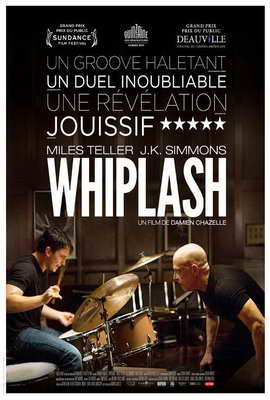
The best film in what has been a very strong year, writer-director Damien Chazell’s story of a 19-year-old jazz drummer (Miles Teller) and his relationship with his driven jazz teacher, played by J.K. Simmons, is flawlessly delivered and thought-provoking. Teller aspires to be the next Buddy Rich, and matriculates at the best music school in the country.  Simmons chooses him to join his ensemble, a stepping stone to greatness but also, an invitation to the meat grinder of abuse handed out by the demanding, mercurial instructor.

The story avoids every pitfall and expected plot turn of a feature film, yet it is not contrary for the sake of it. You can count on two hands the places a more pedestrian picture would take you, and the resolutions it would offer, but in service of a better narrative, Whiplash rejects the certainty of the tried and true, instead allowing the audience to come to their own conclusions.

The film is also about something, exploring the nature of greatness and what is necessary to achieve it; the limits of drive and the intersection of ego and cause; the meaning of teaching; and the changes and struggles between nature and nurture, raising children, molding character and demanding perfection. At one point, Simmons remarks, “There are no two words in the English language more harmful than good job,” and while that may play well to the instincts of some, he is such a flawed deliverer of the message, the audience is forced to question such an ethos knowing it will be practiced by such people.  I saw the film with my wife, my college-age daughter, and my high school-age son, and we talked about it – and I’m confident will continue to do so – for some time.

The film is evenhanded, a trait best represented in its depiction of minor characters. In a family dinner scene, Teller’s family, who appear casually condescending towards his achievements, are also perfectly decent, pushing back at his obnoxious “tortured artist” routine with annoyance but also concern and patience.  When Teller is approached by an attorney who represents a student allegedly harmed by Simmons’ practices, she does not lick her chops.

The picture is also stunningly confident, an achievement made even more impressive by its 19 day shooting schedule and $3.1 million budget.  Clint Eastwood released a film about music earlier this year, and he should have consulted Chazell about how to make Jersey Boys less static, less turgid. Whiplash is loaded with musical numbers played by stationary figures, but the camera riffs along with notes, constantly in motion, and like the art form it dramatizes, it is inventive and surprising.

I can’t commend the performances of Teller and Simmons enough.  They are both entirely natural and convincing, Teller conveying the conflicting hubris and hesitation of an ambitious yet shy young man, Simmons the grandiosity and brutality of the committed, brilliant instructor, inspiring one minute, petty the next.

Finally, Chazell has done something that is very rare in film. I suppose there are some folks who see Gladiator and think, “Hmmm. Roman history looks interesting. I might take a look into that.” But not many. Conversely, by his own depiction of the music, and the dramatization of love for it through the eyes of Teller and Simmons, I’m confident that many people who see Whiplash will one day look back at it as their entrée to jazz. That may be my enthusiasm for the picture talking (I’m not a jazz enthusiast myself), but I’m sticking with it.


There is trouble in the North Pole. Santa (Jim Broadbent) is listless and bored, barely phoning it in.  His oldest son and heir (Hugh Laurie) has digitized and corporatized Christmas, while his predecessor (Bill Nighy), retired, undermines him at every turn, dreaming of a return to glory.  His youngest son (James MacAvoy) has the spirit but lacks any discernible skill. When a gift from Santa goes undelivered, the fissures of this dysfunctional royal family emerge.

The computer animation is expert, the story enjoyable for kids and adults alike, and it’s even slyly subversive.  Santa Nighy is a misogynist, Laurie’s male elf assistant appears to have a crush on him, and the elves who man the North Pole have a denizen-of-Jonestown quality (so much so that the film threatens a mass elf suicide at the end).

I just saw this on the AFI big screen with Will and my nephew in from Spain, Julian.  A great holiday classic.

John McClain (Bruce Willis), a NYC cop who is flying to LA to spend some time with his kids over Christmas, drops by his estranged wife’s (Bonnie Bedelia) holiday party in the gleaming high-rise, Nakatomi Plaza.  Unfortunately, he arrives just when the party is crashed by a terrorist gang led by the slick and debonair Hans Gruber (Alan Rickman).  The terrorists had the perfect plan, but they did not foresee a rogue cop picking them off one by one.

When I first saw Die Hard, I was impressed such an efficient, commercial, cop-against-the world shoot ’em up could be so deft and clever.  Most contemporary blockbuster cop pictures were devoid of humor; featured laughable, deadly serious male leads spouting leaden dialogue and women relegated to looking 80s video hot; invariably starred Sylvester Stallone, Arnold Schwarzenegger or Steven Seagal; and sucked.  The only outliers were vehicles for established comedians (Beverly Hills Cop) or buddy pics (48 Hours and Lethal Weapon).

Willis, in his first big role, is winning.  When the terrorists strike, he is in his wife’s private office bathroom, shoeless and clad in pants and a wifebeater.  He’s vulnerable, put-upon and even giddy, and his charm is infectious.  He’s the perfect guide.

He’s assisted by an intricate, charming villain.  Rickman eschews stock heavy,  opting for an amused persona that hides a deeper ruthlessness :


The film also features numerous secondary characters who resonate even with limited screen time.  Reginald VelJohnson is the patrolman first on the scene and McClain’s link via walkie-talkie to the activities on the ground, with a tragic backstory of his own; Alexander Gudonov is the number 2 for the terrorists, infuriated because McCalin has killed his brother; Bedelia becomes the de facto leader of the hostages and has a few nifty exchanges with Rickman; and William Atherton (the haughty EPA investigator in Ghostbusters) is a convincing slimy television reporter.  Most notable is Hart Bochner, the coke-snorting LA cool cat who works for Bedelia.  I always thought Bochner would be a big star and the scene where he tries to “negotiate” McClain’s surrender damn near steals the picture.

Finally, Jeb Stuart’s writing is fresh, cynical and all the more surprising given this was his first picture.  Stuart writes for all characters, providing great, unobtrusive repartee.


It’s difficult to resist a dissipated, alcoholic, and profane Billy Bob Thornton as a Santa Claus who works department stores to crack their safes, especially when he meets an eternally cheerful but clueless grade schooler (Brett Kelly) left alone with his addled grandmother (Cloris Leachman) in their tony Arizona suburban ranch home.  In true Christmas spirit, Thornton discovers the boy is essentially alone and defenseless, moves right in, raids the liquor cabinet, and trysts with a slutty barkeep (Lauren Graham) who has a Santa fetish.

Santa is so bad he rips open the kid’s Advent calendar to get at some chocolates.  He pisses himself on the job.  He beats up children.  He engages in sodomy in the dressing rooms of the Big & Tall Women’s section of the department store.  He looks in the cherubic faces of all those blessed children who revere him and  . . . well, see for yourselves.

Is there redemption for Bad Santa? Kind of. But Thornton is a character who could endure three Dickensian ghosts and conclude, “Eh. Fuck ’em.”

Bad Santa is the ultimate anti-Christmas flick and a holiday favorite.  Thornton is brutally acerbic (especially when dealing with a host of bratty kids on his lap), Graham is indescribably hot, and John Ritter and Bernie Mac (as mall security and management) contribute significantly to the humor (Ritter’s repulsion/fascination with Bad Santa is inspired; what a loss he was).

image

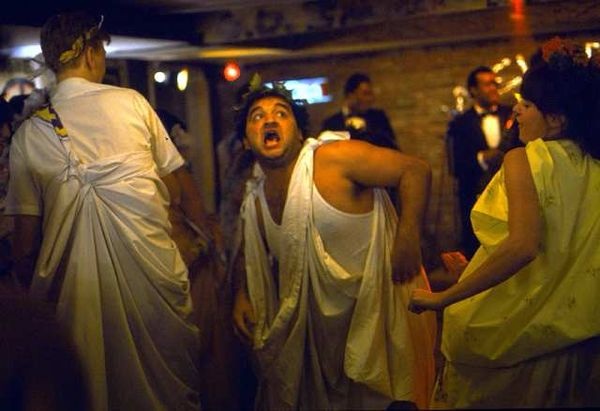
We were invited to the 50th birthday party of an old friend this weekend, and the theme was Animal House. In preparation of attending as Boon (Peter Riegert) and Katy (Karen Allen), my wife and I watched the movie to identify what they wore in the hopes of being identified as the characters. Our specific goal was delayed by our enjoyment of the movie, which neither of us had seen for twenty years or more.  It is sharply written, consistently inventive and enhanced by dozens of astute comic performances.  John Belushi’s physicality tends to get the lion’s share of accolades, but I’ve always been a bigger fan of Dean Wormer (John Vernon), who was chosen after Jack Webb turned the part down, and the pot-smoking Professor (Donald Sutherland), who took a $50,000 paycheck instead of the offer of 15% of the gross, a decision I’m certain haunts him to this day (the movie went on to gross $141 million).  His plaintive plea to his class is still one of my favorite moments of the movie:

Perhaps the greatest joy in these repressed, politically charged times is its dogged insistence on political incorrectness. Today, there would be a line of $46-an-article on-line ‘zine shitheads excoriating the film for its casual racism, sexism, insensitivity to the mentally disabled, and homophobia.   I can see the clickbait banners now:

“Animal House: The Genesis of the UVA Scandal”

“Nearly 40 Years Later, and We’re Still Laughing at Animal Cruelty”

“Animal House: A Frat Guy’s Birth of a Nation”

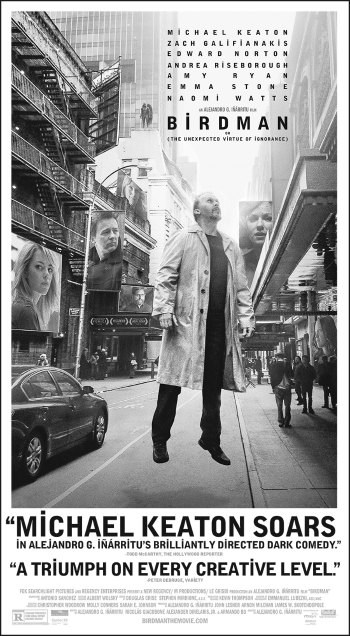
Birdman is so visually audacious you almost lose focus on its engrossing performances, cutting sense of humor and ambitious breadth. It is Rope on meth, tracking, almost hounding, with very few cuts, our tortured protagonist (Michael Keaton) in, through and around Broadway’s St. James Theater as he seeks to revive an acting career defined by his iconic role as a movie superhero. His fortune and name are on the line, and he is beset on all sides by family (fresh out of rehab daughter Emma Stone, ex-wife Amy Ryan), his jittery manager (Zack Galifianakis), his needy female co-stars (Andrea Riseborough, Naomi Watts), his antagonistic male co-star (Edward Norton) and a vicious and even more antagonistic New York Times reviewer (Lindsey Duncan).

One other character gives him some trouble as well.  His alter ego, who at first is a voice in his head but soon appears in person, telling him that all this stage acting bullshit is just that, he needs to get his ass back in a Birdman movie, and he must “shave off that pathetic goatee. Get some surgery. Sixty’s the new thirty, motherfucker!”

Director Alejandro Gonzalez Inarritu collaborated with three others on the play-within-a-play script, which is a satirical series of verbal jousts on the topics of sex, relationships, acting, the stage versus Hollywood, machismo, art versus commerce and the impact of social media.  The clashes between Keaton and Norton (sell-out v. artiste’) and Keaton and Duncan (the sell-out virus stinking up the hallowed stages of Broadway v. the Lord Protector of those stages) are particularly sharp, but the entire screenplay is chock full of gems.  My favorite is Keaton explain how he is holding up under the strain:  “”I’m broke, I’m not sleeping and this play keeps hitting me in the balls with a tiny little hammer.”

The frenetic, adrenaline rush style of the film heightens the tension (the cinematographer, Emmanuel Lubetzki, was the mastermind behind the dizzying tracking shot in Children of Men). The manic shooting makes the performances all the more impressive.  Keaton is superb.  His early trademark (ironically, before he became Batman) was a fevered, riffing style of acting, which could be spellbinding or just exhausting.  Older and more world-weary, Keaton internalizes his frenzy, struggling to bottle it in just as he struggles to keep Birdman at bay.  It’s a riveting turn.  Everyone else is excellent, and Norton deserves special mention.  As an actor with a history of being temperamental, Norton’s performance as a condescending, difficult, self-loathing actor is canny and knowing.  He damn near steals the film, which again, mirrors what is going on in the story.

Gonzalez Inarritu also gives the actors a great deal of space.  In Boogie Nights, Paul Thomas Anderson filmed a solid chunk of a drug deal going bad solely on the face of Mark Wahlberg.  The effect was powerful because in Wahlberg’s eyes, the audience could register the disaster unfolding before him.  Whenever I think of that classic film, I first remember that scene.  Of all the memorable parts of Birdman, there is a scene when Stone lashes out at her father, purposefully trying to hurt him.  In one of the few times the camera isn’t moving, Gonzalez Inarritu holds on Stone’s face as she delivers the cut and then as she sees its effect.  It’s a captivating moment in a film full of them.

Thus far, the best film I’ve seen all year.

image

In the vein of Carl Franklin’s One False Move, writer director Jeremy Saulnier has produced a moody, taut and earthy thriller that bleeds authenticity. Dwight (Macon Blair) is a seemingly harmless, homeless drifter who haunts a beach town in Delaware. He eats out of the boardwalk trash cans and his crimes are petty (he breaks and enters not to steal, but to take hot baths while the homeowners are away). Dwight is well known to the authorities, one of whom takes him aside and lets him know the killer of his parents has been released from prison in Virginia. This revelation sets in motion a chain of events that brings Dwight back home to confront the killer, and his family.

Saulnier shoots the eerie back roads of Virginia in a manner that accentuates Dwight’s foggy mental state. He seems almost enveloped by a mist of doom upon returning to his childhood home. Despite the haunting, dreamlike feel of the picture, Saulnier does not glamorize the violence, which is up-close, personal and jarring.  People panic, they miss their mark, they make unbelievably stupid mistakes, and they say things under duress that people under duress actually say.

The actors are true. Blair near carries the entire film (in a fair and just world, he’d be an Academy Award nominee). We meet him insulated by the cloud of his drifter life. When he is jerked back to grim reality, we see the dawning, and the depth of the anger he has been suppressing.  When he reunites with his sister (Amy Hargreaves), the familial anger is obviously shared, but we pointedly feel her ambivalence upon the return of her troubled brother. It’s as if she worked for years to form a scab which is ripped off the moment Dwight arrives.

Saulnier’s storytelling is such that you credibly piece together the events that led to Dwight’s fresh hell, and there is no predictable satisfaction from extraction of his revenge. Instead, both he and the audience come to realize this is a slow-moving clusterfuck of a car crash from the word go.

If none of this floats your boat, I have one more pitch:  Eve Plumb (of The Brady Bunch) makes an unexpected, terrifying appearance.

One of the better pictures of the year, a deserved 96% on rottentomatoes, available streaming on Netflix and all the more impressive when you know it was done for $425,000.

Image result for Babadook
Never let your child select his own book to read at bedtime, for he might select “Mr. Babadook.” This is a terrifically scary psychological thriller/haunted house yarn about a single mother (Essie Davis) pushed to the breaking point. Widowed seven years prior when a car accident took her husband’s life en route to the hospital to deliver her son, she’s not in a good place. The boy (Noah Wiseman) is uncontrollable during the day and plagued by monsters underneath his bed at night. He is, in short, a spoiled handful and a weird one at that. His peculiarity is driving his mother to the brink, and in the midst of this turmoil comes Mr. Babadook, a terrifying bogeyman.

Davis is sympathetic as she tries to resist the evil force that has taken advantage of her torment, and as has been proven time and again in scary films, from The Shining to The Sixth Sense to The Devil’s Backbone, the contribution of a gifted child actor greatly enhances the terror, as you see what unfolds through the child’s eyes. Wiseman is a brilliant mix of charming and brutally annoying, and while he evokes both compassion, you resent him, making the viewer complicit in unleashing Mr. Babadook.

This is writer/director Jennifer Kent’s first feature and it is assured and often iconic. There are images that stick hard with you, they are not solely the scary ones, and she doesn’t resort to gore (late night Australian television, which is playing a good portion of the film, is quite horrifying enough). While Kent owes a little to James Wan’s Insidious, she avoids his slickness and has a way of capturing what frightens even in the most mundane of settings. She merits a Hollywood project.

image

The film versions of Dennis Lehane’s books Mystic River and Gone Baby Gone are excellent, but they are mythic stories about the bonds of family in a criminal world. The Drop has no such sweep. It’s a small crime film about a Brooklyn bar and the little people (James Gandolfini and Tom Hardy) who run it for the Chechen mob. When the bar is used as a “drop bar” for the mob’s money, and it is robbed, the little people are thrust into a situation they are ill-equipped to handle.

I just saw Hardy as a meticulous Welsh construction manager dealing with his crumbling life in Locke, and he was immersed in the role. But when you bring foreigners to “New Yawk” (or Biloxi, for that matter), you run the risk of the mannered, cartoonish accent and swagger of Russell Crowe in Naked City. Forget foreigners. Even Mickey Rourke and Eric Roberts can succumb to the perils of “da’ street, and as anyone who has seen The Pope of Greenwich Village will attest, the sight is not pretty.

Not so with Hardy. He is comfortable with the character and the milieu and while it’s no stretch for Gandolfini to play the type, in his last role, Tony Soprano does not disappoint. Hardy is Gandolfini’s quiet second banana, either inscrutable or dim, but steady and loyal either way. As the out-of-their depth small-timers, Hardy and Gandolfini are ably supported by Noomi Rapace, the damaged local girl who binds with Hardy over an abused pit bull left in her trash can (the dog is so cute as to be unnerving; his fate becomes almost too paramount and you spend an inordinate amount of time asking, “Where’s the damn dog?”).

As good as these actors are, Matthias Schoenaerts steals the film as Rapace’s ex-boyfriend, a local hood looking to capitalize on the heist. He presents the perfect mix for a villain; terrifying, intriguing and just a little sympathetic, although you can’t put your finger on why. It’s a great performance that should be recognized come Oscar time. There is no chance that will occur.

This is Michael Roskam’s first American film, and the Belgian exhibits everything you want a new filmmaker to show. It is understated, assured in its pace, taut, organic and comfortable with the quiet moments.  Roskam feels no need to amp the action or to bolster the emotional connection between the characters. He lets the audience fill in the gaps, resulting in very poignant moments between Hardy and Gandolfini and a compelling love story between Hardy and Rapace, even though they don’t so much as kiss.

One of the best films of the year.