Archive

1 star


This biopic of Alfred Hitchcock’s making of Psycho attempts to juggle three stories:  the strain on the relationship between the director (Anthony Hopkins) and his wife (Helen Mirren), Hitchcock’s own perverse infatuations with his leading ladies, present and former (Scarlett Johannson as Janet Leigh and Jessica Biel as Vera Miles), and the actual making of the movie, with its unsettling, revolutionary ties to the Ed Gein murders.  Each of these threads is presented in a tepid and/or listless manner.

Hopkins and Mirren are quite good, but the script gives Hitch little to do but mope about his wife’s inattention, and Mirren’s near-dalliance with another writer (Danny Huston) is a bit uncomfortable.  Either the 68 year old Mirren, or Alma Hitchcock (she was 60 at the time of the making of Psycho) are too old for the communication of unquenched sexual urges necessary for the role.

As for Hitchcock’s own urges, the film cops out.  The director is shown as a peeping tom, and any darker heart is reflected only by his silly imagined conversations with Gein.  Leigh and Miles commiserate a bit on the director’s peculiarities, but nothing particularly upsetting is revealed, and neither actress is capable of delivering some deeper psychic injury or fear.  At best, they cluck, “oh, be careful.  You know old Hitch.” Given the director’s very disturbing behavior prior to, during and after Psycho, the wispy treatment seems cowardly. But even if the filmmakers were reluctant to travel that dark path, they missed many other opportunities to illuminate the eccentricities of the director. The lore has it that Leigh and Hitchcock were both unhappy with John Gavin’s work in his love scene with the former, and that Hitchcock instructed her to “take matters in her own hands” to amp up the passion. Yet this gem of a vignette is left out?

Finally, there is the risky making of Psycho, a film Hitchcock bankrolled himself when the studio became leery over the subject matter.  Hitchcock is ostensibly based on Alfred Hitchcock and the Making of Psycho by Stephen Rebello. which I have not read but hope is more interesting than was portrayed in the film.  The making of the film is characterized as worrisome at times. The director’s financial stress is shown, and he pouts when his wife is away, but that’s about it. Nothing of Hitchcock’s craft is developed, and some of the hurdles, such as the fight with the censors over the shower scene, are played mainly for laughs. So much is missed.

Take Rebello in a 2010 interview:

But she is killed in the shower in the novel. In fact, Hitchcock told many people that he was most attracted by Bloch’s notion of a murder coming out of the blue in an everyday, confined setting—the shower, where we feel relaxed and complacent but where we’re utterly vulnerable.  Hitchcock was thrilled with the idea of shocking audiences by casting a major star as the heroine and killing her off so early in the picture. That violated every Hollywood rule. Bloch’s heroine has her head cut off in the shower, not exactly the kind of thing that even Hitchcock could have gotten away with, even if he had been tempted. Bates in the novel is middle-aged, pudgy, alcoholic, brooding, unattractive, repugnant. He also has extensive conversations with his mother, which would have been fatal and a cheat on film. Casting Anthony Perkins was a lucky masterstroke; he’s as charming, attractive, sad, perverse, and lethal as earlier Hitchcock killers like the one Joseph Cotten played in Shadow of a Doubt and Robert Walker played in Strangers on a Train. Perkins had already worked with top directors like William Wyler, Anthony Mann, and Stanley Kramer, and Paramount had spent lots of money promoting him as a successor to the late James Dean or comparing him to the young James Stewart or Henry Fonda. Although he had become a teen idol and even made some hit records, things hadn’t quite clicked and, at the time, Perkins felt typecast and owed Paramount a movie. Hitchcock could hire him inexpensively. It was a perfect storm.”

There is so much here, but the film merely gives us Hitchcock cackling at killing Leigh early and the tut-tutting over the ghastly plot, with Alma disapproving, the powers that be huffing “You can’t do that!” and Hitch gleeful as the bad little boy.

One added point.  As noted, Johannson and Biel are pedestrian, but they aren’t the only ones.  The bullying studio head is played in embarrassingly broad fashion by Richard Portnoy, James D’Arcy’s Anthony Perkins is an impression rather than an embodiment, and Ralph Macchio is unfortunately unearthed for a short scene as the writer, Joseph Stefano.  The Karate Kid is not missed.  And I can watch Robocop only so often to remove the taste of yet another Kurtwood Smith uptight authority figure performance.

At the end, you’re left with a damning question – why make this picture?  It does little to communicate Hitchcock’s demons or his genius, it meanders and plays it safe, an unfortunate testament for a cinematic trailblazer. One that should not have been delegated to director Sacha Gervasi, whose resume’ is anchored by his 2008 documentary of a Canadian metal band, Anvil: the Story of Anvil.

Related image

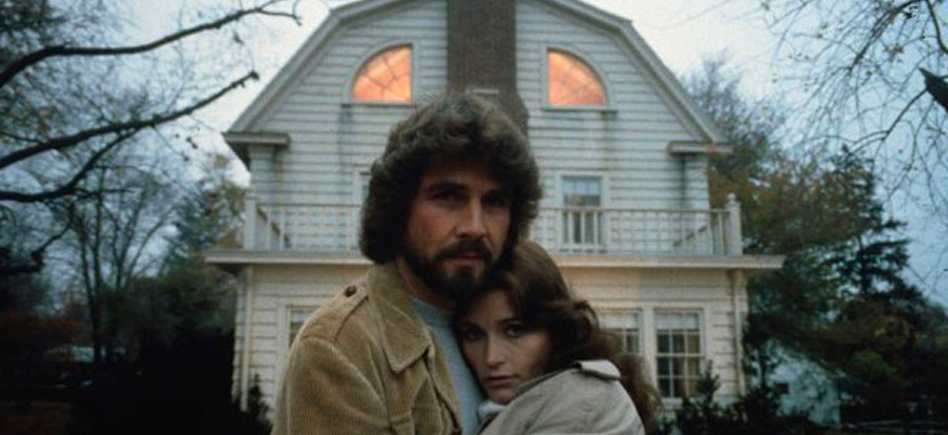
Often listed as a top picture in the horror genre, this 1979 release is rather dull and clunky.  Based on a “true” story that is decidedly untrue, the Lutz’s (James Brolin and Margot Kidder) move into a cheap dream house in Long Island knowing full well a 20 year old murdered his entire family there the year before. When their local priest, Rod Steiger, comes to bless the house, the demons therein drive him out and eventually, blind him. The house soon possesses Brolin, and Kidder (and her three children) are endangered.

The house itself is awfully creepy and the score features a chilling sing-songy ghostly whisper of children’s voices.  But Brolin is flat and ridiculously coiffed, even for 1979, Kidder is uninvolved, the children may as well have been mannequins, and Steiger overacts the hell out of his role.

Performances aside, the movie just isn’t that scary. Sure, flies congregate, the walls bleed, creepy eyes shine in the window, and there appears to be a guy dressed as the devil behind a wall in the basement, but these features come off about as frightening as a decently prepared house on Halloween. Director Stuart Rosenberg, who helmed some interesting films (Cool Hand Luke, The Drowning Pool) is clearly uncomfortable with the genre, and apart from some disturbing externals of the house, offers very little visually. It’s a blocky, uninteresting picture, and the ending (Brolin goes back for the dog!) is ridiculous, though not as ridiculous as when locals tell Brolin he is the spitting image of the 20 year old killer.

No 20 year old killer looks like this:
Image result for Amityville horror

Search Results for gangs of new york GIFs on GIPHY | Gangs of new york,  Leonardo dicaprio, Gang

Martin Scorsese’s sprawling, excessive period piece, set in The Five Points of Civil War era New York City, is almost punishing in its immoderation. A directionless Leonardo DiCaprio works his way up the ladder of nativist gang chieftain Bill “the Butcher” Cutting (Daniel Day Lewis) to avenge the death of his father, Liam Neeson, who died at Cutting’s hand when DiCaprio was a boy. Scorsese sought to offer a steamy, vibrant and bloody portrait of the slum that was lower central Manhattan, but the feel is inauthentic and verisimilitude is overcome by the garish. The opening scene – the gang fight resulting in Neeson’s death – plays as a mash up of Walter Hill’s The Warriors and a really violent version of West Side Story. You almost expect Neeson to sing, “The Dead Rabbits are gonna’ get their way, toniiiiiight!” as he brings his crew to battle.

If only. The story is deathly dull, duller even than the featured Cameron Diaz, horribly miscast as an Irish lassie/grifter (her accent comes and goes like the viewer’s interest).

Day Lewis’s performance is widely lauded and he was nominated for a best actor Oscar, but he is so over-the-top as to appear foolish. Still, scene-chewing is bound to garner easy accolades, and Day Lewis is voracious. More surprising are the nominations of the phlegmatic script and Scorsese’s aimless helming. The film meanders, half-heartedly committing to DiCaprio’s vengeance but then veering into historical re-creation, such as the machinations of Boss Tweed and the draft riots. The former plot line is marred by DiCaprio’s sullen, disinterested performance, the latter by pat conclusions (including a pretentious morphing of old and new Manhattan that closes the film and nearly induces the gag reflex).

By the time Gangs of New York was released, Scorsese had suffered the indignities of having his classic Raging Bull lose to the tepid Ordinary People and Goodfellas go down to the overpraised and politically acceptable Dances with Wolves and certainly, the Academy felt bad about that. But guilt is a bad adviser, and this is Scorsese’s worst film (though the dull and similarly overpraised Hugo and the bruising Shutter Island are close seconds).

An ingenious concept undone by a tedious pace, a dull heroine, an indecisive tone, and a cheezy feel.

First, the concept. The world is post-apocalyptic and zombies mill about, waiting to eat human brains. One twist – when they eat the brains, they get a rush of the memories of the prior owner. Our protagonist. Nicolas Hoult (About a Boy, X-Men: First Class) eats the brains of Dave Franco (brother to James), fiance’ to Teresa Palmer, and immediately falls in love with Palmer.  So, he saves Palmer’s life and an unlikely romance ensues. So far, so good.

Palmer, clearly an acolyte of the Kristen Stewart school of acting, makes no impression. She’s all smarm and attitude and lacks any depth necessary for material deeper than Glee. It may seem like niggling but it is not, because she has to convey that she has fallen for a zombie. She doesn’t come close.

With Palmer failing to communicate a romance, what is left is the scary.  It is not scary, at all, and the use of CGI skeletors – really evil zombies who have lost all their flesh – suggests the old stop motion visual effects of the Harry Hamlin Clash of the Titans – and not in a good way.

Since it is not scary, it should be funny. After all, talk about your clash of cultures. But it is only occasionally amusing. Hoult, whose speaking is necessarily rudimentary, mainly mumbles and moons at Palmer. While he is given a voiceover to explain what he feels and sees, the observances are pedestrian.

The picture looks just awful – again, not in a good way. The post-apocalyptic world looks more like a Meadowlands dump, the encampment where the humans are holding out looks like the porn set of a parody (Dawn of the Head? apologies)*, and in comparison to Zombieland or even The Walking Dead, the feel just seems chintzy.

It’s also deathly slow. At only 90 minutes, I started to feel like the zombies themselves, numb and mindlessly staring at the TV, waiting desperately for something to chew on.

*  I made that up, but I shouldn’t have had to.

Behind the Candelabra (2013) - Rotten Tomatoes

This is Steven Soderbergh’s last picture? A flimsy, small biopic about a kitschy figure (Michael Douglas as Liberace) and his boy toy (Matt Damon as Scott Thorson), arguing over dog poop in the mansion, plastic surgery and the fact that Thorson won’t agree to be on the receiving end in sex? There is no insight, Liberace’s fear of being outed is without nuance, and Soderbergh doesn’t have any fun with the Vegas excess, so the film fails as a character study and as a mindless guilty pleasure, ala’ Mommy Dearest. At its best, it is a decent VH1 “Behind the Music” as Thorson’s descent progresses. Mainly, it is clumsy and pedestrian and really disappointing when we realize this is Thorson’s story (Liberace is the reasonable one pretty much throughout).

Douglas has some strong moments, especially during his last visit with Thorson as he lay dying of AIDS, but Damon is way past “boy” much less “toy” (Thorson met Liberace when has was 17 and stayed with him until he was in his mid 20s) and he is unconvincing.

This is the filmic equivalent of Bjorn Borg’s comeback and the subject matter is Soderbergh’s wooden racket.

This 1974 documentary is devoid of voicever narrative, alternating between footage of the Vietnam War, news footage of the era, anti-communist propaganda documentary clips, movie clips, and interviews with ordinary American citizens, Vietnamese villagers, American soldiers and policymakers.  The thrust of the documentary is that the conflict was precipitated by a racist, warrior society (high school football being an engine of the former malady), a hysterical fear of communism, and a hubristic, imperial policy.  It is skillful, affecting and pernicious, simplifying a complicated reality with editing that feels deceptively selective.  Worse, because it is comprised of raw footage and heartfelt interviews, it presents as an honest portrayal.  As Roger Ebert noted, “Here is a documentary about Vietnam that doesn’t really level with us … If we know something about how footage is obtained and how editing can make points, it sometimes looks like propaganda … And yet, in scene after scene, the raw material itself is so devastating that it brushes the tricks aside.”

An example: interviews with American bombers, where we never hear the documentarians, but it is clear the answers of the fliers have been elicited by questions about the experience, followed by footage of Vietnamese peasants, who are asked to recount the effect.  I imagine most viewers would deem this strategy hunky dory, but the effect is to create an easy falsity-our boys dig on the need for speed and the kick-ass of it all, encased in their imperialistic manned drones, while the carnage below them escapes their notice.  Indeed, I saw this storyline on an episode of M*A*S*H.

Another: the treatment of the policymaker interviewees.  The anti-war Senator Fullbright and Daniel Ellsberg are edited as erudite, comprehensive and certain, and Ellsberg is even filmed breaking down recounting the assassination of Robert Kennedy. Walt Rostow’s contribution as selected is halting, petulant and confused. William Westmoreland seems near-sandbagged, even in a sit down interview.

Finally, if there is a patriotic rally or demonstration, the filmmakers always find the most extreme commenter, generally dressed up in a historical costume to punctuate his inevitable, “America, love it or leave it!”

This film is the father to the staged propaganda of Michael Moore, saying less about the subject matter and everything about how the filmmakers want you to feel about the subject matter (it is an indictment of Moore’s skills that he must insert himself as the center of his films to hammer home his points). In that manner, it is comprehensive, a cinematic Cliffs Notes to the most basic conventional wisdom about the conflict.

The picture was also clearly influential on Oliver Stone’s Platoon and Born on the Fourth of July and Stanley Kubrick’s Full Metal Jacket.


I saw the original Broadway play, which was fun, silly and wholly dedicated to some of the worst hair metal and pop of the 1980s. The play sensed your patience and came in at 90 minutes. The movie is an interminable 2 hours and actually adds more awful tunes, playing many of them straight.

The film takes the tongue-in-cheek silliness of the play and reduces it to reverential lip synching and air guitar. I was immediately reminded of Julie Taymor’s underrated Across the Universe, which cut a swath through the 60s with Beatles hits and brilliant, kinetic choreography, and still just came up a little short. Here, we get crappy tunes played with sincerity and nary a dance sequence beyond finger snaps and flash mobs. Alec Baldwin, Paul Giamatti, Russell Brand and Catherine Zeta Jones (a zealot Tipper Gore bent on shutting down the latter’s rock and roll world and club in LA) camp their way lazily through this thin flick, with a few winks (isn’t Michael Jackson getting pale?) and not much more. Glee blows this away, and Glee sucks (director Adam Shankman actually graduated from directing this awful film to directing . . . Glee). Tack on the star crossed leads, two nobodies so boring I didn’t bother to look them up for this review, and the disaster is complete. The one star is for Tom Cruise’s turn as Stacee Jaxx, the dissolute rock god, who busts his ass in a lost cause. He always gets an A for effort.


Poor little rich girl, Amy Minsky (Melanie Lynskey) is in her early 30s, recently divorced, depressed and living at her parents beautiful, opulent home in Westport, CT.  My how times change. When Jill Clayburgh did it, she was An Unmarried Woman and it was kind of a big deal because she had to face economic dislocation, romantic inexperience and societal reproval.

Here, Amy is surrounded by the usual troupe of insensitive caricatures who serve to make us feel she is really the good one, and in case we forget, she is juxtaposed against her ambitious parents, high school friends who have not moved on, and a would-be suitor utilized to show that though Amy presents as a wallowing mope, at least she’s not a loser like him.  And she’s a photographer, no less, but she gave it up for love. Odds on a return to that vocation by the end of the film are, obviously, high.

The character is too fortunate and too dull to gin up any sympathy or interest.  She flings with the 19 year old son of friends of her parents (Christopher Abbott), whose charming little quirk is that he is an actor who hates acting (Abbott’s character ends up going to Oberlin, which, coincidentally, is where his character in HBO’s Girls matriculated).  They bemoan their uncool parents, Westport, and their sad stations (his second quirk is pretending to be gay for his mother because she is “into being accepting”). Minsky’s Mrs. Robinson experience does not make her more compelling.

Expectedly, the film sports precious acoustic music and a pile of Lilith Fair ditties to cement its indie bona fides (Liz Phair should sue Laura Veirs, but I guess there ain’t a lot of money there), and in most other respects is as cookie-cutter as any studio assembly line production.

It does have one good line, when her ogre of a mother (at least, as played by Blythe Danner, she is supposed to be an ogre) upbraids her for her laze and self-pity with, “What did you think life was going to be, one ribbon cutting after another?”

But that’s like after an hour.


Sofia Coppola’s fourth feature is a return to the lackadaisical moodiness of her breakout film Lost in Translation, but instead of a disconnected and lonely established actor (Bill Murray) in Tokyo, we get a young Hollywood star (Stephen Dorff) when he is not working, every bit as disconnected. He lives in the Chateau Marmont, beds beautiful women regularly, spends time with his daughter (Ellie Fanning), and fights ennui. Unlike Lost in Translation, however, Dorff and Coppola don’t have jet lag or the outsider in a foreign land to explain or sustain the languid pace and feel. Dorff is also no Bill Murray. The latter registered pathos and bemusement in an understated manner, while Dorff (Blood and Wine, City of Industry, Feardotcom), who normally plays the heavy, lacks the chops and just seems tired.  He is not aided by Fanning, who seems adrift, and the two fail to convey any familial connection.

The result?  Coppola has made a film about a bored person that is boring. While the director is intrigued by long repetitive scenes (identical twin strippers who perform for Dorff, Dorff’s daughter performing a routine on ice, lots of freeway driving), the feeling is not mutual, and the scenes play interminably. Most others just feel like your own day if you were a dull Hollywood actor.

This doesn’t even work as the anti-Entourage. Mood pieces can be nice, but you need some meat on that bone, and Coppola’s paltry output (4 features in 11 years) is perhaps explained by the fact she has little to say.

Image result for The Perfect Storm crew

A Gloucester fishing boat captained by George Clooney goes out to get some fish and is soon in “the perfect storm.” Based on Sebastian Junger’s best-selling book about the fate of the Andrea Gail, the visuals are occasionally impressive but this is no Captain’s Courageous. The characters have a working class look but not the feel, and Clooney, who normally chooses well, is too damn dreamy to be the salty sea dog (he would have been better as the telegenic and wide-eyed meteorologist who captures the storm on his Doppler).

A better skipper would have been John Hawkes, the crewman furthest to the right above, who was nominated for an Oscar for Winter’s Bone and should be nominated again this year for The Sessions.

Junger’s book delved deeply into the precarious, brutal and chancy world of commercial fishing, but the script elects to show hard drinkin’, hard lovin’, misunderstood men of the sea while on land, and on the water, a boring band of brothers. The screenplay is either hackneyed or just plain dull.

Here’s a taste.

This is the the moment of truth”

“Billy, you’re not gonna’ like this but I’m gonna’ say it anyway.  You be careful.”

“I always find the fish.  Always.”

“Last night was worth it. There’s nothin like sleepin’ with you… just sleepin’… lyin next to you… all warm and sweet… Me wishin’ the mornin’ would never end.”

“You just caught me on a good night. I’m doing what I was made to do – and I’ve got a feeling I’m going to do it even better this time.”

And when crew member John C. Reilly is about to drown, he doesn’t scream or panic. Instead,  being a man of the sea, he says to no one in particular, “This is gonna be hard on my little boy.”

Hard on the audience as well, John.

There’s also a lot of forlorn women looking out the window for these good men of the sea (Diane Lane is completely wasted). Old Spice commercials are filled with greater verisimilitude.

Director Wolfgang Peterson made it to Hollywood on the strength of his gripping U boat drama Das Boot, but since then, he’s gone to sea twice, with The Perfect Storm and the even worse Poseidon.

He needs to stay on land.