Archive

1 star

image

Downton Abbey is a hugely successful period British soap opera that is anachronistic, predictable and overwrought.  The Imitation Game is Downton Abbey for the movies.  Alan Turing (Benedict Cumberbatch) is the Sheldon Cooper of World War II; brilliant, odd, effeminate and humor impaired, and he is tasked with cracking the Nazi Enigma code.  He does so, with the help of Keira Knightley and Matthew Goode and an actor from Downton Abbey, all the while struggling with his sexuality, his anti-social personality and a race against the clock.

There is not much in the film that isn’t expected.  After alienating his colleagues, Turing wins them over.  After being quirky, we are charmed and in his corner.  After connecting with a teen friend in boarding school in flashback, the boy dies. After that boy tells Turing, “Sometimes it is the people who no one imagines anything of who do the things that no one can imagine,” that line is delivered again and then again.  After the team cracks the code, they immediately pinpoint the location of every ship in the Atlantic and deduce that a passenger ship is in danger, but they can’t save it, because it would give their achievement away to the Nazis, and then, it turns out the brother of a team member is on the ship in danger, and he tells Turing he can’t be God.

Cumberbatch is good in parts, but it is a mannered, tic-laden performance, one that eschews every one of the relationships he is supposed to develop.  You don’t believe he has bonded with his co-workers and you sure don’t believe he and Knightley have established an intellectual kinship.  Curiously, Turing’s homosexuality is successfully used against him – when he discovers a Soviet spy in his midst, the spy threatens to reveal Turing’s sexual orientation and Turing clams up.  And how did the spy come to learn Turing was gay?  When Turing became engaged to Knightley to keep her on the team, after treating his sexuality as a state secret, he rather comfortably tells the spy his personal business.

Another problem is the insistence on establishing a suffering symbol for homosexuality, a dramatic decision that has plagued African American characters in historical films for eons.  The real Turing was pretty openly gay with his co-workers, even coming on to several male colleagues.  Now that is interesting.  But we need a noble victim here so, let’s just forget the stubborn and inconvenient facts.  It is one thing to amp up Turing’s role in creating the device that breaks the German code.  It’s another to change his very essence to deliver us our important lesson.

But its British, it’s topical, it has sweep and it is a tragedy anchored by Cumberbatch’s Oscar bait tears and quivers.  So, it is heralded.  But when it is not being ridiculous and ahistorical, it is pedestrian.

It was on.  Nothing else was on.  An old recipe–

*2 tsps. hunk from “The Wall” on Game of Thrones (Kit Harrington)

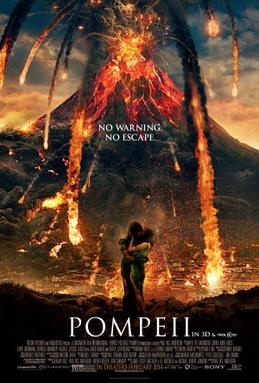
*1 lb. Gladiator, including a contest in the arena based on a Roman conquest where our hero commands an ahistorical result, an African gladiator who becomes our protagonist’s friend and soul mate, a knock-off of the ghostly Hans Zimmer score, and a baddie (Kiefer Sutherland) who wants to put his thumb down but must turn it up lest he lose the favor of the people

*1/2 lb. Titanic, including star-crossed lovers from different backgrounds, looming disaster, a chase through the beleaguered city as time runs short, and laugh-out-loud funny anachronistic dialogue, mostly from our Kate Winsletian heroine, Emily Browning (“Men killing each other for amusement is not a sport”; “Senator, you have mistaken me for the kind of woman who drapes herself across your lap in Rome“; “He made me feel… safe. “

* 12 lbs. of crazy ass CGI

It cost $100 million to make and made $110 million at the box office worldwide, so Pompeii II: The Reaping has probably been avoided.

image

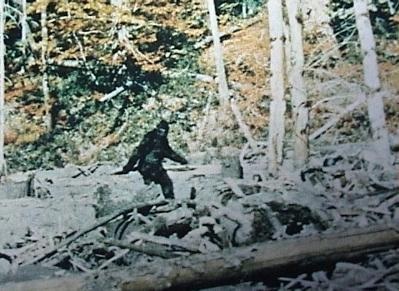
The ingenious creators of The Blair Witch Project knew enough not to go back in the woods again with their follow up. But 15 years later, director Bobcat Goldthwait has picked up the torch, only this time, his unfortunate videographers are on the trail of Bigfoot, not ritual killers. After slumming with the locals, where absolutely no tension mounts and no character is developed, our couple (he, an overgrown kid obsessed with the Bigfoot sighting, she a supportive actress girlfriend, neither very interesting) go into the woods of the Pacific Northwest. Unlike their predecessors in the woods of Blair Witch’s Burkittsville, these geniuses receive three very clear early warnings to get the hell out of Dodge, but hey, what’s a camping trip without a sinister, threatening local, your clothing mysteriously hung from the trees and a wrecked campsite? We must sally forth to find, well, not even Bigfoot, but the place where this iconic picture was taken.

image

This has all been done and much better at that (the scene where the couple realize they are lost is a criminal rip-off of Blair Witch). The characters are so culpable they repel sympathy, and the acting is woeful (Bryce Johnson, the Bigfoot enthusiast, conveys fear with a goofy face that I’m sure he assumes is grim determination but comes off as half concussed, half constipated).

There’s also not a scary moment in the film.

One star, though, for the kitschy Bigfoot locales and The Bigfoot burger.

image

Noah (2014) - Rotten Tomatoes
Noah is a modern day environmentalist/pacifist who is also a vegetarian, fights the rape of the land, and communes with Transformer-like monsters/fallen angels (it was quite a shock to learn that Optimus Prime was so critical to the Old Testament). God tells him to save the innocent; the animals. He complies.

Unfortunately for us, neither God or Noah cannot save this dreary and ponderous story nor can they remedy Darren Aronofsky’s leaden direction. I was surprised by James Gunn’s ability to handle a broad and sweeping epic in Guardians of the Galaxy given his prior experience with smaller films. In Noah, Aronofsky, who also has little experience with big films, does not surprise. He is completely lost visually, primarily relying on a slow backward tracking shot to say BIG! Some of the CGI, and there is a lot of it, looks as silly as Harry Hamlin-age Clash of the Titans.  The script, which Aronofsky co-wrote, is a repetitive mix of New Age blather (birds arrive and Crowe intones, “it begins”) and mundane domestic drama. The performances are rote, good actors intuiting “this is biblical” which they apparently perceive as solemn.

On the plus side, the making of this film means at least one less Aronofsky ode to masochism and sadism (although Aronofsky does let Russell Crowe sing again).

You also get the sense Aronofsky feels the film is getting away from him, so he relies more on Noah’s trippy dreams and his story of creation (a psychedelic light show and some stop-action photography), and indeed, they are welcome respites from the numbing dialogue.

And the flood is pretty damn cool.

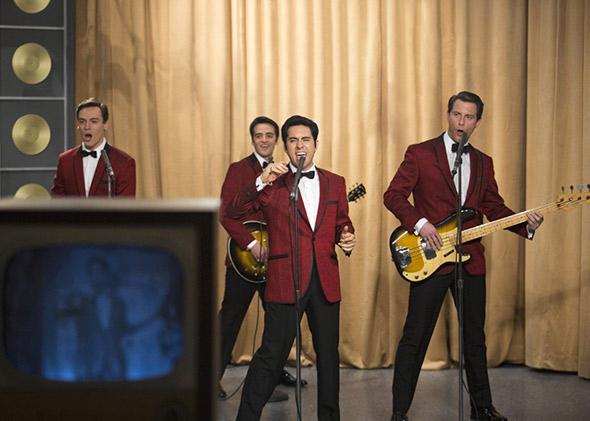
Jersey Boys, the movie, directed by Clint Eastwood, reviewed.
Having re-watched Walk the Line, I then took my son to go see Clint Eastwood’s Jersey Boys, the film version of the “smash!” Broadway hit chronicling the rise and fall of Frankie Valli and The Four Seasons. He liked the picture. I did not. Let me count the ways.

1)      You couldn’t pick a worse director for this project than Eastwood. Music needs to be shot with energy and verve. Clint’s camera work is fixed and unimaginative. Basically, he shot Frankie Valli much like he shot J. Edgar Hoover. Close up. Then farther away. Then a shot to an admiring audience.

2)      The performances mostly run from pedestrian to dreadful. In the latter category, John Lloyd Young as Valli sports a Broadway pedigree and little else. His “go to” move seems to be consternation, be it at the loss of a gig, $1 million or a daughter. Vincent Piazza (Boardwalk Empire) is so goombah you half expect him to hawk Ragu sauce.

3)      The film can’t decide on being a whimsical tribute to the Broadway show or a dark, cautionary tale on the perils of stardom. Tonally, it’s schizophrenic.

4)      One theme in particular – the omerta of tough Jersey guys – is severely undercut by the fact that these tough Jersey guys are about as scary as The Sharks and The Jets.   In West Side Story, no one was asking you to be scared of ballet dancing toughs; it was a fantasy, delivered in dance, where even the violence was poetic. Here, their bond and hardscrabble roots are important, yet the whole existence seems comedic and pleasant.

5)      134 minutes!!!

6)      The makeup here was worse, if that’s possible, than in J. Edgar, and I didn’t think that could be possible.

My son countered that I didn’t like the music and that queered the film for me. But I didn’t like the music in Dreamgirls, and that was a perfectly fine film.

If you want to see the antithesis of this picture, rent Tom Hanks’ That Thing You Do, which captures the excitement, fun and then, the letdown, of a one-hit wonder band.

So, why one star?  Filial loyalty and the very funny turn by Mike Doyle as producer Bob Crewe.

A game performance by Chadwick Boseman cannot overcome every sports, race, and mythic America trope or Harrison Ford’s schmaltzy Oscar-bait bid as Branch Rickey. Brian Helgeland’s script is a bore, and the performances feel like civic duty. If you want to watch a richer, more interesting baseball film with a numeric title, try Billy Crystal’s 61*.

Image result for Man of Steel

The allure of Superman is inescapable. A baby arrives on earth with super human strength and is cared for by a Midwestern couple. As he grows up, he must learn to surreptitiously use that strength for good, wondering all the while the nature of his origins.

Director Zack Snyder (300, Watchmen) gives us a few flashbacks to Clark Kent’s upbringing under the tutelage of his earth father, Kevin Costner, and these are by far the most interesting scenes in the film. But it is clear Snyder is more interested in the fate of Krypton, which results in a tedious dramatization of the planet’s politics and an over-the-top performance by Michael Shannon as the maniacal General Zod. Cue the inevitable, droning CGI fest at the end, plus Superman’s ridiculous triumph (all he had to do was snap Zod’s neck?), and you’ll be awakened from your slumber just in time to see Superman take a job at The Daily Planet, a newspaper populated by such dim bulbs that the mere accoutrement of horn rims serves to disguise the man who just saved them from certain death.

At least the film includes that sly indictment of modern journalism. Other than that, and a spunky performance from Amy Adams, there is little to recommend.

Part 2 would appear to be unavoidable, and word on the street is that Denzel Washington is in talks to take the role of The Green Lantern (green being the operative word).


My nephew recommended this picture and it was directed by Guillermo del Toro (The Devil’s Backbone, Pan’s Labyrinth). I feared I’d missed a hidden gem. Monsters come from beneath the ocean to get us, and we humans make big metal suits helmed by duos to fight them. This is Transformers (and Real Steel) for middle schoolers instead of mental defectives, scored bombastically, loaded with manly exchanges (“let’s gets this son of a bitch!”, “you can finish this”) and cast with the immediately forgettable (except poor Idris Elba, who I trust just wants to forget).

There is some cool CGI and at the outset, it poses as being cynically dystopian. Still . . .

Ryyyyyyyaaaaaaaaaan!!!!!! You owe me one dollar!!!!!!!!!!

When Dead Again came out in 1991, 31 year old Kenneth Branagh was fresh off his stunning Henry V, and along with Emma Thompson, threatened to be the next big thing. So as a follow-up, why not try a modern Hitchcockian homage set in San Francisco, with Branagh playing the hard-bitten gumshoe who runs across Thompson, a mysterious woman who has lost her memory, is terrorized by nightmares from her past, and needs Branagh to sort it out.

At the time, the film was well-received (Roger Ebert – “I am a particular pushover for movies like this, movies that could go on the same list with Rebecca, Wuthering Heights or Vertigo”) and it holds an 82% on Rottentomatoes. I can’t scoff. In 1991, I thought it was clever and well-conceived.

How wrong I was.  Dead Again just became available on Netflix streaming. It is an atrocious film.  Branagh’s “American” accent is an awful, nasally annoyance; Thompson barely makes an impression; the story (Thompson and Branagh both lived past lives where he, a famous composer in the 40s, was executed for her murder) is a preposterous pile of pure Gouda; and the villain is so obvious and nonsensical that you are offended at the degradation of the fine actor playing him.

He’s also not so good with scissors.

I’ll give credit where credit is due – Robin Williams does a few decent cameo scenes as a disgraced former psychotherapist and a babyfaced Campbell Scott shows off some nifty ninja kicks. 


I saw this on my flight back from Rome. I tried something new, a review in real time, where I watched and typed, watched and typed.

Big trouble early. The First Lady is Ashley Judd and she telegraphs where we may be going when she tells our hero, Secret Service agent Gerard Butler, that the president (Aaron Eckhart) can get the country off its dependence on foreign oil but cannot pick her earrings. I think I know who the bad guys are.

President Eckhart and wife leave Camp David in a motorcade in brutal, snowy weather, they hit black ice, and as the car totters on a bridge, Butler must make a tough call. Goodbye Ashley.

18 months later, Butler is haunted. And cashiered at the dreaded desk job at Treasury.   Martial music portends trouble and Butler is dressed for it. Unshaven, dark on dark, like Christopher Moltisanti.

A massive unidentified military plane gets in near spitting distance of the White House before receiving a final warning from the two, and only two, jets hawking it.  When it shoots the jets down, and starts shooting up the White House, no worries. We send one, as in the loneliest number, other jet to intercept. The threat is seemingly neutralized at the expense of the top of the Washington Monument.

As this goes on above ground, the President is hurried to his bunker beneath the White House with the VP, the Secretary of Defense (Melissa Leo), the South Korean prime minister and a boatload of aides and security personnel.  The president is apparently a sexist, because it is Leo to whom he says, “Ruth. Where is my son?”  Sadly, she did not respond, “I’m not the fu**ing nanny.”

Meanwhile, Butler is out in the street in front of the White House, which is suddenly overrun with Asian ninja-skilled terrorists. He’s killing a boatload and it is on, on like Donkey Kong.

Oh snap. The president gets jumped by the South Korean prime minister’s security team. They’re really North Korean! [insert joke here] And the White House has been overrun above ground and below . . . Hey, wait. Olympus HAS fallen!

Luckily, Butler is in Olympus. He’s John McClane! I’m intrigued. Forget the play by play. I watch uninterrupted. This experiment has failed.

LATER:  I was wrong about the bad guys. Not big oil. Former Secret Service agent Dylan McDermott went traitor and snapped at the president about “globalization and Wall Street” and the $500 million necessary to buy the presidency. I smell Tea Party, who as we all know, have a natural affinity for the North Koreans.

Regardless of its politics, this is the most anti-American film I’ve ever seen. Not so much philosophically, but competence-wise.   As noted, the Secret Service takes the President on icy bridges at night and the skies around D.C. have become a lot friendlier 12 years after 9-11.

Also, Morgan Freeman is Speaker of House and thus, acting president.  Freeman is also a total puss. He actually started withdrawing troops from the Korean DMZ and the Seventh Fleet after the terrorists killed the VP and threatened to kill the President.

President Eckhart makes Freeman seem like Teddy Roosevelt. It seems the U.S. has a nuclear failsafe system. 3 people can provide numbers to defuse our nuclear missiles in case of a rogue launch, making us defenseless in the process, which seems to be the aim of the terrorists. So what does Eckhart do? He orders two of the code handlers to give up their codes so they won’t be killed. Eckhart has the third. But it turns out the terrorists didn’t need the third code. Because they intended to blow the missiles up in the silos. Which required only one code.

Nice system.  Good choices. Bad movie. Impeach Eckhart.