Archive

Scary

An ingenious concept undone by a tedious pace, a dull heroine, an indecisive tone, and a cheezy feel.

First, the concept. The world is post-apocalyptic and zombies mill about, waiting to eat human brains. One twist – when they eat the brains, they get a rush of the memories of the prior owner. Our protagonist. Nicolas Hoult (About a Boy, X-Men: First Class) eats the brains of Dave Franco (brother to James), fiance’ to Teresa Palmer, and immediately falls in love with Palmer.  So, he saves Palmer’s life and an unlikely romance ensues. So far, so good.

Palmer, clearly an acolyte of the Kristen Stewart school of acting, makes no impression. She’s all smarm and attitude and lacks any depth necessary for material deeper than Glee. It may seem like niggling but it is not, because she has to convey that she has fallen for a zombie. She doesn’t come close.

With Palmer failing to communicate a romance, what is left is the scary.  It is not scary, at all, and the use of CGI skeletors – really evil zombies who have lost all their flesh – suggests the old stop motion visual effects of the Harry Hamlin Clash of the Titans – and not in a good way.

Since it is not scary, it should be funny. After all, talk about your clash of cultures. But it is only occasionally amusing. Hoult, whose speaking is necessarily rudimentary, mainly mumbles and moons at Palmer. While he is given a voiceover to explain what he feels and sees, the observances are pedestrian.

The picture looks just awful – again, not in a good way. The post-apocalyptic world looks more like a Meadowlands dump, the encampment where the humans are holding out looks like the porn set of a parody (Dawn of the Head? apologies)*, and in comparison to Zombieland or even The Walking Dead, the feel just seems chintzy.

It’s also deathly slow. At only 90 minutes, I started to feel like the zombies themselves, numb and mindlessly staring at the TV, waiting desperately for something to chew on.

*  I made that up, but I shouldn’t have had to.

While there are a few scary moments, and the young actor who plays the “disfigured baby” grown up is, in fact, truly terrifying, there are just too many problems to recommend the picture, including–

*  thematic confusion – is this a comedy?  Because if it is, casting such a frightening actor as the demon is a mistake.  Why is the screenwriter wearing sunglasses inside in the middle of winter?  Why is the neighbor wearing a Virginia Tech hoodie?  And why does he smile so much and then screech intermittently?

*  mumble mouth dialogue from the young actor playing the neighbor (he tells us the story of the house but we can’t understand him) and over-acting (“Who could that be?”) from the protagonist, who distrusts the script and opts for a play-by-play narrative.

*  sloppy editing – why use tracking shots if your actors are going to be looking back as if being chased by the camera?

*  poor scene locations – the haunted house is dank and scary, but it seems that a young screenplay writer who just moved into it would not have a Batman pillow case and  a life size figurine of Batman.

*  Will Larroca’s insistence on playing the lead was too much of a distraction.  He seems to be giving non-verbal direction to the camerman.

Again, this is a shame, because the actor playing “The Monster” is bone-chillingly good.

Word on the street is that the writer/director/star is in pre-production for another horror film, and he has some money behind it.  It may be make or break.

UPDATE:  My review has been reviewed, and rather unkindly


This Guillermo del Toro produced ghost story is scary, judiciously using the shock techniques of The Woman in Black, and intriguing, developing an actual mystery behind the horror.  First time director Andres Muschietti is confident, evoking the creepy feel of The Ring, and Jessica Chastain and Nikolaj Coster-Waldau (Jamie Lannister in Game of Thrones) are convincing as the caretakers of two girls found abandoned in a Virginia cabin 5 years after their father (Coster-Waldau’s brother) absconded with them and disappeared. Upon discovery, it turns out the girls have been adopted by a new, more sinister force. A little more patience and exposition prior to the gripping finale, and less of a CGI bonanza during that finale, could have made this a horror classic. As it is, it’s pretty damn good.

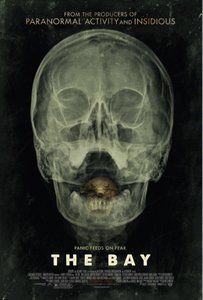
Image result for The Bay

The Bay had a few things in its favor going in.  Director Barry Levinson is no slouch.  The “found media” approach is appealing to me, as is evidenced by my affection for the Paranormal Activity movies. And the premise – a small Maryland town is plagued by a bacteria that cuts through it on a July 4th celebration – had promise.  Two factors, one personal to me and the other a colossally stupid decision on Levinson’s part, resulted in my turning the flick off about a third in.

I’ll take my lumps first.  I can handle slashers (if not gore porn), serial killers, unsettled ghosts, zombies . . . you name it.  But a plague of pustules and vomiting blood and boils? A very, very hard ask.  And then, there were afflicted children.  Damn, this better be good.

It wasn’t. Levinson was more interested in making an eco-horror tract than an actual scary movie.  As such, once his narrator (a witness to the July 4th disaster who is video-blogging) introduces us to the source of the plague (apparently, chicken shit being run off into the Chesapeake Bay), we learn that near everybody but our narrator dies.  At the outset!  She even points out people in the collated footage and says, “he dies” and “he doesn’t survive the day.” So, within 15 minutes, the audience knows the source of the killings and pretty much who dies.

Hell if I’m going to sit through pustules and boils on children under such circumstances.

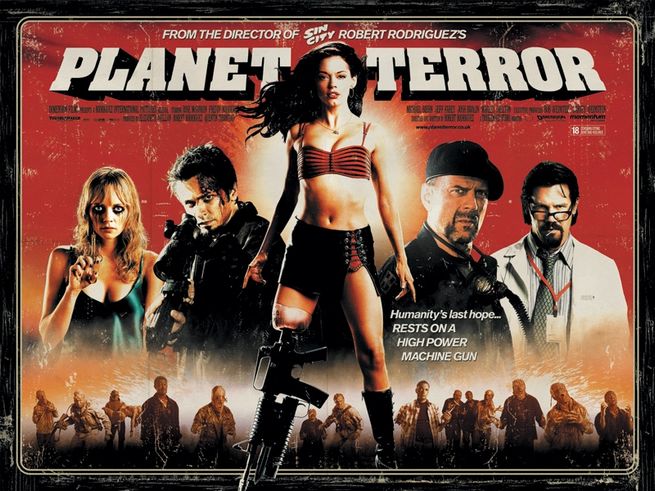
In evaluating Robert Rodriguez’s half of the Grindhouse double feature experiment/debacle with Quentin Tarantino, one has to remember that the insistence on an homage to 70s drive-in crap was an insurmountable mistake.  

A small Texas town is beleaguered by zombies, created by a military experiment gone bad. All hell breaks loose. Not really funny and not at all terrifying, mostly boring, often disgusting. But in the ultimate structural pass, Rodriguez is not responsible for a lazy, uninteresting film, because he is patterning his movie on same.  Along with Tarantino’s Death Proof, there are few greater examples of Hollywood hubris.

Entertainment Weekly called it “crazily funny and exciting tribute to the grimy glory days of 1970s exploitation films” that “will leave you laughing, gasping, thrilled at a movie that knows, at long last, how to put the bad back in badass”, proving that some critics will go to great lengths for fear of seeming uncool.

It was, however, kind of gutsy to cast a near midget (Freddie Rodriguez) as the strong, silent hero.

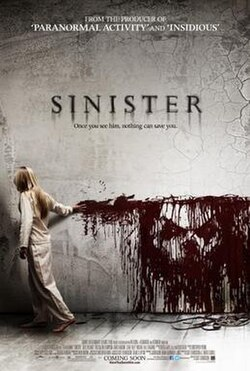
Ethan Hawke is a true crime writer on the down slope who moves his wife and kids into the house where the grisly murder of another family occurred. His m.o. is to solve the case or to at least highlight the screw-ups of the authorities.

The funny thing is, he doesn’t tell his wife or two children he’s moved them into a house where grisly murders occurred, he finds Super 8 film of the grisly murders and the grisly murders of numerous other families from other areas throughout the country in the attic, his teen son is flipping out from night terrors, his lights don’t work, there are horrible thumps in the attic (and a snake and a scorpion), he sees a creepy dude in the yard who he has also seen in the Super 8 films, and his kids start drawing gruesome images of dead children. And his wife sleeps the sleep of a thousand nights, even though, during the day, she’s understandably nervous about this whole situation.

And he stays because “This could be my In Cold Blood.”

So his wife stays.

Implausible, predictable and stupid.

Unbreakable (2000) - IMDb
It is a testament to M. Night Shyamalan’s clout after The Sixth Sense that he could get such a deliberate and meditative film made. Bruce Willis is a Philadelphia security guard, an ex-jock in a crumbling marriage with Robin Wright. His son is overly attached to him, sensing in his father something special and perhaps dangerous. After Willis emerges from a horrific train wreck as the sole survivor, with nary a scratch, the son’s suspicions are confirmed by the appearance of a comic book aficionado (Samuel L. Jackson) who leads Willis to a great revelation. It’s an old movie, but to discuss it further substantively would be an injustice. Before Shyamalan became a slave to big twists and reveals that became increasingly ridiculous, from aliens who invade earth but for whom water is acid (Signs) to an eco-counterattack where trees make people commit suicide (The Happening), he could deliver some truly effective codas, and Unbreakable contains my favorite.

Great ending aside, the story is original and sophisticated, Shyamalan’s Philly locales are lovingly chosen and spooky, Willis is the perfect choice for a regular Joe who soon learns he is anything but, and Jackson projects brilliant obsession. The penultimate scene, where Willis tests his new incarnation, is one of the more frightening I’ve ever seen.

The studio and Shyamalan had to have been disappointed by the latter’s sophomore effort. While it did very well overseas, its domestic gross exceeded budget by only $15 million compared to The Sixth Sense‘s $250 million. But Shyamalan had to know that such a painstaking, personal film would not garner an expanding mass audience, even if the studio didn’t.

The Awakening (2011 film) - Wikipedia

A hodgepodge of The Devil’s Backbone, The Others, The Sixth Sense, and The Orphanage, the resulting stew lacks the intrigue, creepiness or depth of any of those films. Post WWI, a noted spiritualist debunker played by Rebecca Hall (The Town, Parade’s End) is enlisted by a teacher (Dominic West) to come to a remote English boy’s school. A young student has died and the children have been traumatized, not only by that tragedy, but by the ghost of another boy. After begging off, Hall unconvincingly takes on the challenge, easily solving the more recent death in the first quarter of the film. The rest is devoted to her chasing the ghost about, falling for West, and being manipulated for a big Shymalanesque reveal that is rushed, awkward and unnecessary. The film is overly ambitious, neglecting the less showy aspects of a ghost story, like pace, investigatory patience, and diversion. Instead, Hall tears around the house, easily converted from skeptic to believing hysteric, until her ludicrous connection is clumsily offered via flashback. It’s director Nick Murphy’s first feature and he is overmatched. Worse, there are a mere three scary moments, a number The Woman in Black provided ten fold.

The fourth of the series, it is the weakest entry, but it still delivers a double threat: gore-free chills and inventive use of a series of cameras allowing us to be voyeurs to the terror. The cast is a little less compelling, though one of two boys being possessed by a demon is pretty creepy. With no name stars to pay, no real location budget, and more of the story to tell, we can expect these for some time.

Midnight Screaming: Dawn of the Dead (2004) | The Long Take

AMC’s The Walking Dead is successful in part for its visceral presentation of a dystopian United States where calamity has not only brought the dead to life, but those dead have pretty much overrun the country.  Even more disturbing, our cast of characters has learned that all living people carry the virus that will make them zombies hungry for flesh after they die, and that only a post-zombification destruction of the brain can stop their lust for humans.

Still, zombies in The Walking Dead are slow, near catatonic (though, like me passing a Chick-fil-A, they get more animated when near a meal).  If you stay in an open space or avoid them in bunches, you should be fine.  These zombies are like the walking dead in George Romero’s Dawn of the Dead (1978).  Don’t get in an elevator without knowing what’s on the other side of the door and you should be okay.

This is a trial for the show’s writers, who have to continually come up with scenarios where the protagonists and the zombies must come to close quarters (i.e., the group just wrangled with hundreds trying to clear them out from a prison that, if habitable, will be the perfect fortress).

No such problem for Zack Snyder’s (300, Watchmen) unappreciated remake of Romero’s film.  Nurse Sarah Polley and her husband wake up to see a little neighbor child at the foot of their bed.  Awww.  Sally is sleep walking again. Nope.  She’s a zombie and she’s fast and she strikes like lightning.

And away we go.  The zombies are like bullets, carbon copies of the victims of “the rage” in Danny Boyle’s 28 Days Later.  The decision is brilliant, because now, it becomes plausible that zombies actually took over the world (a ridiculous notion if, to become zombies, they had to die, and then get up and move about at the speed of latter years Andy Griffith).  A motley crew of survivors, including Polley, Vingh Rames as a cop, Mekhi Phifer as a hood, Jake Webber as the conscience, and an impressive Michael Kelly as the security guard who traverses from self-interested and greedy to semi-heroic, hole up in the mall.  All is well until they try and help a man they can see from their binoculars and it goes poorly, to say the least.  What follows is a harrowing escape from a their breached fortress.

First time director Snyder makes his mark at the outset with an introduction showing the breakdown of society as scored by Johnny Cash

It’s a helluva a ride and has numerous touches that elevate the material.  I’ll list three.  First, the film has the guts to show us what happens to a baby in the womb if that womb belongs to a zombie.  Second, it can be very funny, one such moment being target practice on the top of the mall that becomes a competition to shoot Burt Reynolds:

Third, it features my favorite zombie ever

Ty Burrell of Modern Family.