Any film where the director kicks the Jesuitical screenwriter off set because the latter wants the film to be unequivocal in its conclusion that God triumphs over Satan is bound to be unique. As that screenwriter William Peter Blatty observed:
Like so many Catholics, I’ve had so many little battles of wavering faith over the course of my life. And I was going through one at that time. And when I heard about this case and read the details, that seemed so compelling. I thought, my God, if someone were to investigate this and authenticate it, what a tremendous boost to faith it would be. I thought, someday I would like to see that happen. You know, I would like to do it . . . the research into it affected me. And the novel, it very much strengthened my faith.
Director William Friedken had other ideas.
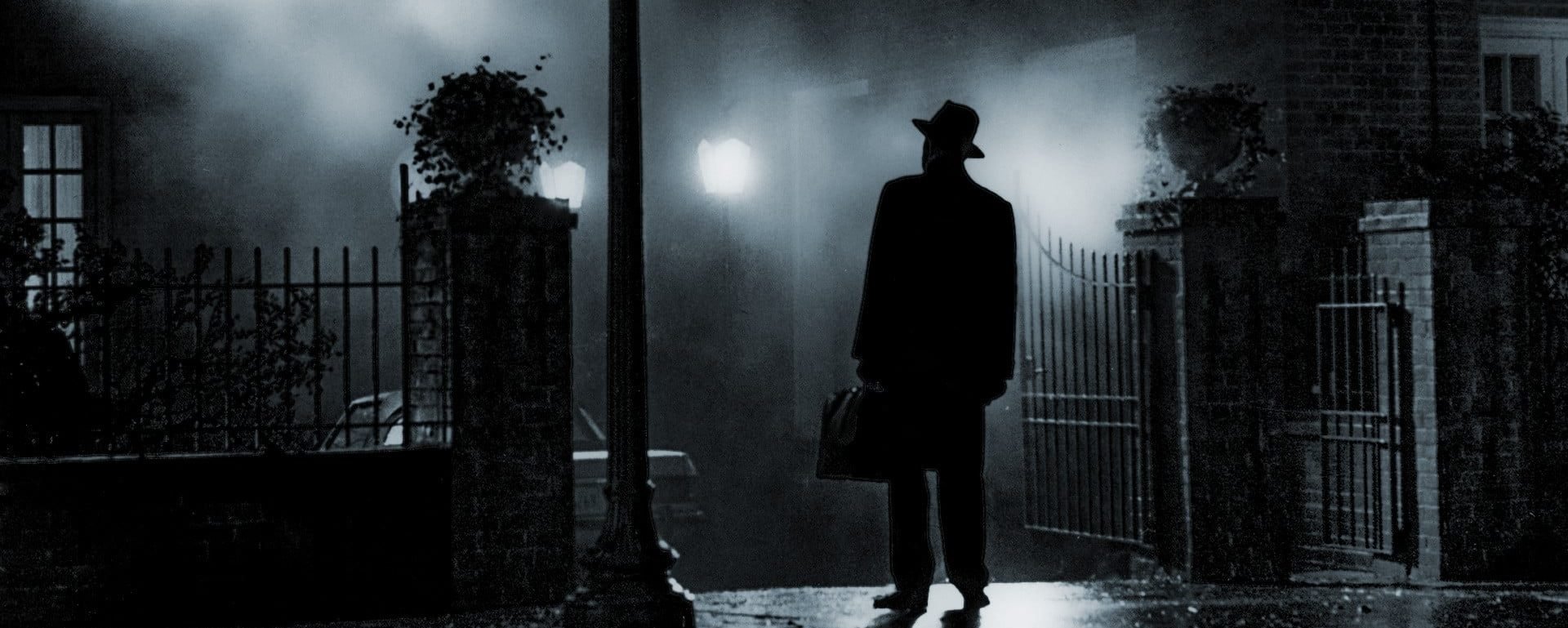
The film opens near an archaeological dig in Iraq. There, Friedken depicts a harsh and poverty-stricken world, where the blind are led by starving children, a widow grieves inconsolably, people work in small foundries like toilers in a fiery, oppressive Hell, and Father Merrin (Max Von Sydow) receives a sign that he will soon be meeting Satan. We are then transported to Washington, D.C., where another priest – Father Karras (Jason Miller) – is in a modern Hell. He is counselor to unsure and shaken Catholic priests. He tells one, “There’s not a day in my life when I don’t feel like a fraud.” To another, “I think I’ve lost my faith.” Karras’ mother is in her own nightmare, 1970s New York City. She needs care, she lives in a slum, and Karras is wracked with guilt over her abandonment.
Friedken masterfully portrays the connection between a society sick by sin and the infestation of one little girl, Regan McNeil (Linda Blair), the daughter of a Hollywood actress (Ellen Burstyn) filming on location in D.C. As Regan’s personality changes, she undergoes rigorous medical procedures (an arteriogram and a pneumoenchephalogram, to name two) that are graphic and invasive, as well as psychological probing (way before its time, the film has a doctor extolling the virtues of Ritalin). Her father forgets to call her on her birthday, pointing up the damage of divorce. Regan is alone and left to play by herself and eventually, an imaginary friend, in a foreign town and a rented townhouse. She is the quintessential “modern” child.
Other characters are also on the point of a knife. Father Karras nears breakdown after the death of his mother yet he continues to counsel other priests sick at heart and doubting of faith. The director of Burstyn’s “film in the film” (Jack MacGowran) is a lonely drunk cursed by memories of the Holocaust who scathingly brands Burstyn’s housekeeper of Germanic descent a closet Nazi. Everything and everyone seem rife with wrong and discomfort, raw and vulnerable. Von Sydow is nothing less than a condemned man, awaiting his confrontation with Satan and dependent on nitroglycerin pills for his ailing heart.
As Regan descends into the throes of possession, Friedken and Blatty smartly turn the world on its head: the physicians, once cocky, can offer Burstyn only the Jesuits, but only because a symbol of God might suggest salvation to Regan, the idea of faith, of course, being ridiculous. And when Regan talks to Karras (himself an Ivy League trained psychologist), the priest immediately sends her back to the doctors and recommends the child’s institutionalization. This is what modernity does when confronted by evil – denies it or locks it away. Friedken’s reservations aside, Blatty gets his morality play.
But it’s a morality play encased in a thrill ride. When the nature of Regan’s torment can no longer denied, and her abuse progresses, Friedken uses all means at his disposal to discomfort the viewer, from the foul, such as the vomit and green goo and the masturbation-with-crucifix (Blair had a stunt double who was used in the disturbing sexual scenes, for those who may have been wondering – double or no, it is still quite a shock to see a little girl utter the abomination “Let Jesus fu** you, let him fu** you”) to the subtle (the use of subliminal cuts, as when Father Karras dreams of his mother and sees a death mask and then, the same mask is overlaid on Regan’s face during the exorcism). Friedken also had the set dropped to below freezing by placing a restaurant air conditioner across the top of the set, which he then ran all night. The effect on the actors is stunning – their fear is enhanced by physical cold and the steam of breath is another frightening component.
Understandably, Blatty fretted over Friedken’s depictions: “A large section of the audience probably came because something that shocking and vulgar could be seen on the American screen. Bill Friedken always said that would be the case; that they would come to see the little girl masturbate with the crucifix . . . At the time I didn’t believe it; I thought he was destroying the film. But when I perceived that he was absolutely right, I thought it was terribly depressing.”
Friedken, however, is not only a showman, he’s a damn good one. He sets one spooky scene after another, constantly tracking his characters slowly in a manner that feels as if they being enveloped … by something. Burstyn’s walk home from a film shoot in Georgetown, where she witnesses Karras furtively counseling one priest and then passes two nuns with the wind whipping their garb, lends an eerie sense of the foreign and the what is to come. Much of the camera work is elegant tracking and slow zooms, soon to be punctuated by the occasional hand-held jolt (mostly, when characters are rushing to Regan’s room). The effect lulls the viewer, making the terror – when it occurs – all the more shocking.
Friedken understood that the spinning head was important but not as important as verisimilitude: “It’s set in the real world, with characters who are portrayed as humanly possible. So I think that the fact the story is portrayed realistically is what disturbs people about the events in it.”
The performances are poignantly measured, just on the edge of documentary. The film should be a Hollywood treatise on the exposition of minor characters. Blair is sweet and gentle as needs be, until – with the help of a stunt double, the guttural voice of Merecedes MacCambridge and various pulleys – she transforms convincingly into a leering, goading demon. Burstyn presents as a pampered star and mother at the end of her rope, but she grows to a hardened, more simple warrior. Von Sydow is appropriately ghostly as the doomed Father Merrin. McGowran and Lee J. Cobb are memorable as the murder victim and the murder policeman. Cobb’s gentle interrogations of Karras and McNeil are the kind of quiet respites necessary for such a tense film. Cobb also represents the skeptic and a rebuttal to any sense of despair. He is, after all, steeped in the evil that men do. But he is also kind and supportive, looking for an autograph from Burstyn and a friend in Miller. His supporting performance is one of my favorites in all of film.
The great turn, however, belongs to Miller (a playwright who succumbed to drink and never really did much as an actor after The Exorcist). His is a tortured existence, filled with doubt. His trepidation shows in his eyes. Physically, Miller plays as a man who fears his weakness is obvious to all, so he shrinks into himself so as not to be noticed. Merrin and Karras act like a men who know Satan is looking for them. The difference is that Merrin knows what is coming and solemnly accepts it. Karras thinks he can hide, and that is why he is so compelling. Friedken almost always films Miller hunched over, or huddled in talk, or sitting down, or crouched, or in a crowd, accentuating his need to be anonymous.
In the end, despite the tension between Friedken and Blatty, the latter need not have worried. The film is a clear triumph of good over evil. To save Regan, Karras defies the devil, “Come into me! Come into me!” The devil obliges, and for a moment, it looks as if Satan/Karras will kill Regan. Karras, however, summons his faith and hurls himself out of the window. He is given last rites, and later, a recovered Regan (having no memory or the possession) sees a priest and kisses him.
The Exorcist is a great popcorn flick but also a cinematic declaration that palpable, defined evil exists. It is an ultimate rejection of moral relativism, a harsh check on modern mores and technological advances. It is also, despite its slick sophistication, religious. After all, you cannot really find “good” or “justification” or “well, sure . . . but” in Satan. There is no bargain, even as Burstyn asks a herd of befuddled doctors “You’re telling me that I should take my daughter to a witch doctor?” The answer is, yes, there is no modern skate or help for you. And Friedken, the carnival barker, effectively shows you just how frightening and insidiously entertaining Satan can be.
A closing note: Blatty wrote The Exorcist many years after attending Georgetown University in Washington, D.C. One of his inspirations was newspaper reports of a real life exorcism of a boy in Mt. Rainier, Maryland.  That boy went to my high school, and you can read about his story here — http://www.strangemag.com/exorcistpage1.html Enjoy.