Richard Donner’s devil picture was a big hit in 1976, and 40 years later, it’s easy to see why. Rejecting the dour, sinister tone of The Exorcist, The Omen also lacks that film’s intelligence and gravitas. In its stead, however, is schlock elevated by top-notch performances (Gregory Peck, Lee Remick and David Warner play it straight and true, and Billie Whitelaw is chilling as a modern Mrs. Danvers) and some truly terrifying scenes. A suicide by hanging at a child’s birthday party, an impalement of a priest, and poor Remick’s two falls are memorable, as is the demon child’s first visit to church (he is not happy) and his drive through a wild animal park (they are also not happy). But it also follows the rules of a mystery. Clues are given, investigation follows, and then, terrible dawning. Jerry Goldsmith’s Oscar winning original score rejects subtlety, and even as over-the-top as it is, heightens dread.
Best, any film that ends with Peck about to stab a child with ceremonial knives and an unmitigated win for the devil has a place in my heart.
Inventive, scrupulous and at times, bone chilling, It Follows is yet another nail in the coffin of gore porn and a heck of a scary move to boot. The set-up is simple (stop reading if you don’t want to know even this much): a “thing” that can take many forms follows its target, and you become a target through having sex with someone the thing is following. If you have sex with someone else, it throws the follower off, until it gets that someone, and then it is back on your trail. No one can see the thing except its targets.
It Follows adroitly handles the revelation of the curse, and what ensues is a terrifying spook story in which Kelly (Lili Sepe) must run from what follows, with the assistance of her sister, friends and neighbor, while weighing the moral implications of buying herself more time.
Writer-director David Robert Mitchell knows his stuff; the film is a near homage to John Carpenter’s Halloween, with its dreamy sense of suburbia and techno-synthesized score. His actors approach the material in a studied, restrained manner, further emphasizing the hazy unreality of the entire endeavor. He also incorporates Detroit and its desolate environs, as near an urban haunted ruin as this country has. Finally, the film trusts your intelligence rather than being explicit, no mean feat in this genre. It gets a tad ragged in the end, but closes smart.
One of the charms of The Blair Witch Projectwas a nostalgic authenticity, which transported you back to a younger time and made the actions of the hikers seem like exactly the kind of hubristic, stupid thing you would do at that age. It Follows has the same trait: this feels like your childhood neighborhood, and evokes the times you looked out the window and saw something that seemed off, or something you were not supposed to see, or even something your fevered mind conjured after watching too many Kolchak The Night Stalkers.
I watched this flick with my son and 5 of his high school friends; they all agreed it would be significantly more effective as a sex-ed tool than what they were currently enduring.
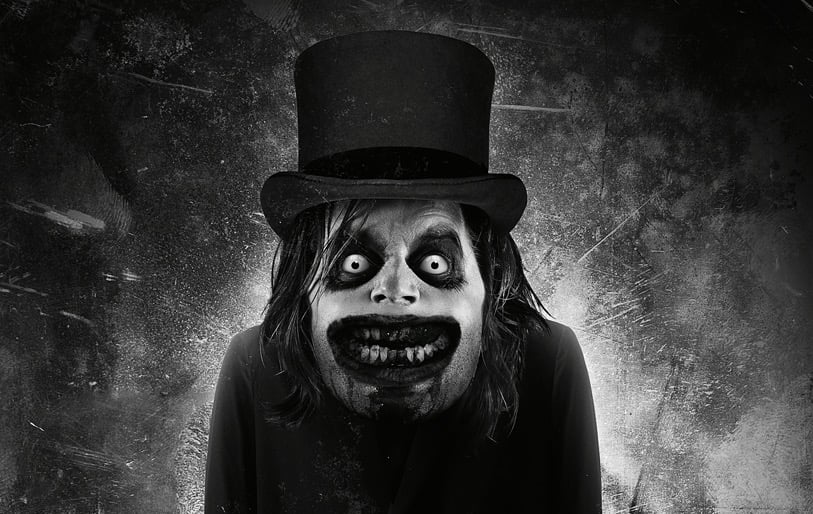
Never let your child select his own book to read at bedtime, for he might select “Mr. Babadook.” This is a terrifically scary psychological thriller/haunted house yarn about a single mother (Essie Davis) pushed to the breaking point. Widowed seven years prior when a car accident took her husband’s life en route to the hospital to deliver her son, she’s not in a good place. The boy (Noah Wiseman) is uncontrollable during the day and plagued by monsters underneath his bed at night. He is, in short, a spoiled handful and a weird one at that. His peculiarity is driving his mother to the brink, and in the midst of this turmoil comes Mr. Babadook, a terrifying bogeyman.
Davis is sympathetic as she tries to resist the evil force that has taken advantage of her torment, and as has been proven time and again in scary films, from The Shining to The Sixth Sense to The Devil’s Backbone, the contribution of a gifted child actor greatly enhances the terror, as you see what unfolds through the child’s eyes. Wiseman is a brilliant mix of charming and brutally annoying, and while he evokes both compassion, you resent him, making the viewer complicit in unleashing Mr. Babadook.
This is writer/director Jennifer Kent’s first feature and it is assured and often iconic. There are images that stick hard with you, they are not solely the scary ones, and she doesn’t resort to gore (late night Australian television, which is playing a good portion of the film, is quite horrifying enough). While Kent owes a little to James Wan’s Insidious, she avoids his slickness and has a way of capturing what frightens even in the most mundane of settings. She merits a Hollywood project.
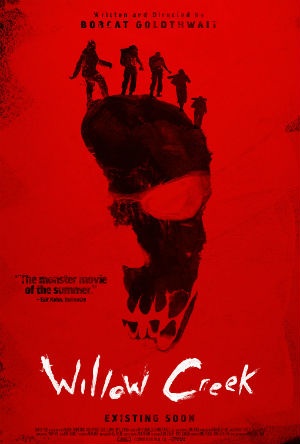
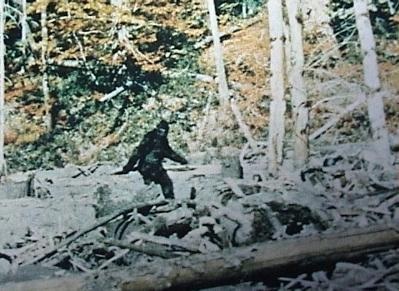
The ingenious creators of The Blair Witch Projectknew enough not to go back in the woods again with their follow up. But 15 years later, director Bobcat Goldthwait has picked up the torch, only this time, his unfortunate videographers are on the trail of Bigfoot, not ritual killers. After slumming with the locals, where absolutely no tension mounts and no character is developed, our couple (he, an overgrown kid obsessed with the Bigfoot sighting, she a supportive actress girlfriend, neither very interesting) go into the woods of the Pacific Northwest. Unlike their predecessors in the woods of Blair Witch’s Burkittsville, these geniuses receive three very clear early warnings to get the hell out of Dodge, but hey, what’s a camping trip without a sinister, threatening local, your clothing mysteriously hung from the trees and a wrecked campsite? We must sally forth to find, well, not even Bigfoot, but the place where this iconic picture was taken.
This has all been done and much better at that (the scene where the couple realize they are lost is a criminal rip-off of Blair Witch). The characters are so culpable they repel sympathy, and the acting is woeful (Bryce Johnson, the Bigfoot enthusiast, conveys fear with a goofy face that I’m sure he assumes is grim determination but comes off as half concussed, half constipated).
There’s also not a scary moment in the film.
One star, though, for the kitschy Bigfoot locales and The Bigfoot burger.
The good: the clever set-up of the origins of the beast incorporated into the opening credits; Bryan Cranston, as the obsessed Area 51 type who devotes his life to revealing those origins and the threat; the avoidance of the evil military-industrial tropes that often infect disaster movies; the destructions of cities other than NYC and LA; an ominous, moody score; and the monster battles, which are realistic, haunting and classic instead of computer-dizzying, antiseptic and deadening. And at just over 2 hours, it is the perfect length.
The bad: the script is banal. Anything the scientists (a barely intelligible Ken Watanabe and an absolutely pointless Sally Hawkins) contribute is mush, and when they object to the military’s plan to lure other monsters from the Godzilla family with nuclear weapons (which the eat like Chicklets), Hawkins merely shakes her head, like, you know, come on . . . that’s soooooo crazy, and Watanabe produces the pocket watch his father carried . . . in Hiroshima. Heavy.
Military commander David Staitharn is merely low grade concerned throughout, with an almost “Well, thank God this ain’t no 9-11” air about him. Aaron Taylor Johnson (Kick Ass), in a role made for Channing Tatum, is as evocative as a hot dog bun sopped in tap water (The Atlantic’s Christopher Orr said it better: “As for Taylor-Johnson’s performance as Ford, the movie’s central human protagonist, it was so dutifully generic that I forgot it even as I was watching it. I have no lasting impression of him whatsoever”). There is also a child actor who is child actory, better utilized to sell Underoos than terror at the loss of his mother and/or father. Finally, this is Godzilla. I don’t need Seth Rogen toking on a bong and yukking it up, but this film has almost zero sense of humor, depicting a world that perhaps deserves a good stomping.
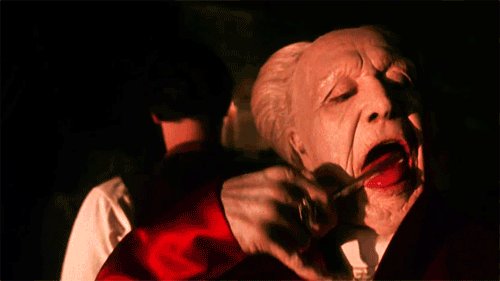
Francis Ford Coppola’s take on the Dracula story is wild, campy, and brisk. It also has a few scares, but one gets the sense Gary Oldman’s operatic Transylvanian count is not to be taken too seriously.
After all, Oldman appears in, by my count, 7 guises, including a nifty pile of rats, and he is just short of hammy in all. Not to be outdone, Anthony Hopkins’ Dr. Van Helsing is near giddy in his thirst for scene-chewing and vampire heads.
In its first half, the picture feels very Baz Luhrmann meets Saturday-at-the-movies serial. It settles into a more leisurely pace in the middle, as Dracula attempts to take root in London and his opposition grows. The picture is a gas, and Coppola’s rejection of an overly serious, brooding vampire is welcome. Perhaps it is not quite a rejection, as Oldman tries so hard to be otherworldly and tortured, he may be the last one in on the joke.
The film is also surprisingly erotic, as is evidenced by poor Jonathan Harker’s seduction at the hands of Dracula’s babes and the complete, sensual overload delivered to Winona Ryder and Sadie Frost as they fall under Dracula’s sway and then use all of their wiles to get at necks.
Speaking of, Harker is played by Keanu Reeves, who was then fresh off of two Bill and Ted’s Excellent Adventure movies. If you thought Kevin Costner had problems with an English accent in Robin Hood, you have to check out this performance (both Costner and Reeves are listed in the Top Five Most terrible British Accents, and rightfully so. Reeves can hold his accent – barely – for one line, and then, he’s one syllable away from San Dimas and “duuuude.” Then, he’s back to a dramatic and unconvincing “Carfax Abbey” only to drop it again, as if he knows how silly he sounds. Ultimately, Reeves appears so uncomfortable, he retreats into the implacably unaffected stoner no matter what Oldman and Hopkins throw at him, a treat all in itself.
The trend away from gore porn and toward chilling, moody scary movies remains welcome. Oculus is a worthy fingers-over-the-eyes addition, in the mold of The Conjuring, and sporting a clever storyline that tracks, and intersects, the childhood trauma of two kids whose house was haunted by a spooky mirror and their attempts as adults to destroy it. The execution is crisp and even ingenious, and the child actors (Annalise Basso and Garret Ryan) are superb. As to the flaws, there is one, and it is a rather big one, but I can’t reveal it without telling too much. Suffice it to say that it falls under the “Well, if X, then why the hell would they do Y?” variety. It’s a testament to the skill of writer/director Mike Flanagan (born, I shi** you not, in Salem, Massachusetts) that I was able to shelve the issue and just sit back and enjoy the film.
My son is headed off with his pals to see The Silence of the Lambs tonight, courtesy of AMC theaters’ occasional screenings of older films. I saw it with him a few weeks back and I think he’s looking forward to watching it again in the theater as much as witnessing the reaction of his friends.
Jonathan Demme’s masterpiece is one of the few films that focuses on the serial killer but doesn’t give way to excess. What we know about Hannibal Lecter (Anthony Hopkins) is simple: he is locked up for eating people; he is brilliant and fascinating; and he is lethal. When a serial killer, Buffalo Bill (Ted Levine) starts to plague the Ohio, Pennsylvania, West Virginia area, FBI profiler Jack Crawford (Scott Glen) sends a trainee, Clarice Starling (Jodie Foster), to elicit any advice from Lecter. Starling and Lecter use each other for their own ends, engaging in a thrilling psychological dance that is one part therapy and one part mental combat; she seeks to stop Buffalo Bill while he waits for a slip-up.
The Silence of the Lambs is so well-paced and taut that on occasion, you are near-breathless. There is only one pause in the film’s very serious, unrelenting tone (when Starling is “hit on” by two geek entomologists with whom she is consulting). The pressure is not only from Lecter and Buffalo Bill, but from Starling’s lack of experience, harrowing childhood, and even her gender and diminutive physicality. The odds seem uncomfortably stacked against her.
The exchanges between Hopkins and Foster are electrifying. You can see just how dangerous Lecter is and near curse yourself for being charmed by him. Yet, you root for the seemingly overmatched Starling, and when she stumbles, you feel the sting of her awkwardness. When Lecter so easily assesses her background and her sexual desires, it is excruciating. Yet Starling comes up to speed and achieves a plausible parity. Levine is also expert as the tortured, frightening Buffalo Bill, and his transformation to “normal” when he is questioned is a chilling addition to this “monsters among us” story.
The picture is one of only three to win Academy Awards in all the top five categories: Best Picture, Best Actor, Best Actress, Best Director, and Best Writing (Adapted Screenplay), and deservedly so.
Few Stephen King books or short stories are successfully translated on screen, and only one is brilliant –The Shining(it speaks volumes about the author that he felt Stanley Kubrick got it wrong, so wrong he made another version, with one of the two leads from the sitcom Wings in Nicholson’s role).
Carrie, Salem’s Lot, and Misery are very good, and Stand by Me is competent, if treacly. Dolores Claiborne, 1408, Christine, and Silver Bullet are pedestrian, but have their moments. The Shawshank Redemption is a wildly overrated, ridiculous film, but deserves mention because the great weight of authority deems it a near masterpiece.
So, where does David Cronenburg’s The Dead Zone fit in? Three-fourths of this story in about a man who can see your future and your past after he touches you, I’d have ranked it just below The Shining. Cronenberg creates a creepy atmosphere made even more unsettling by the unique performance of Christopher Walken, and the bleak misery of his existence as a crippled freak stuck in a small town is haunting. Striking visuals add to the spooky feel:
Then, the damn thing falls apart due to two ridiculous storylines. First, Anthony Zerbe plays a rich man who hires Walken to tutor his son, knowing full well Walken’s gift of second sight. So, what does Zerbe do when Walken sees the boy and his friends crashing through the ice during hockey practice and warns him accordingly? Wounded that his son has rejected his judgment about skating on the pond, Zerbe conducts hockey practice anyhow, and two boys die. The decision is bananas yet in keeping with King’s low esteem for parents (the father in Stand By Me practically tells poor Will Wheaton, “the wrong kid died” like the father in Walk Hard: The Dewey Cox Story).
Second, Walken is introduced to senatorial candidate Martin Sheen and sees Sheen’s future as a messianic president of the United States, instigating a nuclear conflagration. Sheen plays the character so oily and low it is hard to imagine anyone would vote for this cretin. And when Walken thwarts his ambition, the manner in which Sheen self-immolates is so broadly stupid the film is near ruined.
The premise is about as plausible as Escape from New York. If crime can increase so much that Manhattan must be cordoned off as a separate, lawless prison, than the nation could establish a 12 hour period annually where its citizens can “purge” and commit any crime without punishment. The purge is a mix of a social reform (by allowing one night of consequence free crime, we have no other crime the rest of the year) and patriotic-religious act. But it occurs in 2020, and as bad as either Bush or Obama has been, I can’t see that kind of institution gaining traction so quickly. Frankly, it is unlikely the government could get the website for The Purge up and running in 6 years. In the end, the filmmakers don’t really invest much in the concept, and as my son remarked, “the problem with the movie is that you didn’t need The Purge to make it.” He’s right. When the killers looking to take advantage of their wild night surround the well fortified home of Ethan Hawke and his really stupid family (note to self; on Purge night, make sure your foolish son doesn’t get all Good Samaritan and lift the security gates), they may as we’ll be zombies or Manson family members or the bad guys in The Strangers orYou’re Next.There is no reason to go high concept if you have no intention of exploring that concept.
Or maybe not. On a budget of $3 million, it made $64 million.