Archive

Genre

24 Hour Party People quad poster.jpg

Michael Winterbottom’s time capsule sells itself as a rendering of the birth of the rave culture.  In fact, as the film’s protagonist – Manchester television personality and producer Tony Wilson – constantly informs us in fourth wall breaking break away chats and insights made directly to the camera, the film is about at least a half dozen things: Manchester itself, the rave culture, the birth of what I then-called the British moany-boy bands (Joy Division, New Order), punk, “selling out”, and the comforts of being the next big thing.

The picture has been reviewed in the following manner: “if you liked New Order, you’ll . . . “, as if enjoying the music is intrinsic to enjoying the picture.  Untrue. The picture is sharp and funny, regardless of whether you dig the music at its center (I never did).  Indeed, Winterbottom explicitly dispenses with the necessity of the bands being good.  With the constant wild Kurt Loderesque accolades to the bands (there are even two “geniuses”), Winterbottom is mocking the creation of mini-gods to fuel the gravy train.

Smartly filmed, sometimes gonzo, always electric, and all the performances – especially Steve Coogan’s Wilson (our self-interested cum true-believer-in-the-music guide) are tops.

The Piano Teacher.  An icky foreign film about a gruesome piano teacher (Isabelle Huppert) who self-mutilates and otherwise sexually degrades herself. Why?  She’s over 40, lives with her overbearing mother, has a father in an insane asylum, and a deep loathing for love, joy or compassion.  When she finds a love (in the form of a young piano student), she does not know how to receive it and thus, she must pervert it.

Why would you want to watch a 2 hour foreign film about such a person, even if it were well acted and adequately directed?  Perhaps you too have a deep loathing for love, joy or compassion.  You should get that looked at.

Hollywood Ending (2002) |

My how the semi-mighty have fallen.  The Woody Allen stable of Diane Keaton, Diane Wiest, and Mia Farrow are replaced by Tea Leone, Debra Messing and . . . wait for it . . . Tiffany-Amber-Thiessen.  Worse, the 67 year old Allen still insists on casting himself as a love interest (this time, with 36 year old Leoni).  The courtship is ridiculous and the images revolting.

Worse, the film lacks one funny premise, line or sketch.  Allen plays Allen, arms waving and neuroses on all cylinders. But oh does he have some subversive things to say about filmmaking.

Allen is directing a $60 million picture.  He he he.  And he’s stricken by psychosomatic blindness. Te he he.  But he makes the film anyway, and in the process, reunites with his ex-wife.  And again, they kiss (just vile – you’re praying his teeth do not fall out).  And guess what?  In the end, the French love the film.

Har har har.

Nyuk nyuk nyuk.

It is the worst film of 2002, certainly one of Allen’s most terrible and perhaps the shittiest film of the millennium.  In the face of Hollywood Ending, saying “Well, Allen directed Annie Hall and Hannah and Her Sisters,” is like saying “Well, Hitler built the Autobahn.”

Amazon.com: Murder By Numbers [VHS]: Sandra Bullock, Ben Chaplin, Ryan  Gosling, Michael Pitt (II), Agnes Bruckner, Chris Penn, R.D. Call, Tom  Verica, Janni Brenn, John Vickery, Michael Canavan, Krista Carpenter, Neal  Matarazzo,

Awful. The protagonist is a hardened, take-no-crap bitter homicide detective with ghosts in the past and a skeleton in the closet. This detective fucks hard and then kicks you out of bed so you don’t get too close. Voices haunt this detective. This detective is a pro, hardened by the massive homicide rate of a California coastal town in San Benito County, California. This detective has seen it all.

This detective is played unconvincingly by professional pixie Sandra Bullock.

The next Jack Ryan may as well be David Hyde Pierce.

Grizzled ole’ Sandra has to deal with two Leopold and Loeb wannabes (Ryan Gosling and Michael Pitt) who fail the Leopold and Loeb movie prerequisites of being either 1) smart or 2) cool under fire. The plot is a senseless mush of hackneyed stew, and Bullock is humiliated by being given a discordant tough gal role, only to be pushed around time after time after time by one of these high school punks.

Worse, she gets attacked severely by . . . a monkey.

You really have to see it, but I recommend that you do not.

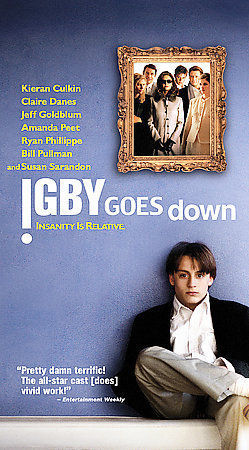
Igby Goes Down (VHS, 2003) for sale online | eBay

A punk of a little rich kid, Igby (Kieran Culkin), is sold to us as righteous because all who vex him are, comparatively, worse. There is his pill-popping, domineering mother (Susan Sarandon), his coldly efficient and soulless brother (Ryan Phillipe), and his go-go godfather (Jeff Goldblum). So, yea smarmy little shit Igby is indeed the best of the bunch.

Igby also has a schizophrenic father (Bill Pullman), an unhappy childhood, and he is in therapy. While “rebelling” (i.e., escaping various boarding schools and bumming off of people in New York), Igby harshly judges those around him, has some sex (Amanda Peet and Claire Danes) and comes to terms with . . . well, he doesn’t really come to terms with anything.  Rather, Igby endures angst, punctuated by slow motion scenes of our lonely rich boy running through New York – lost.

Yes lost in a world of hypocrisy.  Poor lost Igby, reduced to running through Manhattan to Coldplay or The Dandy Warhols.

This film might appeal to folks who fantasize about always having the perfect comeback and who fancied themselves terribly oppressed and misunderstood (because of their unflinching truth-telling and high standards) when they were teens. Folks who lived high school with a really cool soundtrack in their heads, and who think schizophrenia is bad, but it may just be more “honest” than normal life.

None of which may be surprising, as it was written and directed by Burr Steers,  who has familial ties to Jackie Kennedy and Gore Vidal and even Aaron Burr. Like Igby, Steers was educated at the best, kicked out by the best, and eventually, forced to attend military school.

The film is crap. If you want to see a funny, soulful and intelligent coming of age NY flick, see Tadpole and if you want to see Kieran Culkin play in a coming of age flick with heart, see The Dangerous Lives of Altar Boys.

The Last Samurai - Wikipedia

Tom Cruise is a dissipated, drunken Civil War vet who slaughtered women and children Indians (at the evil Tony Goldwyn’s behest) and must atone and “find himself” in the mystical East.

I’m not a Tom Cruise hater.  His effort is incomparable and he’s a star, in that, most everything he does on screen, if not interesting, is watchable. But he has two huge drawbacks.  First, he’s eternally youthful and thus, cannot effectively be world-weary.  Second, he is just weird in period pieces.  I didn’t like Cold Mountain, but Jude Law struck me as a man of his time and thus lent the film authenticity.  Cruise, on the other hand, is hopelessly 21st century and appears on the cusp of saying “Dude” a few times.

He is not helped by this hackneyed, American-hating, simplistic piece of garbage that is the script.

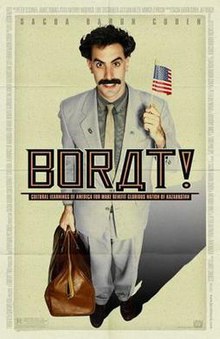
Borat - Wikipedia

Funny to the point of tears, but a testament to the generous nature of Americans.  My fear was that Sacha Baron Cohen would be cruel to his subjects, but the film is, perhaps unintentionally, quite the opposite.  Yes, the rubes and dudes and New York toughs can be less than politically correct, but what they lack in modern manners they make up for in their easy acceptance of this bizarre, crude faux immigrant who tests the limits of all patience. As Christopher Hitchens noted:

Americans are almost pedantic in their hospitality and politesse. At a formal dinner in Birmingham, Ala., the guests discuss Borat while he’s out of the room… agree what a nice young American he might make. And this is after he has called one guest a retard and grossly insulted the wife of another… The arrival of a mountainous black hooker does admittedly put an end to the evening, but if a swarthy stranger had pulled any of the foregoing at a liberal dinner party in England, I wouldn’t give much for his chances. 


Image result for LA Confidential

A byzantine noir potboiler set in post-war go-go America, rich in gangsters, drugs, sex and corruption, this is one of my favorite films and an excellent adaptation of James Ellroy’s classic novel.  I’m re-posting because I just noticed it is available streaming on Netflix.

Depth, pacing, and authenticity – the flick has it all.  The three main characters are rich and finely drawn.  LAPD Lt. Edmund Exley (Guy Pearce) is half ambition, a quarter condescension, and a quarter insecurity.  Anything he fears he must best, even destroy.  He fears fellow cop Bud White (Russell Crowe), who is outwardly all muscle and frontier justice.  So he testifies against White in a brutality scandal to have him kicked off the force.  White survives Exley’s testimony, but White’s partner does not, and thereafter, White seethes with hatred and desire for payback.  When they become entwined in the same investigation, a mass shotgun slaying which claims White’s disgraced partner, they clash, and yet, they are forced to work together.

Prior to formation of the uneasy alliance, White tries to tear Exley’s head off.  Their supervisor, Captain Dudley Smith (James Cromwell) intervenes in an exchange that typifies the dialogue:

DUDLEY SMITH: It’s best to stay away from the lad when his color is up.

ED EXLEY: His color is always up.

DUDLEY SMITH: Then perhaps you’d do well to stay away from him altogether.

A third detective, Jack Vincennes (Kevin Spacey), rounds out the trio.  I saw Spacey on Inside the Actors Studio and he said that he patterned Vincennes on Dean Martin in Rio Bravo.  It shows.  Spacey’s Vincennes alternately swaggers and hunches, bravado followed by just a little shame.  He’s corrupt, he’s good at being corrupt, and corruption has made life easy, but he is torn between the celebrity and easy cash and the guilt his choices have brought him.  In a film that is so sweeping, Spacey has little time to make the transition from crook to clean.  But he does it in a very brief scene, alone, at a bar, as he eyes a $50 bill (a payoff from the slimy editor of the scandal rag Hush, Hush, played by Danny Devito).  Spacey looks at the bill, sees his face in the mirror, places the bill on his shot, and leaves to do the right thing.  It’s a beautiful, economical moment.

Kim Basinger won the Supporting Actress Oscar as the high class prostitute who captivates Bud White, and while she’s sleek, sultry and affecting, every other major performance is better than her own and more deserving of accolade.

The care taken by director Curtis Hansen (who we sadly lost in 2016) is evident in every scene, be it a jail melee’, a triple interrogation, or a stunning shotgun shootout.   Hansen is straightforward and confident, and the picture positively hurtles but it never feels pell mell.  Save for some gentle interplay between Basinger and Crowe,  the movie is quick, sharp movement, punctuated by real or verbal violence.   It never, ever drags or becomes self-indulgent.  You love what you are seeing but want it to be over because you want to see more.

The film also oozes the L.A. of the time period. It feels right and looks better (for the opposite – a tacky, awful, ridiculous L.A. film –  see Mullholland Falls). 

A Serious Man.  I consider Fargo and No Country for Old Men to be two of the best films ever made.  The only resemblance the Coen brothers’ Oscar-nominated film, A Serious Man, bears to those films is attention to detail and the potential evocation of outrage from a distinct group (in Fargo, Minnesotans took umbrage at their farcical portrayal; here, it should be Minnesotan Jews circa 1967).  A Serious Man beats up on its protagonist, a Jewish professor with cretins for children, a disloyal shrew for a wife, cartoonishly unhelpful religious guidance, and various other unpleasant people who vex him, including a disgusting uncle with a cebacious cyst he must drain on a regular basis.  Apparently, the protagonist is cursed, a curse handed down from his Polish ancestors, but the curse appears to be the fact that he’s Jewish.  The moment it appears he can get out from under, the curse strikes again, and the film ends abruptly.

This is an unpleasant, frustratingly tedious film that may have served as some sort of the therapy for the Coen brothers (they grew up in St. Louis Park, Minnesota, a suburb of Minneapolis, in the 60s).  It has few other attributes and they shouldn’t have worked out their issues on us.

Watch Avatar: The Way of Water Family Audio Track (Includes Bonus) | Prime  VideoIf you are a 14 year old boy who thinks The Lion King script was opaque, Transformers was too sedate and you have plans to major in “Live Action Role Playing” at college, James Cameron’s technological Sominex is the film for you.  While there were tussles over the politics of the film (it is, as a fact, virulently anti-corporate, anti-military, anti–Coca-Cola, anti-modern and anti-Bush, Iraq, Afghanistan etc . . .), the script is truly at the level of Disney’s Pocahontas, so it’s difficult to engage in an analysis of the meaning with much gusto. That said, minor examples that for whatever reason made me laugh: the corporate shill’s name is Parker Selfridge and the psychotic “Burn the village and fu** saving it” stand-in for Lt. Calley is Col. Miles Quartich.

I’m guessing the first draft included Bernie Skilling and Col. Ariel Cheney, but legal problems ensued.

Cameron’s script for Titanic was simplistic and laugh-inducing (“Will the lifeboats be seated according to class? I hope they aren’t too crowded”), and that too is a terrible blight of a picture, but at least you knew the damn boat would sink and sink with a bang, so you had that to look forward to.   Here, it’s all blue people, interminably hopping from tree to tree, and there is no assured calamity to keep the lids from drooping.