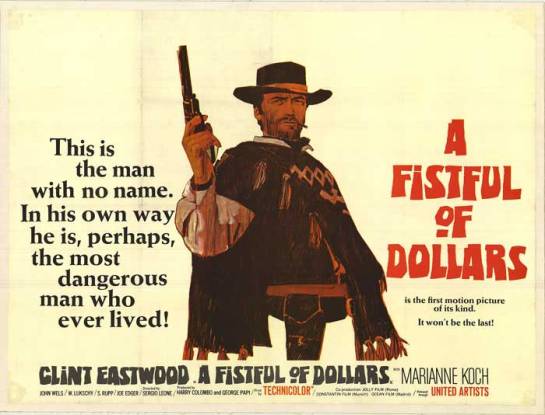
The first of Sergio Leone’s “Spaghetti Western” trilogy with Clint Eastwood’s “Man with no Name”, A Fistful of Dollars was actually shot in Spain.
I guess “Paella Western” wasn’t an option.
Eastwood comes to a town at war. Two families seek the upper hand, and Eastwood shuttles between one and the other for the cash.
As fun as it can be, the movie is stilted. Leone’s visuals are ambitious but his sweep is not yet broad, and like Sean Connery as James Bond in Dr. No, Eastwood is still working on his persona and lacks gravitas (interestingly, Eastwood was Leone’s eight or ninth choice, behind Henry Fonda, Charles Bronson, James Coburn and others). The entire cast, Eastwood excluded, is foreign and the dubbing is spotty (in the case of a crying child, I was immediately reminded of the dubbing in the Japanese animated series, Speed Racer).
This film ends up being a critical warm-up to the better For a Few Dollars More and its classic follow-up, The Good, the Bad and The Ugly.
Tim Burton hasn’t declined so much as remained spotty. Last year’s Frankenweenie was in his animated wheelhouse, but his two previous films were the excessive and dull Alice in Wonderland and the truly awful and unfunny Dark Shadows. Before those films, however, was Burton’s first live musical, Sweeney Todd: The Demon Barber of Fleet Street, a rich, dark rendition of the Stephen Sondheim stage musical. Burton maintains the macabre edge of the play, infuses it with his trademark visual trickery, but wisely doesn’t screw with its heart, an entire story mostly sung, rarely spoken.
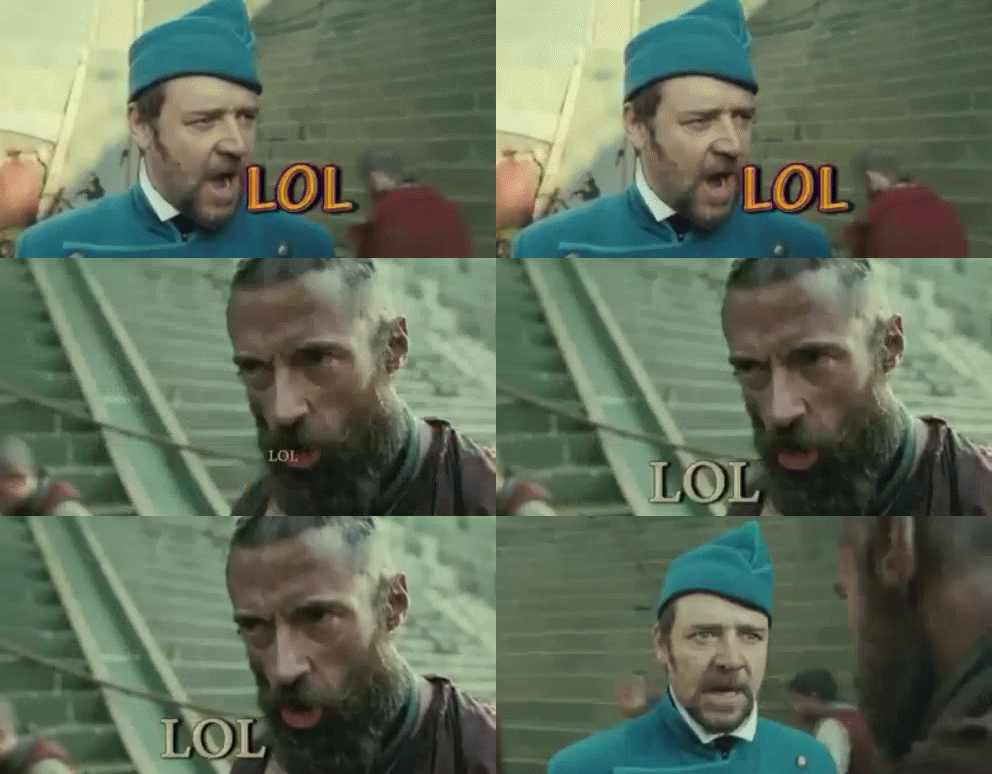
Johnny Depp and Burton’s wife, Helena Bonham Carter, are not great singers, but they are great actor/singers (Depp took singing lessons and was nominated for Best Actor), a feat Russell Crowe could not accomplish in Les Miserables, as is evident in “My Friends.”
Speaking of Les Miserables, Depp and Bonham Carter are quite good, but they need merely convey anger, sarcasm, and bloodlust. If I’m going to knock Crowe, I have to laud Anne Hathaway and Hugh Jackman whose first numbers, sung live on set (using live piano accompaniments played through earpieces), are perhaps the most moving in musical film history.
Depp and Bonham Carter are ably supported by a moving Edward Sanders as Tobias Ragg and a hilarious Sasha Baron Cohen as the competing barber, Pirelli.
One nit is the unnecessary bloodiness of the throat cutting, which was accomplished with a mere splash of red in the stage play. It’s discordant. Another is inherent in the play, which is so dark as to be dispiriting.
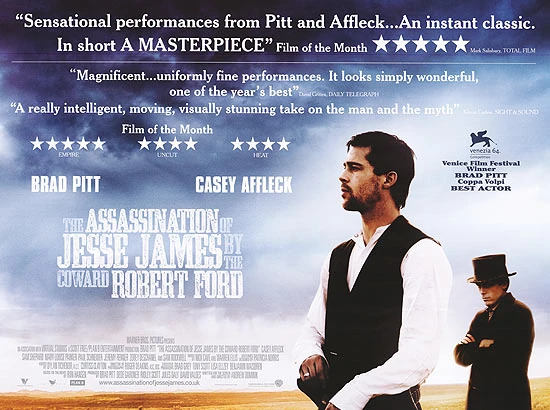
Andrew Dominic’s moody, elegiac picture melds Terence Malick’s imagery from Days of Heaven and Walter Hill’s sense of time in The Long Riders. As Ford, Casey Affleck is mesmerizing, and Brad Pitt’s depiction of James as a manic-depressive sociopath is chilling. Their performances are enhanced by Dominic’s sweeping, beautiful vistas (the film drew an Oscar nod for best cinematography) and a mournful score courtesy of Nick Cave and Warren Ellis.
A $30 million western without a single shootout (at least, one involving Jesse James) is destined to make a mere $3 million back domestic, but this film is more about hero worship, fame-seeking and insecurity than the violent exploits of the James gang. Affleck, who was nominated for best supporting actor, subtly communicates living in the shadow of Jesse James, traversing the path from awe for a legend, to anger over his idol’s coldness and indifference, to maturation and resolve as James becomes more suspicious, mercurial and dangerous. Ford’s likening of himself to James in the great killer’s presence, which can be found below, is startling in its honesty and vulnerability.
Affleck and Pitt receive strong support, including Jeremy Renner and Paul Schneider as feuding gang members, but as ever, Sam Rockwell near steals the picture as Charlie Ford, playing dumb but in truth, whipsmart and canny. Garret Dilahunt (Deadwood) is also resonant as a doomed and dim Ed Miller.
Upon first review, I wrote, “a glaring fault is an unnecessary voice over narrative, the voice being similar to that of David McCullough. The effect is redundancy and a PBS/History Channel vibe.” I also gently criticized the picture on its length. I recently saw it again and I was wrong on both counts. The voice over is not obtrusive nor is it merely aping what is happening on screen. Rather, it enhances the film’s tragic nature (this is a ghostly western and a movie about one of the first celebrity screw-ups) with an explanation as to how it fits historically and personally. And I was sorry to see it end no matter how long it ran.
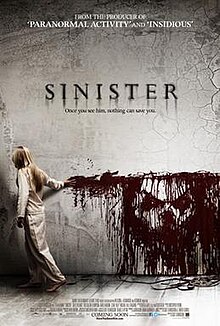
Ethan Hawke is a true crime writer on the down slope who moves his wife and kids into the house where the grisly murder of another family occurred. His m.o. is to solve the case or to at least highlight the screw-ups of the authorities.
The funny thing is, he doesn’t tell his wife or two children he’s moved them into a house where grisly murders occurred, he finds Super 8 film of the grisly murders and the grisly murders of numerous other families from other areas throughout the country in the attic, his teen son is flipping out from night terrors, his lights don’t work, there are horrible thumps in the attic (and a snake and a scorpion), he sees a creepy dude in the yard who he has also seen in the Super 8 films, and his kids start drawing gruesome images of dead children. And his wife sleeps the sleep of a thousand nights, even though, during the day, she’s understandably nervous about this whole situation.
And he stays because “This could be my In Cold Blood.”
It is a testament to M. Night Shyamalan’s clout after The Sixth Sense that he could get such a deliberate and meditative film made. Bruce Willis is a Philadelphia security guard, an ex-jock in a crumbling marriage with Robin Wright. His son is overly attached to him, sensing in his father something special and perhaps dangerous. After Willis emerges from a horrific train wreck as the sole survivor, with nary a scratch, the son’s suspicions are confirmed by the appearance of a comic book aficionado (Samuel L. Jackson) who leads Willis to a great revelation. It’s an old movie, but to discuss it further substantively would be an injustice. Before Shyamalan became a slave to big twists and reveals that became increasingly ridiculous, from aliens who invade earth but for whom water is acid (Signs) to an eco-counterattack where trees make people commit suicide (The Happening), he could deliver some truly effective codas, and Unbreakable contains my favorite.
Great ending aside, the story is original and sophisticated, Shyamalan’s Philly locales are lovingly chosen and spooky, Willis is the perfect choice for a regular Joe who soon learns he is anything but, and Jackson projects brilliant obsession. The penultimate scene, where Willis tests his new incarnation, is one of the more frightening I’ve ever seen.
The studio and Shyamalan had to have been disappointed by the latter’s sophomore effort. While it did very well overseas, its domestic gross exceeded budget by only $15 million compared to The Sixth Sense‘s $250 million. But Shyamalan had to know that such a painstaking, personal film would not garner an expanding mass audience, even if the studio didn’t.
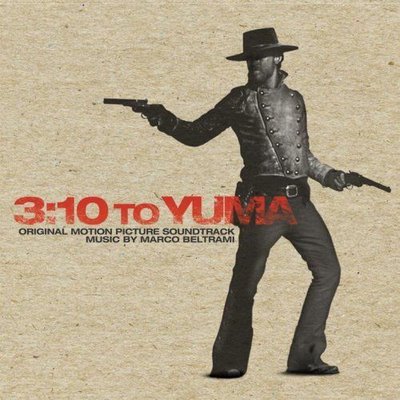
A barely competent remake, James Mangold’s follow-up to Walk the Line pits brutal and charming highwayman Ben Wade (Russell Crowe) against desperate and pitiful rancher Dan Evans (Christian Bale). Bale is scratching a living out of the barren Arizona earth, debilitated by a war injury, harassed by a businessman who wants his land for the railroad, and scorned by a 14 year old son (Logan Lerman) who thinks his father is a coward. When his path crosses with Crowe, Bale takes the high-paying gig of joining a crew ferrying Crowe to town and on the train to justice, harried the entire way by Crowe’s gang, led by Charlie Prince (Ben Foster). Unfortunately, Bale is so stolid he borders on dull, and Crowe’s lethal charm is in short supply, though he does have a moment seducing a local barmaid.
Mangold keeps the story crisply moving and his action sequences are first-rate. While the leads don’t shine, the support is strong. Foster’s serpentine, scary right hand is matched by the crusty and seemingly indestructible Pinkerton subcontractor Peter Fonda and the precise Dallas Roberts as the main Pinkerton and leader of the endeavor.
The film, however, is nearly undone by an implausible ending wherein Crowe and Bale bond through a series of mutual confessions (Crowe’s mom abandoned him, Bales was shot by his own man in the war, and Bales’s son is sick with tuberculosis) and Crowe repents, assisting Bale in his own ferrying to the hangman’s noose.
George Miller’s frenetic, creepy vision of a future where a version of The Wild Ones terrorizes the roads is a confident, distinctive picture made all the more impressive by its paltry $400,000 budget. Miller went on to make The Road Warrior, cementing Mel Gibson as the most bankable of stars, but in Mad Max, Gibson barely resonates until he is transformed, ala’ Charles Bronson in Death Wish, into a silent, dispenser of retributive violence. His payback is gripping, played out on a widescreen lens at high speeds on the desolate roads of Australia. Still, the picture stops dead in its tracks halfway through as we wait for the brutal thugs of the road to incur Gibson’s rage. It is also the worst scored film in the history of movies, a blaring and bizarre Bernard Hermann knock-off.
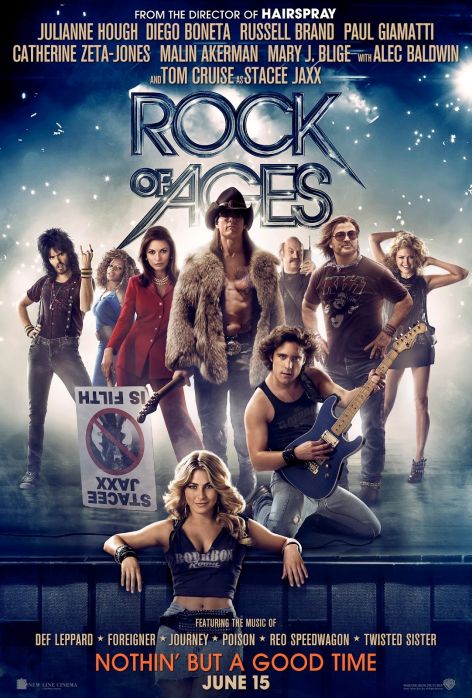
I saw the original Broadway play, which was fun, silly and wholly dedicated to some of the worst hair metal and pop of the 1980s. The play sensed your patience and came in at 90 minutes. The movie is an interminable 2 hours and actually adds more awful tunes, playing many of them straight.
The film takes the tongue-in-cheek silliness of the play and reduces it to reverential lip synching and air guitar. I was immediately reminded of Julie Taymor’s underrated Across the Universe, which cut a swath through the 60s with Beatles hits and brilliant, kinetic choreography, and still just came up a little short. Here, we get crappy tunes played with sincerity and nary a dance sequence beyond finger snaps and flash mobs. Alec Baldwin, Paul Giamatti, Russell Brand and Catherine Zeta Jones (a zealot Tipper Gore bent on shutting down the latter’s rock and roll world and club in LA) camp their way lazily through this thin flick, with a few winks (isn’t Michael Jackson getting pale?) and not much more. Glee blows this away, and Glee sucks (director Adam Shankman actually graduated from directing this awful film to directing . . . Glee). Tack on the star crossed leads, two nobodies so boring I didn’t bother to look them up for this review, and the disaster is complete. The one star is for Tom Cruise’s turn as Stacee Jaxx, the dissolute rock god, who busts his ass in a lost cause. He always gets an A for effort.
Beautiful, sumptuous and deservedly nominated for production design, costume design, and cinematography Oscars, the film is also leaden and dull. There is no burning desire detectable in the icy, mannered Keira Knightley, and her illicit romance with the fey Aaron Taylor-Johnson (Kick-Ass, Nowhere Boy) is unconvincing. The lush production is soulless and a bit gimmicky, replete with a dance sequence that recalls Tony and Maria in West Side Story (minus the passion), and a distracting movie-within-a-play depiction. Very pretty and little else. Knightley is preeternaturally girlish. She cannot convey having lived long and rich enough to put it all on the line for an adulterous love, so she opts for Anna as bipolar.
Frank Langella lives alone in the country a few hours from New York City. He is slowly succumbing to Alzheimer’s, functional but slipping, and at first, appears to be little more than a forgetful, petty thief of decorative soaps sold in the town’s gift shop. When his son (James Marsden) brings him a robot for company and guidance, we learn that Langella was once a second story burglar who did two stints in prison. He loathes the robot until he learns it has no conscience. A friendship develops, and soon, the robot is acting as his accomplice in a jewel heist.
The movie is clever, often touching, and a bit subversive. There is a hilarious section where Langella’s anti-robot daughter (Liv Tyler) visits. Horrified at her father’s reliance on the robot, she turns it off, only to surreptitiously turn it on when she wants the house cleaned.
Though the film is set in the not too distant future, the credits are accompanied by clips of the work robots are currently doing (or being designed to do) for humans, and the future is now.





 filmvetter