Archive

Drama

The Last Samurai - Wikipedia

Tom Cruise is a dissipated, drunken Civil War vet who slaughtered women and children Indians (at the evil Tony Goldwyn’s behest) and must atone and “find himself” in the mystical East.

I’m not a Tom Cruise hater.  His effort is incomparable and he’s a star, in that, most everything he does on screen, if not interesting, is watchable. But he has two huge drawbacks.  First, he’s eternally youthful and thus, cannot effectively be world-weary.  Second, he is just weird in period pieces.  I didn’t like Cold Mountain, but Jude Law struck me as a man of his time and thus lent the film authenticity.  Cruise, on the other hand, is hopelessly 21st century and appears on the cusp of saying “Dude” a few times.

He is not helped by this hackneyed, American-hating, simplistic piece of garbage that is the script.

Image result for LA Confidential

A byzantine noir potboiler set in post-war go-go America, rich in gangsters, drugs, sex and corruption, this is one of my favorite films and an excellent adaptation of James Ellroy’s classic novel.  I’m re-posting because I just noticed it is available streaming on Netflix.

Depth, pacing, and authenticity – the flick has it all.  The three main characters are rich and finely drawn.  LAPD Lt. Edmund Exley (Guy Pearce) is half ambition, a quarter condescension, and a quarter insecurity.  Anything he fears he must best, even destroy.  He fears fellow cop Bud White (Russell Crowe), who is outwardly all muscle and frontier justice.  So he testifies against White in a brutality scandal to have him kicked off the force.  White survives Exley’s testimony, but White’s partner does not, and thereafter, White seethes with hatred and desire for payback.  When they become entwined in the same investigation, a mass shotgun slaying which claims White’s disgraced partner, they clash, and yet, they are forced to work together.

Prior to formation of the uneasy alliance, White tries to tear Exley’s head off.  Their supervisor, Captain Dudley Smith (James Cromwell) intervenes in an exchange that typifies the dialogue:

DUDLEY SMITH: It’s best to stay away from the lad when his color is up.

ED EXLEY: His color is always up.

DUDLEY SMITH: Then perhaps you’d do well to stay away from him altogether.

A third detective, Jack Vincennes (Kevin Spacey), rounds out the trio.  I saw Spacey on Inside the Actors Studio and he said that he patterned Vincennes on Dean Martin in Rio Bravo.  It shows.  Spacey’s Vincennes alternately swaggers and hunches, bravado followed by just a little shame.  He’s corrupt, he’s good at being corrupt, and corruption has made life easy, but he is torn between the celebrity and easy cash and the guilt his choices have brought him.  In a film that is so sweeping, Spacey has little time to make the transition from crook to clean.  But he does it in a very brief scene, alone, at a bar, as he eyes a $50 bill (a payoff from the slimy editor of the scandal rag Hush, Hush, played by Danny Devito).  Spacey looks at the bill, sees his face in the mirror, places the bill on his shot, and leaves to do the right thing.  It’s a beautiful, economical moment.

Kim Basinger won the Supporting Actress Oscar as the high class prostitute who captivates Bud White, and while she’s sleek, sultry and affecting, every other major performance is better than her own and more deserving of accolade.

The care taken by director Curtis Hansen (who we sadly lost in 2016) is evident in every scene, be it a jail melee’, a triple interrogation, or a stunning shotgun shootout.   Hansen is straightforward and confident, and the picture positively hurtles but it never feels pell mell.  Save for some gentle interplay between Basinger and Crowe,  the movie is quick, sharp movement, punctuated by real or verbal violence.   It never, ever drags or becomes self-indulgent.  You love what you are seeing but want it to be over because you want to see more.

The film also oozes the L.A. of the time period. It feels right and looks better (for the opposite – a tacky, awful, ridiculous L.A. film –  see Mullholland Falls). 

A Serious Man.  I consider Fargo and No Country for Old Men to be two of the best films ever made.  The only resemblance the Coen brothers’ Oscar-nominated film, A Serious Man, bears to those films is attention to detail and the potential evocation of outrage from a distinct group (in Fargo, Minnesotans took umbrage at their farcical portrayal; here, it should be Minnesotan Jews circa 1967).  A Serious Man beats up on its protagonist, a Jewish professor with cretins for children, a disloyal shrew for a wife, cartoonishly unhelpful religious guidance, and various other unpleasant people who vex him, including a disgusting uncle with a cebacious cyst he must drain on a regular basis.  Apparently, the protagonist is cursed, a curse handed down from his Polish ancestors, but the curse appears to be the fact that he’s Jewish.  The moment it appears he can get out from under, the curse strikes again, and the film ends abruptly.

This is an unpleasant, frustratingly tedious film that may have served as some sort of the therapy for the Coen brothers (they grew up in St. Louis Park, Minnesota, a suburb of Minneapolis, in the 60s).  It has few other attributes and they shouldn’t have worked out their issues on us.

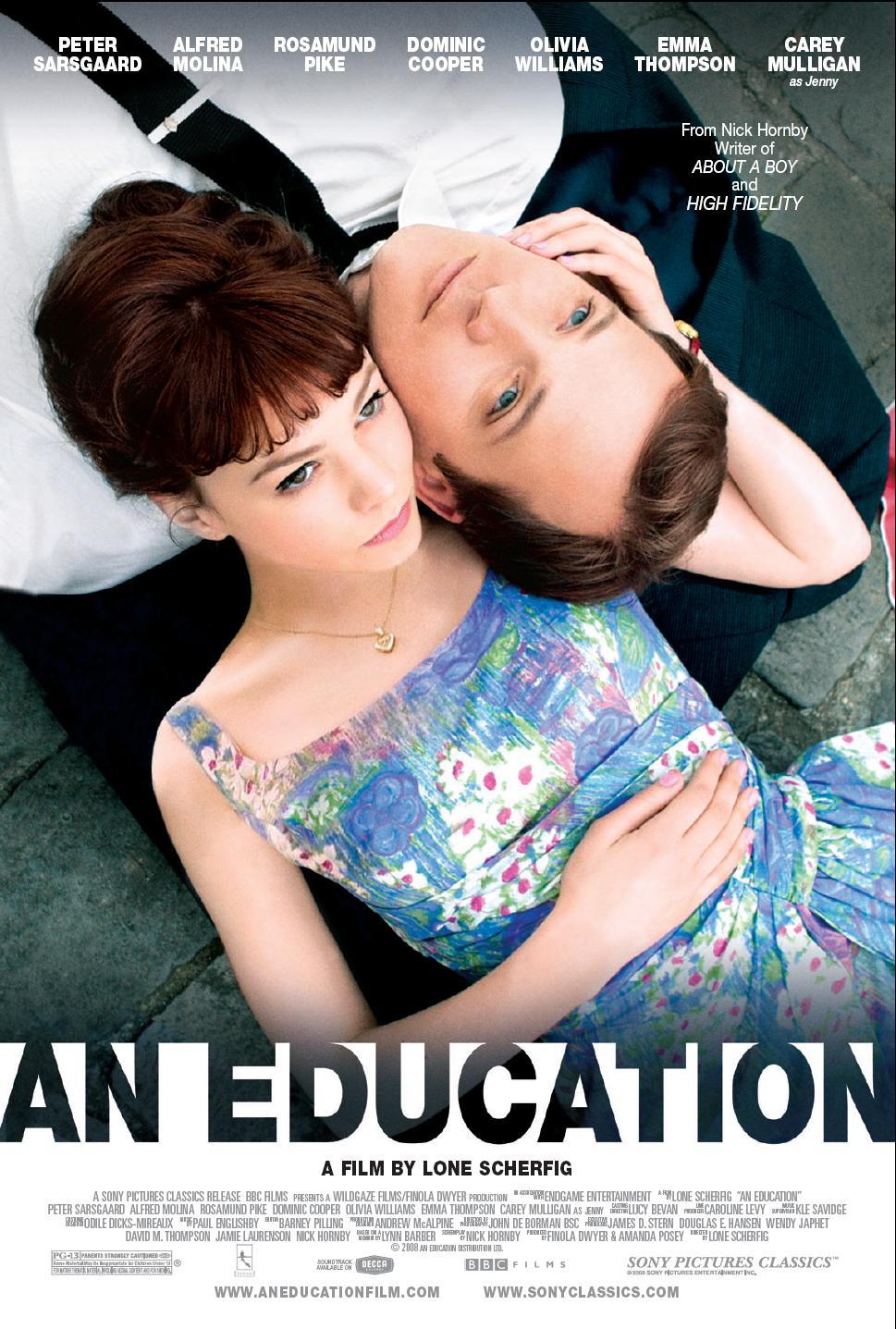
An Education (2009) - IMDb

A fine period (1961 Twickenham, London, Paris) and coming of age piece, anchored by a very engaging Carey Mulligan as a 16 year old schoolgirl who dreams of Oxford until she is swept off her feet by an older, debonair man (Peter Sarsgaard).  She is nearly derailed by his machinations and the misguidance of her parents, who want to protect her but also want her to be happy (and presumably, not like the protagonist in McCartney’s “She’s Leaving Home”).  Scripted by Nick Hornby and directed by Lone Scherfig, who has a knack for the travails of young women in earlier times (see Their Finest).

But this is no more than a nice little film, and the idea that it was nominated for Best Picture is just one more example of the awkwardness of ten such nominations.

Big Fan (2009) directed by Robert D. Siegel • Reviews, film + cast •  Letterboxd

Patton Oswalt gives a helluva performance in this grim film, one that surprises given the picture’s refusal to have its main character validated or bettered.  Oswalt is a 34 year old Staten Island parking garage attendant who lives with his mother and eats, breathes and exists for the New York Giants. He is so committed he writes prose in his booth, in particular, a speech he will give nightly to a sports radio station on behalf of his team.  When he sees his idol (a Giants linebacker), it is like seeing a super hero, and he follows him to a strip club, where things go horribly wrong.

This is a strange and quirky picture, and it rises on Oswalt’s fealty to his bizarre code. His loyalty is not to himself, his lone friend (the always down-to-earth and believable Kevin Corrigan, who at this juncture should be in The Supporting Character Actor Hall of Fame), his family, or justice, but always to the team, which is nuts but also endearing, and given his loneliness, understandable. Oswalt is actually quite moving in a “Travis Bickle meets Jim Rome” way.

You also get a different view on why certain people smash their TVs,  brawl, or become hysterical when a team to which they have no foundational connection other than geography loses.

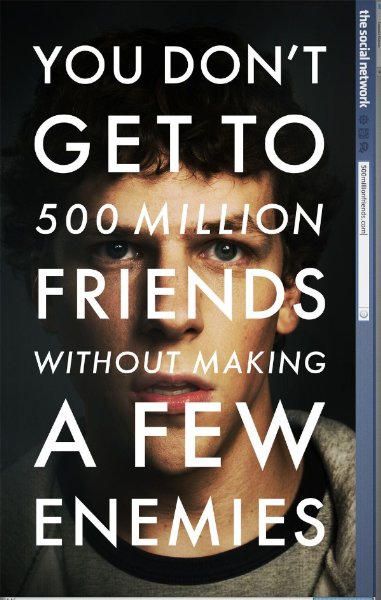
The Social Network Reviews - Metacritic

Brilliantly acted, expertly paced, endlessly fascinating, topical and armed with an Aaron Sorkin script shorn of the rat-a-tat cutesy, this film was by far and away the best picture of 2010, with a story that sucks you in immediately.  The protagonist, Mark Zuckerberg, is one you alternatively love and hate, but you always care about.  The loosely historical rise of Facebook in the setting of Harvard is about as fertile ground as you can find for a character rich story of treachery, honor and greed.  There is not a false note (save for the final scene, where a second year law associate tells Zuckerberg the score, but I niggle) or a stock character and your allegiances are constantly tested.

David Fincher, who last directed the masterpiece Zodiac, has made a masterful film.

Like most Darren Aronofsky movies, this is alternatively unpleasant and mesmerizing.  This story of a virginal and mentally disturbed ballet dancer who has been given the plum twin roles of the white and black swan in Swan Lake, you might be more interested in the ballet than the story, as it centers on Natalie Portman, who appears marginally more intelligent and interesting than your average runway model, but only marginally.  Because you don’t invest in her, the film ends up being a lot of visual game playing, a steamy lesbian scene between Portman Mila Kunis, and little more.

Winter's Bone (DVD) - Walmart.com

A rough, gritty picture about a girl (Jennifer Lawrence) living a bleak life in the hills of Missouri.  Her father is a crank processor who put up the family land for bond and has gone missing.  Accordingly, it is up to his daughter to navigate the familial bonds and brutal reality of her surroundings to find him and convince him to appear for trial.  Her journey takes us to the core of a back hills and backwards society that in many ways echoes the distrustful, independent and dangerous world of Walter Hill’s The Long Riders, although the setting is modern day.  The film also echoes James Foley’s At Close Range, giving an insight into a foreign criminal world in our rural midst.  Gripping and authentic, and Lawrence gives one of those assured performances that portends stardom.

The King's Speech - Movie Review - The Austin Chronicle

If not exceptional, the film is a competent and beautifully appointed period piece. The Oscar nominations of Colin Firth and Helena Bonham Carter are well deserved.  As King George, Firth encapsulates the insecurity and terror of a man thrust into power who fears he will be found wanting, or even an imbecile, such is his speech impediment. As Firth’s wife, Bonham Carter deftly plays the role of droll, drawing room observer as well as the rock that supports her husband. Their bond is authentic.

The interplay between George VI and his speech therapist (Geoffrey Rush) is funny and very well written, and the introduction of modern psychology to the era’s infantile methods of treatment for the speech malady is interesting.

Guy Pearce also contributes as the callow Edward, leaving his brother and country in the lurch for that Baltimore tramp.

Time Magazine's 'Person of the Year' since 1927 | Wallis simpson,  Socialite, Wallis

I picked up The American mainly because it starred George Clooney and he had a gun in his hand on the DVD cover. So, on me.

There is a lot wrong here.  Foremost is Clooney, miscast as an emotionally detached killer-sort. Steve McQueen, sure. But not Clooney, who mistakes emotionally detached with catatonic.

He plays a killer and/or facilitator for killers who has to hide out in the most picturesque town in Italy.  There, he demonstrates that he is a spartan and a loner, because, well, he is alone, has no pictures in his apartment and does a fair amount of sit-ups and push-ups. Of course, he strikes up a friendship with a priest, who pushes him a little morally, and a prostitute, who, given how attractive she is, should charge $50,000 a roll.

George a gent for Violante sex – The Sun

And, yes, he decides it is time to “get out.”

The film is overbearingly serious, and chock full of tropes, like, oh, he kissed a prostitute on the mouth and went down on her = love.  And then he was in a shoot-out and won, and got in the car, and . . . is that blood?  Oh my God!  He was so in shock and it was all so crazy, he didn’t even know he’d been shot in the gut until he was driving a a mile out of town.

This guy is really . . . detached.

And “they” won’t let him “out.” Why?  Unsaid, unexplained. Apparently, it’s enough to say “I’m out” and then some really serious French dude makes arrangements for you to be offed.

I wish I could have gotten out too. But no.