Archive

Crime/Mystery

Related image

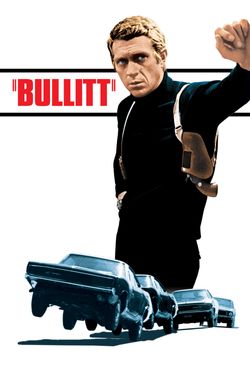
Peter Yates’ 1968 detective thriller is a medium cool exercise in restraint propelled by the quiet, canny performance of Steve McQueen as Detective Frank Bullitt. Bullitt is assigned to protect a mob witness by an ambitious D.A. (the charmingly oily Robert Vaughn) and the case goes bad.  As he tries to salvage the situation, we learn about Bullitt’s relationships, methods and character, all with less than 100 words from our hero.

The picture is notable for an over 10 minute car chase in and around San Francisco that alternates between chess match and smash up derby. The effect is mesmerizing, an automotive ballet, which is in many ways more impressive than William Friedken’s bid to outdo it in The French Connection three years later (the car chase wasn’t the only influential set piece; Bullitt has an extended chase scene on foot through the exterior of the San Francisco Airport, which Michael Mann reprised in Heat).

The film also demonstrates why Steve McQueen is such an icon. The debates over his ability to “act” are legitimate.  The “movie star versus actor” discussions invariably arise in consideration of  impossibly macho or attractive leads, such as Wayne, Eastwood, Redford and Gibson. Debate aside, McQueen so resonates on screen that discussing his skills as a thespian seems like quibbling. There is something to be said for understatement (Tom Cruise may just be learning that now).  McQueen can do more with a look or eating a sandwich than a lot of folks can with a soliloquy or stem winder.  When he is poorly imitated (see the catatonic Ryan Gosling in the wildly overrated Drive or George Clooney in The American), his charisma and presence become all the more apparent.

Yates’ film is a bit of a jazz riff and some of his shots are annoyingly showy, but hey, it’s 1968 San Francisco and Bullitt’s girlfriend is the chic and arty Jacqueline Bisset.  So, he gets a pass.

Blood Simple (1984) - Rotten Tomatoes

Al Pacino once explained his attraction to a project by tapping his finger to his temple and noting that the director had “a vision.” That director was Warren Beatty and the project was the bloated Dick Tracy.

The Coen Brothers’ first film demonstrates a true vision, one that has it flaws, but one that is unique and rich, through and through – a sun-drenched, steamy Texas noir potboiler that evokes Jim Thompson and James Cain, updated to include a very sly, dark humor. The plot takes numerous turns, but it is simple in its introduction.   A bartender (John Getz) runs off with the wife (Frances McDormand) of his boss (Dan Hedaya), who in turn puts a lethal private investigator (M. Emmett Walsh) on their trail. Walsh introduces the story in voiceover:

“The world is full of complainers. But the fact is, nothing comes with a guarantee. I don’t care if you’re the Pope of Rome, President of the United States, or even Man of the Year–something can always go wrong. And go ahead, complain, tell your problems to your neighbor, ask for help–watch him fly. Now in Russia, they got it mapped out so that everyone pulls for everyone else–that’s the theory, anyway. But what I know about is Texas…”

What follows is the twisted story of these four characters against the backdrop of a flat, unforgiving landscape. The photography is stunning, and the camera-work is assured, if sometimes a bit too film school flashy (as McDormand and Getz confront each other at his front door, a slo-motion newspaper crashes against it to startle us all). Composer Carter Burwell started his partnership with the Coens on this film, and his score is primarily solo piano, sparse and ominous.  Hedaya is the embodiment of the cowardly cuckold, but he seethes, almost a human pressure cooker. Walsh’s sleazy dick is repellant. He almost oozes, but he’s canny, using his “aw shucks” as a way to get the advantage. Getz and McDormand are weaker. Getz just doesn’t project and while I respect the Coens for eschewing the expected sultry, bored kept woman, McDormand’s character requires some charisma and sexuality to justify the risks taken on her behalf. She’s never been that kind of actress and here, she’s flat.

Still, this is a very good film, and as a debut, it’s all the more impressive, presaging the brilliance of Fargo.

To Live and Die in L.A. - The Best Movie You Never Saw

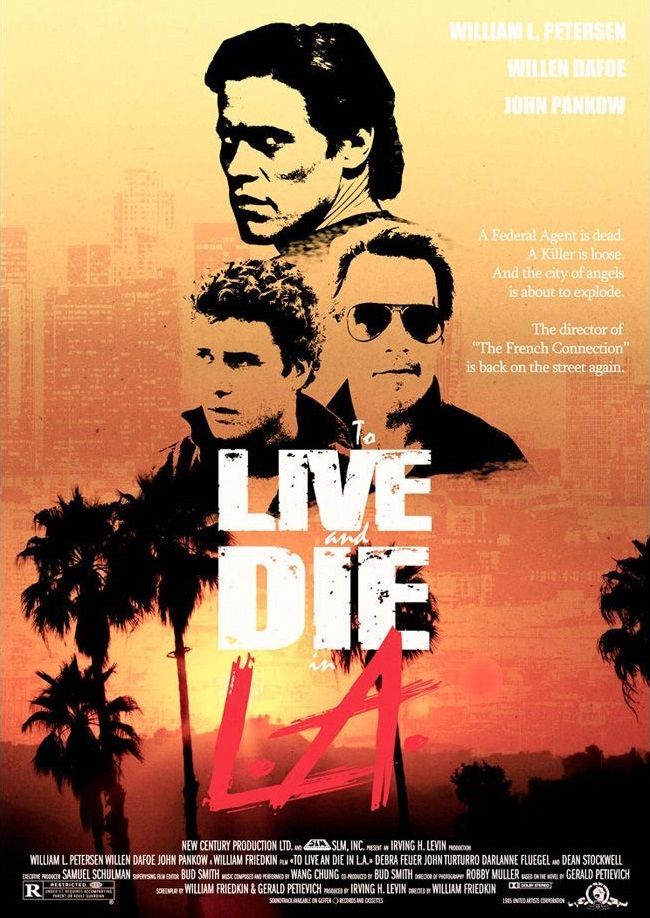
During AFI’s recent LA Modern series, we were hoping to see William Friedken’s picture on the big screen, but schedules wouldn’t permit, so we settled for a Netflix rental.  Friedken’s modern crime noir tracks Secret Service agents William Peterson and John Pankow as they hurtle through a maelstrom in an effort to bag master counterfeiter and killer Willem Dafoe. Their zeal seals their doom.

It’s a more than competent thriller, with a few problems.  Peterson’s adrenaline junkie character is too one-dimensional, and the screenplay (written by a former Secret Service agent and Friedken) can be awkward in its reliance on hyper machismo, tough guy patter (“You want bread?  Fuck a baker!”) or even hackneyed (“I’m getting too old for this shit”).

But the second half of the movie overcomes a lot of the weaknesses of the first, as Peterson and Pankow are revealed to be screw-ups in the ultimate clusterfuck. As they dig deeper, Pankow enlists the aid of Dafoe’s own lawyer, a confident but slightly oily Dean Stockwell, and it is a revelation to see the portrayal of a cop who is probably took weak for the job. Meanwhile, Dafoe proves less efficient than his stylish demeanor suggests and his errors eventually become too much to bear. Dispensing with super cops and criminal masterminds results in a much more satisfying picture.

Friedken also includes a boffo car chase after a heist gone bad in homage to his own The French Connection, and all of his action scenes are non-stylized and immediate (my son observed that the flick has to hold the record for guys shot in the face at 3). Notably, and in keeping with its inclusion in the AFI series, the locations are almost exclusively sun-bleached and bleak industrial LA, a rarity.

Finally, if you were a Wang Chung fan, this is your movie.

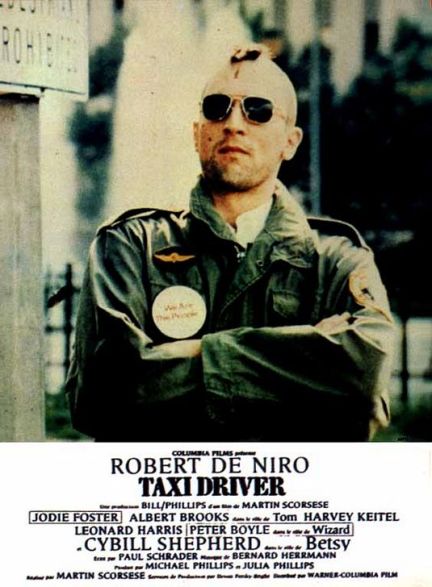
I was surprised to see several things in my recent re-viewing of Martin Scorsese’s classic, including Albert Brooks as the exact same character he has been playing for nearly 40 years; Scorsese himself making a Hitchcockian appearance in the background, but then taking a significant one-scene role as a lunatic in the back of Travis Bickle’s (Robert DeNiro) cab, suggesting he changed his mind about how much time he would spend in front of the camera; and the effectiveness of the score, which was Bernard Herrmann’s last one.

That aside, it holds up as the classic it is considered (47 on AFI’s Top 100). Scorsese’s New York is a modern hell.  He shoots the city so it almost reeks. Steam pulses out of the grates, rot is everywhere and kindness is non-existent (I couldn’t get a fantastic book, “Ladies and Gentlemen, the Bronx is Burning” out of my mind).  The viewer is immediately in kinship with Bickle’s voiceover, “All the animals come out at night – whores, skunk pussies, buggers, queens, fairies, dopers, junkies, sick, venal. Someday a real rain will come and wash all this scum off the streets.” Bickle is a Vietnam vet who can’t sleep and teeters on the edge of sanity. When he falls for a campaign worker (Cybill Shepherd) merely by viewing her through a plate glass window, it seems creepy only until he approaches her, and then there is charm and hope. He is similarly touching with teen prostitute Iris (Jodie Foster), passionately replying to her taunt that he is a square: “Hey, I’m not square, you’re the one that’s square. You’re full of shit, man. What are you talking about? You walk out with those fuckin’ creeps and low-lifes and degenerates out on the streets and you sell your little pussy for peanuts? For some low-life pimp who stands in the hall? And I’m square? You’re the one that’s square, man. I don’t go screwing fuck with a bunch of killers and junkies like you do. You call that bein’ hip? What world are you from?”

But they are from the same world. Bickle is not wired right, he sabotages himself with Shepherd, and soon, he retreats into the mode of a dangerous and unstable assassin, one who has gone from observer of the inferno to an extinguisher. Ahead of its time, Bickle’s would-be John Hinckley gets a Bernie Goetz makeover, cementing Scorsese’s theme that in the jungle, there’s often but a hair between hero and lunatic, moral beacon and dysfunctional threat. Woody Allen’s Blue Jasmine doesn’t seem a natural comparison to Taxi Driver, but in essence, when it ends with Cate Blanchett in rumpled clothes, talking to herself in the park, the directors are exposing the same reality.

The Silence of the Lambs - July 11th, 2020 at Lefty's Drive In!

My son is headed off with his pals to see The Silence of the Lambs tonight, courtesy of AMC theaters’ occasional screenings of older films. I saw it with him a few weeks back and I think he’s looking forward to watching it again in the theater as much as witnessing the reaction of his friends.

Jonathan Demme’s masterpiece is one of the few films that focuses on the serial killer but doesn’t give way to excess. What we know about Hannibal Lecter (Anthony Hopkins) is simple: he is locked up for eating people; he is brilliant and fascinating; and he is lethal. When a serial killer, Buffalo Bill (Ted Levine) starts to plague the Ohio, Pennsylvania, West Virginia area, FBI profiler Jack Crawford (Scott Glen) sends a trainee, Clarice Starling (Jodie Foster), to elicit any advice from Lecter. Starling and Lecter use each other for their own ends, engaging in a thrilling psychological dance that is one part therapy and one part mental combat; she seeks to stop Buffalo Bill while he waits for a slip-up.

The Silence of the Lambs is so well-paced and taut that on occasion, you are near-breathless. There is only one pause in the film’s very serious, unrelenting tone (when Starling is “hit on” by two geek entomologists with whom she is consulting). The pressure is not only from Lecter and Buffalo Bill, but from Starling’s lack of experience, harrowing childhood, and even her gender and diminutive physicality.  The odds seem uncomfortably stacked against her.

The exchanges between Hopkins and Foster are electrifying. You can see just how dangerous Lecter is and near curse yourself for being charmed by him. Yet, you root for the seemingly overmatched Starling, and when she stumbles, you feel the sting of her awkwardness. When Lecter so easily assesses her background and her sexual desires, it is excruciating. Yet Starling comes up to speed and achieves a plausible parity.  Levine is also expert as the tortured, frightening Buffalo Bill, and his transformation to “normal” when he is questioned is a chilling addition to this “monsters among us” story.

The picture is one of only three to win Academy Awards in all the top five categories: Best Picture, Best Actor, Best Actress, Best Director, and Best Writing (Adapted Screenplay), and deservedly so.

After seeing Harper as part of the AFI Silver LA Modern series, me and my son watched Paul Newman’s follow-up turn as Ross McDonald’s P.I. in 1975’s The Drowning Pool.  Lew Harper finds himself in New Orleans in the middle of a scandal involving an ex-love (Joanne Woodward), a sleazy oil man (Murray Hamilton) and a protective local police chief (Tony Franciosa).  Newman again gives an infectious star turn as the cynical but funny private detective brought into to town by Woodward to get to the bottom of her being blackmailed.  When Franciosa is impressed by his $150 per day plus expenses rate, Harper explains that it isn’t all that much when you work four days a year.

But the picture lacks too many elements that made its predecessor so good.  New Orleans ain’t LA, and while there is a certain fish-out-of-water charm to Harper’s investigation, the setting feels off.  The score is also very cheezy, alternating between musical interludes worthy of a Mannix or Barnaby Jones and an annoying symphonic riff of Roberta Flack’s “Killing Me Softly”.   Worse, Joanne Woodward’s Louisiana drawl is borrowed straight from The Long Hot Summer.  She’s ridiculous in her theatrics and a terrible replacement for Janet Leigh as Harper’s love interest. Hamilton does his best to give his character some flavor, and an 18 year old Melanie Griffith is an alluring near-jail bait, but most everyone else is either histrionic or blah.

While Woodward is a step down, Griffith as the poisonous Lolita is a significant upgrade from Harper’s Pamela Tiffin.

And a reminder of the horrors of plastic surgery.

Very much like Goodfellas, but with a broader palette and more compelling characters. In Goodfellas, Liotta, DeNiro and Pesci are sharks, swimming to survive and devour, and the peek Martin Scorsese gives us into their immoral, brutal world is such a dizzying kick, we tend to forget that these brutal archetypes are no more than that. In Casino, Scorsese aims higher. DeNiro’s Sam Rothstein is not just an Irish street thug, but instead, a wunderkind Jewish bookie who is handed the keys to the cash cow for the mid-West mob – the Tangiers hotel (funded, of course, by union pension money) in 70s Las Vegas. DeNiro finds his oasis in the desert and works to re-create himself as a solid citizen. His efforts are doomed to fail, however, because no executive title, country club membership, or professional success can sanitize the shit on his shoes. He’s still just a functionary effectuating the skim just like when he was picking Oklahoma, taking the points. But DeNiro’s self-deception is absolute. At one point, he even hosts a casino television show which he devotes to exposing the raw treatment he has received at the hands of the local politicians who have forsaken him, ala’ Lenny.

When DeNiro feigns respectability, his protector, Nicky Santoro (Pesci) is always around to puncture his pretensions. In one of my favorite scenes, Pesci accuses a silk robe wearing, cigarette holdered DeNiro of walking around like “fucking John Barrymore.” It is Pesci’s presence that ensures DeNiro’s success (he muscles out any competitor or threat) as well as his demise (every Pesci excess is linked to DeNiro). And DeNiro is incapable of truly weaning himself off of his criminal past. As he cannot reform or blunt Pesci, he uses him to bring his conniving wife (Sharon Stone) to heel. Stone was a working girl who DeNiro hoped to take with him on his journey to polite society, but she was no more malleable than Pesci. DeNiro is, rather strangely for a Nicholas Pileggi/Scorsese character, a romantic, opening the film with “When you love someone, you’ve gotta trust them. There’s no other way. You’ve got to give them the key to everything that’s yours. Otherwise, what’s the point? And for a while, I believed, that’s the kind of love I had.” So you invest in him. His inevitable tragedy is unsurprising yet moving.

Scorsese’s use of music is, as always, impeccable, and the fluid camera-work manages to convey not only the mechanics of Vegas but the exhilaration of the town. Moreover, the film’s ending lament about its corporatization is one of his few codas to a Scorsese film supported by what preceded it.

If there is a weakness, it is in the last third of the film, where the dissolution of the DeNiro-Stone marriage is exhausting and a bit tiresome.  That identified, this is a great film and certainly a top ten American crime picture.

Robert Altman’s send-up of Hollywood process and morality opens with an audacious 7 minute, no-cut scene that is a primer on economical, fluid exposition. We meet most of our characters, including the studio’s no. 2, the writer’s executive, Griffin Mill (Tim Robbins), and the tone is set.  Unfortunately, Altman cannot fulfill the promise of his introduction. Robbins’s star is falling and he is also being threatened via postcard by a writer he has brushed off. Unnerved, he sets up a meet with who he believes to be his stalker, accidentally kills him and then falls in love with the writer’s girlfriend (Greta Scacchi). The murder is implausible and the heat-of-the-moment relationship unconvincing (a love scene with Robbins and Scaachi is not so much hot as uncomfortable). Robbins is way too mannered and standoffish to elicit empathy, and the film swerves artlessly from suspenseful to broadly comic (Whoopi Goldberg is very funny as the investigating detective, but she’s too funny).

On the plus sides, we are treated to a whirlwind tour of LA, and Altman makes sure it is populated by just about every star, young or old, he can get his hands on. Also, the lingo of the pitch meetings can be very funny:

“It’s a TV star who goes on a safari.”

“A TV star in a motion picture?”

“A TV star played by a movie star.”

“A movie star playing a TV star.”

“Michelle, Bette, Lily.”

“Dolly Parton would be good.”

“I like Goldie.”

“Great, because we have a relationship.”

“Goldie goes to Africa.”

“She’s found by this tribe.”

“- of small people.”

“She’s found and they worship her.”

“It’s like The Gods Must Be Crazy.”

“except the coke bottle is an actress.”

“Right. It’s Out of Africa.”

“meets Pretty Woman.”

Still, the script is rather gentle on the town, and it never really succeeds as a thriller or a satire. In fact, the movie could have been done without any reference to the murder at all, which, ultimately, drags it down. The Player falls into the category of Movies You Thought Were Better at the Time (Altman was nominated as Best Director, as was Michael Tolkin for the script)

Point Blank was introduced by its presenter at the AFI Silver as “the most pretentious good film ever made.” The “good” discussion follows, but there is no doubt John Boorman’s tough noir picture is arty, almost to the point of distraction.

The story is simple: Walker (Lee Marvin) and his pal Reese (John Vernon, Dean Wormer from Animal House, in his film debut) make a score, Reese double-crosses Walker, takes his lady and his dough and leaves him for dead. Walker returns and with the help of his sister-in-law Chris (Angie Dickinson) works his way up the criminal syndicate that protects Reese to get his money.

This is a cold film. The characters are hollow, and Marvin is catatonic. The story is near non-existent and Boorman relies on showy and repetitive flashbacks that suggest portent and meaning but do not deliver. Boorman’s prior film, Having a Wild Weekend, was a romp in the mode of Help, featuring the Dave Clark Five, so his high-mindedness may have been itching to get out.

On the plus side of the ledger, the color and texture of the film are vivid, Boorman’s depiction of violence is jarring (in particular, a vicious brawl in a cacophonous soul club), many of Point Blank’s images are stunningly iconic, and the fractured timeline clearly influenced Quentin Tarantino, among others.

The virtues of Point Blank are more identifiable in its legacy than in the viewing. Except for the incomparable Dickinson.

As part of the AFI Silver LA Modern series, I took my son and his friend to see a double-feature Saturday, the first entry being 1966’s Harper. I’d probably seen this Paul Newman vehicle 5 or 6 times before this weekend. It was on regular rotation as the 4 o’clock daily movie during the 1970s, and I was immediately enamored of the sarcastic, bedraggled Newman playing Ross McDonald’s updated private dick, Lew Archer, changed to Harper for the picture.

It turns out I’d never seen it in full. Those bastards at Channel 7 must have cut the living crap out of it, because there were at least four scenes absolutely new to me.

I digress. Harper is a treat. Newman’s jovial cynicism fits the character perfectly.  Thankfully, Frank Sinatra was not interested in the role.  He lacked Newman’s playfulness and ability to make fun of himself.  Interestingly, when Dirty Harry came around 5 years later, Sinatra again begged off, as did numerous others, and Newman was approached.  Turned off by its politics, Newman suggested Clint Eastwood.

Lauren Bacall is deliciously venomous as Newman’s client (the paralyzed wife of a missing tycoon), Harper’s byzantine plot is more than serviceable (though, overly complicated), LA is well traversed, and the supporting cast (Robert Wagner, Strother Martin, Julie Harris, Arthur Hill, and Janet Leigh as Harper’s suffering ex-wife) is impressive.  It also didn’t hurt to see the film in AFI’s palatial main theater.