Archive

Crime/Mystery

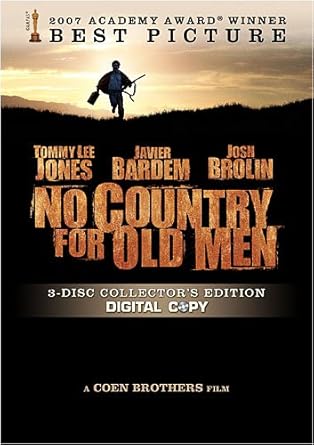
The Coen brothers’ finest film, a gritty, nerve-wracking crime story and an existential horror movie set in the harsh and desperate environs of dusty, bleak Texas.  Josh Brolin takes the wrong money from the wrong drug dealers, victims of a cocaine buy gone bad, after he happens upon their slaughtered bodies while hunting.  Javier Bardem is dispatched by the higher-ups to get it back, killing most everyone he encounters along the way (including rival bounty hunters sent by his employer).  The pacing is taut, the terror near-asphyxiating.   But interwoven in the story is a sense of generational disconnect, rot and the utter bewilderment of an older generation at the brutality and senseless violence of the new.  An observation from a friend is also spot on: “I thought the most important theme in the movie was that older men gradually lose contact with their country, and that this sad fact has nothing to do with the objective reality of what’s happening but is the natural consequence of getting older.”

Set in 1980, the young are depicted as callous and corrupt.  Brolin, shot and desperate to get to Mexico, encounters kids on the border bridge returning to the U.S. after a night of carousing.  He offers to buy a shirt from one of the trio to cover his bleeding, but they quickly demand money, and when he asks for a beer, they want more.  Similarly, at the end of the film, two boys encounter a wounded Bardem and bicker over the share of what he has given them for a shirt.

The Vietnam generation is represented by Brolin and Woody Harrelson, the latter sent to bring Brolin in before Bardem gets to him.  Brolin is not exactly honorable but he still maintains a tie to some principles.  He literally awakes with guilt because he can’t let a dying drug dealer go to his end without water, and it is that charity that brings Bardem his way.  Harrelson, also a Vietnam vet, has a similarly flexible code (he is a killer), but at least there is some code there.  As he says to Brolin about Bardem: “You can’t make a deal with him.  Let me say it again.  Even if you gave him the money he’d still kill you.  There’s no one alive on this planet that’s had even a cross word with him.  They’re all dead.  These are not good odds.  He’s a peculiar man.  You could even say that he has principles.”  When Brolin returns from Mexico, still hobbled but intent on stopping Bardem, a border guard lets him through on the strength of Brolin’s Vietnam service.

Then, there are the old men for whom there is no longer a country.  Tommy Lee Jones and his law enforcement contemporaries just don’t get it.  It’s all gone to hell and a hand basket and while they understand violence, they don’t understand the new violence.  As Jones says, bewildered, reading the paper: “Here last week they found this couple out in California they would rent out rooms to old people and then kill em and bury em in the yard and cash their social security checks.  They’d torture them first, I don’t know why.  Maybe their television set was broke. And this went on until, and here I quote… ‘Neighbors were alerted when a man ran from the premises wearing only a dog collar.’ You can’t make up such a thing as that. I dare you to even try.”

It is not Jones’ world anymore (my favorite Jones musing was from Cormac McCarthy’s book – “She kept on, kept on. Finally told me, said: I don’t like the way this country is headed.  I want my granddaughter to be able to have an abortion.  And I said well ma’am I dont think you got any worries about the way the country is headed.  The way I see it goin’ I dont have much doubt but what she’ll be able to have an abortion.  I’m goin’ to say that not only will she be able to have an abortion, she’ll be able to have you put to sleep.  Which pretty much ended the conversation”).

The film ends with Jones driven to retirement, talking to other older lawmen about what it all means:

Roscoe: It’s all the goddamned money, Ed Tom. The money and the drugs. It’s just goddamned beyond everything. What is it mean? What is it leading to?

Jones: Yes.

Roscoe: If you’d a told me twenty years ago I’d see children walkin the streets of our Texas towns with green hair and bones in their noses I just flat out wouldn’t of believed you.

Jones: Signs and wonders. But I think once you stop hearin’ sir and madam the rest is soon to follow.

Roscoe: It’s the tide. It’s the dismal tide. It is not the one thing.

And the end of the film, Jones has retired (he’s done, “overmatched,” he says) and he sits with an older retired lawman, Barry Corbin, who observes, “All the time you spend tryin to get back what’s been took from you there’s more goin’ out the door.  After a while you just try and get a tourniquet on it.”

And the coda:

Corbin: You’re discouraged.

Jones: I’m… discouraged.

Corbin: You can’t stop what’s comin.  Ain’t all waitin’ on you.

Bardem is what is waiting on us all. Certain, unstoppable, arbitrary death.

This is a beautiful, unrelenting movie, deservedly winning Oscars for best picture and supporting actor for Bardem.

Thirteen years later, Martin Scorsese has re-made Boiler Room, writer-director Ben Younger’s patient and understated Wall Street picture about a sweet kid (Giovanni Ribisi) who gets sucked into the easy cash of a penny stock chop shop run by crooked investment manager Tom Everett Scott. Scorsese’s picture is from the vantage point of Scott’s character, penny stock maven Jordan Belfort, and clearly, the guy who played the drummer in That Thing You Do wasn’t going to cut it as his lead. Enter Scorsese’s boy Leonardo DiCaprio, an able and unsurprising choice. But as I sat through this excessive, gaudy, and at too many times, repetitive extravaganza of the go-go 90s, I pined for the more muted touch of Ben Younger.

DiCaprio as Belfort is an aspiring stockbroker tutored by Matthew McConaughey (who is hilarious; what a year he’s having) but wiped out on 1987’s Black Monday. He reinvents himself by switching to penny stocks, where the clientele is working class, the investments not so much risky as ludicrous, and the broker commissions 50%. Soon, with a band of merry fuckups (including Jonah Hill, who walks a steady line between an ambitious man and a raging child), he is crazy rich. He is also a drug and sex addict of mythic proportions and his life is an endless bacchanal, until, like Ray Liotta in Goodfellas, he must pay the piper.

The Wolf of Wall Street apes Goodfellas and Casino in its exposition, showing us through voiceover or DiCaprio speaking directly to the camera just how the securities game works. But writer Terence Winter lacks interest in the mechanics, and many times, DiCaprio leers and tells us directly, “You don’t want to know this.”

The film deduces that what we really want to know is what it’s like to live a high-wire act where every desire is fulfilled, and then some. For the most part, the filmmakers are correct, but in depicting the excess, they overindulge in it. There are two too many orgies, drug crack-ups and the like and at times, the mind wanders. Worse, as in Casino with Sharon Stone and Robert De Niro, Scorsese wrongly presumes we are interested in the marriage of DiCaprio and his trophy wife (Margot Robbie), a union founded on lust, greed and advancement that doesn’t deserve the time given to dramatize its crack-up. Our interest in Robbie peaked on her first date with DiCaprio, when she alights from the bedroom naked save for thigh highs of her own design.

Despite these foibles, the film is often very funny, and when it hits strides, dizzying and infectious. It also does not labor under the burden of a heavy message. Oliver Stone would surely have had Martin Sheen arrive in the final chapter to lecture us about American greed. Hell, Adam McKay, he of titanic films that reach to the heart of who we are as nation, closed The Other Guys with a tutorial on the excesses of Bernie Madoff (but we would expect no less from our new Capra, the creator of not only Anchorman, but Step Brothers and Anchorman 2). Instead, Scorsese and Winter don’t provide a message as much as a testament to the tribal customs and loyalty of certain American subcultures (Winter wrote 19 episodes for The Sopranos) and the universal intertwinement of the American dream and gluttony. But really, this is a picture about how crazy shit can get when those who pray at the altar of the dollar are fueled by endless cash, and the result is both alluring and grotesque.

The cast is very good. DiCaprio gives such a muscular, physical, manic performance (his 1 mile trip from his country club to mansion while on too many Quaaludes is herculean) , he is a lock for a best actor a nomination, but the win will go to McConaughey for Dallas Buyer’s Club.

When Dead Again came out in 1991, 31 year old Kenneth Branagh was fresh off his stunning Henry V, and along with Emma Thompson, threatened to be the next big thing. So as a follow-up, why not try a modern Hitchcockian homage set in San Francisco, with Branagh playing the hard-bitten gumshoe who runs across Thompson, a mysterious woman who has lost her memory, is terrorized by nightmares from her past, and needs Branagh to sort it out.

At the time, the film was well-received (Roger Ebert – “I am a particular pushover for movies like this, movies that could go on the same list with Rebecca, Wuthering Heights or Vertigo”) and it holds an 82% on Rottentomatoes. I can’t scoff. In 1991, I thought it was clever and well-conceived.

How wrong I was.  Dead Again just became available on Netflix streaming. It is an atrocious film.  Branagh’s “American” accent is an awful, nasally annoyance; Thompson barely makes an impression; the story (Thompson and Branagh both lived past lives where he, a famous composer in the 40s, was executed for her murder) is a preposterous pile of pure Gouda; and the villain is so obvious and nonsensical that you are offended at the degradation of the fine actor playing him.

He’s also not so good with scissors.

I’ll give credit where credit is due – Robin Williams does a few decent cameo scenes as a disgraced former psychotherapist and a babyfaced Campbell Scott shows off some nifty ninja kicks. 

Killing Them Softly - Wikipedia
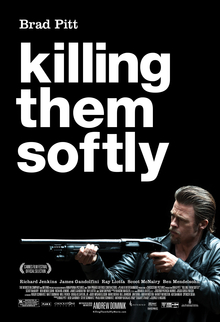
The Assassination of Jesse James was a wildly impressive American debut by director Andrew Dominik, but the director’s dreamlike, meditative style does not lend itself to a basic, gritty crime story. This tale of a hitman (Brad Pitt) laboring under the fiscal corner-cutting and meddling of his employers on a pedestrian job is dull, and no amount of pretty slow-motion photography can change that fact. The story is also awkwardly juxtaposed against the 2008 financial crisis and the ascendance of Obama, seemingly all for one supposedly killer line by star Pitt that closes the film. Specifically, referring to Obama’s victory speech, Pitt rejoins: “This guy wants to tell me we’re living in a community? Don’t make me laugh. I’m living in America, and in America, you’re on your own. America is not a country; it’s just a business. Now fucking pay me.”

Oof.  I mean, wince.  Sigh. Then, oof.

If the movie has worth, it is to see James Gandolfini (as a hitman who has lost his nerve) in one of his few post-Sopranos film roles.  

Rear Window, or the World's Scariest Bottle Episode – Scriptophobic

I just engaged in a donnybrook of a discussion with a few friends over this film, the primary contention being what it was actually about. It was the kind of exchange only the participants could enjoy, but the spirited debate about the film and Hitchock in general led me to re-watch Rear Window this weekend.

Jimmy Stewart is an adventurous photographer who has a broken leg (but he got the shot of the crashing motor car before it hit him). Cooped up in his New York City apartment, he spends the time peeping on his neighbors across the way (he has a splendid view of their windows and courtyards), and in the process, he begins to suspect one (Raymond Burr) of murdering his wife. He enlists his socialite girlfriend (Grace Kelly), whose marriage entreaties he is fending off, in his investigation, leading to a thrilling conclusion.

The film succeeds on three levels. First, it is a witty comedy, with sharp exchanges between Stewart (the confirmed bachelor and super snooper) and Kelly, as well as Stewart’s health care attendant, the brusque Thelma Ritter. The women are pro-marriage and anti-peeping. As these discussions develop, Stewart enlists them in his monitoring of Burr, and thereby, Kelly “proves” herself to Stewart as something more than a rich, pampered girl. At its best, it plays like a David Ogden Stewart or Ruth Gordon battle of the sexes script.

It is also a love story, initially very light, but when Kelly is in harm’s way, Stewart evinces true passion. Stewart has been lampooned so often (“Zu Zu’s petals!”) that one forgets his ability to communicate depth of emotion, but before those petals, there was his haunting breakdown in Martini’s bar. Also, given the 21 year age disparity, it is surprising Stewart and Kelly manage chemistry, but it’s there.  Indeed, the insane idea of rejecting Grace Kelly is made more comprehensible by Stewart’s cranky maturity.

Finally, this is a meticulous thriller with a few dark overtones. Stewart peeps as a lark, but soon, he is obsessed and a little ashamed.  He sheepishly admits to Kelly that they’re viewing “pretty private stuff going on out there.”  She retorts, “We’re two of the most frightening ghouls I’ve ever known.”  And what they see is generally pretty depressing: a suicidal Ms. Lonelyhearts, a composer in despair, newlyweds from shine to routine. And, of course, a killer, nagged by his wife and driven to extremes. It’s not a happy place, as is shown by one neighbor whose dog, sniffing in the wrong garden, meets an untimely end.

I’ll end with the thoughts of someone more distinguished, David Thomson, from his book The Moment of Psycho: How Alfred Hitchcock Taught America to Love Murder:

Hitchcock knew that a system locked into watching and seeing can misread its surroundings and can even lose its identity and ordinary human sympathies because of the pressure of voyeurism. The voyeurism is so heavy, so forceful, it can smother real human nature. Psycho is the conclusion to a set of films beginning with Rear Window, and for me that is Hitchcock’s best film in that the smile of satisfaction at the end covers without hiding the loneliness that affects real people. Rear Window is a romance, a comedy and a thriller, but a portrait of alienation too. The apartments and windows are screens, of course, but they are traps, or cells – in that entire courtyard no one seems to “know” anyone else; neighborliness has not been invented.

This BBC 5 part mini-series is a taut crime story, lovingly detailed, and anchored by a powerful, understated Gillian Anderson performance. A serial killer is loose on the streets of modern day Belfast and he is targeting professional women of a particular physical type, who he tracks, monitors and then strangles in an elaborate, almost artistic ritual. Stella Gibson (Anderson) is brought in from London to perform a review. When the killer strikes again, she is assigned the case.

This is not a whodunit, as we are introduced to the killer in the first few moments. Instead, The Fall is a meticulous police procedural with a distinct take on Belfast.  Be it the ways of a tough neighborhood, the politics of the investigation or specifics of a crime scene, the feel is assured and authentic.  The characters are also very strong, in particular, the killer (Jamie Dornan).  While he is in no way sympathetic, he is unique in that we see him not only planning and executing his gruesome acts, but as a seemingly loving father and husband, and a conscientious civil servant (of all things, he is a grief counselor). 

The Fall was created by Alan Cubitt, who has credentials as a writer for the Helen Mirren series, Prime Suspect, and at first blush, Anderson’s Gibson and Mirren’s Jane Tennyson have some similarities. They are both Detective Chief Inspectors in a male-dominated profession and they both do not have a significant male others. There is where the similarity ends, as Gibson is in a new environment (the last Prime Suspect was almost a decade ago), one that is more friendly to women, but also one where male expectations and bias evince themselves in a subtler fashion. Anderson’s Gibson is also clearly more reserved and in-control than Mirren’s Tennyson, who was rock-solid on-the-job, but more vulnerable in her private life. Gibson is not vulnerable at all, but she is not brittle or overtly righteous. In many ways, she is a “first” for a female police lead, as male as any officer, certainly stronger and smarter than most, and emotionally detached without lapsing into copycat or bitch. When a married detective with whom she has casually slept with is investigated, and she is questioned as to the liaison in a manner different than a man would endure, she suffers the double-standard with a certain patience before matter-of-factly telling the investigator that the detective’s wife was her lover’s problem, not hers. She also has somewhat of a sexual kink. Not Clint Eastwood in Tightrope kinky, but a kink nonetheless, a true rarity for a female lead.

It’s a great character and Anderson has left a lot to develop.    BBC Two has renewed the series for a second season and I hope Gibson becomes the next Jane Tennyson, who carried us through 7 Prime Suspects.

Available on Netflix streaming.

I would have given a great deal to have been at the studio screening of David Fincher’s Zodiac. I wonder who said first, “You mean, this movie is almost 3 hours and we never definitively learn whodunnit?”

The 1969-1970 Zodiac killings are unsolved and at least by serial killer standards, the Zodiac racked up a meager body count (only 5 victims are confirmed as by Zodiac’s hand).  Nonetheless, these narrative infirmities are more than compensated for by the killer’s panache.  Zodiac taunted the police departments of four different Northern California communities with letters to newspapers, including ciphers to be broken which promised to reveal his identity and wild threats (including one to shoot San Francisco kids as they left school buses). Like Jack the Ripper, the Zodiac wanted to lord his superiority over his pursuers.

Fincher takes the Zodiac case and uses it to dramatize exactly how such a crime burrows itself into the marrow of people, altering them profoundly. Jake Gyllenhaal is The San Francisco Chronicle cartoonist Robert Graysmith, who becomes obsessed with the killer the day his first letter to The Chronicle appears. Graysmith would eventually write the definitive book on the Zodiac, and as played by Gyllenhaal, he is sucked into the mystery to the near exclusion of all else. Robert Downey, Jr. plays Paul Avery, the Chronicle crime reporter who covered the case and received a threatening letter from the Zodiac. Avery had labeled the Zodiac a latent homosexual and the Zodiac wrote him a Halloween card warning, “You are doomed” (which resulted in the staff of The Chronicle creating buttons emblazoned with “I Am Not Paul Avery”).  Downey’s Avery is driven from The Chronicle, to drink and drugs and despair, exacerbated by his fear of the Zodiac. The two police officers assigned to the case are also damaged. William Armstrong (Anthony Edwards) eventually transfers to another division while Dave Toschi (Mark Ruffalo) is at one point accused of forging a Zodiac letter (he was cleared of all charges).  There are also the survivors. The Zodiac attacked 3 couples while they were alone and vulnerable, but two men survived, one of whom was the only living person to see the Zodiac. He is a shell, having escaped the country, found at the end of the film to provide one final clue.

The psychological study is encased in a meticulous yet accessible procedural. Screenwriter James Vanderbilt keeps myriad threads intertwined without sacrificing pace, no mean feat given a multi-jurisdictional crime reverberating in the worlds of the police and journalism.

Fincher re-creates those crimes in a manner that communicates their terror and the vulnerability of the victims without being sensationalist or gratuitous. Indeed, the most frightening scene is one where no violence is done. Five months after his last killing, the Zodiac killer pulled over a woman with her baby on a highway, letting her know her back tire was wobbly. He feigned assistance by tightening the lugnuts, but the wheel fell off immediately after she got back on the road. The killer came back, offered to bring her to a service station, but instead drove her around until she was able to escape into a nearby field with her baby (the connection to the Zodiac was made after he referenced the encounter in a letter to The Chronicle a few months later).

It’s hard to imagine that the director of the gruesome Seven made this picture, which is restrained, methodical and to my mind, infinitely scarier. Having to turn away and shut your mind off has less of an effect than when you cannot do so and you’re required to think.

This film has just recently been offered for streaming on Netflix so take advantage.

The excellence of writer/director Jeff Nichols’ Mud lies in its authenticity, confidence and reserve. As I watched this coming-of-age story about two boys, Ellis (Tye Sheridan) and Neckbone (Jacob Loffland), both of poorer Arkansas stock, and their involvement with a fugitive (Matthew McConaughey), I couldn’t shake what the film wasn’t – maudlin, simplistic or heavy-handed (i.e., like the template for so many “coming-of-age” stories about young boys, Stand by Me). While those two films have the Huck Finn story in their DNA, that’s where the comparison ends. Stand by Me needed a narrator to tell you what was of import and what was not in the adventures of their young male characters, and by the end of it, you felt thoroughly manipulated. Mud, however, requires no such crutch. The symbol of what is a man and father, what the divorce of his parents means to a boy, what young love is, and the heart of friendship, is depicted in a lifelike, piercing way. There is a wonderful scene where Loffland’s uncle, played by Michael Shannon, tries to impart some wisdom to Ellis, explaining in a deft but allegorical manner how Ellis needed to stay out of trouble and the nature of his responsibility to Neckbone, who is both a rock and a natural born follower. When Neckbone asks Ellis what they were talking about, Ellis shrugs and replies, “I don’t know.”

The performances are almost completely spot on, and Sheridan and Loffland should be shoo-ins for best actor and best supporting actor, but I’m certain they will be overlooked. That’s a shame, because they are at the ages where pure naturalism (for example, Quvenzhane Wallis in last year’s Beasts of the Southern Wild) cannot carry the day. These boys are making intuitive choices. Their interplay alone is mature and steady, and Sheridan’s scenes with a would-be girlfriend are heart wrenching. They will evoke your best friend from childhood, and you won’t need Richard Dreyfus intoning, “he was my best friend from childhood.”

McConaughey, who has bouts of phoning in roles with a quick smirk and a lazy drawl, delivers a much deeper performance here as the outlaw, desperate not only to escape the law but to reconnect with his true love (Reese Witherspoon). Nearly every other supporting character – from the rigid, recluse Sam Shepard to Ellis’s parents (Ray McKinnon and Sarah Paulsen), to Shannon (whose three scenes damn near steal the movie) – contributes in an effective, understated manner. If there is a weakness, it is Witherspoon, and she was not bad, she was just a little outclassed.

Nichols (Take Shelter) shoots the Mississippi River as a dream, and when the boys are on or traveling to and from the island where McConaughey is holed up, the feel is very Terence Malick. But when the boys are back home or amongst the townies, the look is bleached and tacky, further emphasizing the juice they get from their adventure.

Another kudo – when Hollywood deals with the non-urban, at its worst, you get a grotesque caricature, and at best, you merely get a sort of condescending ennobling, the hick version of “the magical negro” (usually wrapped up in a “you’re better than this place, Willie!”). There is none of that here. Instead, Nichols has written rounded, grounded, real characters.

It is perhaps unfair to use this picture as a club against Stand by Me. To the positive, it ranks up there with the equally excellent Sling Blade and One False Move and is thus far the best film of 2013.


Dreadful in every respect. Ostensibly about an impeccably tailored group of LA police vigilantes formed to take down gangster Mickey Cohen in 1949, Gangster Squad sports a script so hackneyed it seems like a goof. The picture is a mash of The Untouchables and LA Confidential, if those films were re-written by a 13 year old boy whose sole inspiration was Rambo II.

Some gems:

“To the sarge. You’re a bull in a china shop but we’d follow you anywhere.”

***

“I’ve been with a lot of outfits but none better than you group of misfits”

“To the Gangster Squad!”

***

“I signed up for this so I could tell my boy I tried to do something about it”

***

“Can you remind me of the difference between us and them? Because at this point I can’t tell anymore.”

***

“If I leave, Keeler dies for nothing.”

***

“Tomorrow they’ll take my badge. Tonight I’m still a cop.”

***

“Let’s finish it.”

***

“We gotta’ take out that gun!”

“Watch this, hoss.” (six shooter beats machine gun)

***

“Wanna’ dance?” (Man with gun drops it so a fistfight can occur)

***

“Every man carries a badge. Mickey Cohen pledged allegiance to his own power.”

***

“Jerry threatened to leave the force but he never did. I guess he couldn’t shake the call of duty that echoed in his ears.”

You simply cannot believe what you are hearing.

The squad is led by the wooden and true Josh Brolin and is rounded out by a playboy (Ryan Gosling), a cowboy (Robert Patrick), a black guy (Anthony Mackie, who uses a knife just like James Coburn in The Magnificent Seven), a Hispanic (Michael Pena, who is Patrick’s Tonto, and maybe even his son, depending on your reading of a death scene), and a geek (Giovanni Ribisi).

Not quite Costner’s gang in The Untouchables, but damn close.

All the character are awful, but Gosling is by far the worst, utilizing a Brooklyn accent on helium. The result is a really dreamy Elmer Fudd.

And Sean Penn as Cohen?

Image result for Sean Penn Mickey Cohemn

See Sean Penn in Casualties of War.

The picture also gives us Emma Stone as the Kim Basingeresque world weary ingenue?

Taylor Swift must have been unavailable.

***

Ryan Gosling. “Don’t go.”

Emma Stone. “Don’t let me.”

***

***

The plot thuds along.  Our avengers mess with Cohen, but their efforts must be expedited because Cohen is setting up a wire service which will give him control of all betting west of Chicago . . . in a week! If it becomes operational, he will be too big to take down.

But our heroes can’t find the location of this new wire service.

Perhaps they shouldn’t have blown up his trucks carrying the wire service equipment instead of following them.

No matter. Because Cohen places the wire service HQ, the jewel in his criminal crown, in the back of the nightclub that doubles as the hottest spot in LA.

The film was not well received but it is troubling that it was not roundly demolished, it is so crappy.

For example, in one scene, a thug’s overcoat (in balmy LA, mind you) catches on fire when he is backed into flames. He removes the burning coat, kills a man, and yet, in the next shot, voila!  The overcoat has returned to his body, unsinged!

The film also shows Mickey Cohen watching footage of one of his boxing matches, an Cohen explains how he held on to the championship.

The real Cohen, however, never had a championship fight (he lost to World Featherweight Champion Tommy Paul two minutes into the first round), which I suppose is nitpicking.  Yet, despite being a “championship” boxer, Cohen loses a fistfight to Brolin to close the movie, which is not nitpicking.

The following critics gave the film positive reviews: Ricardo Baca (Denver Post), Richard Roeper, Rafer Guzman (Newsday), Rex Reed (The New York Observer), John Hanlon (Big Hollywood) and Peter Debruge (Variety).

Follow the money, I say. Follow the money.

Tom Cruise plays a former military detective, a ghost drifter who is drawn into the role of lead investigator for the defense of an Iraq War sniper accused of a senseless shooting spree in Pittsburgh. As he digs deeper, he unravels the true motive for the killings and the web of intrigue surrounding them.

Jack Reacher is a competent thriller, and Cruise is convincing as a smart, tough ex-military hero. He exudes a certain intelligent menace despite his short stature (the Jim Grant books had him a lot bigger) and the story whips along. The bad guy, a disfigured Werner Herzog, is a treat, and the scene where he gives a man a chance to avoid execution is memorable.  There are also some sharp exchanges in the script which, if not Dirty Harry, is subversively conservative.

Still, the aim of the villains is weak (a construction company???); the late introduction of Robert Duvall as a sidekick for Cruise strains credulity; and the effort to mask the necessary killing in the cloak of a shooting spree is, upon reflection, wild overkill, the kind of gambit that would elicit the attention the bad guys sought to avoid.  These weaknesses are forgivable, but when Cruise drops his gun to go mano a mano with his nemesis, the film veers into Road House territory, if only for a moment.