Archive

Crime/Mystery

After a promising start, this picture spins so wildly out of control it is almost impressive. Mild mannered Texas picture framer Richard Dane (Michael C. Hall) shoots a home intruder, earning the enmity of the intruder’s fresh out of prison father (Sam Shepard), but they soon learn there is something bigger than the both of them connected to the killing. The first half of director Jim Mickle’s movie is tense and effective. But then, the picture abruptly shifts course, veering into the implausible. Hall and Shepard improbably team up together with the assistance of Don Johnson as a Houston private investigator (Johnson delivers a jokey performance that undercuts the film’s dark feel) and we get a bit of a buddy movie. The awkward shift in tone is accompanied by nonsensical plot points and an ostentatiously arty, bloody end that utilizes slow motion and a synthesizer rich soundtrack reminiscent of The Terminator without a hint of irony.

Post Dexter, Hall is as good as he can be, but the writers give him absolutely no real reason to become a confederate with a man who not only threatened his life, but that of his wife and child. The critics gave this 85% on rottentomatoes.com while the audience posted a 69%. The audience got it right.

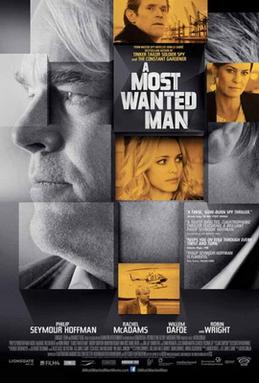
On the plus side, this moody, meditative adaptation of a John le Carre’ novel is intelligent yet explicable (unlike the rushed and byzantine Tinker Tailor Soldier Spy) and anchored by one of the greatest actors of a generation, the late Phillip Seymour Hoffman. On the downside, while it is compelling in parts, it is hurt by a weak Rachel McAdams performance and an inapt one by Robin Wright.  More problematic, the grim resolution seems a cop-out, an easy resolution that makes the viewer wonder what the hell this was all about.

Hoffman is a German intelligence officer who leads an anti-terror unit in Hamburg. Like Jessica Chastain in Zero Dark Thirty, he is haunted by an intelligence failure from his past. He is tracking two terror suspects, one a potential bomber and the other a funder, when he formulates the idea of baiting the latter with the former. McAdams plays a lefty lawyer representing the suspected bomber and, as usual, she is thin, distractingly glamorous and, when asked to buckle under the weight of seclusion and interrogation, inept and unconvincing. Wright, as a CIA counterpart to Hoffman, is merely odd. She’s much too high brow, playing a minor variation of her character in Netflix’s excellent House of Cards, fine for a First Lady but not so much for a spook.

Hoffman, however, is stellar, whether keeping a frightened mole from turning, managing his younger team, or lecturing McAdams on the naivete of her politics. He is supported ably by Willem Dafoe as a banker caught in the middle of Hoffman’s gambit. Dafoe exudes the fear and discomfort of a “civilian” dragged into the high stakes of thwarting terror.  If the film’s end is somewhat ho hum, both actors are more than worth the watch, especially since this was Hoffman’s last finished picture.

image

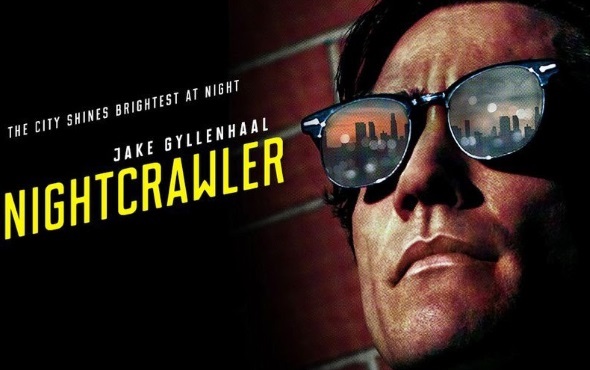
A clever black comedy that emphasizes story over a message (“if it leads it bleeds”), Nightcrawler works in large part to Jake Gyllenhaal’s riveting performance as an aspiring freelance videographer who haunts LA at night, capturing its brutality for sale to local TV news. Gyllenhaal is a mixture of King of Comedy‘s Rupert Pupkin, Rushmore‘s Max Fischer, and Jim Carrey’s Cable Guy, a driven cipher who spouts business motivational doctrine and relentlessly pushes further and further over the line of acceptable journalistic practices in capturing people in crisis or even death throes. You guiltily root for him because he is so compelling and his Dale Carnegie pitch, even unmoored from any concept of morality, comes off as an earnest entrepreneurial pitch. But by the end of the film, a series of tense crime scenes invaded by Gyllenhaal, his philosophy is both corrupting and lethal. He makes it bleed even more that it otherwise would, and as a result, he excels.

It’s a simple tale, well told, but there isn’t a lot to this picture other than Gyllenhaal, who exudes a real inner force (while his character is certainly different, I kept coming back to De Niro in Taxi Driver). He has two co-stars; Renee Russo, a hard-bitten struggling TV producer whose star rises with Gyllenhaal’s footage, and LA at night, which writer director Dan Gilroy shoots as a haunted ghost land of deserted streets and foggy canyons. Gilroy is a longtime writer of pretty bad films (Freejack, Two for the Money, Real Steel), but he directs this thriller with pace and verve.

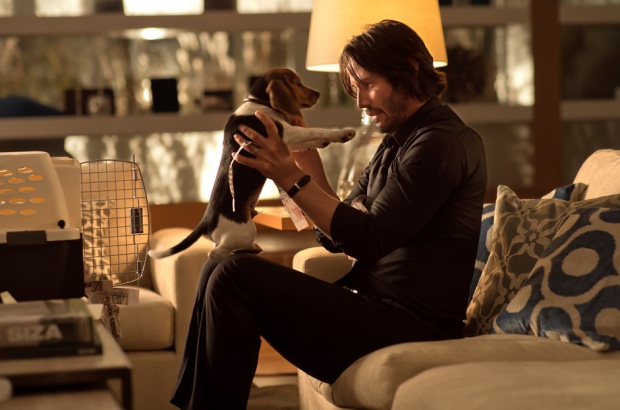
Terrific shoot ’em up, mindless yet smart, thrillingly violent yet tasteful. John Wick (Keanu Reeves) is a retired hitman, at least until the snot-nosed son of New York City’s crime boss steals his car and destroys the last gift given to him by his beloved, deceased wife.

image

Oh, and then it’s on. The film sports sixty to eighty beautifully choreographed deaths (the co-directors are seasoned stunt coordinators), a few funny lines, and a clever depiction of a criminal underground with its own rules, parlance and neutral Switzerland. Reeves plays Wick straight and dead serious, so we are not tormented by smirks, tag lines or witty asides. And the bad guys are, as they should be, the most interesting characters in the film.  If there is a criticism, it’s this: whatever the final count, it’s about 20% over the killings the film should have.  Nobody can employ that many henchmen in this economy.

image

In the vein of Carl Franklin’s One False Move, writer director Jeremy Saulnier has produced a moody, taut and earthy thriller that bleeds authenticity. Dwight (Macon Blair) is a seemingly harmless, homeless drifter who haunts a beach town in Delaware. He eats out of the boardwalk trash cans and his crimes are petty (he breaks and enters not to steal, but to take hot baths while the homeowners are away). Dwight is well known to the authorities, one of whom takes him aside and lets him know the killer of his parents has been released from prison in Virginia. This revelation sets in motion a chain of events that brings Dwight back home to confront the killer, and his family.

Saulnier shoots the eerie back roads of Virginia in a manner that accentuates Dwight’s foggy mental state. He seems almost enveloped by a mist of doom upon returning to his childhood home. Despite the haunting, dreamlike feel of the picture, Saulnier does not glamorize the violence, which is up-close, personal and jarring.  People panic, they miss their mark, they make unbelievably stupid mistakes, and they say things under duress that people under duress actually say.

The actors are true. Blair near carries the entire film (in a fair and just world, he’d be an Academy Award nominee). We meet him insulated by the cloud of his drifter life. When he is jerked back to grim reality, we see the dawning, and the depth of the anger he has been suppressing.  When he reunites with his sister (Amy Hargreaves), the familial anger is obviously shared, but we pointedly feel her ambivalence upon the return of her troubled brother. It’s as if she worked for years to form a scab which is ripped off the moment Dwight arrives.

Saulnier’s storytelling is such that you credibly piece together the events that led to Dwight’s fresh hell, and there is no predictable satisfaction from extraction of his revenge. Instead, both he and the audience come to realize this is a slow-moving clusterfuck of a car crash from the word go.

If none of this floats your boat, I have one more pitch:  Eve Plumb (of The Brady Bunch) makes an unexpected, terrifying appearance.

One of the better pictures of the year, a deserved 96% on rottentomatoes, available streaming on Netflix and all the more impressive when you know it was done for $425,000.

image

The film versions of Dennis Lehane’s books Mystic River and Gone Baby Gone are excellent, but they are mythic stories about the bonds of family in a criminal world. The Drop has no such sweep. It’s a small crime film about a Brooklyn bar and the little people (James Gandolfini and Tom Hardy) who run it for the Chechen mob. When the bar is used as a “drop bar” for the mob’s money, and it is robbed, the little people are thrust into a situation they are ill-equipped to handle.

I just saw Hardy as a meticulous Welsh construction manager dealing with his crumbling life in Locke, and he was immersed in the role. But when you bring foreigners to “New Yawk” (or Biloxi, for that matter), you run the risk of the mannered, cartoonish accent and swagger of Russell Crowe in Naked City. Forget foreigners. Even Mickey Rourke and Eric Roberts can succumb to the perils of “da’ street, and as anyone who has seen The Pope of Greenwich Village will attest, the sight is not pretty.

Not so with Hardy. He is comfortable with the character and the milieu and while it’s no stretch for Gandolfini to play the type, in his last role, Tony Soprano does not disappoint. Hardy is Gandolfini’s quiet second banana, either inscrutable or dim, but steady and loyal either way. As the out-of-their depth small-timers, Hardy and Gandolfini are ably supported by Noomi Rapace, the damaged local girl who binds with Hardy over an abused pit bull left in her trash can (the dog is so cute as to be unnerving; his fate becomes almost too paramount and you spend an inordinate amount of time asking, “Where’s the damn dog?”).

As good as these actors are, Matthias Schoenaerts steals the film as Rapace’s ex-boyfriend, a local hood looking to capitalize on the heist. He presents the perfect mix for a villain; terrifying, intriguing and just a little sympathetic, although you can’t put your finger on why. It’s a great performance that should be recognized come Oscar time. There is no chance that will occur.

This is Michael Roskam’s first American film, and the Belgian exhibits everything you want a new filmmaker to show. It is understated, assured in its pace, taut, organic and comfortable with the quiet moments.  Roskam feels no need to amp the action or to bolster the emotional connection between the characters. He lets the audience fill in the gaps, resulting in very poignant moments between Hardy and Gandolfini and a compelling love story between Hardy and Rapace, even though they don’t so much as kiss.

One of the best films of the year.

Who's who in 'Sin City: A Dame to Kill For'

This movie is more than bad. It’s an affront to genre, consistency and common sense. It also represents the end of film as art, the shape of things to come. Just as novels will soon give way to comics, movies will give way to . . . . comics.

The sequel pretends at noir but it has no kinship with it save for a string of laugh-out-loud, hard-bitten lines. The worst of the bunch: “I was born at night. Not last night.” Every single line is like that, played deadly straight, as if writers Robert Rodriguez and Frank Miller concluded, “You know! The same idiots who have substituted, you know, books for serialized comics are, like, the ones coming to this stupid movie, so why would we try and, you know, make the dialogue anything more than the drivel in the picture book?”

There are three story lines, each more boring than the last. Joseph Gordon-Levitt is a hot shot gambler who crosses mean Senator Powers Boothe. Jessica Alba is a stripper who crosses mean Senator Powers Boothe. In between, Josh Brolin (taking over for Clive Owen, who screwed the pooch turning down James Bond but made the right call here) gets double-crossed by his ex-wife, Eva Green. Gordon-Levitt beats 4 Kings with 4 Aces and then, ah, who cares? Alba and Brolin enlist madman Mickey Rourke to get them out of jams. That’s the whole of it, except Lady Gaga pops up as a clichéd waitress, following in Madonna’s footsteps yet again. Blood spatters, bodies are dismembered, the ominous score thuds along, and yawns are stifled.

Nothing makes sense. While Rourke blows up an estate, the guards remain unalerted, the easier to chop their heads off. Green seduces a cop (Christopher Meloni) and enlists a crime boss (Stacey Keach, made to look like an ambulatory Jabba the Hut) to invade the part of Sin City run by armed whores clad in Frederick’s of Hollywood because the girls are hiding Brolin. Both entreaties are awkwardly dropped shortly after their introduction. Brolin, healed by the whores, comes back with a newly reconstructed face to exact revenge, except he looks just like he did before, only with a sprightly toupee.

It’s a nasty, stupid, senseless movie. It’s also a little frightening. The first Sin City was a modest success, grossing $70 million domestic on a $40 million budget. It had the benefits of being unique and a little humor. Almost ten years later, they churn this dour turd out, and the budget is $70 million.

Maybe there is hope in the fact that it is getting killed at the box office ($11 million and trickling) but something tells me the Chinese will bail it out.

Death is just like life in Sin City. It always wins.

Actual line.

Image result for barton fink

There’s not a scene in this Coen Brothers film I don’t like, and the story of a Clifford Odets-esque playwright’s (John Turtorro) introduction to the oily world of Hollywood is both visually striking and thematically ambitious.  But no matter the film’s look or intriguing interpretations (the mind of the writer, the dangers of solitude, the corruption of money), by the end, you feel trifled with, as if you watched a parlor trick perpetrated by a cast of broad, comic actors (John Goodman, John Mahoney, Michael Lerner) for no greater purpose than the goof.  Like The Hudsucker Proxy and Miller’s Crossing, Barton Fink has its joys, but the feel is sterile and your investment unrewarded.

50 Years Ago: 'The French Connection' Helps Kick Off '70s Cinema

Today, William Friedken’s 1971 Academy Award winner seems better-than-standard cop fare, but this is an extremely influential film, notable for its verisimilitude, grit and movement. Shot on the mean streets and ugly haunts of decrepit New York City, Friedken follows two detectives, Popeye Doyle (Gene Hackman) and Buddy Russo (Roy Scheider), as they try and take down a huge heroin shipment. No prior American film seemed as immediate or aggressive. Friedken’s camerawork is frenetic and edgy, and his virtuoso car chase scene is still one of the best in all of film.  Here is Friedken on the chase, which took 2 weeks to shoot.

Friedken’s insistence on visual authenticity extends to Ernest Tidyman’s script. Doyle is a casual racist and a simplistic bully, Scheider a slightly more pleasant accomplice. They are neither archetypes or anti-heroes. They’re just dogged, unremarkable cops. What is a little mystifying is the Best Actor win and Best Supporting Actor nomination for, respectively, Hackman and Scheider. These performances are almost 100% sweat, the equivalent of thespian calisthenics. There is no arc or development, and I don’t believe there has been this much running in any film save for Chariots of Fire, The Gods Must Be Crazy and any film about Steve Prefontaine.  Roger Ebert disagrees about Hackman’s performance, writing: “As Popeye Doyle, he generated an almost frightening single-mindedness, a cold determination to win at all costs, which elevated the stakes in the story from a simple police cat-and-mouse chase into the acting-out of Popeye’s pathology.”

Interestingly, Friedken didn’t want Hackman (they fought constantly and as Friedken writes in his memoir, “His outbursts [onscreen] were aimed directly at me… more than the drug smugglers”). But Paul Newman and Steve McQueen were too pricey, Peter Boyle objected to the film’s violence and Friedken’s first choice – Jackie Gleason! – was deemed unsuitable by the studio.

To the moon, drug dealers  To the moon!

Ranked 21 on AFI’s Top 100 films, Roman Polanski’s Chinatown opens with credits that suggest the romanticism of Rebecca, but what follows is a more cynical noir that reveals a pre-war Los Angeles rotten to its core. Private investigator Jake Giddes (Jack Nicholson) becomes embroiled in a snoop case that appears to be standard infidelity but the job embroils him in discovery of political corruption and sexual depravity. His client, Faye Dunaway, is hiding a horrible family secret that involves her titan of a father, John Huston. Giddes carries scars of his own, stemming from his time in the police force working Chinatown.

Polanski’s film is meticulously shot, presenting a classic LA that is mesmerizing and foreboding. Robert Towne’s script is taut and engrossing. Still, this is an overpraised film. Towne chooses to keep the demons of Giddes’ past a secret, which is ultimately unsatisfying, given how critical he is to the story. Moreover, the love affair between Nicholson and Dunaway is unconvincing, mainly because Nicholson is giving a modern performance, whereas Dunaway is mannered and breathlessly dramatic, as if they were working separate material. Nicholson is updating the tough talk of Sam Spade while Dunaway is embracing the older form. When Nicholson puts himself on the line for her, the act seems forced and inauthentic, and the closing line has the faint whiff of the Gouda.

A fine film but certainly not the 21st best picture of all time.