Archive

Crime/Mystery


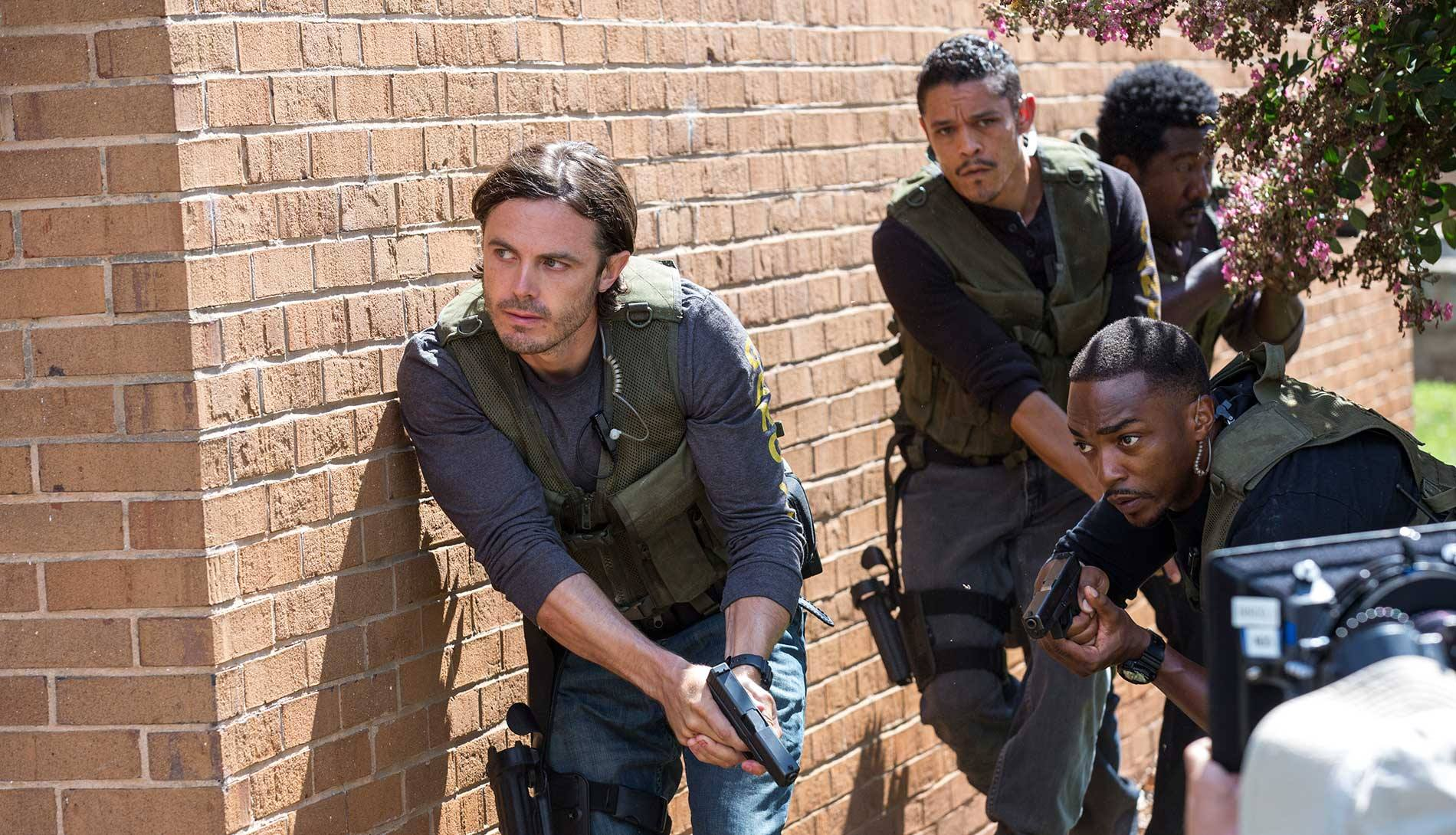
So hellbent on being tough and gritty, it doesn’t realize how ridiculous it presents.  Dirty cops, ex-vets, drug addicts, hard asses, double dealers, all on the mean streets of Atlanta.  When these men commiserate, well, shit gets real, and words like “family” and “brother” and “trust” are bandied about.  Because, “Out here, there is no good and there is no bad. To survive out here, you’ve got to out monster the monster. Can you do that?”

Yeesh.

Add a hilarious Kate Winslet as a Russian mobster  with hair from Married to the Mob, a lazy crazy Woody Harrelson phoning in his standard quirky drunk cop with a nose for the perps, a cheezy industrial score, a bunch of young actors testing out their hard stares (Casey Affleck, Anthony Mackie, Aaron Paul, Norman Reedus), and a boring end that I suppose was meant to be anti-climactic, and you get this poser of a crime flick.

Plot-wise, the entire caper rests on having an innocent cop shot in the darkest and dankest housing project so his dirty cop partner can call in a “999”, whereupon, at least in Atlanta, every cop in the city’s 3300 square miles drives like a bat out of hell to the scene, and thus, we have a diversion, so other dirty cops can steal a case for the Russians that just happens to be housed in the Atlanta office of the Department of Homeland Security.

Got that?

This idiocy is made even more noticeable because when the “999” is called in, indeed, every cop lights out for the scene, Woody Harrelson leads the charge and almost kills dozens of civilians in the process in what is meant to be a bravura car chase scene.  But it is not a chase scene.  It is a race to get to a destination, a race made dumber by the fact that Harrelson is screaming at his partner “Do you know who was shot?” (Affleck was on scene and he is Harrelson’s kin).  And for what?  When Harrelson gets to the locale, there are already dozens of cops on the scene drinking coffee and showing vacation pics to each other, and Affleck looks relaxed, like he just had a backrub from Atlanta’s newest Tactical Massage Unit.  And why didn’t Harrelson’s partner call any of the dozens of cops on scene to ask who was shot?

Also, why do these jamokes actually have to kill an innocent cop instead of shooting some rounds and getting on the radio and just saying “999”?  Then, when every cop bugs out for the location, the dirty cop can just say, “My bad.  I thought he was shot.”   Hell, have the cholo in the housing projects who was contracted by the dirty cops to shoot the innocent cop and instigate the “999” just bonk the innocent cop on the head, shoot a round in the air, and then the dirty cop can call on his radio, “Hey, 999”, as the cop is, technically, down.  Or just have a shootout and get on the radio and have the cops screaming, “we are getting shot up in here.”  Will all of the cops in Atlanta just keep playing Candy Crush because they didn’t hear “999” but instead , “Shots fired.  At me!!!!”

And what is with this stupid “999”, anyway?  Is “999” the equivalent of “Candyman” and if you say that word three times in a mirror, cops jump in their cars and go berserk like bees to the queen?

Besides, Homeland Security ended up having its own SWAT team, who, apparently, were taking a collective bath when the caper began.

And of all the cops to shoot, why choose Affleck, who has previously demonstrated he’s bad-ass in a gunfight?

Not only is Affleck bad-ass, he’s also the Sherlock Holmes of the A.T.L.  He cracks the case because he checks the wallet of the cholo contracted to shoot him and Ay Caramba!  It has the address and time of the shooting (8th and Washington, 4 pm).  What is it with Latino gang members and a) their inability to remember a few easy things and b) their predilection for semi-cursive?  Affleck then goes to the dead cholo’s  neighborhood and asks the first Latino kid he sees what’s what, and wouldn’t you know, that kid just gives it out like candy.

Director John Hillcoats’ The Proposition and Lawless were similarly moody and slow, but I don’t recall them being stupid.  That distinction must be laid at the feet of first time writer Matt Cook.

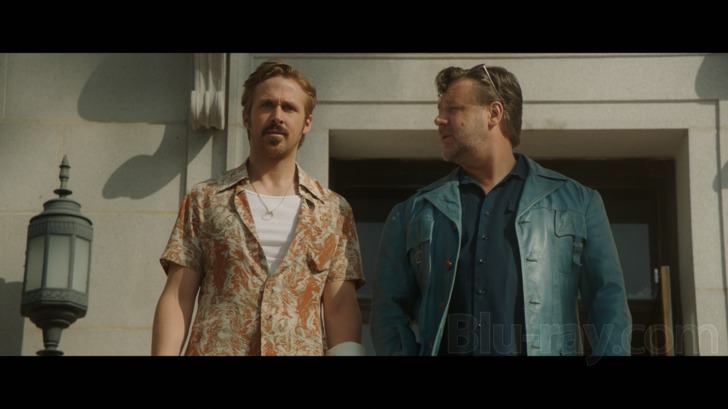
The Nice Guys Blu-ray Release Date August 23, 2016 (Blu-ray + DVD)

It sounds silly to say, but I’m compelled – they just don’t make movies like this anymore.  Shane Black’s (Kiss Kiss Bang Bang, Iron Man 3) noir-ish 70s buddy crime comedy pays homage to the genre by faithfully adhering to many of its precepts while updating the form in ways that are progressively more clever.  It’s late 70s LA.  Russell Crowe is a burnt out “enforcer” making his dough in the protection racket with brass knuckles and dogged determination.  Ryan Gosling is a private investigator rip-off artist with a drinking problem, a mouthy (but not precocious) pre-teen daughter, and an air of intelligence, if not actual smarts.  Crowe is hired to beat up the person or persons (one of whom is Gosling) looking for a young femme fatale, and the two team up as the semi-serious, but not really serious plot – which melds porno and corporate skullduggery – thickens.

The banter is first rate, the look primo, and the tone just right.  Black writes cynical yet hopeful, and while he makes all his station stops on time, the rides in between are a gas, made even more enjoyable by his crackling script and brilliant physical comedy.  Gosling is particularly adept at slapstick, giving Leonardo DiCaprio’s turn in The Wolf of Wall Street a run for its money.

The chemistry between Crowe and Gosling is so strong that I hope the broad hint of a sequel at the end of the film is genuine.  I was reminded of Nick Nolte and Eddie Murphy in 48 Hours , Alan Arkin and James Caan in Freebie and the Bean, and Robert DeNiro and Charles Grodin in Midnight Run.  These guys are having a blast together

Yet, Black never fully commits to the “buddy pic” requirements.  When Crowe, in a moment of reflection, reveals his tender side or Gosling seemingly rises to the occasion by exhibiting theretofore hidden mental gifts, the payoffs are unexpected and laugh out loud funny.  A dream sequence is inserted that is truly ingenious, and there are more than a few other moments when Black’s detours enhance the humor.   One of the best films this year.

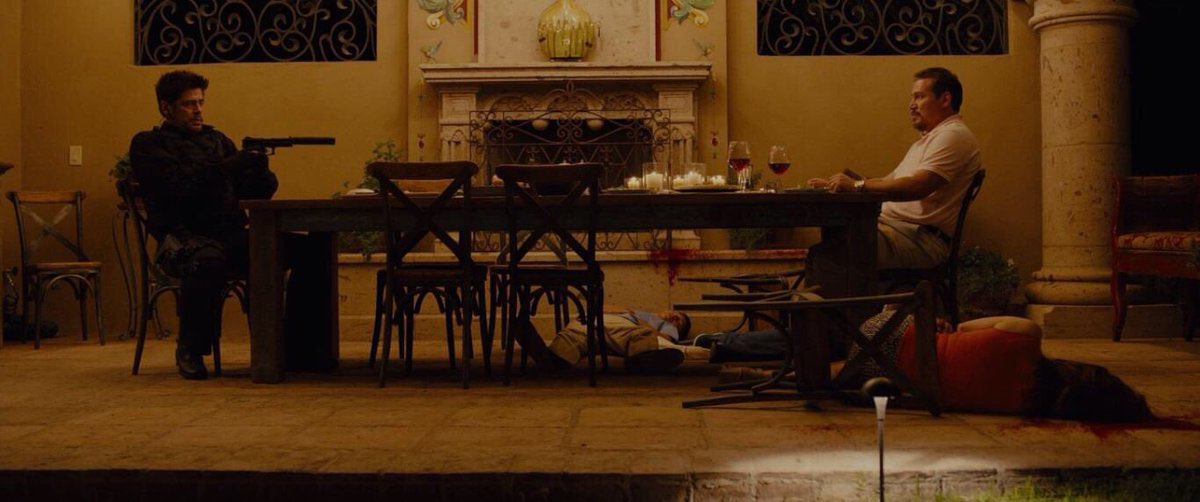
Deric Poston on X: "Is the final scene in Sicario the best revenge ending  in a movie ever??? I think so https://t.co/xYUmzFrDzb" / X

Engrossing, often pulse-pounding, and armed with a realistic sensibility, Sicario tells the story of an FBI agent in the drug war (Emily Blunt) recruited by a U.S. government task force leader and its consultant (Josh Brolin and Benicio del Toro, respectively) to assist with an exfiltration of a drug lieutenant and then a targeting of a Mexican drug lord. As Blunt gets deeper into the mission, the motives of the players and other aims of the endeavor are revealed. Blunt is excellent as a hardened officer who struggles with the seeming futility of her job and the machinations around her. Who would have thought that the arch, bony fashion assistant in The Devil Wears Prada was capable of projecting such strength? But this is the third role where I’ve seen Blunt play a convincing, strong, physical woman (the others are Looper and Edge of Tomorrow).  By that, I mean that she doesn’t shed gender and its attributes, nor does she just merely ape a man in what is a male-dominated role, where she’s chucking dudes around because, hey, that’s equality! She has a scene of physicality where the director demonstrates not only Blunt’s own strength but its limitations when pitted against a strong man. Its’ authenticity melds perfectly with the film, gritty and direct and disinterested in symbol.

On the downside, while Blunt can convey heart and strength, she can’t create a character where one does not exist, and writer Taylor Sheridan’s first screenplay doesn’t really provide her one. There’s nothing that makes you claim or invest in her. The moody, sparse setting of the film and Blunt’s no-nonsense portrayal can only go so far. It’s a testament to the taut pacing of the picture that you don’t recognize its emptiness until afterwards. Still, a good watch.

image

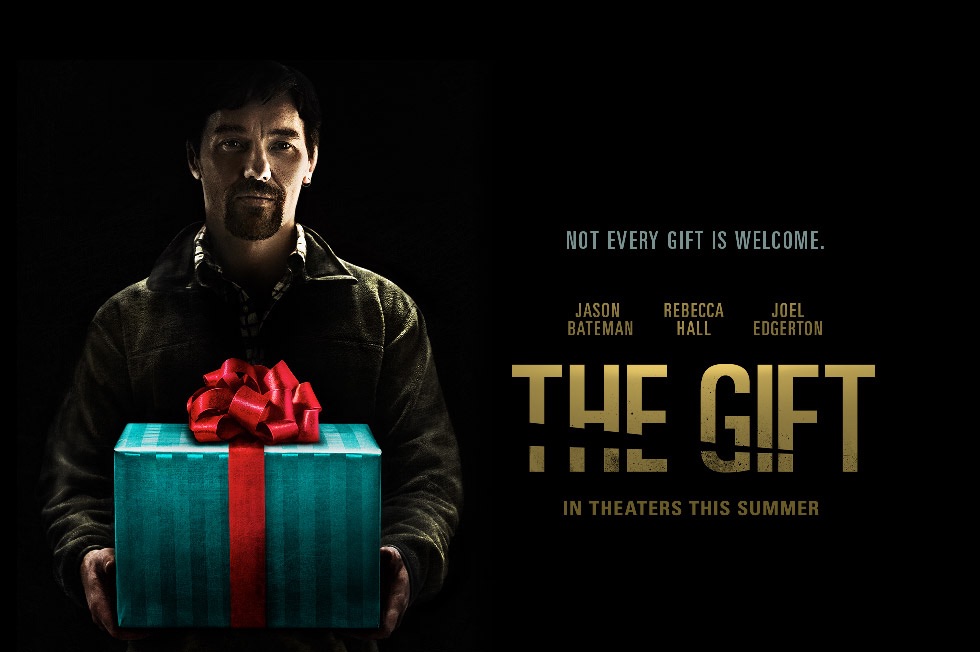
Nicely done, but ultimately plagued by some clunkiness and a fair amount of inexplicable behavior by the couple (Rebecca Hall and Jason Bateman) who are terrorized by a stranger from Bateman’s past (Joel Edgerton). Otherwise, this is a classier Lakeview Terrace, Unlawful Entry, or Pacific Heights, movies about California rich people haunted by a weirdo, but with a reverse Gone Girl twist. A note on Bateman, normally a light, Ben Stilleresque comedian: he’s really good as a man trying to exorcise his worst instincts while continuing to profit from them.

image

Sherlock Holmes (Ian McKellen) has been in retirement for decades, forced there by the traumatic events of his last case, a case he has increasing trouble remembering as senility does its damage. With Watson long gone, Holmes relies on the son (Milo Parker) of his caretaker (Laura Linney) to assist him in his daily activities and serve as a bridge to younger, healthier and more lucid days. Holmes is soon entwined in the hostile relationship between the working class mother and her clearly clever yet condescending son, and he confronts the mistakes of his past while engaging, reluctantly, in their very pedestrian domestic drama. This is Holmes adrift, vulnerable and shorn of the cock-sure bravado of his younger years.

It’s hard not to over-praise McKellen’s performance. Too much Gandolf has fixed him as caricature, but here, he deftly injects Holmes’s withering intellect and emotional shortcomings with a plaintive frailty. Director Bill Condon has experience with McKellen – their work in Gods and Monsters was similarly touching, restrained and intelligent and also garnered McKellen a Best Actor nod.  The film is also blessed by a strong turn by Parker. If I’ve said it once, I’ve said it a thousand times, as in life, you warm to a child who is genuine as opposed to precocious, natural instead of stagey.  Parker is just right.

Occasionally, the movie is a little dragging, but this is still one of my favorite films this year.

You won’t fall asleep in this picture, and it has a few nice moments (plus very good performances by Rory Cochrane and W. Earl Brown, as henchmen), but at root, this is a hackneyed crime saga that celebrates the dreary over all else.

Sure, it offers a bonanza of Boston accents. There’s the “Downtaaaaaaaaahhhhhhhn Abbey” (Benedict Cumberbatch, as Whitey Bulger’s more respectable brother), the “all-in” (Australian Joel Edgerton, as the FBI agent who utilizes Bulger as a confidential informant), and even the “Robin Hood Costner” (Corey Stoll, as the U.S. Attorney who brings the Bulger crew down; sometimes he does a Boston and sometimes he says, “Eh, fuggedaboutit”), all of which, mind you, are better than the “Kennedy Costner” from 13 Days, which, while we’re talking, was execrable, yet better than the Cajun Costner in JFK.

As fun as it is watching everyone extend there “aaahhhhrrrrrrrrrrrrrrrrrrrs”, they ahhhhhhhrrrrrrrrrrrrrren’t saying anything worth hearing. We are introduced to Whitey Bulger (played by a monochromatic, cloudy-eyed Johnny Depp) on his way up, and that trip is blindingly dull. He is kind to the old women of the neighborhood, he loves his Mommy, he tells his son “if no one sawwwwr it, it didn’t happen” and if you cross him, he comes at you in a gray, humorless, inexorable way.  When he does joke, it’s in the Joe Pesci manner of Goodfellas, by which I mean this movie actually has him bully a guy after the guy says something innocuous, only to say, “I had you going there, didn’t I.” It’s hard to say if Bulger was even that good a criminal. They keep telling us he’s mythic and runs all the dirty deeds in Beantown, but as far as I can tell, he made enough dough to live in a shitty house and occasionally go to Florida to watch Jai alai.

Bulger’s way up was paved by the FBI agent, played by Edgerton, so perhaps he’s the story? He turns out to be not much of one. He wants fancy things and he wants them badly, and he’s loyal to Bulger from his Southie days, so we suffer countless scenes of him defending the protection of Bulger as a source of information at FBI headquarters. Kevin Bacon, who plays Edgerton’s boss, pops in repeatedly to say the same things, awkwardly accompanied by Adam Scott sporting a porn ‘stache (Scott’s presence is jarring; you almost expect the rest of the Anchorman gang to follow behind him).  As Edgerton grows more desperate, Edgerton’s Boston mugging gets worse.

With accent wars and a story bordering on the torpid, at least we get Boston, no? Not really, Director Scott Cooper (Out of the Furnace) has a fondness for bad 1970s kitchens and office buildings. We get it. Even interior design was ugly in the 70s.

Pointless.

image

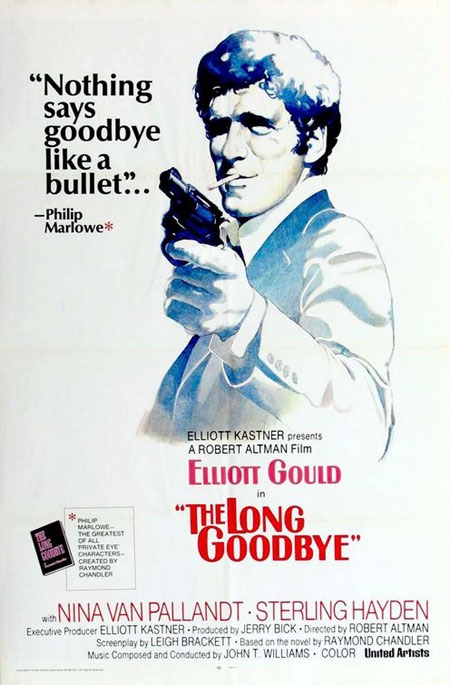
Robert Altman’s Phillip Marlowe (Elliot Gould) isn’t a hard-bitten cynic but rather, a seemingly scattered, chain-smoking hippie in a suit (his mantra? “it’s okay with me”), as bemused by the conservative cops who roughly bring him in for questioning (“Someday all the pigs are gonna’ be in here and all the people are gonna’ be out there. You can bet on that. You’re not in here. It’s just your body”) as the perpetually stoned yoga nudists who are his neighbors (“They’re not even there. It’s okay with me”). The truth is that much is decidedly not okay with Marlowe, in particular, his being used by old friend Terry Lennox (former NY Yankee pitcher and baseball whistleblower Jim Bouton) after the mysterious death of Lennox’s wife.  As Marlowe floats through a Los Angeles that feels desolate and burnt out, he moves closer and closer to the truth, navigating the authorities, hangers-on and brutes while standing by his friend.

Mark Rydell, who later became a decent director (Cinderella Liberty, On Golden Pond), stands out as a particularly chilling gangster who peppers his threats with loopy new age nonsense and boasts about his physical fitness regimen and the fact he lives near Nixon.

Altman and screenwriter Leigh Brackett aggressively revamp the source material, but Marlowe is still Chandler’s in many ways.  He needles the cops (“Is this where I’m supposed to say, ‘What’s all this about?’ and he says, ‘Shut up! I ask the questions’?”), can shake from his seeming fog to register a keen read on the situation, and when he arrives at the end of the journey, he is all Chandler’s Marlowe, with his own unyielding code.

Critic David Ehrenstein once told me that The Long Goodbye “was” Los Angeles and while the film doesn’t figure prominently in Los Angeles Plays Itself, it’s hard to argue it doesn’t have Hollywood in its marrow. Movie memorabilia can be found in Marlowe’s otherwise bare bones apartment (which was just recently available for rent), presumably from a prior occupant.  The security guard at a gated ocean community specializes in impressions, from Barbra Stanwyck to Jimmy Stewart to Walter Brennan.  The score is some version of the torch song “The Long Goodbye”, be it Muzak in a supermarket or a cocktail lounge piano number, the same ditty re-packaged as only Hollywood can.  Son of Old Hollywood Robert Carradine shows up as a jailhouse prophet and Altman exhibits prescience in his casting of Arnold Schwarzenegger as a mute thug.  LA itself seems an otherworldy ghost town, where everything seem to be trying to pass as a facsimile of the real thing.  As Ehrenstein noted, “Back then the city was a sprawling, sleepy, empty place — Altman’s The Long Goodbye capturing its ultra-casual look and feel perfectly.  ‘But there’s nothing there,” my east coast friends would say”).

This is a seminal picture, and a prime example of reinventing a genre.

image

If you want to learn how a little-known director gets a big budget, Oscar-bait vehicle, watch Headhunters, a clever, fast-paced thriller about a corporate recruiter/art thief who gets in over his head financially and otherwise.  An engrossing thrill ride with a “wrong man” Hitchcockian vibe, the film’s only stumble is an overly intricate initial plot device that introduces the protagonist to his tormentor.  Otherwise, this is a cool, steady, occasionally grisly film in the vein of Blood Simple.

Headhunters was a massive success in Norway, which translated to about $14 million foreign but just over a mere million here in the U.S.  Still, Hollywood noticed and selected director Morten Tyldum to helm a picture that had absolutely nothing in common in style, substance, or feel with his breakout movie, the woeful The Imitation GameOf course, that film was nominated for Best Picture, so what do I know.  I just hope Hollywood similarly rewards Jeremey Saulnier (Blue Ruin) and Jennifer Kent (The Babadook).

Available on Netflix streaming.

image

J.C. Shandor wrote and directed my favorite film of 2011, Margin Call, a verbose, intricate “what if?” financial thriller set before the crash of 2008. Last year, Shandor made the critically acclaimed All is Lost, a tale of survival on the sea starring Robert Redford and featuring a script of a mere 31 pages (it is now on Netflix streaming but I’ve neglected to see it). If there was any doubt, Shandor’s third film cements that he has no interest in doing the same thing again.  A Most Violent Year is the anti-crime picture, a meticulous thriller set in the suburbs of 1981 New York City revolving around the intricacies and corruption of . . . the home heating oil business. Oscar Isaac and Jessica Chastain are a married couple working to expand their reach in the business, in the face of union troubles, a prosecutor’s investigation, the hijacking of their trucks and the intimidation of their sales force. Isaac, an immigrant, is resolute in combating these obstacles in a legal and above-board manner. Chastain is the daughter of a mob boss, and her fealty to the straight-and-narrow is less stringent. As the screws turn, you think you can see where this is going.  You’re wrong.

Chandor’s medium cool meditation emphasizes Isaac’s passion, ethics, and larger vision and while the stakes are small in the scheme of things, to Isaac, they are everything, and Shandor effectively invests the audience in his struggle without infusing the narrative with the expected fleshy, pulpy, satisfying retributive violence. I’ll admit:  bloodletting is what I wanted and expected and as the tension mounted, Chandor’s resolution felt unsatisfying. In that way, Chandor transforms the genre.

This is an ingenious, unique movie.  Chandor’s feel for 80s New York is sharp, his pacing is tight and he never veers far from the heart of the picture, the unswerving devotion of Isaac and Chastain to their business and to each other. Their performances are riveting; they feel like a married couple who melded passionately but never addressed longstanding disputes in their view of the world.  Like a real married couple.

One of the best of the year.

Photo Gallery - Inherent Vice - Inherent Vice Movie Poster

Paul Thomas Anderson’s (Boogie Nights, Punch Drunk Love) private investigator noir evokes Robert Altman’s The Long Goodbye, but instead of Elliot Gould as Phillip Marlowe-meets-Jeff Bridges’ “The Dude”, Joaquin Phoenix is all 1970 Southern California hippie, all the time, so “out there” he has to keep a notepad with one word reminders to stay focused. The result is a detective yarn, but through the eyes of a stoner, in parts scintillating and in parts frustrating. If you approach the picture traditionally, you’ll find yourself trying to connect the dots of a plot that seemingly fuses murder, real estate, the FBI, the Las Vegas mob and a drug trade that profits from its customers on the front end and back. However, Phoenix is our guide on this trip (there is no scene without him), and he is unreliable. Two couples walked out of the theater during this movie, and while the thought never occurred to me, I could see it occurring to others. Anderson has a nice cheat at work here: the byzantine plot has promise, but rigor is unnecessary when viewed through the eyes of a doper. When you shake your head, you’re a square and not in on the joke. When you go with the flow, it’s a little tiresome, and at 148 minutes, even boring.

Anderson’s movies look fabulous, and this is no exception. His sundrenched beach LA is almost mystical, and his re-creation of Manson-era, Southern California weirdness is vivid. The picture can also be very funny, with nice contributions from Josh Brolin as a straight-laced, psychologically fragile LAPD detective, and Martin Short as an electric, drug-snorting dentist.  Katherine Waterston, as the femme fatale and the only character who seems to ground the picture, is a revelation, mesmerizing and completely believable as the woman who could penetrate even Phoenix’s lazy, listless existence.

Rottentomatoes.com critics gave this picture a 70%, with only a 57% from the audience. There may be a lesson there.  Even though Anderson is an auteur commodity, he should consider getting back into traditional storytelling. His last two films –The Master and this – have been beautifully shot and acted yet uninvolving and disaffecting.  Phoenix is presented to us as an archetype in both films, without backstory or motivation. As such, it’s hard to care, and that’s a problem.