Archive

Crime/Mystery

You won’t fall asleep in this picture, and it has a few nice moments (plus very good performances by Rory Cochrane and W. Earl Brown, as henchmen), but at root, this is a hackneyed crime saga that celebrates the dreary over all else.

Sure, it offers a bonanza of Boston accents. There’s the “Downtaaaaaaaaahhhhhhhn Abbey” (Benedict Cumberbatch, as Whitey Bulger’s more respectable brother), the “all-in” (Australian Joel Edgerton, as the FBI agent who utilizes Bulger as a confidential informant), and even the “Robin Hood Costner” (Corey Stoll, as the U.S. Attorney who brings the Bulger crew down; sometimes he does a Boston and sometimes he says, “Eh, fuggedaboutit”), all of which, mind you, are better than the “Kennedy Costner” from 13 Days, which, while we’re talking, was execrable, yet better than the Cajun Costner in JFK.

As fun as it is watching everyone extend there “aaahhhhrrrrrrrrrrrrrrrrrrrs”, they ahhhhhhhrrrrrrrrrrrrrren’t saying anything worth hearing. We are introduced to Whitey Bulger (played by a monochromatic, cloudy-eyed Johnny Depp) on his way up, and that trip is blindingly dull. He is kind to the old women of the neighborhood, he loves his Mommy, he tells his son “if no one sawwwwr it, it didn’t happen” and if you cross him, he comes at you in a gray, humorless, inexorable way.  When he does joke, it’s in the Joe Pesci manner of Goodfellas, by which I mean this movie actually has him bully a guy after the guy says something innocuous, only to say, “I had you going there, didn’t I.” It’s hard to say if Bulger was even that good a criminal. They keep telling us he’s mythic and runs all the dirty deeds in Beantown, but as far as I can tell, he made enough dough to live in a shitty house and occasionally go to Florida to watch Jai alai.

Bulger’s way up was paved by the FBI agent, played by Edgerton, so perhaps he’s the story? He turns out to be not much of one. He wants fancy things and he wants them badly, and he’s loyal to Bulger from his Southie days, so we suffer countless scenes of him defending the protection of Bulger as a source of information at FBI headquarters. Kevin Bacon, who plays Edgerton’s boss, pops in repeatedly to say the same things, awkwardly accompanied by Adam Scott sporting a porn ‘stache (Scott’s presence is jarring; you almost expect the rest of the Anchorman gang to follow behind him).  As Edgerton grows more desperate, Edgerton’s Boston mugging gets worse.

With accent wars and a story bordering on the torpid, at least we get Boston, no? Not really, Director Scott Cooper (Out of the Furnace) has a fondness for bad 1970s kitchens and office buildings. We get it. Even interior design was ugly in the 70s.

Pointless.
image

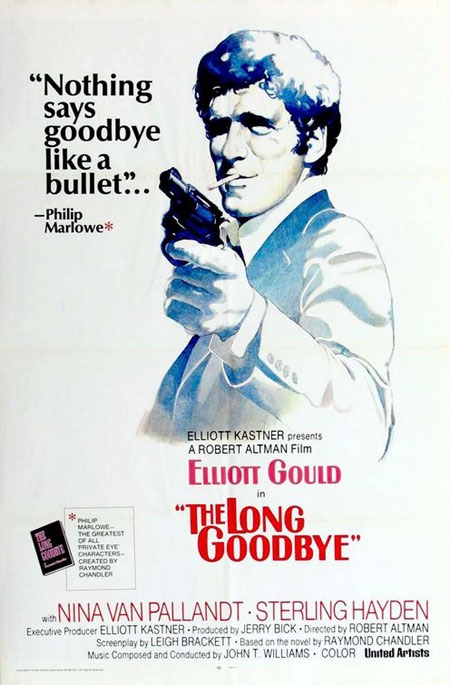
Robert Altman’s Phillip Marlowe (Elliot Gould) isn’t a hard-bitten cynic but rather, a seemingly scattered, chain-smoking hippie in a suit (his mantra? “it’s okay with me”), as bemused by the conservative cops who roughly bring him in for questioning (“Someday all the pigs are gonna’ be in here and all the people are gonna’ be out there. You can bet on that. You’re not in here. It’s just your body”) as the perpetually stoned yoga nudists who are his neighbors (“They’re not even there. It’s okay with me”). The truth is that much is decidedly not okay with Marlowe, in particular, his being used by old friend Terry Lennox (former NY Yankee pitcher and baseball whistleblower Jim Bouton) after the mysterious death of Lennox’s wife.  As Marlowe floats through a Los Angeles that feels desolate and burnt out, he moves closer and closer to the truth, navigating the authorities, hangers-on and brutes while standing by his friend.

Mark Rydell, who later became a decent director (Cinderella Liberty, On Golden Pond), stands out as a particularly chilling gangster who peppers his threats with loopy new age nonsense and boasts about his physical fitness regimen and the fact he lives near Nixon.

Altman and screenwriter Leigh Brackett aggressively revamp the source material, but Marlowe is still Chandler’s in many ways.  He needles the cops (“Is this where I’m supposed to say, ‘What’s all this about?’ and he says, ‘Shut up! I ask the questions’?”), can shake from his seeming fog to register a keen read on the situation, and when he arrives at the end of the journey, he is all Chandler’s Marlowe, with his own unyielding code.

Critic David Ehrenstein once told me that The Long Goodbye “was” Los Angeles and while the film doesn’t figure prominently in Los Angeles Plays Itself, it’s hard to argue it doesn’t have Hollywood in its marrow. Movie memorabilia can be found in Marlowe’s otherwise bare bones apartment (which was just recently available for rent), presumably from a prior occupant.  The security guard at a gated ocean community specializes in impressions, from Barbra Stanwyck to Jimmy Stewart to Walter Brennan.  The score is some version of the torch song “The Long Goodbye”, be it Muzak in a supermarket or a cocktail lounge piano number, the same ditty re-packaged as only Hollywood can.  Son of Old Hollywood Robert Carradine shows up as a jailhouse prophet and Altman exhibits prescience in his casting of Arnold Schwarzenegger as a mute thug.  LA itself seems an otherworldy ghost town, where everything seem to be trying to pass as a facsimile of the real thing.  As Ehrenstein noted, “Back then the city was a sprawling, sleepy, empty place — Altman’s The Long Goodbye capturing its ultra-casual look and feel perfectly.  ‘But there’s nothing there,” my east coast friends would say”).

This is a seminal picture, and a prime example of reinventing a genre.

image

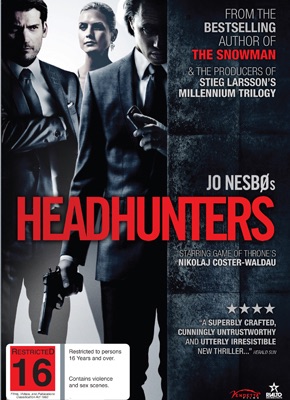
If you want to learn how a little-known director gets a big budget, Oscar-bait vehicle, watch Headhunters, a clever, fast-paced thriller about a corporate recruiter/art thief who gets in over his head financially and otherwise.  An engrossing thrill ride with a “wrong man” Hitchcockian vibe, the film’s only stumble is an overly intricate initial plot device that introduces the protagonist to his tormentor.  Otherwise, this is a cool, steady, occasionally grisly film in the vein of Blood Simple.

Headhunters was a massive success in Norway, which translated to about $14 million foreign but just over a mere million here in the U.S.  Still, Hollywood noticed and selected director Morten Tyldum to helm a picture that had absolutely nothing in common in style, substance, or feel with his breakout movie, the woeful The Imitation GameOf course, that film was nominated for Best Picture, so what do I know.  I just hope Hollywood similarly rewards Jeremey Saulnier (Blue Ruin) and Jennifer Kent (The Babadook).

Available on Netflix streaming.

image

J.C. Shandor wrote and directed my favorite film of 2011, Margin Call, a verbose, intricate “what if?” financial thriller set before the crash of 2008. Last year, Shandor made the critically acclaimed All is Lost, a tale of survival on the sea starring Robert Redford and featuring a script of a mere 31 pages (it is now on Netflix streaming but I’ve neglected to see it). If there was any doubt, Shandor’s third film cements that he has no interest in doing the same thing again.  A Most Violent Year is the anti-crime picture, a meticulous thriller set in the suburbs of 1981 New York City revolving around the intricacies and corruption of . . . the home heating oil business. Oscar Isaac and Jessica Chastain are a married couple working to expand their reach in the business, in the face of union troubles, a prosecutor’s investigation, the hijacking of their trucks and the intimidation of their sales force. Isaac, an immigrant, is resolute in combating these obstacles in a legal and above-board manner. Chastain is the daughter of a mob boss, and her fealty to the straight-and-narrow is less stringent. As the screws turn, you think you can see where this is going.  You’re wrong.

Chandor’s medium cool meditation emphasizes Isaac’s passion, ethics, and larger vision and while the stakes are small in the scheme of things, to Isaac, they are everything, and Shandor effectively invests the audience in his struggle without infusing the narrative with the expected fleshy, pulpy, satisfying retributive violence. I’ll admit:  bloodletting is what I wanted and expected and as the tension mounted, Chandor’s resolution felt unsatisfying. In that way, Chandor transforms the genre.

This is an ingenious, unique movie.  Chandor’s feel for 80s New York is sharp, his pacing is tight and he never veers far from the heart of the picture, the unswerving devotion of Isaac and Chastain to their business and to each other. Their performances are riveting; they feel like a married couple who melded passionately but never addressed longstanding disputes in their view of the world.  Like a real married couple.

One of the best of the year.

Photo Gallery - Inherent Vice - Inherent Vice Movie Poster

Paul Thomas Anderson’s (Boogie Nights, Punch Drunk Love) private investigator noir evokes Robert Altman’s The Long Goodbye, but instead of Elliot Gould as Phillip Marlowe-meets-Jeff Bridges’ “The Dude”, Joaquin Phoenix is all 1970 Southern California hippie, all the time, so “out there” he has to keep a notepad with one word reminders to stay focused. The result is a detective yarn, but through the eyes of a stoner, in parts scintillating and in parts frustrating. If you approach the picture traditionally, you’ll find yourself trying to connect the dots of a plot that seemingly fuses murder, real estate, the FBI, the Las Vegas mob and a drug trade that profits from its customers on the front end and back. However, Phoenix is our guide on this trip (there is no scene without him), and he is unreliable. Two couples walked out of the theater during this movie, and while the thought never occurred to me, I could see it occurring to others. Anderson has a nice cheat at work here: the byzantine plot has promise, but rigor is unnecessary when viewed through the eyes of a doper. When you shake your head, you’re a square and not in on the joke. When you go with the flow, it’s a little tiresome, and at 148 minutes, even boring.

Anderson’s movies look fabulous, and this is no exception. His sundrenched beach LA is almost mystical, and his re-creation of Manson-era, Southern California weirdness is vivid. The picture can also be very funny, with nice contributions from Josh Brolin as a straight-laced, psychologically fragile LAPD detective, and Martin Short as an electric, drug-snorting dentist.  Katherine Waterston, as the femme fatale and the only character who seems to ground the picture, is a revelation, mesmerizing and completely believable as the woman who could penetrate even Phoenix’s lazy, listless existence.

Rottentomatoes.com critics gave this picture a 70%, with only a 57% from the audience. There may be a lesson there.  Even though Anderson is an auteur commodity, he should consider getting back into traditional storytelling. His last two films –The Master and this – have been beautifully shot and acted yet uninvolving and disaffecting.  Phoenix is presented to us as an archetype in both films, without backstory or motivation. As such, it’s hard to care, and that’s a problem.

I was alerted to this film by David Thomson’s tribute to its writer, R.I.P. Alan Sharp, a Writer Too Dark for Hollywood.  Thomson credited two Sharp films, Ulzana’s Raid and Night Moves:  “Neither of them was nominated for anything, and only Ulzana’s Raid did any business.  But if you want to experience the richness of American films in the early 1970s, they are worth tracking down. You will be surprised how complex they are and how tense. They seem to understand movie narrative in a way so few films do today: He used mystery to draw audiences into his stories, trained them to answer the small puzzles, and then had them ready to grasp the implications he preferred not to underline. And both films are tough, bitter, and bleak, bearing the imprint of an unusual and talented outsider.”

Whenever we watch a movie from the 70s, my wife sighs and asks, “Is everybody going to die in this one?”  Night Moves is indeed a dark film, but Thomson is also dead-on in identifying its allure.  Gene Hackman plays a former pro football player turned private detective who is hired by an aging Hollywood not-quite-a-star (a dissipated but crafty Janet Ward) to find her wayward 16 year old daughter (Melanie Griffith, reprising her jailbait, tart role in The Drowning Pool, minus the malevolence).  Griffith has taken flight, bouncing between movie sets in Arizona and her creepy stepfather’s (John Crawford) compound in the Florida Keys.  In the meantime, Hackman discovers that his wife (Susan Clark) is having an affair, so he is in essence conducting two investigations, only one of which is really private.  The picture is leisurely and intricate, until, as Thomson notes, a “deeply upsetting” end.

Hackman turns in an interesting version of the traditional private investigator, part canny but part limited.  He is clever, but not the sharpest knife in the drawer.  He’s also very human, a vulnerability.  Along with Elliott Gould’s Phillip Marlowe in Robert Altman’s The Long Goodbye, Hackman’s p.i. is a marked and welcome departure from the type.

Sharp’s dialogue is noteworthy, especially in some of the exchanges between Hackman and Clark as they confront the state of their marriage and the import of her infidelity.  Hackman is also given some wonderful lines:

Ward: Are you the kind of detective who, once you get on a case nothing can get you off it? Bribes, beatings, the allure of a woman…

Hackman: That was true in the old days. Before we had a union.

* * *

Paula: How do you resist Delly?

Hackman: Oh, I just think good, clean thoughts, like Thanksgiving, George Washington’s teeth.

* * *

Crawford: (on his nubile stepdaughter Griffith)  You’ve seen her.  God, there should be a law.

Hackman:  There is.


An effective spy thriller, in keeping with the post-Watergate cynicism and paranoia of so many American films (The Parallax View, Executive Action, The Conversation, Winter Kills). Robert Redford is a lowly CIA analyst at a New York City agency front (a historical society) who comes back from lunch one day to find all of his co-workers gunned down.  Redford goes on the run, commandeering Faye Dunaway, and as he flees the hitmen (led by Max Von Sydow) and negotiates with the Agency rep (Cliff Robertson), he woos Dunaway and uncovers the reason for the murders. Needless to say, that reason is of the times.

There are problems. Redford can be intense, but he cannot be harried or excitable. As such, he handles some pretty shocking developments in a discordantly world-weary way. As far as the plot, despite all the cloak-and-dagger, it’s very bare bones. The film is also horribly scored, sporting a 70s saxophone that makes the dullest love scene ridiculous. Redford and Dunaway don’t seem to be having sex so much as playing the “who blinks first” game.

Dunaway, however, is quite good, managing to convey a captive’s ability to bond with her captor, and as an Agency “contractor”, Von Sydow is understated and interesting. Robertson is also given respect, even though he’s ostensibly the government baddie. His speech to Redford at the end is a fair defense of the dirty tricks spy trade:

As Director Sydney Pollack noted about Robertson’s character, “I’m much more interested in the CIA guys who are trying to help us and do something [widely considered] immoral than I am about guys who are just immoral because they want to sell dope and make money. That’s boring to me. It’s much more complicated to say, here’s a bunch of guys whose job it is to protect us and they’re saying there’s no way we’re going to sell the fact that the Middle East [states] control the oil and if we don’t get control of the oil and they [seize its production], we’re going to end up with what we have now.”  Now, juxtapose Pollack’s view of Robertson with Oliver Stone’s Wall Street creation, Gordon Gecko, who at the height of his megalomania, answers a question as to why he wants to wreck a company with, “Because it’s WRECKABLE!” and you’ll understand why that film travels so poorly.

Pollack also makes great use of grimy 70s New York City – the World Trade Center figures very prominently in the film. More Pollack: “I was looking for the logic of where the [Central Intelligence Agency (CIA)] might be [located]. I didn’t want to have a building that said CIA on it because I didn’t think that would exist. I figured they would want some kind of anonymity and that the best kind of anonymity are these two massive buildings with thousands of offices and you wouldn’t know who’s where.”


After a promising start, this picture spins so wildly out of control it is almost impressive. Mild mannered Texas picture framer Richard Dane (Michael C. Hall) shoots a home intruder, earning the enmity of the intruder’s fresh out of prison father (Sam Shepard), but they soon learn there is something bigger than the both of them connected to the killing. The first half of director Jim Mickle’s movie is tense and effective. But then, the picture abruptly shifts course, veering into the implausible. Hall and Shepard improbably team up together with the assistance of Don Johnson as a Houston private investigator (Johnson delivers a jokey performance that undercuts the film’s dark feel) and we get a bit of a buddy movie. The awkward shift in tone is accompanied by nonsensical plot points and an ostentatiously arty, bloody end that utilizes slow motion and a synthesizer rich soundtrack reminiscent of The Terminator without a hint of irony.

Post Dexter, Hall is as good as he can be, but the writers give him absolutely no real reason to become a confederate with a man who not only threatened his life, but that of his wife and child. The critics gave this 85% on rottentomatoes.com while the audience posted a 69%. The audience got it right.

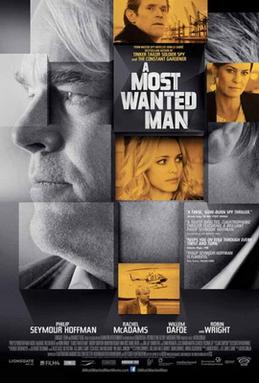
On the plus side, this moody, meditative adaptation of a John le Carre’ novel is intelligent yet explicable (unlike the rushed and byzantine Tinker Tailor Soldier Spy) and anchored by one of the greatest actors of a generation, the late Phillip Seymour Hoffman. On the downside, while it is compelling in parts, it is hurt by a weak Rachel McAdams performance and an inapt one by Robin Wright.  More problematic, the grim resolution seems a cop-out, an easy resolution that makes the viewer wonder what the hell this was all about.

Hoffman is a German intelligence officer who leads an anti-terror unit in Hamburg. Like Jessica Chastain in Zero Dark Thirty, he is haunted by an intelligence failure from his past. He is tracking two terror suspects, one a potential bomber and the other a funder, when he formulates the idea of baiting the latter with the former. McAdams plays a lefty lawyer representing the suspected bomber and, as usual, she is thin, distractingly glamorous and, when asked to buckle under the weight of seclusion and interrogation, inept and unconvincing. Wright, as a CIA counterpart to Hoffman, is merely odd. She’s much too high brow, playing a minor variation of her character in Netflix’s excellent House of Cards, fine for a First Lady but not so much for a spook.

Hoffman, however, is stellar, whether keeping a frightened mole from turning, managing his younger team, or lecturing McAdams on the naivete of her politics. He is supported ably by Willem Dafoe as a banker caught in the middle of Hoffman’s gambit. Dafoe exudes the fear and discomfort of a “civilian” dragged into the high stakes of thwarting terror.  If the film’s end is somewhat ho hum, both actors are more than worth the watch, especially since this was Hoffman’s last finished picture.

image

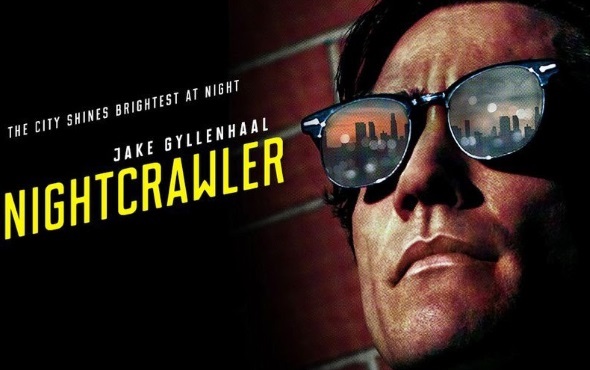
A clever black comedy that emphasizes story over a message (“if it leads it bleeds”), Nightcrawler works in large part to Jake Gyllenhaal’s riveting performance as an aspiring freelance videographer who haunts LA at night, capturing its brutality for sale to local TV news. Gyllenhaal is a mixture of King of Comedy‘s Rupert Pupkin, Rushmore‘s Max Fischer, and Jim Carrey’s Cable Guy, a driven cipher who spouts business motivational doctrine and relentlessly pushes further and further over the line of acceptable journalistic practices in capturing people in crisis or even death throes. You guiltily root for him because he is so compelling and his Dale Carnegie pitch, even unmoored from any concept of morality, comes off as an earnest entrepreneurial pitch. But by the end of the film, a series of tense crime scenes invaded by Gyllenhaal, his philosophy is both corrupting and lethal. He makes it bleed even more that it otherwise would, and as a result, he excels.

It’s a simple tale, well told, but there isn’t a lot to this picture other than Gyllenhaal, who exudes a real inner force (while his character is certainly different, I kept coming back to De Niro in Taxi Driver). He has two co-stars; Renee Russo, a hard-bitten struggling TV producer whose star rises with Gyllenhaal’s footage, and LA at night, which writer director Dan Gilroy shoots as a haunted ghost land of deserted streets and foggy canyons. Gilroy is a longtime writer of pretty bad films (Freejack, Two for the Money, Real Steel), but he directs this thriller with pace and verve.