Archive

Crime/Mystery

Michael Mann’s crime opera clocks in at over 3 hours. It is too long, but not by much. The trimming of one plot line could have made this cool and intricate crime drama excellent. Instead, it is merely very good.

Robert De Niro and his crew of criminals (which includes Tom Sizemore and Val Kilmer) are master thieves in LA.  Al Pacino and his crew of cops (which includes Wes Studi and Mykelti Williams) are master thief busters. The criminals plan and execute three jobs, and the cops try and stop them, while juggling family, wives/girlfriends, and the hazards of the professions.

The opening and closing heists are brilliantly staged by Mann, especially a bravura bank job gone wrong in downtown LA.  De Niro’s crew tears through the police, making Swiss cheese of them in a several block, by-car and then on-foot getaway. I had always assumed the scene was based on a real-life North Hollywood shootout where 2 heavily armed men In body armor robbed a bank, were confronted by lightly armed police and injured a dozen of them before being shot down.  In fact, the real-life robbery came two years after the movie.

The story also smartly weaves the stories of a three secondary characters (a member of De Niro’s crew who was kicked out and seeks revenge; a crooked investor for drug interests who takes exception to being ripped of by De Niro’s crew; and, a recently paroled criminal trying to stay out of the game), all of whom intersect with and enhance the primary plot.  Pacino’s relationship with his third wife and her emotionally fragile daughter (Natalie Portman) is also handled well. The wife is not a stoic sufferer but a modern, divorced and frustrated character who is too focused on Pacino to the detriment of her child.

I have three complaints. First, Pacino goes a little too Scent of a Woman. He is so ferocious at times that it is hard to stifle a chuckle, and his accent is strangely southern, then it is not. He is either very good in the movie (his low-key confrontation over coffee with De Niro is one such moment) or he is cartoonish (the entire scene with his informant is bizarre; Pacino looks like he might start speaking in tongues and “Hoooooo-AHHHHHH” never seems far off).


ACTUAL STILL FROM THE PICTURE

Second, the attempt to humanize De Niro by introducing a forced love interest with Amy Brenneman is a mistake and it interrupts the pace. The relationship is unconvincing and as such, does not explain certain choices De Niro makes at the end.  Given the brutality of De Niro (by my count, he kills or wounds a dozen cops and orders the execution of a security guard), it is enough for us to root for him only when he is pitted against others of his ilk. But the attempt to make the audience empathize with his lonely life of crime is several bridges too far.

Third, Val Kilmer’s escape is unconvincing, making a police character we’d been led to believe was sharp look borderline incompetent.

Otherwise, this is a stylish, gripping picture.  And for music fans, Henry Rollins and Tone Loc get minor roles.  Also, it features a young Ashley Judd, who bravely allowed herself to look as worn and haggard as the wife of a brutal, volatile and uncommunicative criminal should.

John Frankenheimer’s Ronin was a primer on film car chases, equaling William Friedken’s set pieces in The French Connection and To Live and Die in L.A. and surpassing Peter Yates in Bullitt (though, The Seven Ups has the best car chase scene in film history).

In James Foley’s The Corruptor, you can see the worst car chase in all of film, a 25 mile per hour snorefest through the alleys of NYC’s Chinatown. One straight line, very low speed, back and forth, back and forth. One Adam 12 had wilder high speed pursuits.

The “chase” is indicative of Foley’s ineptitude with the action genre (Foley’s best work has been in the non-action category – Glengarry Glen Ross and After Dark, My Sweet. His principals – Mark Wahlberg and Yun Fat Chow – kill everyone in sight with handguns, loaded by their inexhaustible supply of clips. And if you are firing at Wahlberg or Chow with a machine gun, you will miss, but you will also break a lot of glass. Indeed, the opening action sequence is a shootout in a lamp and ceramic store.

So, the action is ham-handed and sadly, the script sucks. In a nutshell: Old vet meets young rookie, who has been assigned to Chinatown. Old vet tells young rookie, “You don’t change Chinatown. It changes you.” Or something like that, because Chow’s English is a little iffy, so the line may come across as follow: “Ru don chanse Chintown. It chanses ru.” Thereafter, we hear the patented “dow, dow, ding” of Chinese massage parlor music.

Chow’s principal strength is the ability to make his eyes go all crazy just before he’s about to shoot a bunch of guys.

Wahlberg, who can be effective when leashed very tight, merely sleepwalks through this muddle.

Lurid, inane, bordering on the sick, Simon West’s picture attempts to tell the story of the murder of a military woman on a Georgia base. She is tied to the ground by tent pegs, spread-eagled, naked, and strangled. West lovingly lingers on the image. Worse, her physical entrapment is connected to a gang rape in similar circumstances years prior. West cruelly enjoys that image as well.

But forget The General’s Daughter as a pseudo snuff film. Even if you can get by that horror, you are left with four insurmountable handicaps.

First, the story is absurd. When a new clue is required to move it along, boom! – it drops out of nowhere. When the investigators (John Travolta and Madeline Stowe) must wrangle information from the daughter’s psychiatrist, they suggest a breach of his medical ethics that is so moronic you can’t believe it has been penned for the screen. If another clue is needed, Travolta just sticks a gun to the head of a character and there you have it -the beans are spilled. When Stowe confronts a suspect in the gang rape seven years earlier, she uses the most obvious technique in the book (the threat of DNA evidence on the daughter’s panties), he succumbs, and voila’ – case solved. Apart from the hackneyed interrogation technique (gasp! – they were just-bought panties, not old panties, and it was all a bluff!), the suspect confesses that he tried to stop the rape, but was unable to do so. Which begs the question: WHY WOULD A BLUFF AS TO HIS DNA ON PANTIES FAZE HIM IN THE SLIGHTEST IF HE WAS NOT ONE OF THE GANG RAPISTS?

Second, the acting is abysmal. Travolta is particularly awful, a condescending bore overly taken with himself. Stowe is useless, and her puffy, mis-shapen face, distorted by collagen and who knows what else, is upsetting, especially when one remembers her in The Last of the Mohicans. With the exception of an interesting weird turn as the daughter’s mentor by James Woods, the rest of the characters are forgettably stock.

Third, the film unintentionally creates a sub-theme of backlash against women in the military. Ostensibly, the film presents women in the military as a good thing, and West clumsily ties the daughter’s gang rape and murder years later to this new phenomenon. Yet, when Travolta and Stowe question a female guard who was on post the night the daughter was murdered, the female solider is a) incompetent; b) blubbering like a brook; and then c) blase’, as she explains to the investigators that people on base often came to the scene of the crime all the time “to fu**.” Add the truly bizarre behavior of the daughter (she essentially sleeps with everyone under her general father’s command), the depiction of military men as almost crazed in their dislike of women in their ranks, the creepy mutual attraction of Woods and the daughter (he is her superior in the chain of command), the fact that Stowe and the daughter – both military women – are made to look sexually enticing (even sporting cherry red lipstick), and an early sexual foxtrot between Travolta and the daughter, and you get the feeling that maybe this film is anti-women in the military. Either that, or West is doing some recruiting. Join Up! The Chicks are Hot!

Finally, if you don’t know who the murderer is in the first 20 minutes, you were probably shocked that the boat sank in Titanic.

Lock, Stock and Two Smoking Barrels - Wikipedia

A black crime comedy that is full of visual gambits (many hit, many miss), this is a heist film billed as Great Britain’s Pulp Fiction. It has many similarities – the screwing around with sequence, the blase’ attitude to brutality, the quirky characters – but visually, it shares more in common with the Cohen Brothers first film, Blood Simple, though post-MTV in attitude. The director shows you every knife in his drawer, from stop action to slow motion 360 (an entertaining card game gone bad), to interspered music video. The result is a mash of a film, but it is populated by engaging players (a quartet of inept thieves, a trio of crass, drugged out marijuana brokers, a Mr. Big, a fatherly enforcer with a weird concept of family values, an Abbott and Costello) and it moves quickly (sometime, too quickly, because the Cockney is a bitch).

The director, Guy Ritchie, has moved on to the Robert Downey-Jude Law Sherlock Holmes flicks, infusing them with the same action and pace as this picture.

Does it have soul? None. It’s all flash and teeth.

Image result for The Limey

Terence Stamp plays a just-released British convict who comes to Los Angeles to investigate the death of his estranged daughter.  Stamp is a tough guy, but not Bob Hoskins cockney and bluster, The Long Good Friday tough (thankfully, Stamp is more intelligible). He’s icy and removed, grimly determined to get to the bottom of his daughter’s death. His search opens several leads, the most promising being Peter Fonda, a record executive who made his bones in the 60s, and Barry Newman, Fonda’s dubious associate (Newman was a 70s American television staple as “Petrocelli” the lawyer).

As icons of the 60s, Fonda and Stamp are dinosaurs, two powerful men not quite at ease in the 90s, and Soderbergh uses them to insert a generational disconnect in a taut psychological crime thriller.

Stamp evokes the macho rage of an absent father well. His anger burns, even though his memories are but a few snippets and stories (he was in prison for a great period of her upbringing). His inner demon is not so much what he lost, but what he squandered, and he’s powerful.

Where Stamp is driven, Fonda is resigned. He senses that his time is past, and his desperation is palpable. His weakness is subtle (his conversations with a lover 30 years his junior are wonderfully pained, the scripted equivalent of a middle-aged man in a Porsche, a head mottled by Rogaine, and “The Byrds” on the CD, as he waxes about his past, only to be met with “Oh, I think you’ve told me that story”).

Solid noir.


Tom Ripley's “Talent” Explained in Psychological Terms | by Martine Nyx |  Cinemania | Medium

Anthony Minghella’s The English Patient did not have the beauty (such is Italy versus the Middle East), the narrative strength or the strong characterizations of The Talented Mr. Ripley. While it won best picture, it can comfortably be catalogued in that big picture-big bore compendium of Gandhi, The Last Emperor, and Out of Africa. The somnambulate performances of Ralph Fiennes and Kristin Scott Thomas sealed the deal.

Not so in Minghella’s follow-up. Matt Damon plays, in his own words, a “nobody” named Tom Ripley who by chance and minor deception is hired to retrieve the wayward son (Jude Law) of a shipping magnate (James Rebhorn) in Italy. When he gets there, Damon insinuates himself into Law’s life, as well as the life of his fiance (Gwyneth Paltrow) through a mix of artifice and honest friendship. Damon immediately becomes entranced by Law and by Law’s life. His love-affair with both gives us entree into the mind of a malformed ego undergoing slavish adoration.

And Law is worthy of adoration. He is the energy of this picture, alternately charming, impetuous and cruel. As Damon keeps sidling up to Law, you feel for both if them. Damon is voracious but because Law is so captivating, Damon’s need to be near him and eventually to be him elicits understanding. This is a crucial component, for while the sexual undertones are strong, what Minghella does is make you a partner to Damon’s mental, rather than physical lust for Law.

This is the film’s triumph, as most psychological thrillers suffice to center on the madness within the sociopath, rather than lay a sympathetic base for why the sociopath becomes sociopathic.

Here, Minghella allows us to see the Damon-Law relationship through courtship, their bad moments, Damon at his most fawning and pathetic, Law at his most generous and spiteful. All with the backdrop of beautiful Italy, a locale Minghella makes almost dreamlike, the better to underscore Damon’s dizzying descent.

Damon manages the role very well, though he overrelies on a few tics (the weird, self-effacing grin, the penetrating stare). Still, his is a measured and affecting performance, certainly a worthy contrition for his “aw shuckism” of Saving Private Ryan. Everyone else is quite good, with special mention to Philip Seymour Hoffman as Law’s monied playboy friend from Princeton. His time on screen is limited, but he dominates every moment he has with a dry, smart rendering.

Reindeer Games. Imagine Paul Reubens playing Sam Spade and you come close to Ben Affleck as a hardened car thief (yes, because our hero, though a criminal, must not be a real criminal, he must be a car thief, like Nicolas Cage in Gone in 60 Seconds or the redheaded guy from NYPD Blue in the other Nicolas Cage car thief movie) who comes out of prison pretending to be his ex-cell mate (shanked, I kid you not, by DE Dana Stubblefield, formerly of the Washington Redskins) so he can score with his ex-cell mate’s pen pal, a lithe blonde played by Charlize Theron, because all criminals get lithe blonde pen pals who wait for them outside the prison gates and then take them to a motel, and all of these pen pal women are Charlize Theron attractive too. It’s true. Ask Scott Peterson.

So, then Theron’s scraggly, scummy cohort (Gary Sinise) and his crew arrive and they want Affleck to help them rob a casino where Affleck used to work, except that Affleck didn’t work there, his ex-cell mate did, and so, of course, you see the problem.

Nice pool scene with Theron. Otherwise, plodding, stupid and nouveau violent (slo-mo, big holes in people, and snappy one-liners simultaneously).

The Black Dahlia. Right at mid-point, you realize that Brian De Palma actually makes the Elizabeth Short murder, one of the most sensational in American history, humdrum. Worse, the entire film is spent with Josh Hartnett, who is attempting a medium cool but merely achieves dull. His weak performance doesn’t really matter, because you don’t know what the hell is going on anyway. The film is grotesque, confusing and embarrassing. Based on the first of author James Ellroy’s L.A. quartet, its only value is as a crappy comparator to the classic L.A. Confidential.

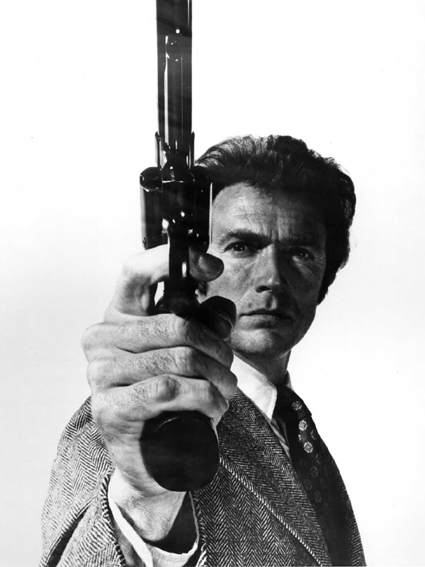
Harry Callahan (Clint Eastwood) is a no-nonsense detective in 1970s San Francisco, where the political correctness is thick, Miranda-warning era sensitized bureaucrats rule, and crooks are coddled (every thug in Dirty Harry has the sneering, arrogance of a punk who knows that the law is on his side). The baddest guy in a sea of bad guys is the film’s facsimile of the Zodiac Killer, a vicious beatnik with Woodstock hair, an army fatigue jacket and a peace symbol on his belt buckle. Callahan is called in to help with the case.  He is immediately accosted by the D.A. for his excessive brutality.

District Attorney Rothko: You’re lucky I’m not indicting you for assault with intent to commit murder.

Callahan: What?

District Attorney Rothko: Where the hell does it say that you’ve got a right to kick down doors, torture suspects, deny medical attention and legal counsel? Where have you been? Does Escobedo ring a bell? Miranda? I mean, you must have heard of the Fourth Amendment. What I’m saying is that man had rights.

Harry Callahan: Well, I’m all broken up over that man’s rights!

In fighting with the mayor – who wants to give in to the killer’s demands – Callahan is blunt and dismissive.

Mayor: I don’t want any more trouble like you had last year in the Fillmore district. Understand? That’s my policy.

Harry: Yeah, well, when an adult male is chasing a female with intent to commit rape, I shoot the bastard. That’s my policy.

Mayor: Intent? How did you establish that?

Harry: Well a naked man is chasing a woman through an alley with a butcher’s knife and a hard-on, I figure he isn’t out collecting for the Red Cross.

Even in his ultimate scene, where he mocks one of three hold-up men, Callahan embodies the rugged conservative fantasy of turned-tables and frontier justice.

Harry: Ah Ah, I know what you’re thinking. Did he fire six shots or only five? Well, to tell you the truth, in all this excitement, I’ve kinda lost track myself. But being as this is a .44 Magnum, the most powerful handgun in the world, and would blow your head clean off, you’ve got to ask yourself one question: ‘Do I feel lucky?’ Well, do ya punk?

Punk. He’s a punk. Not a suspect. Not a person. Not a downtrodden, misunderstood product of an uncaring society.

Paul Newman was offered the film, but legend has it he was nervous about its politics, and suggested Eastwood for the part. Great suggestion. Eastwood has commented on Dirty Harry that “It’s not about a man who stands for violence, it’s about a man who can’t understand society tolerating violence.” Pauline Kael called the film “fascist.” This is, however, the same Pauline Kael who was stunned when McGovern lost in 1972, saying “I live in a rather special world. I only know one person who voted for Nixon.”

Politics aside, this is an excellent picture. Eastwood is mythic, the story moves, the San Francisco locale is used to great advantage, and the killer is truly frightening.

Image result for reservoir dogs

\Quentin Tarantino’s debut picture has weaknesses, and it is in some ways showing its age, but many of the things that are good about it remain very good. The dialogue remains vivid, fetishizing pop-culture via tough guy patter. The conversations are irresistible, trading in on the vulgar, racist, homophobic pitch-and-catch of the red-blooded American male killer. Tarantino’s explanation of “Like a Virgin” (“It’s all about this cooze who’s a regular fuck machine, I’m talking morning, day, night, afternoon, dick, dick, dick, dick, dick, dick, dick, dick, dick”); Steve Buscemi’s theory on tipping; the back-and-forth “he’s trying to fuck me in front of my Daddy” between Chris Penn and Michael Madsen – it all crackles.

The machismo is undercut, however, when they get their aliases:

MR. PINK
Why am I Mr. Pink?

JOE
Because you’re a faggot, all right?

(Mr Brown laughs, Mr Blonde smiles)

MR. PINK
Why can’t we pick our own colors?

JOE
No way, no way. Tried it once, it doesn’t work. You get four guys all fighting over who’s gonna be Mr. Black. But they don’t know each other, so nobody wants to back down. No way, I pick. You’re Mr. Pink. Be thankful you’re not Mr. Yellow.

MR. BROWN
Yeah, but Mr. Brown, that’s a little too close to Mr. Shit.

MR. PINK
Mr. Pink sounds like Mr. Pussy. How about if i’m Mr. Purple? That sounds good to me. I’ll be Mr. Purple.

JOE
You’re not Mr. Purple. Some guy on some other job is Mr. Purple. You’re Mr. Pink.

MR. WHITE
Who cares what your name is?

MR. PINK
Yeah, that’s easy for you to say. You’re Mr. White. You have a cool sounding name. All right look, if it’s no big deal to be Mr. Pink, you wanna trade?

JOE
Hey, nobody’s trading with anybody. This ain’t a goddamn fucking city council meeting, you know. Now listen up, Mr. Pink. There’s two ways you can go on this job– my way or the highway. Now what’s it going to be, Mr. Pink?

MR. PINK
Jesus christ. Fucking forget about it. It’s beneath me. I’m Mr. Pink. Let’s move on.

The dialogue is even given its own soundtrack; Steven Wright’s droning as the “Super Sounds of the 70s” dee jay is our comic relief.

Until Gerry Rafferty’s “Stuck in the Middle With You” accompanying a torture becomes one of the scarier songs ever.

Tarantino also does so much with very little. No big action sequences. No big money.  Economical and still impressive.

Two things I didn’t like about the film. First,

You’re not to make a move till Joe Cabot shows up. I was sent in to get him. All right? Now you heard me. They said he’s on his way. Don’t pussy out on me now, Marvin. We’re just going to sit here and bleed till Joe Cabot sticks his fucking head through that door.

The idea that the cops are parked around the corner a block away waiting for mastermind Joe Cabot while two of their own are in the place as hostages (one actually dying, one being mutilated) is absurd.

Second, Tim Roth was bad. He was fighting his accent and he lost. I never bought him. Still don’t.