Archive

Crime/Mystery

A Simple Plan | Rotten Tomatoes

Sam Raimi’s Fargo without the sweep, innovation or strong characterizations.  It settles for snow and violence.

Three men, two of them brothers (Bill Paxton, Billy Bob Thornton) find money. They try to keep it. Things go terribly wrong.

Thornton was deservedly nominated for best supporting actor. He plays an alternatively canny and dimwitted local yokel who unravels as the heat increases. Thornton captures perfectly the essence of the childlike, simple brother who stays home to drink with his dog, immersed in something beyond his capabilities by his smarter, greedier brother (Paxton).

Unfortunately, Raimi’s direction is workmanlike and forgettable. In the end, however, the script sinks the ship. Paxton is dumber than a hound’s tooth. Worse, he is singularly uninteresting and he is the protagonist we are forced to follow, more so than Thornton.

Bridget Fonda plays his greedy wife, a transformation that takes her over in a millisecond.  In fact, it would be hard to cast two thinner actors than Paxton and Fonda.  Perhaps this was the strategy, to show everyday folks turned to greedy dullards, but dullards are dullards.

The plan simply wasn’t simple enough for these snoozers.

Coen brothers confirm Fargo is a true story after all, or at least based on  some | The Independent | The Independent

One of the best crime movies ever made, deservedly on AFI’s list of the top 100 films (no. 84). This is the Coen film that brought flesh-and-blood characters and a cinematic theme eclipsing their technical skills.

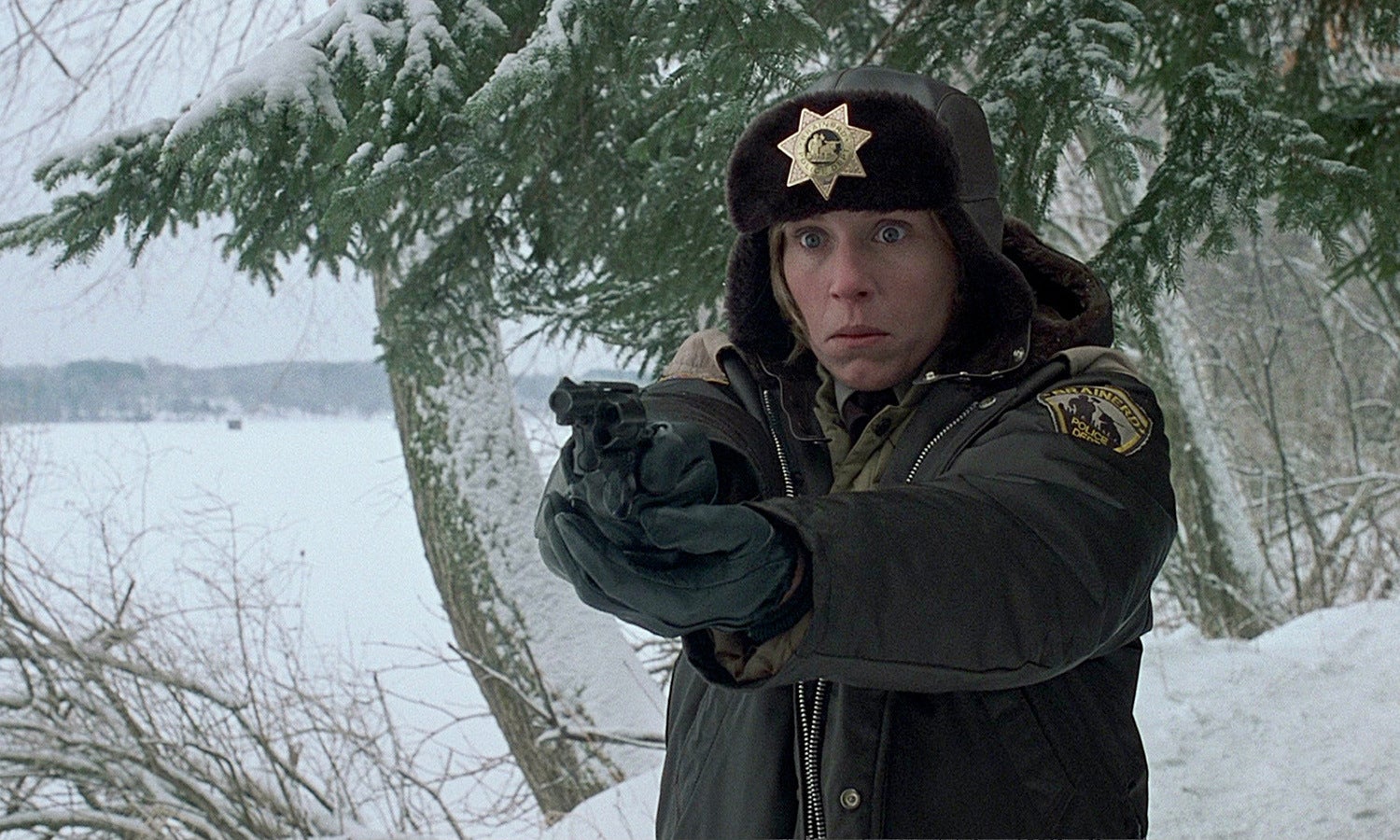
Fargo is about American crime. The ridiculous crime you read about in newspaper blurbs. The Coens offer a rich explanation behind “Man Found Shredded in Wood Chipper” or “Couple Carves Fetus out of Young Woman.” But while the story is mythic (aided by Carter Burwell’s memorably dark score), the characters are not mythical. William H. Macy is a scared, little man who wants to make his mark, gets in hock, and cooks up a scheme to have his wife kidnapped and ransomed. The kidnappers (Steve Buscemi and Peter Stormare) are ignorant and brutal, sharp, cunning animals who subsist on the reticence of victims to respond. That they will resort to violence is never in doubt. They are criminal through-and-through, of the type depicted in In Cold Blood or One False Move or, for a truer example, in occasional “Real Live Video” shows. The killers in Fargo remind me of a true video I saw of a carjacking, which was filmed from inside the car. The “carjackee” is an undercover cop, and he tries to calm the carjacker down to give the police time to swoop in. The carjacker will not be assuaged.  He is a vicious animal, constantly pointing his gun at the undercover cop, threatening to blow his head off. Up until the moment the police swoop in and disarm him, the criminal is a beast. Immediately upon being disarmed, however, the carjacker is all, “It’s cool, it’s cool.” He’s smiling. He’s reasonable. He’s a completely different person, almost in a prep mode to appear more deferential and misunderstood.

Here, the Coens show something rare in crime films – they show the killers in everyday, mundane life, as driving companions, as drinking buddies, as guys picking up chicks at a bar, or holed up watching TV and waiting for the money. Then, after we laugh at or with them and become more comfortable with their demonstrated incompetence, the directors show us their vicious sociopathy. Quickly, their first instinct when pressured is to kill, and they do it without remorse or reflection. They eventually turn on each other, and it is Macy who let loose these furies through his mind-numbing weakness.

Their foil is Frances McDormand, a pregnant sheriff who has a simple uncomplicated sensitivity and a very clear, tough line of right-and-wrong. She still doesn’t understand Stormare, who, at the end, sits forlornly in her squad car:  “There’s more to life than a little money, ya know. Don’tcha know that? And here ya are. And it’s a beautiful day. Well. I just don’t understand it.”  That’s enough for her.

What McDormand exudes, unlike the tortured Sheriff played by Tommy Lee Jones in the Coens’ bookend film No Country for Old Men,  is that she really doesn’t care to understand it. She’s not interested in giving a Stormare the time to think about his motives, his beginnings, his modified persona as a captured animal. He’s an animal, she knows it, and she moves on.

In this way, I also think Fargo is a uniquely American movie, a window to a culture that champions individual rights yet accepts the death penalty. That’s nifty work, one that keeps you interested in the criminals, but does not elicit anything more than the most base sympathies (though it is hard not to feel somewhat bad for the hapless Buscemi as he tries to hide money with a bullet in his face).

Public Enemies: America's Greatest Crime Wave and the Birth of the ...

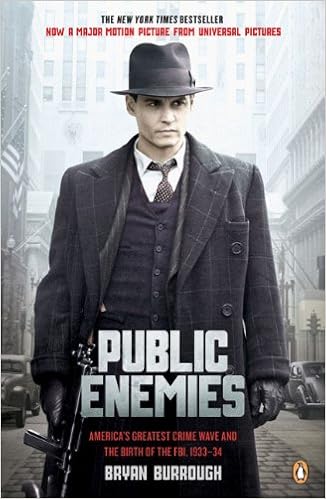
I watched 40 minutes, which was 40 minutes too much.  Michael Mann’s last picture – Miami Vice – was bad in exactly the same way Public Enemies is bad – all mood and cool, beautifully photographed, and as interesting as a super model on a talk show.  Within 20 minutes, we learn all we would ever learn about our lead, John Dillinger (Johnny Depp).  He is cooly attractive, wear a suit well, lives for the moment and . . . he is cooly attractive.

Moll: What do you want?

John Dillinger: Everything. Right now.

Blech.

23 Things We Learned From the 'Road to Perdition' Commentary

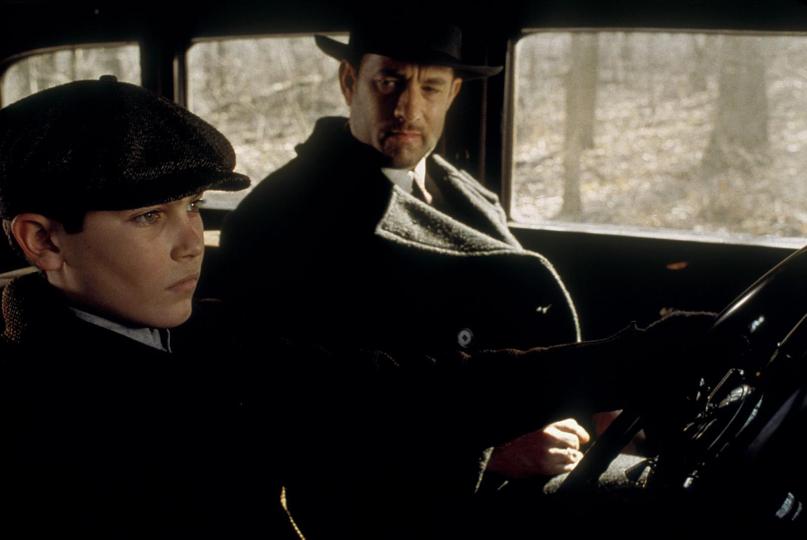
Sam Mendes’ follow-up to the overpraised American Beauty almost survives the miscasting of Tom Hanks, the overacting of Jude Law, an at-times leaden script, and an unhealthy preoccupation with slow visuals.  With all of that, Road to Perdition is also a beautiful movie graced by some very smart, substantial performances by Paul Newman (his last big screen role) and Stanley Tucci as mobsters working in the same organization.  Thomas Newman’s haunting score is perfect for the material, and the set design, art direction, costumes and cinematography recreating the Depression-era Midwest are impeccable.

But a film about fathers and sons cannot survive a child actor who does not resonate.  The actor playing Hanks’ son is not awful but he’s not very good either.  As our narrator, he simply doesn’t register, and as the guide to the life of his father (mob enforcer but family man Michael Sullivan, played by Hanks), this cannot do. Indeed, the last line of the film is “He was my father.”

It didn’t really seem like it.

Hanks is also problematic. His character is a bit like Eastwood’s William Munny in Unforgiven.  He is supposed to have demons.  The way Sullivan is played by Hanks, however, is as more of an automaton.  When things are going well, Hanks seems grimly fine with family and pot roast and a solid 9 to 5 job committing violence on behalf of his boss and father-figure (Newman).  When things go poorly, you get the sense Hanks doesn’t really have much to reassess.  He just seems sad that the easy 9 to 5 gig is up (and up in a rather cruel manner).  When he does soften, it seems too easy, like a swell guy has been just beneath that hard surface all along. The role is a lily-pad to a villain, but Hanks drowns on it.

And can Hollywood please take the “powerful and honorable man driven to treachery by his weak issue” trope out back and put it down with a bullet?  The weak son here – Daniel Craig – is entertainingly rotten, but God, I’ve had enough!

Hanks does have some moments, such as his meeting with an amused Tucci, where he tries to offer his services in return for permission to exact revenge on his old employers.  But overall, I don’t think he was the right call.  Bruce Willis may have been a more apt choice.  Certainly Ed Harris.  The best choice would have been Chris Cooper.

Still, there is enough good in here to watch.

Amazon.com: Murder By Numbers [VHS]: Sandra Bullock, Ben Chaplin, Ryan  Gosling, Michael Pitt (II), Agnes Bruckner, Chris Penn, R.D. Call, Tom  Verica, Janni Brenn, John Vickery, Michael Canavan, Krista Carpenter, Neal  Matarazzo,

Awful. The protagonist is a hardened, take-no-crap bitter homicide detective with ghosts in the past and a skeleton in the closet. This detective fucks hard and then kicks you out of bed so you don’t get too close. Voices haunt this detective. This detective is a pro, hardened by the massive homicide rate of a California coastal town in San Benito County, California. This detective has seen it all.

This detective is played unconvincingly by professional pixie Sandra Bullock.

The next Jack Ryan may as well be David Hyde Pierce.

Grizzled ole’ Sandra has to deal with two Leopold and Loeb wannabes (Ryan Gosling and Michael Pitt) who fail the Leopold and Loeb movie prerequisites of being either 1) smart or 2) cool under fire. The plot is a senseless mush of hackneyed stew, and Bullock is humiliated by being given a discordant tough gal role, only to be pushed around time after time after time by one of these high school punks.

Worse, she gets attacked severely by . . . a monkey.

You really have to see it, but I recommend that you do not.

Image result for LA Confidential

A byzantine noir potboiler set in post-war go-go America, rich in gangsters, drugs, sex and corruption, this is one of my favorite films and an excellent adaptation of James Ellroy’s classic novel.  I’m re-posting because I just noticed it is available streaming on Netflix.

Depth, pacing, and authenticity – the flick has it all.  The three main characters are rich and finely drawn.  LAPD Lt. Edmund Exley (Guy Pearce) is half ambition, a quarter condescension, and a quarter insecurity.  Anything he fears he must best, even destroy.  He fears fellow cop Bud White (Russell Crowe), who is outwardly all muscle and frontier justice.  So he testifies against White in a brutality scandal to have him kicked off the force.  White survives Exley’s testimony, but White’s partner does not, and thereafter, White seethes with hatred and desire for payback.  When they become entwined in the same investigation, a mass shotgun slaying which claims White’s disgraced partner, they clash, and yet, they are forced to work together.

Prior to formation of the uneasy alliance, White tries to tear Exley’s head off.  Their supervisor, Captain Dudley Smith (James Cromwell) intervenes in an exchange that typifies the dialogue:

DUDLEY SMITH: It’s best to stay away from the lad when his color is up.

ED EXLEY: His color is always up.

DUDLEY SMITH: Then perhaps you’d do well to stay away from him altogether.

A third detective, Jack Vincennes (Kevin Spacey), rounds out the trio.  I saw Spacey on Inside the Actors Studio and he said that he patterned Vincennes on Dean Martin in Rio Bravo.  It shows.  Spacey’s Vincennes alternately swaggers and hunches, bravado followed by just a little shame.  He’s corrupt, he’s good at being corrupt, and corruption has made life easy, but he is torn between the celebrity and easy cash and the guilt his choices have brought him.  In a film that is so sweeping, Spacey has little time to make the transition from crook to clean.  But he does it in a very brief scene, alone, at a bar, as he eyes a $50 bill (a payoff from the slimy editor of the scandal rag Hush, Hush, played by Danny Devito).  Spacey looks at the bill, sees his face in the mirror, places the bill on his shot, and leaves to do the right thing.  It’s a beautiful, economical moment.

Kim Basinger won the Supporting Actress Oscar as the high class prostitute who captivates Bud White, and while she’s sleek, sultry and affecting, every other major performance is better than her own and more deserving of accolade.

The care taken by director Curtis Hansen (who we sadly lost in 2016) is evident in every scene, be it a jail melee’, a triple interrogation, or a stunning shotgun shootout.   Hansen is straightforward and confident, and the picture positively hurtles but it never feels pell mell.  Save for some gentle interplay between Basinger and Crowe,  the movie is quick, sharp movement, punctuated by real or verbal violence.   It never, ever drags or becomes self-indulgent.  You love what you are seeing but want it to be over because you want to see more.

The film also oozes the L.A. of the time period. It feels right and looks better (for the opposite – a tacky, awful, ridiculous L.A. film –  see Mullholland Falls). 

I picked up The American mainly because it starred George Clooney and he had a gun in his hand on the DVD cover. So, on me.

There is a lot wrong here.  Foremost is Clooney, miscast as an emotionally detached killer-sort. Steve McQueen, sure. But not Clooney, who mistakes emotionally detached with catatonic.

He plays a killer and/or facilitator for killers who has to hide out in the most picturesque town in Italy.  There, he demonstrates that he is a spartan and a loner, because, well, he is alone, has no pictures in his apartment and does a fair amount of sit-ups and push-ups. Of course, he strikes up a friendship with a priest, who pushes him a little morally, and a prostitute, who, given how attractive she is, should charge $50,000 a roll.

George a gent for Violante sex – The Sun

And, yes, he decides it is time to “get out.”

The film is overbearingly serious, and chock full of tropes, like, oh, he kissed a prostitute on the mouth and went down on her = love.  And then he was in a shoot-out and won, and got in the car, and . . . is that blood?  Oh my God!  He was so in shock and it was all so crazy, he didn’t even know he’d been shot in the gut until he was driving a a mile out of town.

This guy is really . . . detached.

And “they” won’t let him “out.” Why?  Unsaid, unexplained. Apparently, it’s enough to say “I’m out” and then some really serious French dude makes arrangements for you to be offed.

I wish I could have gotten out too. But no.

Ben Affleck’s follow-up to Gone Baby Gone finds him sticking with his roots, again setting the film in a desolate part of Boston. But there is nothing to heavy here, just a crackling, straightforward crime caper, part Heat and part The Departed, with a few nice twists, solid performances and Don Draper as the dogged FBI agent on the trail of a Boston robbery squad. No great shakes, but efficient, smooth and entertaining. Best, Affleck smartly plays the lead as monochromatic, keeping his lifting to a minimum.  Bonus:  Blake Lively plays trashy and she carries it off!