Amazon Prime is loaded with old crime pictures and though it pains me to categorize a 1990 flick as an “old crime picture,” there you have it.
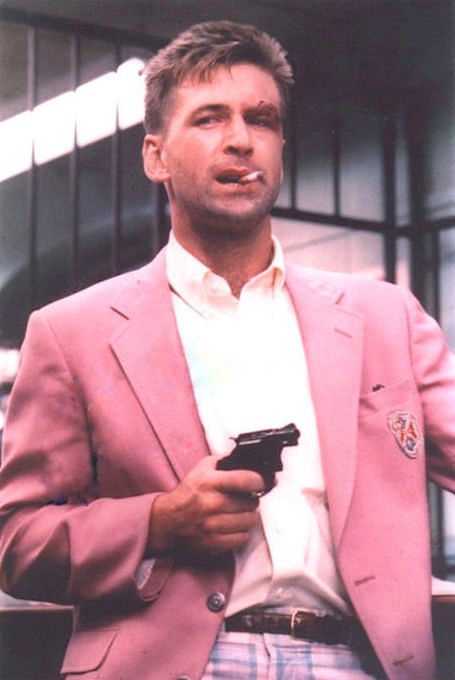
George Armitage (Grosse Pointe Blank) directs an adaptation of a Charles Willeford Detective Hoke Mosely novel (Willeford is a Florida crime novelist less heralded and a lot better than Carl Hiaasen). Alec Baldwin is a quirky thug just out of prison who lands in Miami, accidentally kills a Hari Krishna at the airport, and lands with small town and just starting out call girl Jennifer Jason Leigh. He evades arrest by Detective Mosely (Fred Ward), who is investigating the death of the Hare Krishna, and in the process, steals Mosely’s gun, badge, and dentures, thereafter ripping people off with the imprimatur of authority. The movie is absurdist and light, Armitage’s direction is workmanlike and industrious, and the result is more soft than hard boiled, a fun jaunt through weird 80s Miami. Enjoyable and mostly forgettable.
Mostly. Baldwin is so talented, loose and committed, his weirdo ex-con is fascinating and often gut-splitting. Literally every time he flashes Mosely’s badge, it is laugh out loud. As everyone he tries to hoodwink responds with a weary “ya’ gotta’ be kidding me,” Baldwin amps up his TV cop persona and the result is even funnier. These were early days for Baldwin, a hell of a dramatic actor but stellar in comedies. His choices are brazen and risky, and they all hit. The performance screams “star.”
To complement him, Jason Leigh as the hooker with a heart of gold is so earnest (she is saving up to start a fast food franchise) she actually moves you. Baldwin matches her with a crazy sweetness as they play house (until Mosely closes in).
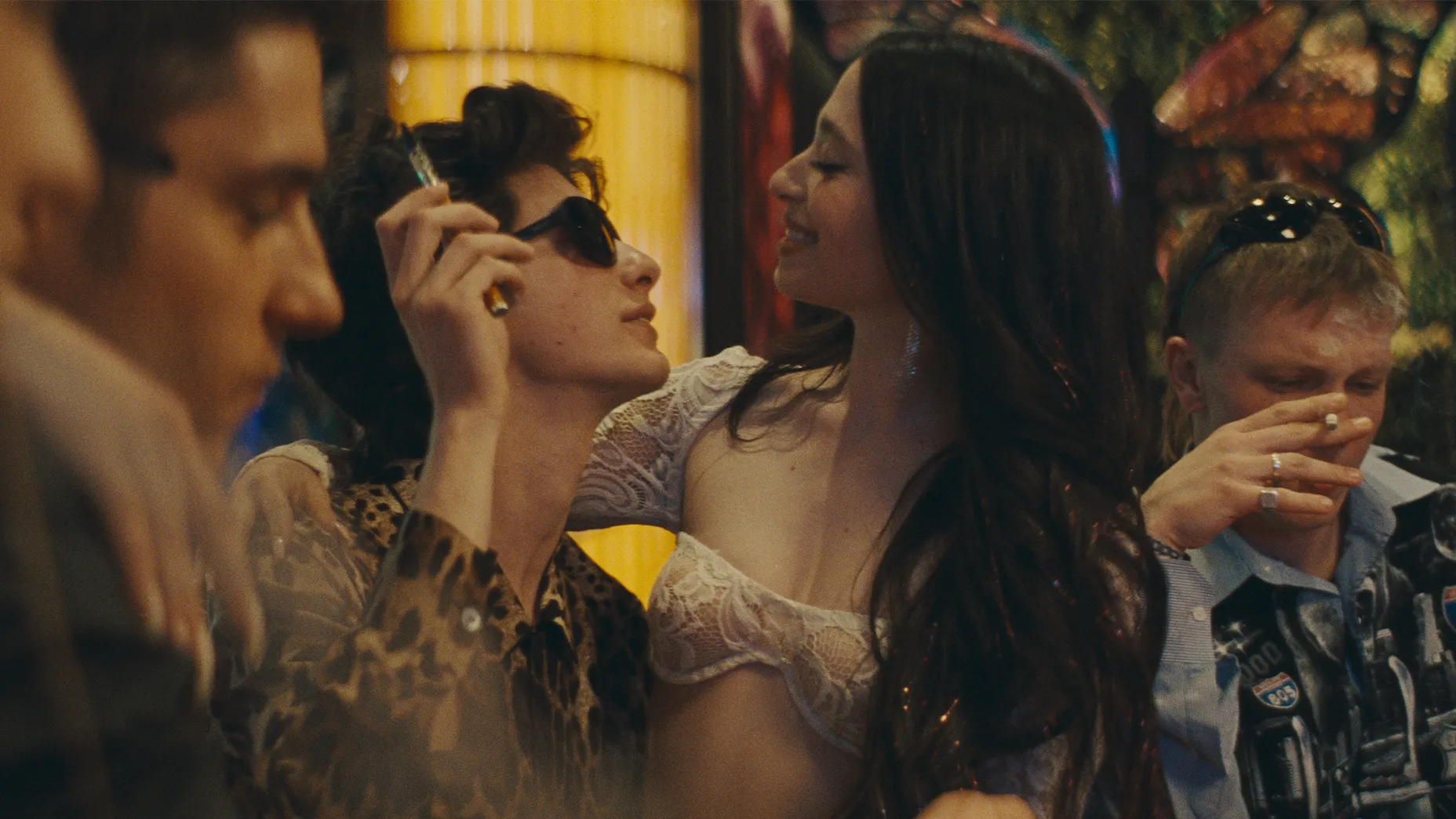
Sean Baker (The Florida Project) delivers an uproarious, tender, unexpected love story, powered by a rollicking, unyielding performance from Mikey Madison as the lead (last seen by me as one the Manson gals of Once Upon a Time in Hollywood, the one who Leonardo DiCaprio ultimately dispatches with a flamethrower).
Anora, or Ani, works as a stripper at Headquarters in Midtown, a sanctum where she peddles her wares (simple company, lap dances, and in the private rooms, maybe more). She supplements her income as an escort. Sex is transactional, which does not devalue her ability to enjoy it, but the financial nature permeates the act such that her brittle nature seems organic rather than a symptom.
Then, she meets her knight in shining armor, Vanya, the child-like, fun-loving son of a Russian oligarch (Mark Eydelshteyn), who blows through Daddy’s rubles like water, rents her for the week, and then, after a bender in Vegas, marries her. This obviously does not go down well, and the oligarch must rely on his Armenian reps in New York to rectify the situation. They are not quite the Eastern thugs of lore, and their intercession is more Three Stooges than John Wick.
As they say, hilarity ensues.
As does much more. The connection between the man-child Vanya and Anora is in part about money, yes, but you can feel a spark, and even though Anora remains focused on the payments, soon, she fancies herself Julia Roberts. This is love, and he is hers, even if he just started shaving. You know that it cannot be, but Baker has you as enthralled as Anora, on pins and needles, hoping against all hope and reason. When the forces of power intercede, they are partially represented by an Armenian thug Igor (Boris Yurasov) who reveals a gentle, protective disposition and an alternative approach, one that Anora fights with the same verve and fire she exhibits to hold on to Vanya.
Ultimately, there is a reckoning, a declaration of independence, and a new beginning, but before we get there, Anora and her unwelcome coterie of Armenian minders endure an evening that harkens to Scorsese’s After Hours.
As with The Florida Project, Baker has such command of place, you feel immersed. Here, due to the whirlwind nature of the story, Baker’s pace is not Florida languid, but Big Apple urgent and exhilarating. It’s a joy ride with heart.
Madison, Eydelshteyn, and Yurasov all deserve Oscar nominations, and my fingers are crossed, as Madison and Yurasov received nominations for the Golden Globes.
I have many films to see, but this is currently the leader in the clubhouse for best of the year.
Elliott, a vacuous, self-satisfied, snarky Canadian teenager (Maisy Stella) is visited by her 39 year old self (Aubrey Plaza) during a mushroom trip. Plaza’s old ass has much to say to Elliott’s young ass, much of it a violation of the Prime Directive, the guiding principle of Starfleet that prohibits its members from interfering with the natural development of alien civilizations.
Yes. I watched Star Trek. What of it?
The set-up is well worn. Elliott wants to swap the family cranberry farm for the big city of Toronto. She is meant to be celebrated for her freedom and grab-life-by-the fistful approach. She’s gonna’ shake the red juice off her small town boots and let loose before global warming interferes with her cell service. She’s a rebel. But she’s also a loudly stupid and narcissistic rebel, and all the soft piano, oboe, and terrible acoustic dirges cannot make her anything other than grating.
With a lead who could act and a less obvious, smarter script, My Old Ass could have been a clever twist on the coming of age flick, Freaky Friday meets A Christmas Carol.
Stella (member of the music duo Lennon & Maisy), however, cannot act. She is one-note, snotty, and charmless. And with her mien, so goes the picture.
For example, the film has a few genuine moments where Plaza, Elliott’s mother, and her would-be first boyfriend all present Elliott with a remembrance, a well-rendered insight, a moment of tenderness. In response, Elliott – not allowed to say “dude, what the fuck? for the umpteenth time – offers a “dude, what the fuck?” countenance. Any expressed emotion crashes into her stubbornly smug visage. Such that we are thinking, “Miley Cyrus could have really done something with this role!”
Worse, no one has bothered to make the trick explainable. After the drug trip ends, inexplicably, Plaza still texts and calls and visits Elliott. Tripping as portal to an Apple data plan? This is lazy mush, indicative of the ragged nature of this endeavor.
The script is mostly middling sitcom. Plaza and Elliott say cool stuff like “when do we …?” Followed by “oh my God. This happens …” Plaza says to Elliott: “Moisturize!” Elliott replies with a form of “What the fuck? Dude!???” Elliott to Plaza: “Can I kiss you?” Plaza replies with “ewwwwwwwwwwww!” or some derivation of same. Stella says “fuck” and “dude” and “like” and “sick” a lot. She spouts hip cliche’-ridden observations that may tickle the fancy of an 18 year old peer, but test the patience of anyone who has read a magazine. Or a cereal box.
When we get to the meat, Plaza reveals a particular thing Elliott must prepare for, something so obvious, it seems perfunctorily preordained. It is asked to serve as the emotional linchpin of the movie, yet the most Stella can muster is the disappointment of a girl who pours a bowl of Lucky Charms only to find a low marshmallow count.
Sometimes, in these flicks, you get some funny, well-drawn secondary characters who maybe could drag Stella along. But everybody is pretty vanilla and meh.
The film might have been saved if Plaza told Elliott not to take a particular hike and she did it anyway and then she was almost murdered by the Green River killer.
Missed opportunity.
Last point. Yes, teens say “like” and “fuck” nonstop, like men in war curse beyond any comprehension. But to actually let characters lapse into this doggerel in a script? Jesus. It may as well be serial farting.
The picture was on a few top 25s and 50s and very highly rated on Rottentomatoes.com.
A beautiful, meditative story about family, and the disconnect between ancestry, past, and shared blood. Writer-director Jesse Eisenberg (The Social Network), and Kieran Culkin (Succession) are disconnected cousins who used to be very close when young, and are now held together by a strong attachment to their recently deceased grandmother. In remembrance and per her wishes, they join a tour group to Poland to visit her origins, including the concentration camp she survived. In that journey, they hash out some old differences, reveal their insecurities and grievances, and otherwise, commune with the past. Culkin is enagaging, charming, yet emotionally dictatorial, and peripatetic. Eisenberg is OCD, eclipsed, a little bit pissed off about it, and, yet, desperate for his cousin’s ability to connect while at the same time weary of having to clean up his emotional messes.
The film is never overt, but it is very touching, particularly when the fissures between the cousins arise in the midst of a supportive group of fellow tourists (one of whom is Jennifer Grey, from Dirty Dancing, who is really quite good, even if she looks nothing like she used to given the radical plastic surgery she underwent many years ago). They are all on their own journey for different reasons, and they quickly become another family to the two protagonists.
Eisenberg’s script is sharp and his direction leisurely. At times, his take felt a little like Sofia Coppola, such is his comfort with the silences and the scenery (his shooting at the camp is haunting). The pain of the characters, as juxtaposed against the history, is made more acute, but again, there is no resolution, no great battle royale, no truly deeper understanding. But, quite tenderly, the bonds are strengthened. The experience may not change their trajectories, but that seems baked into Eisenberg‘s cake.
Sunday was a lazy day, watching whatever came on and doing squat. I dusted off the serious tone of Doubt with one of the funniest romantic comedies I’ve ever seen. The nucleus of the hilarity is the relationship between Owen Wilson and Vince Vaughn, two domestic relations mediators who crash weddings, and thereby, rather effortlessly bed the bridesmaids and other female guests with their practiced charms. Sure, the sex is good, but watching them savor the mini-crab cakes, woo the kiddies with balloon animals or cut the rug with granny, feels like an equivalent joy. The moves are practiced, the aim morally questionable, but the love of it all is there.
They crash the mother of all weddings, that of a daughter of the secretary of the Treasury (Christopher Walken), where Wilson falls head over heels for another daughter (Rachel McAdams) while the third (Isla Fisher, who is somewhere between effervescent and lunacy) takes a shine to Vaughn. Wilson and McAdams flirt madly, and he saves her from a “too-snarky by a million” wedding toast. Vaughn and Fisher expedite matters, as he seemingly deflowers her at a secluded cove near the reception (which, if memory serves, was the Inn at Perry Cabin in St. Michaels, MD). Naturally, Vaughn wants to flee (one of the bazillion rules of wedding crashing is that there be no emotional involvement or connection after the reception), but out of loyalty to his fellow crasher and in their deception as distant family members, both are invited and go to the secretary’s Eastern Maryland home for the weekend. Hijinks ensue.
Wilson and McAdams are really quite convincing and warm. Chemistry goes a long way and they have it in spades. But the real love story is that of Vaughn and Wilson, who have such a genuine and easy connection that their banter elevates above the normal bro’ babble – these guys really love each other, and their interplay is always very funny and strangely moving. My favorite scene:
They elevate an incredibly hilarious and smart comedy where even without their intimacy, it would be hard to pick the scene that makes you laugh the most, be it the over the top family touch football game (Wilson’s nemesis is a young Bradley Cooper, who exerted stardom even then as the eco-friendly, psychotic heavy) or Wilson, having fallen out with Vaughn, hooking up with the Edison of wedding crashing, Chaz (Will Ferrell), who lives with his Mom and has moved on to funerals.
Whenever I see Vaughn in this flick, I think of my oldest and dearest friend, 40 odd years now, my own big guy who wants to bring it in with the big paws and the hug, Leo
Total blast. And a great montage song straight out of the rom-com bin
I was not a big fan of Yorgos Lanthimos. He is clearly talented, but he also revels in the ugly. The Lobster was inventive, but also, masochistic, even abusive. The Favourite was evocative but also grotesque. Lanthimos traffics in the absurd, but he luxuriates in meanness and the darkly visceral, with all its bleeding, flatulence, fluids, and muck. Yet, here, in this hilarious and charming re-telling of Frankenstein, he allows himself whimsy and some gut-busting hilarity.
The time is Victorian London. Emma Stone (Bella Baxter), a fully grown drowning victim fished from the Thames, is brought back to life by none other than a Dr. Frankenstein (actually, Dr. “God”win Baxter, Willem Dafoe) and given life via the insertion of her own unborn baby’s brain. When we meet her, she’s a mere child, eating like a infant, urinating where she stands, stubborn and defiant. But she grows, quickly, and when she happens upon sexual pleasure, she is out and free, with the assistance of a dandy (Mark Ruffalo) who haughtily acts as her tutor even as he is slowly enslaved. Soon, Bella becomes worldly, and learns a few hard lessons, but she quickly masters (speaking of absurd – this word was tagged by spell check as problematic) the ability to make her own destiny in a world that would normally relegate her to docility and subservience. To see her eat, to come, to dance, it is hard not to be as captivated by Stone’s gifted performance as Bella is by the world. And Ruffalo’s foppish moth to her carnal flame is riotous. Bella’s journey is wondrous, funny and beautifully shot, deftly lifting from the best artistic visions of both Tim Burton and Wes Anderson.
I laughed uproariously and sat in wonderment at Lanthimos’ ingenious world.
Two nits. First, I never really thought I’d say, “Hey, there’s just too much of Emma Stone naked” but the film is 20 minutes too long, and there’s just too much of Emma Stone naked. I think Lanthimos became entranced by Stone’s moxie, but soon, all of the sex seems less like a revelation, and more like an obstacle course.
Second, Jerrod Carmichael makes an appearance and there is no other way to put it – he’s terrible. Stilted, clunky, confused, and aggravatingly amateurish. You kind of feel bad for him, but you brighten when you realize he is gone.
Otherwise, great, smart fun.
Seven down, three (Past Lives, Killers of the Flower Moon, The Zone of Interest), to go.
Very similar to The Talented Mr. Ripley, but without any of the care, build, patience, intelligence, or style of that flick. In Ripley, we are wary of yet sympathetic to Tom (Matt Damon), the working class nobody who insinuates himself into the shine of the rich and beautiful. When the tanned god Dickie (Jude Law) casts him aside, we feel for Tom. We don’t endorse the sociopath’s actions, but as Tom grows closer to capture, we guiltily root for him. When Tom’s desires draw him into greater malfeasance, against our judgment, we thrill to see if he will actually get away with it.
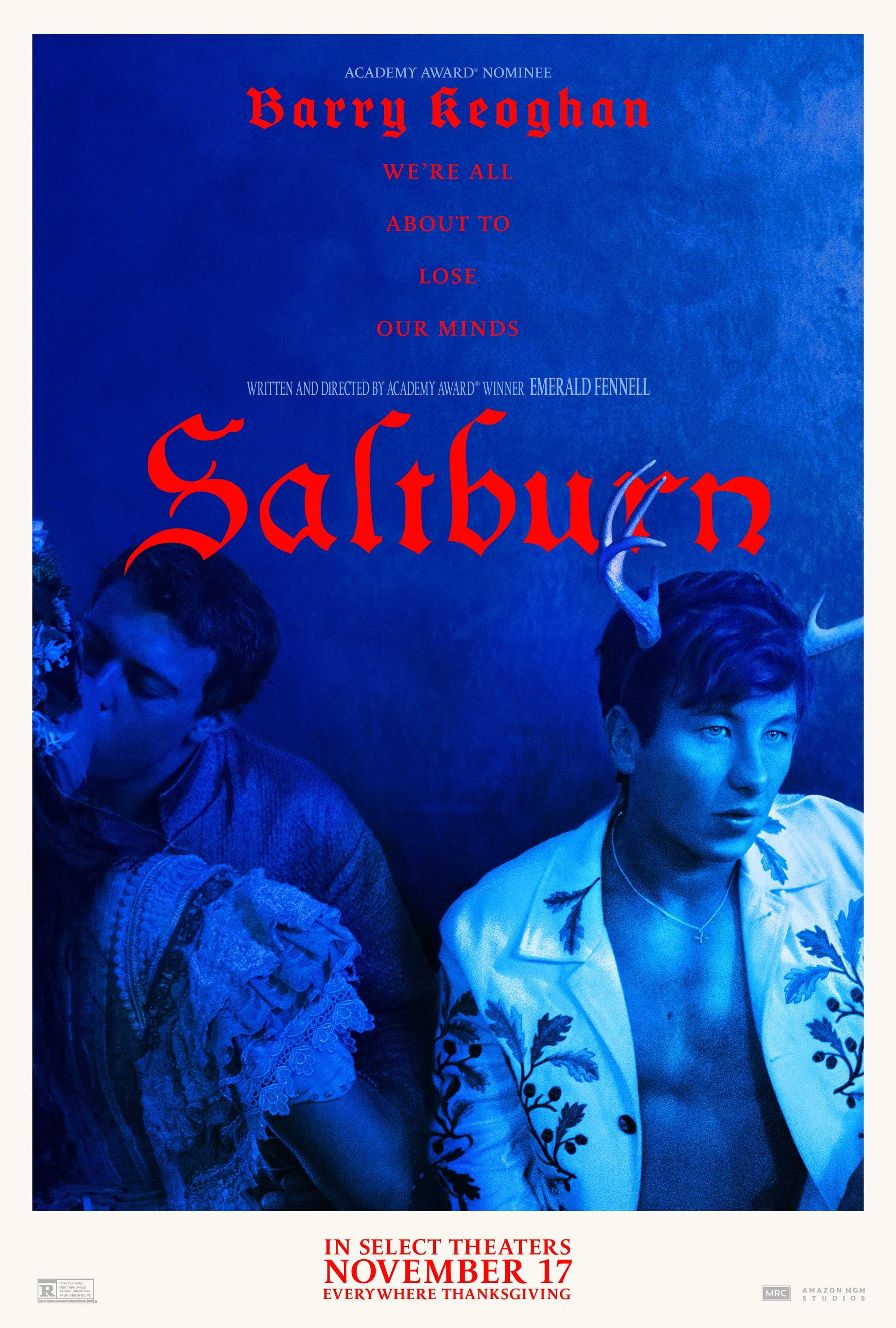
Here, our new Tom Ripley is Oliver Quick (Barry Keoghan), a modern day loser at Oxford who gloms on to his own Dickie, Felix (Jacob Elordi), a rich kid whose monied and titled family lives in a castle on Saltburn estate. After ingratiating himself with Felix, Oliver is invited to Saltburn where he negotiates Felix’s ridiculous caricature of an upper-class family, his own increasing desire for Felix, and the fact that he is disposable to these people when, like Ripley, he is trying to make himself indispensable.
Unlike Tom, however, we don’t root or care for Oliver. He’s a furtive creep. Even when he overhears the rich kids at school or Felix’s family malign him, our natural pang of sympathy immediately gives way to caution. The guy smells of wrong from the get-go and because of it, we have no skin in the game, either about Oliver’s fate or the cartoon characters around him.
What follows is a wretched flick infatuated with its own provocativeness. It’s not very funny, though it is labeled a black comedy. It’s not very edgy, though it is sexually perverse. It’s not very smart, unless rich people one level removed from The Howells on Gilligan’s Island saying grotesque things is your idea of smart. In Ripley, the rich were dazzling. Any condescension was barely perceptible, and accordingly, all the more cutting to Tom. You can see why Tom wants in and how much it stings. Here, Oliver yearns for a world populated by dolts and cretins, so, who cares?
The picture is also repetitive in the extreme. Basically, every scene is Oliver made uncomfortable until he becomes morose. When Oliver gets a win, another cliché rattling his/her jewelry reminds him for the umpteenth time that HE DOES NOT BELONG.
After running the tired plot into a very tight and boring corner, the end lapses into inanity (SPOILER: Oliver kills them all in a manner a mall cop would suss out as foul play inside of a minute; apparently, the British police force is trained by Magilla Gorilla).
But no one is on to Oliver because it’s a shit screenplay so far up its own ass that it need not deign to generate interest, draw characters, or construct a sensible narrative.
The near-end, where we flashback to Oliver’s machinations previously hidden to us, ala’ M. Night Shymalan, is such a clumsy and pathetic attempt at bringing order to this mess I almost felt for the creator.
But then, I realized Saltburn is from the writer director of Promising Young Woman (Emerald Fennell), another infantile, impossible crapfest which got the critics to swooning.
When I saw the preview for Alexander Payne’s latest picture, I thought, “Okay. Older father figure. Private New England boys school. Some Christmas break bonding. Not the Baird school, but Barton. It’s Scent of a Woman, with a couple of tweaks.” I was right and also very wrong.
Now, I like Scent of a Woman. It’s occasionally moving, impressively manipulative, and entertaining as hell. Chris O’Donnell is vulnerable and empathetic. And even in a small part, a young Phillip Seymour Hoffman (poor George, “sitting in Big Daddy’s pocket”) resonates.
But the picture is near-obliterated by Al Pacino’s roar and Martin Brest’s complete lack of restraint. Hey, folks, not only are we going on a last hurrah with a blind depressive and his young charge, but let’s make the blind depressive a) do a flawless tango with a complete stranger; 2) have such a “fix-is-in” fight with his family that you feel for the bad guy, Bradley Whitford, the sneeriest of nephews; and 3) drive a race car in the Big Apple!
Hoo-ah!!!!!!
Still, like a Whopper Jr., the flick delights until the inevitable dyspepsia.
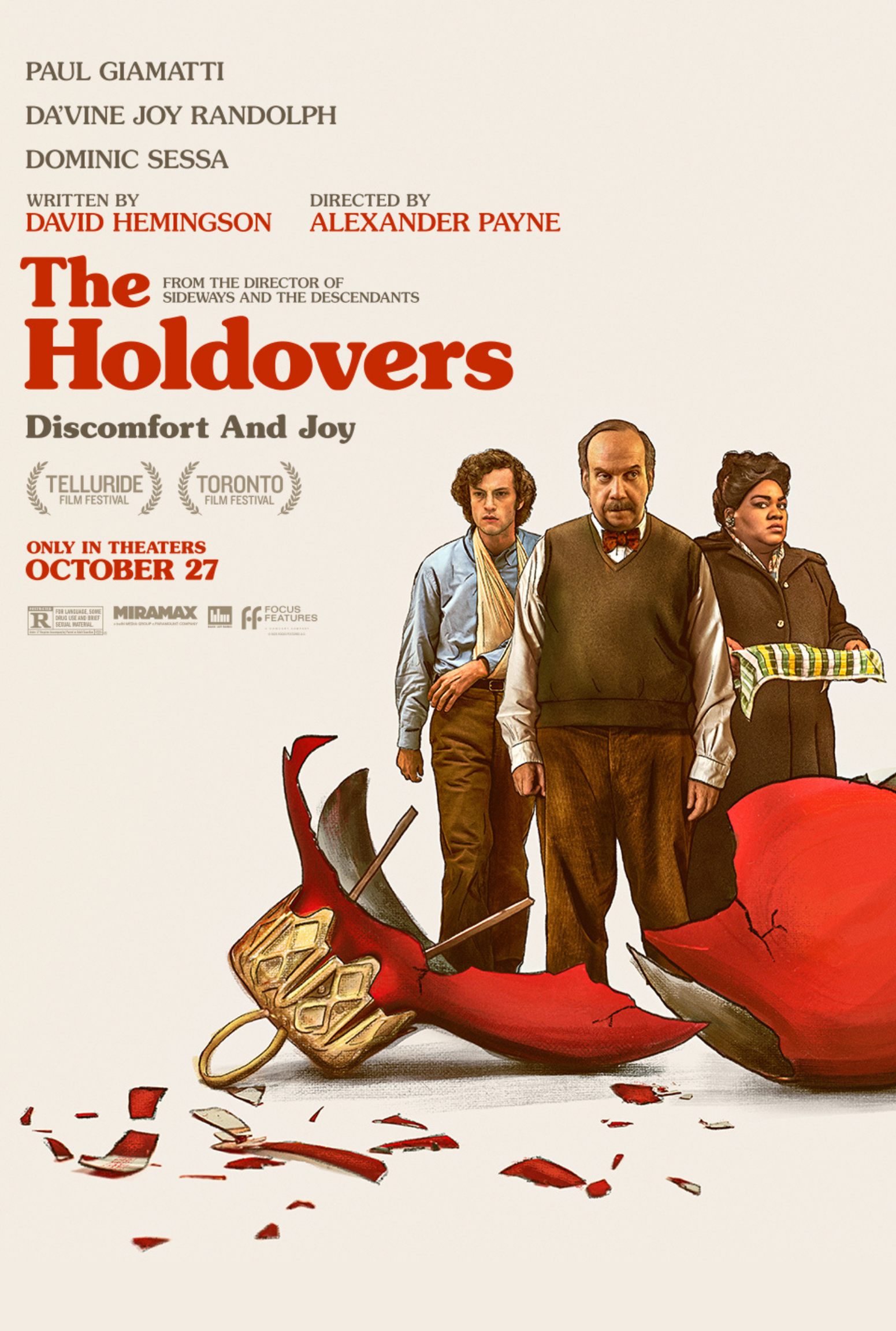
Now, the differences. First, without Pacino sucking up all the oxygen, The Holdovers has room not only for a Paul Giamatti as a strict, sneakily populist professor, and newcomer Dominic Sessa, the poor rich boy abandoned to staying over at school for the holidays under Giamatti’s thumb, but Da’Vine Joy Randolph, the school’s cook, who must endure the Christmas break and her own recent tragedy. I can’t commend her performance enough – restrained, clever, surprising, and then heartrending without a hint of stereotypical sass and easy schmaltz. Her sharing of the ins-and-outs of The Newlywed Game with Giamatti is primo.
But Pacino could not have allowed it. There was simply no space.
Second, Giamatti and Sessa actually grow, and bond, primarily through conversation, revealing a beautifully rendered mutually protective nature. Whereas, Pacino and poor O’Donnell simply pinged from situation to situation, each increasingly absurd, because they were confronted with two legitimate threats.
Third, again, whereas the scorching flames from Pacino’s engine disallowed any real growth, space or time for others, Payne depicts important interplay between or including secondary characters. The heartbreak and frustration of a bullied kid and his mitten choked me up, and after another poor holdover from Korea breaks from homesickness in the middle of the night and is comforted by Sessa, the job was nearly finished. Indeed, the kids in The Holdovers run the gamut – the dumb bully is there, but so too the clueless but tender-hearted jock and the poor youngsters. In Scent, with the exception of O’Donnell, every kid at Baird seemed to be some form of generic, shit heel carnivore or mere prey. Here, Payne delves a little deeper and produces some truly poignant moments.
Last, Pacino had one change to make, from bigger-than-life suicidal howler to a man who wants to live for himself and others. Conversely, Giamatti is seemingly a martinet, but in fact, turns out to be multi-layered. Rather than merely having Giamatti overcome his condescending and authoritarian nature, writer David Hemingson explores several aspects of his personality and past, all of which fill in the puzzle. And Sessa isn’t the only contributor to his growth, which fleshes him out even more fully,
The end of the film is a bit of a surrender to Scent’s need for big dramatic closure, and in particular, one Giamatti zinger is off-kilter and completely out of character. But the sin is venial.
If they are still holding the Academy Awards, I see a slew of nominations, and if you can get some juicy early odds on Da’Vine Joy Randolph for supporting actress, go heavy.
The previews suggest an unrelenting, biting send-up of the idiocy of the so-called black experience as represented in the arts. On that front, the film delivers, though with a stiletto rather than a cleaver. But while the social satire of the film is paramount in its marketing, in presentation, the picture is a sweet and moving story about a family whipsawed by tragedy. It is not lost on the viewer that the dramedy is refreshingly devoid of the stereotypes punctured by the picture. Writer-director Cord Jefferson practices what he preaches, delivering on the traditional at the expense of a caricature he effectively obliterates.
We meet Monk (Jeffrey Wright), a college professor and author in California, as he is confronted by an entitled white undergrad who objects to his having written the title of a Flannery O’Connell short story on the blackboard. Monk explains that as a black man, if he can get over the word that shall not be said, surely, so can she. Our Precious, however, stands in for every vapid girlchild who haunts the modern university, likely cheering for Hamas though they would throw her and her heightened sensibilities off the nearest roof. So she complains. Monk is summarily placed on sabbatical and forced to reunite with his upper middle class family back in Massachusetts and, as with all “going home” movies, things get messy.
Monk is also going through a professional slump, his books fewer and farther between, and not very popular. While attending a book fair, he notices the crowds at another black writer’s (Issa Rae) event, and when she reads a passage from her novel, a tale of domestic hardship told in the patois of the street (“Yo, Sharonda! Girl, you be pregnant again?”), Monk winces. The crowd, however, swoons and applauds the bravery, grit and authenticity.
Furious, Monk writes his own ghetto tale, My Pafology, as a joke and a rebuke. He also creates a pseudonym, and soon, the big publishing houses and Hollywood come calling. He is stunned yet seduced, and in aid of his scam, must adopt the mien of the inner city thug, a character so “real” that he cannot make public appearances because, of course, he is wanted by the law. He negotiates his double life in the midst of rapprochement with his family, with varying levels of success.
I laughed out loud in the theater at least a dozen times, and was thoroughly amused throughout. No one is unscathed, and nothing feels cheap or gratuitous. Most jibes are nuanced, and when Rae and Monk finally go at it, there is no dawning, no lesson. Just an insoluble conundrum that thankfully is not laid at the feet of whitey or oppression or the usual suspects that are part of the grievance mill Jefferson has in his crosshairs.
The script crackles. Not only in Monk’s hilarious attempts at playing street, but in the familial slings and arrows between Monk and his siblings and the interplay between Monk and his colleagues. When Monk is solicited by a tony literature award contest to be one of the judges, the courter explains that they needed to add some diversity to the panel. Monk responds, “I’m honored you’d choose me out of all the black writers you could go to for fear of being called racist” to which he receives the oblivious reply, “Yeah. You’re very welcome.”
If it has any flaws, it may be a bit top-heavy on family melodrama over the social satire. But it’s one of best movies of the year.
The other day, my son bemoaned people who couldn’t just enjoy the silly movies from their childhood, like Star Wars or Indiana Jones, because they had to find a reason to justify the continuation of their early filmic love into adulthood. So, they create a form of criticism that makes their adoration of juvenilia acceptable, even erudite, elevating simple, fun movies to high art or of great social import (which then naturally leads to a concomitant acceptability of their living at home in the basement amongst their toys well into their 30s).
To be fair, I added the parenthetical.
I thought about what he said when I was watching Barbie. Of course, it will be the subject of Gender Studies papers for the next 20 years, and has already spawned reviews of great seriousness (“a searing social critique”; “An earnest feminist manifesto inside a barbed social satire”; an “existential exegesis on what it means to be a woman, and a human”).
There are indeed very smart things in Greta Gerwig and Noah Baumbach’s script, including some clever, contemporary touches and social observations. Some land and some elicit a groan.
However, the movie works best as a series of jokes and physical humor encased in a startlingly resonant set design and an energetic commitment to unbridled fun.
That it lightly lampoons patriarchy, consumerism, wokeness, feminism, bro’ culture, capitalism, and much more is undeniable. But that is icing. The cake is the yuks, and Gerwig offers an endless parade of laugh-out-loud lines and sight gags and rousing musical dance numbers, almost all of which land and charm.
A few nits.
I am sick of Will Ferrell. He’s the same schtick, every single time, and he is lazy and boring.
Also, there’s an inspiring speech that screeches the flow to a halt. A rousing feminist speech. To dolls. It’s a bit like watching a character in Star Wars give a soliloquy about colonialism. To Wookies.
The picture is also a bit repetitive and long in its syrupy, maudlin end (though it lands on a great crack to close out).
But these are annoyances. The film opens wondrously, as we are introduced to Barbieland, where everything is perfect; what is not perfect is plainly identified as such (aka, “Weird Barbie” and “Pregnant Barbie”); girls rule; and the Kens serve and bicker amongst themselves, vying for the attention of their masters. But the perfect world of one Barbie (Margot Robbie) begins to crack (her arches fall, she thinks of death), the real world beckons, and she answers the call with a besotted Ken (Ryan Gosling) as a stowaway. There, she finds sadness, men in power, and her own obsolescence. When she is gone, an empowered Gosling returns to Barbieland, and the Kens rise, in hilarious fashion.
After checking its social responsibility box with indelible ink, the picture ramps up as the Barbies use their superior intellects and, interestingly, their feminine wiles, to overthrow the dum dum Kens during their short-lived reign.
This allows for Gosling’s musical numbers, which are worth the entire movie. There is no way around it. He steals this picture. It crackles in every frame in which he appears, and his resume’ as a strong comedic actor (The Nice Guys, Crazy Stupid Love) has expanded.
And “I’m Just Ken” is undeniably the best musical number EVER!