Archive

Comedy

With only five films to his credit (Metropolitan, Barcelona, The Last Days of Disco, Damsels in Distress, Love & Friendship) and all but one of them in the same milieu (upper class young people in comedies of manners), Whit Stillman is overlooked in discussions of  great American filmmakers who are still working.  This despite the fact that Stillman has written and directed all five of his films, and all have been critically acclaimed.  

Barcelona, Stillman’s second picture, reprises two actors from Metropolitan as different characters.  Taylor Nichols plays Ted, a neurotic salesman in 1980s Barcelona. Chris Eigeman plays his cousin, Fred, a naval officer and freeloader sent ahead of the Sixth Fleet in the midst of a wave of anti-Americanism.  Both negotiate their acrimonious relationship, borne of childhood injuries inflicted by Eigeman, a truly obnoxious sort who as a visitor begins to stink after a day (unlike, as Nichols observes, the fish who takes three).  They discuss religion, women, anti-Americanism, sales, history and shaving, all the while falling in and out and in love with various Catalan women.

Nobody writes quite like Stillman. His dialogue is distinct and erudite, but his characters have such a surface forthrightness that what could seem contrived comes out as wholly honest and fresh. Stillman is particularly impressive in presenting a funny, incisive culture clash between the mildly ugly Americans and the bemused, mildly antagonistic Spanish. Both treat each other as curious, and even hostile interactions over politics are amusing and revealing.

Again, Stillman has no bad films on his resume’,  a rare honor.  Paul Thomas Anderson comes close. Though the second half of Magnolia is bad, the sheer perfection of the first half of that film and its overall audacity generally gets him a pass, but The Master is a long, very hard slog.  Scorsese is a great, but Gangs of New York and Shutter Island are very, very bad films, and his later sycophantic rock documentaries are downright embarrassing.  Coppola has some late career dreck (Jack, The Rainmaker) and have you even heard of his last three efforts (Youth Without Youth, Tetro, Twixt)?  Eastwood has his share of humdrum work (J. Edgar, Bloodwork, Space Cowboys).  Try as I might to suggest otherwise, Wes Anderson’s The Life Aquatic is haphazard at best.  Even the Coens, David Fincher, Gus van Sant, David O. Russell, Richard Linklater, and Steve Soderbergh have at least one dog (see A Serious Man, Alien3, Psycho, I Heart Huckabees, Bad News Bears, Solaris).

Woody Allen is closer to Stillman in style but Allen also makes some really horrific pictures (less so now that he’s not acting in them as much), redeeming himself with a great surprise just when you’ve written him off.  Take this list of Allen movies – Hollywood Ending (2002), Anything Else (2003) and Melinda and Melinda (2004).  All pretty bad.  Ballgame, right?  But then, Allen offers a smart Hitchcockian crime movie, Match Point (2005), and he is resurrected.  Two more sh** sandwiches follow in 2006 and 2007 (Scoop, Cassandra’s Dream), but in 2008, Allen comes off the canvas again with the charming and seductive Vicky Christina Barcelona.  And last year, after another pair of clunkers (Whatever Works, You Will Meet a Tall Dark Stranger), the best original screenplay Oscar goes to Allen for Midnight in Paris, a movie I hated, but I defer to the Academy. 

Stillman deserves better.
Broadcast News - Rotten Tomatoes

James L. Brooks has the ability to make you laugh out loud just before he brings a tear to your eye, a skill he has honed in Terms of Endearment and As Good as It Gets. His missteps (How Do You Know, Spanglish) still contain very funny dialogue, even if the whole doesn’t work.  But to be fair to Brooks, Paul Rudd, Reese Witherspooon, Adam Sandler and Tea Leone are not very formidable substitutes for Jack Nicholson, Shirley MacLaine, and Debra Winger.

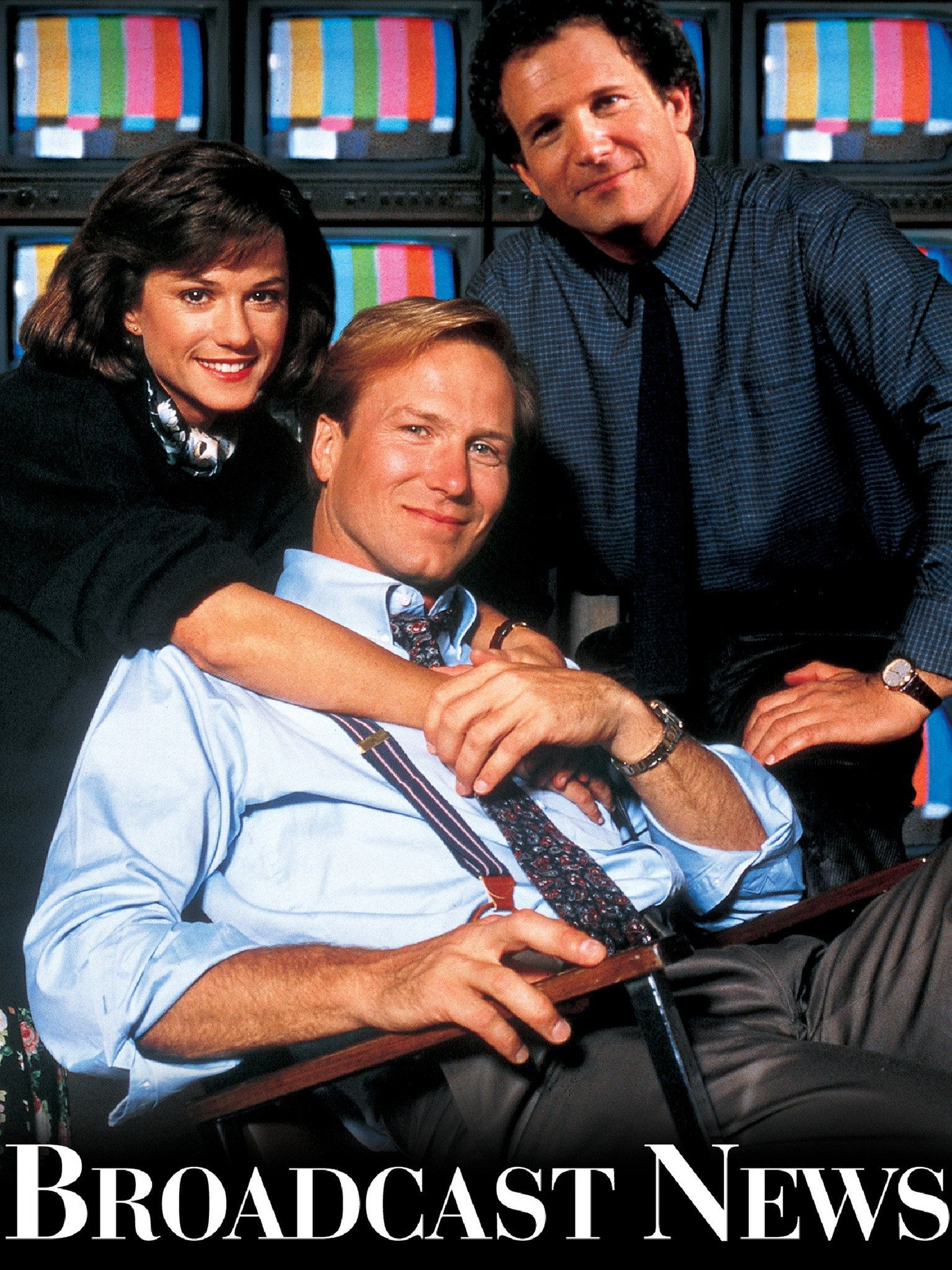
In Broadcast News, Brooks melds a love triangle with a story about journalism and ethics that is prescient.  Holly Hunter is the producer of the Washington bureau of a major news network, Albert Brooks is a gifted but un-telegenic correspondent, and William Hurt is the new up-and-coming golden-boy, groomed to replace the current anchor (Jack Nicholson, in a hilarious cameo).  Hurt is attractive but shallow (as Brooks says, he is against everything Hunter is about).  But Hurt is also sweet and in his own way, genuine.  He fancies Hunter and when Brooks tries to anchor the weekend news in an effort to save his job, Hurt is there, giving him advice, some of which is excellent (“punch” a thought in each sentence) and some of which makes Brooks very uncomfortable (“Just remember that you’re not just reading the news, you’re narrating it. Everybody has to sell a little. You’re selling them this idea of you, you know, you’re sort of saying, trust me I’m, um, credible. So when you feel yourself just reading, stop! Start selling a little”).  Hunter becomes infatuated with Hurt, and as they grow closer, Brooks professes his long love for Hunter and reveals the ethical threat that is Hurt.

The picture is loaded with crisp, witty dialogue, and at its best, it evokes the great Grant/Stewart/Tracy v. Hepburn romantic comedies. The picture also injects something of substance (the deterioration of the news), not with the acid cynicism of Network, but gently, so as not to get in the way of the story and humor.

There is also great physical comedy, provided by Joan Cusack as a gawky assistant producer, and Brooks, who endures the great humiliation of flopsweat during his shot at anchor.  The scene is one of the funniest in film history.

The movie has one problem, but it is a big one.  Holly Hunter is so mannered and quirky that you simply cannot understand Hurt’s attraction to her, much less that of Brooks. Sure, the good looking neophyte might be intrigued by the neurotic but fascinating “other” ala’ Robert Redford and Barbra Streisand in The Way We Were.  But Hunter takes “odd” up several notches, and in many scenes, her facial expressions approximate her work in the live cartoon Raising Arizona.  Her temper is also so volcanic as to suggest mental illness.

Certain lines cannot be crossed in a romantic comedy.  I was reminded of the awful Hugh Grant-Sandra Bullock vehicle Two Weeks Notice, wherein Bullock has an attack of diarrhea on the highway and Grant has to commandeer a stranger’s RV so she can relieve herself.  This may work for Will Ferrell and Zach Galifinakis.  But no romantic lead can be shown in such an unflattering light.  Hunter does not sink to such depths here, but her portrayal does border on the grotesque and it detracts.

There is also the weakness of the import of Hurt’s great journalistic sin (he recreates a moment of emotion in an interview) .  There is no question – the act was unethical.  But in the context of some of the other stagey and easy shortcuts engaged in by Hunter and Albert Brooks, their high dudgeon (which is critical to the picture) rings hollow, and the film never gives them a comeuppance on this point other than Hurt’s rebuttal to Hunter after she accuses him of crossing the line — “It’s hard not to cross it.  They keep moving that little sucker, don’t they.”

Romantic.  Comedy.  Can one be successful with only a little bit of both?  The Jennifer Aniston-Vince Vaughn vehicle, The Breakup (2006), fell into the category, as it depicted the deterioration of a relationship primarily built on convenience and a shared apartment.  The scenes between Vaughn and Aniston were so arch and cringe-inducing you wondered, ‘where the hell is the ‘rom’ much less the ‘com’?'”

Friends with Kids makes The Breakup seem like Love Actually.  Three couples form the center: the unmarried, platonic sister-brother like duo (Adam Scott and Jennifer Westfeldt); the canoodling, just pregnant, earthy types (Maya Rudolph and Chris O’Dowd);and the sizzling, “just had sex in the bathroom” couple (Jon Hamm and Kristen Wigg).  We meet them at a fancy dinner in Manhattan and then fast forward four years to a second meal at the home of Rudolph and O’Dowd.  Scott and Westfeldt are unchanged, but Rudolph and O’Dowd are now sloppy, harried and laden with kids (she screams at him for doing nothing, he does less, and their kids scream all around them).  Hamm and Wigg bring their own newborn, who appears to be just one source of tension in their quietly crumbling relationship.  Scott and Westfeldt survey the wreckage, determine they can do it better, have their own baby while maintaining their independence (and separate apartments in the same building) and live happily ever after.

Well, no.  Westfeldt is in love with Scott, and Scott has absolutely no clue – he’s bought into their experiment.  In the meantime, they go on a ski trip with their friends, each bringing a new beau (Megan Fox and Ed Burns).  Hamm and Wigg implode, and Westfeldt realizes that her love for Scott is so strong she must profess it.

So, let’s tally.  The first scene of mayhem and bitterness (the four years later dinner) is depressing.  The scene of Scott and Westfeldt trying to make years of friendship square with sex to conceive is uncomfortable.  The scenes of Scott casually mentioning how awesome Fox is to Westfeldt are brutal.  The ski trip is akin to the dental examination in Marathon Man.  And Westfeldt’s profession of love, which is spurned by Scott, will open the vodka.

I liked the picture, but it ain’t no rom-com.  Scott, as always, is perfect, both wry and when it is called forth, impressively anguished.  What is funny in the picture is largely due to the crude banter between Scott and Westfeldt.  The other characters play well, save for Westfeldt, who also wrote and directed.  She is so pitifully earnest, it didn’t seem a fair fight.  And the exchanges between the couples are often illuminating.

The film is also quietly traditional.  Scott and Westfeldt do appear to be doing well on the outside with their arrangement, but as the fissures show, during the ski trip from hell, Hamm, in his own deteriorating marriage with Wigg (note: the mastermind of Bridesmaids provides not one single laugh in this picture) delivers an angry, vicious broadside against their hubris.

Scott delivers an effective rebuttal, which, of course, cements Westfeldt’s love for him:

You think that we don’t love each other? You know, I have loved this girl for nineteen years, Ben. That is fully half my life. I know everything there is to know about her. I know the mood she’s in when she wakes up in the morning – always happy, ready for the day. Can you imagine? I know that she is honest; she won’t even take the little shampoo bottles from the hotel room, or sneak into the movie theater for a double feature. She always buys a second ticket. Always. I know that we have the same values, we have the same taste, we have the same sense of humor. I know that we both think that organized religion is completely full of shit. I know that if she is ever paralyzed from the neck down, she would like me to unplug her – and I will. I know her position on just about everything, and I am on board. I am on board with everything about her, so you tell me, Ben. What better woman could I have picked to be the mother of my child?

Nonetheless, the film culminates in Scott’s realization that Hamm was right – you can’t just craft a perfect bubble of domestic bliss by jettisoning the inconvenient parts, such as “’til death do us” and fidelity.

Still, this movie can be a trial.  And the picture is not too traditional.  It is probably the only film to conclude with the line, “Fu** the sh** out of me.”

This is a very funny parody of the unraveling of Richard Nixon, by this story, at the hands of two high school girls, one of whom lives at the Watergate and happens upon G. Gordon Liddy and the gang during the break-in.  To shut them up, the girls are given jobs as dog-walkers at the White House and become seminal in our nation’s history.

Dave Foley (from “Kids in the Hall”) is hilarious as H.R. Haldeman, Dan Hedaya is a workable Nixon – not quite as sweaty as Anthony Hopkins and nowhere near the master of all Nixons, Frank Langella, but still, he’s appropriately shifty and skulking.  Priceless is one girl’s fantasy about Nixon – she has fallen in love with “Dick”, who supplants Bobby Sherman in her world – and in one fantasy, Hedaya rides up on horseback on the beach to tell the girl “Pat understands”.

Bruce McCullouch (also from “Kids”) and Will Ferrell are laugh-out-loud as a fey and bickering Bernstein and Woodward.

Is Will Ferrell ready for a dramatic role? As an alcoholic salesman fired from his job (typically, cruelly, as his boss has to get digs in during the termination meeting just so we know we’re on Ferrell’s side), for the most part, he seems just a spit-take away from breaking into Ron Burgundy or Frank the Tank. A thousand clown roles creates a hearty persona.

He’s fired, bullied at the convenience store, and when he gets home, his stuff is on the lawn, courtesy of his wife, who discovered he had an affair, changed the locks and left town. Ferrell then starts living on his lawn.

His neighbors are quirky, there’s a wise neighborhood child, and the moment I saw Michael Pena in the opening credits, I knew he’d be the Hispanic cop assigned the task of saying, “Dude. You can’t be living on your lawn.” There’s not a character in this who resembles a real person, and no amount of acoustic guitar/piano in the background can change that.

Ferrell is supposed to be endearing or at least sympathetic. For the most part, he’s neither. Rather, he’s bland, one note and when he tries to show depth of feeling, he just looks uncomfortable. He confesses his life and mistakes to an improbable pregnant new neighbor (Rebecca Hall) who, upon moving cross country to a new neighborhood ahead of her husband, naturally takes a shine to a weirdo drunk living on his lawn. Even his confession of what I think was an accused date rape only flummoxes her for a moment. You just keep hoping Vince Vaughn will show.

The film is also sloppy. Ferrell is able to blackmail his neighbor into giving him power from a cord, but in the deep throes of alcohol need, desperate for drink, he downs the backwash from old Pabst cans. With what he has on his neighbor, he’d certainly have been able to wrangle enough for a six pack. And when he’s desperately looking for beer, he checks his mini-frig, and it is empty. The next morning, however, he’s grilling bacon. Where did he get bacon?

Finally, there’s the insipid suburbia bashing as Ferrell decries the mother down the street who “blew her brains out because her daughter didn’t make cheerleading” and preaches, “I’m no different than any of you. I just don’t hide in my house.”

Heavy, man.

Amazon.com: The Last Kiss (Full Screen Edition): Zach Braff, Jacinda  Barrett, Rachel Bilson, Casey Affleck, Michael Weston, Eric Christian  Olsen, Marley Shelton, Lauren Lee Smith, Harold Ramis, Blythe Danner, Tom  Wilkinson, David

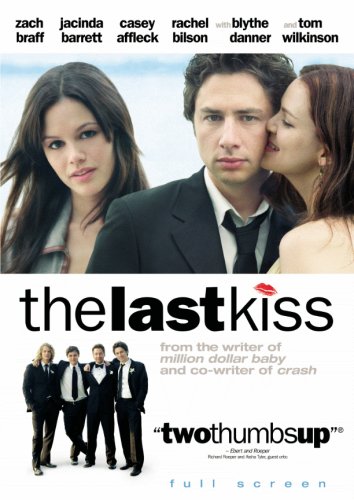
Zach Braff’s gruesome, false dramedy about a guy in his twenties who “has everything” but gets the jitters when his long time girlfriend (Jacinda Barrett) becomes pregnant.  He then recklessly beds a college hottie (Rachel Bilson), and the audience is treated to the extended punishment of his shrieking girlfriend, his unctuous attempts to elicit forgiveness, and side-stories of friends and family similarly bollixed by love, which, as I understand it, reduces everyone to shrieking hysterics.

This indeed may be the way of love for many people, but I sure don’t want to watch it, even with an implausible, redemptive, happy ending.  Braff’s responsibility is minimized.  He only starred in and co-wrote this disaster, with, shockingly, Oscar-winning screenwriter and Scientology attacker Paul Haggis (perhaps this is an excess of Scientology?)

But a curse is a curse, and his post-The Last Kiss, non “Scrubs” work is a cautionary tale — one Canadian movie (The High Cost of Living) and a cameo on a 2012 episode of “Cougar Town.”  He played the pizza delivery guy.

It was kismet that just after watching 1982’s 48 Hours, I’d stumble onto a modern Irish buddy cop picture.  Brendan Gleeson (Boyle) is an Irish policeman in Connemara, content to do his duty while occasionally lifting recreational drugs off of car accident victims or engaging call girls dressed as policewomen for their pleasures.  The FBI, in the form of Don Cheadle (Everett) arrives and they require Gleeson’s assistance in stopping a drug shipment and the brutal gang (led by Mark Strong and Liam Cunningham) facilitating it.

Much more comedic and wry than 48 Hours, The Guard does set up Gleeson as the racist.  When briefed by Cheadle and shown pictures of the white gang, Gleeson goes wide-eyed and says, “I thought only black lads were drug dealers?”  When Cheadle upbraids him for being a bigot, Gleeson responds, “I’m Irish, sure. Racism’s part of my culture.”  But the stronger dynamics are the Cheadle as fish-out-of-water line and a little of Gleeson’s Oscar to Cheadle’s by-the-book Felix.  Gleeson has no real enmity behind his racism and uses it merely to probe Cheadle.  Their interplay gets funnier as they get to know each other.

Best is the depiction of Ireland, which is not so much whimsical as hilariously casual. Gleeson finds some guns meant for the IRA and when delivering them to their contact (the idea of confiscation is never considered), seems bemused that the organization still exists.  The presumption is that almost all the police are on the take, and Gleeson’s explanation as to why he cannot assist Cheadle in the canvassing of potential witnesses to a murder is pitch perfect:

BOYLE:  So what d’ya have planned for the day?

EVERETT:  Well obviously we don’t know who killed McCormick or why. There was no useful forensic evidence found at the crime scene, so I thought we might start by canvassing the area around where the body was discovered. See if anybody heard anything, something they might have thought was relatively insignificant, but which in light of the murder may have a far greater importance. I mean, when I caught that sonofabitch Tyrell Lee Dobbs it was a result of something as seemingly inconsequential as a laundry mark, if you can believe that. The guy had a personal hygiene issue that was almost pathological. The other thing to consider is that McCormick was probably in the process of reconnoitering drop-off points all along the coast. Our friends Sheehy, Cornell and O’Leary are no doubt in other parts of the country doing exactly the same thing. So I’ll liaise with Inspector Stanton and Detective Moody, have them and their men start a coordinated push in all the relevant locations…

He trails off, realizing that BOYLE is concentrating on his food and is not listening to him.

EVERETT:  Sergeant?

BOYLE: I’m sorry, you lost me at “we”.

EVERETT:  We. You and I.

BOYLE:  It’s my day off. Did I not say?

EVERETT:  It’s your day off.

BOYLE:  I’ve had it booked a good while. Ask Stanton.

EVERETT:  We’re investigating a murder and the trafficking of half a million dollars in cocaine–

BOYLE:  Half a billion dollars.

EVERETT: –half a billion dollars in cocaine, and you’re telling me it’s your day off?

BOYLE:  Twenty-four hours won’t make any difference.

EVERETT: Twenty-four hours won’t make any difference

BOYLE:  They’re always saying it does, on those cop shows on the telly, but it doesn’t. Not in my experience, anyways. And why are you always repeating everything I say?

There is also a side story showing Gleeson taking care of his mother (Fionnula Flanagan) in the latter stages of her cancer that is sweet but not distracting.

Finally, the trio of bad guys have a running discussion of philosophy and culture that is Joycean yet Tarantinoesque. It’s rare you’re introduced to crooks in the midst of the following discusssion:

SHEEHY: –Schopenhauer.

O’LEARY:  I’d say Nietzsche.

SHEEHY:  Nietzsche. You haven’t even fucking read any Nietzsche.

O’LEARY:  I have, too. Ah…The Antichrist.

SHEEHY:  Quote me something, then.

O’LEARY:  “What does not kill me–”

SHEEHY:  Ah, for fuck’s sake. Every child knows that one.

CORNELL: Bertrand Russell.

SHEEHY: Bertrand Russell. Will you listen to him. The fucking English. Everything has to be fucking English. Name your favourite philosopher, and lo and behold, he’s fucking English.

CORNELL: He’s Welsh.

SHEEHY: Hah?

CORNELL: Bertrand Russell was Welsh.

SHEEHY: Bertrand Russell was Welsh?

He considers whether or not to take issue with CORNELL’s statement, but then accepts it might be true.

SHEEHY:  You know I never knew that. I didn’t think anybody interesting was Welsh.

CORNELL: Dylan Thomas?

SHEEHY: Like I said, I didn’t think anybody interesting was Welsh.

O’LEARY: “You will not get the crowd to cry Hosanna until you ride into town on an ass.” Nietzsche.

SHEEHY and CORNELL look blankly at O’LEARY. Then —

SHEEHY: Yeah that’s a good one.

CORNELL: Good quote, yeah, nice one.

You might think it showy and contrived, but it’s not. 


Moonrise Kingdom

Wes Anderson’s Moonrise Kingdom is the best film of the year and the best of Anderson’s career.  Anderson writes and directs fables, where child-like adults attempt to grapple with the expectations of a grown-up world.  In Bottle Rocket, Owen Wilson’s Dignan wants to be a mythical man of the big heist, not a Texas service worker.  In Rushmore, Bill Murray wants to be young again, to erase his choices and capture a tenth of the wonder and promise of Jason Schwartzman’s Max Fischer.  Gene Hackman’s Royal Tenenbaum won’t grow up but demands the fealty of a family he has abandoned and when it is not forthcoming, he fakes a fatal illness to win them back.  In all of Anderson’s films, the protagonists are stubbornly fleeing from responsibility while demanding the respect accorded responsible people, creating funny and bittersweet scenarios.

Anderson also creates beautiful love stories between those who cannot be together.  Luke Wilson falls immediately in love with the motel worker in Bottle Rocket, yet she cannot speak English. In Rushmore, neither Murray or Schwartzman can have the love of their life, as Murray is too old and Scwartzman too young, and in The Royal Tenenbaums, Gwyneth Paltrow is loved by childhood friend Owen Wilson, who aspires only to be a Tenenbaum; stepbrother Luke Wilson, who exiles himself to lessen the pain; and her husband, Murray, who can only analyze her.  In The Life Aquatic, Murray cannot be with Cate Blanchett, as she sees his b.s. and realizes he can never shed it.  In all his films, Anderson shows us the absurdity of love but he never mocks it or gives in to cynicism.

At root, all Anderson’s films are children’s films for adults, up to and including The Fantastic Mr. Fox.  Moonrise Kingdom is similar but has as its leads two children who meet in the summer of 1964, fall in love and defiantly plan an escape from the confines of their New England island in the summer of 1965.  The girl (Kara Hayward) is the troubled daughter of emotionally estranged lawyers Frances McDormand and Murray.  The boy (Jared Gilman) is an unpopular orphan attending scout camp under the supervision of Edward Norton.  In pursuit are McDormand, Norton and Murray as well as the entire scout troop (a moveable, hilarious “Lord of the Flies” troupe), island police chief Bruce Willis, Tilda Swinton (who has come to retrieve the boy so he can be sent to reform school) and Schwartzman, who is helping the young lovers on the lam (he’s the King Rat of the scout camp).  The film is charming, comic, and often beautiful.  It brings back the childhood moments of a first kiss, escape and adventure.  The scenes between Hayward and Gilman are poignantly funny and then almost heartbreaking, but Anderson also gives us tender scenes between Murray and McDormand as they confront their distance; Willis and the boy as the former explains his loneliness; and Norton and his tape recorder, as he confesses his inadequacies in scoutmaster logs.

The picture features many of Anderson’s touches, including an inspired soundtrack (courtesy of Devo’s Mark Mothersbaugh), a set that presents as a stage play (as in Rushmore, the movie contains an actual stage play), and a narrator (Bob Balaban), though unlike Alec Baldwin in The Royal Tenenbaums, Balaban is on-screen delivering a funny turn as a documentarian.

What transpires is an exciting children’s adventure that will have the same effect on you the adventure book you read under covers with the aid of a flashlight and may transport you to some magical moment in your childhood.  It speaks to those who had a backwoods fort, summer camp spook stories, a secret love to whom you sent letters without a single “LOL” or “OMG”, hidden treasure or, if you were lucky, all of the above.

48 Hrs. Blu-ray (Remastered | Paramount Presents #19)

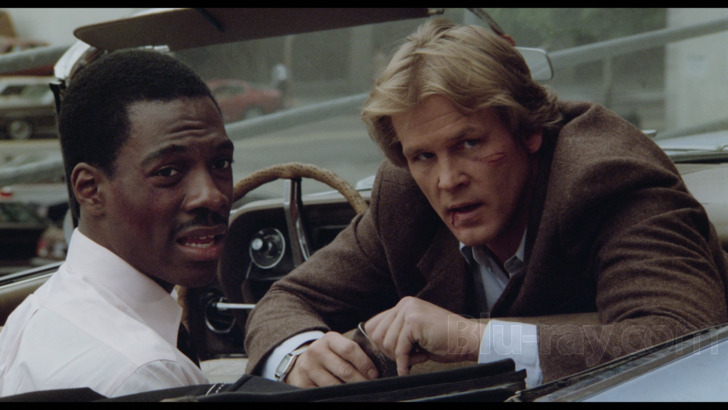
Eddie Murphy kinetically debuts as hustler Reggie Hammond, released from prison for 48 hours under the brutal watch of Detective Jack Cates (Nick Nolte) to hunt for Hammond’s ex-partners, who have gone on a cop-killing spree in San Francisco. The film catapulted Murphy to stardom. It was also the first picture to feature a Saturday Night Live comedian in a raw, crime story and stands as one of the better “buddy cop” pictures ever, though Murphy is really only deputized.

Yes, Murphy is very funny, sometimes side-splittingly so, but he does not treat every scene as an opportunity to do a bit or schtick.  He picks and chooses his moments, trusting in the story directed and mostly written by Walter Hill (The Long Riders). Murphy has one virtuoso scene, when he poses as a cop to roust a redneck bar, but even there, where he puts a knife to a man’s face and tells him, “I’m your worst fu***** nightmare, I’m a ni**** with a badge”, he’s in keeping with the picture’s tough tenor. Nolte’s Cates is brutal, unpleasant and an unrelenting racist, almost shockingly so, given our current advanced ethos, yet, they bond in a manner that feels authentic. Given we’re dealing with tough cops and criminals, the racial dynamic is not off-putting.  It just adds to the tension.

I was also surprised by the gritty brutality of the movie. The body count is high, but rather than explosions and elegant slo-motion, Hill takes more of a Sam Peckinpah approach. The shootings are bloody and awkward, not stylized. And the bad guys – Albert Ganz (James Remar) and Billy Bear (Sonny Landham) – are scary bad.

James Horner’s original music (he’s been nominated 5 times and won for his scoring of Titanic) is apt, a moody mix of jazz and Asian chimes.  Hill also uses San Francisco to his full advantage, mixing the grimy feel of Bullitt and Dirty Harry with a little early 80s glitz.

It has a few weaknesses. Annette O’Toole, for whom I have had my own weakness since Robby Benson’s One on One, is wasted as Nolte’s long-sufferring gal.

And the finale, where Cates and Hammond just “play a hunch.” is a bit lazy.

Still, an uproarious, and assured flick, much more than it seems.


Related image

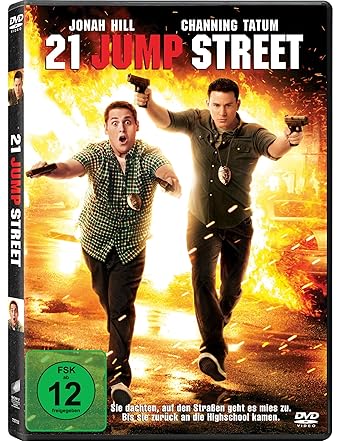
A successful parody of both high school teen flicks and buddy-cop movies (ala’ Hot Fuzz).  A blast of a picture, made better by strong chemistry between Jonah Hill and Channing Tatum.  Hill was the high school geek, Tatum on the top of the social totem pole, but after graduation, they both ended up on the police force, with dreams of car chases, shoot-outs and slo-mo explosions.  Instead, they are assigned as bike patrolmen, and after they screw that up, they are shipped off to the Jump Street division, where their youthful faces land them back in high school, undercover, to break up a drug ring.

So far so good, though not much beyond the formula.  But the material is elevated during their second stint in high school, where Tatum finds himself the geek.  Aggressive jocks, immediate put-downs and a hierarchy are out; tolerance and peace are in; and the main drug dealer (played by James Franco’s brother, Dave, in a very funny, emo/enviro turn) cleaves to the cooler Hill, leaving Tatum as the odd man out.  Hill basks in a high school popularity he always craved, leading to a great exchange where Tatum screams at Hill, “You’re in too deep” after he finds that Hill is filling out college applications in the hopes of matriculating at Berkeley with Franco.

Which brings me to Tatum, who I had unfairly classified as a graduate of the Josh Hartnett school of lobotomized acting.  Indeed, to watch Tatum play Roman period, as he attempted in The Eagle, was cringe-inducing.  But as Clint says, “A man has got to know his limitations.”  Tatum redeems himself and steals this picture with great timing and unexpected sensitivity.  He is also getting very good reviews for Steven Soderbergh’s Magic Mike.