Comedy
Life is Beautiful – 5 stars

Roberto Begnini’s Academy Ward-winning fable is in two parts. First, the love-at-first-sight courtship of a sweet and funny man and a beautiful schoolteacher, followed by a tale of a father’s love for his wife and son and the lengths to which he will go to spare them the cruelty of a Nazi concentration camp. Both halves of the film seamlessly meld, and the picture travels a road from sunny to tense to dire, with Begnini at the heart, lending dignity as he dances faster and faster.
Begnini’s film is neither historically accurate or particularly reality-based. Indeed, the half of the film occurring in the concentration camp could have taken place over a period of months, weeks or days, and Begnini’s character essentially creates a daily circus to shield his boy from the horrors that surround them, behavior not even Colonel Kilnk would have allowed. For this reason, Life is Beautiful came in for criticism from some quarters who believe that a Holocaust movie should not necessarily be the backdrop for a comedy, however bittersweet, and/or that Begnini trivializes and historically mutated the reality of Italian Jews during World War II.
Nuts. The overarching theme of the film is a father’s attempt to protect his son from death, both physical and spiritual, effectively conveyed in a respectful manner. Complaints of inaccuracy or improper tone are misplaced and rigid, as if there is some politically correct blueprint for a Holocaust film. Conservative film reviewer John Podhoretz recently followed this line, attacking the latest X-Men movie – which traces Magneto’s powers and philosophy to his treatment at the hands of the Nazis – thusly: “Genocide and supernatural powers don’t mix”.
Nuts to him too.
Shoah has been made. So too Schindler’s List and The Wansee Conference. Go see them, I implore you, and make your own judgments (and while you are at it, check out Enemies, A Love Story, which actually mines a Holocaust survivor’s post-trauma love triangle for a couple of chuckles). But don’t stilt artistic vision in the name of grim devotion to past horror.
These criticisms smack of paternalistic preaching that might make The Catholic Standard proud. Tarantino and Stone “glorify” and thus perpetuate violence. Lolita makes child molestation all the more probable. And Begnini’s work, according to Slate‘s David Edelstein, similarly offends: “Imagine Harpo Marx giving the hot foot to a pompous official, who takes out a machine gun and blows him away: That’s how cheap Benigni’s hash of farce and tragedy is. It’s a gas, all right.”
Edelstein earned his “I’m A Sensitive Keeper of the Grim Tenor of Concentration Camp Flicks” ribbon. And with that award goes a free ticket to Showtime’s offering, The Devil’s Arithmetic – Kirsten Dunst is transported from modern day history class, where she passes notes and ignores the teacher’s recitation of the the extermination, to a WWII-era Poland. Or The Twilight Zone, where Vic Morrow’s modern day bigot was carted off in a train headed, presumably, to Treblinka.
Controversy aside, the film begins in brilliant color but mutes to near-black and white as the story continues its necessarily sorrowful pace. I can say little about the direction as my eye was trained on Begnini. His performance as an unserious man at the most serious of times mirrors Chaplin (another person we could criticize – how dare he benefit from physical comedy while aping the creator of the concentration camp, Adolf Hitler). His carefree and whimsy is tested as he becomes separated from a rich life, his wife is torn from him, and every day becomes a struggle to personally survive and protect his son. Everyone else is quite good and the son is particularly affecting (the Italians get me every time – see Cinema Paradiso).
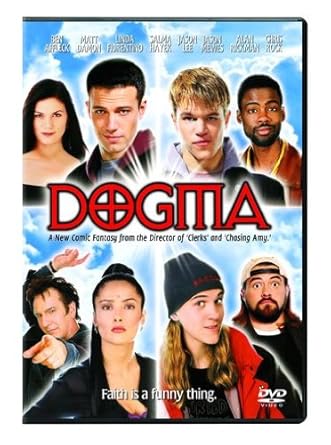
Dogma – 2.5 stars

Prior to seeing Dogma, my dislike for Kevin Smith was pronounced. His “breakout” self-financed picture Clerks was wildly overpraised and when he got a big budget behind him, he produced varying degrees of crap. Mallrats showed that outside the confines of a convenience store, where camera movement is unnecessary, Smith was lost. Chasing Amy proved Smith a lame, unfunny writer, incapable of directing actors, preferring to let them exfoliate, flatulate and otherwise bleed all over his print.
Dogma sucks as well, but there are some pleasures in the sucking, because Smith has written a hit-and-miss lampoon on the perversities of Catholicism. Where he hits, he knocks it out of the park, as he plays fast and loose with the Bible in an effort to tell his modern fable (fallen angels trying to get back into Heaven; other angels, muses, apostles and assorted characters tryng to stop them). Smith also takes a few decent shots at the Pope, and offers a heartfelt tribute to true faith, all in the zany format of The Russians are Coming, The Russians are Coming . . .
Smith still does not direct actors, so the players in Dogma look like they are in home movies (Linda Fiorentino manages an entire film with a smirk and rolled eyes). But his laissez-faire approach is made less ruinous by crafty renderings of four angels (Matt Damon, Ben Affleck, Jason Lee and Alan Rickman) and the best performance to-date by Smith regular, stoner Jason Mewes. The movie is silly, but it is by far Smith’s best work. What followed was more crap (Jay and Silent Bob Strike Back, Jersey Girl, Zack & Miri Make a Porno, Cop Out), and Smith’s sensibility that his crap was actually awesome and the studios don’t “get” it and that’s what makes him awesome and everyone else not awesome.
Which leads to a biography of a director highlighting the following: criticism of Paul Thomas Anderson, as if Anderson were a peer; becoming so overweight he is kicked off of a flight for not having bought two seats; attacking Bruce Willis (“I had no f***ing help from this dude whatsoever”) because Willis did not work hard enough to promote the execrable Cop Out); an attempt to market his last cruddy picture “outside the system”; and retiring, at the ripe old age of 41.
How Do You Know – 2.5 stars

With Terms of Endearment, Broadcast News, and As Good as it Gets on his resume’, James L. Brooks commands the respect of viewing one of his movies, even if it was not well-reviewed. So, I watched How Do You Know, the story of a 31 year old Olympic softballer (Reese Witherspoon) who is cut from the team and thereafter, alternates between two romantic futures – a freewheeling, rich, fun and unserious Major League baseball pitcher (Owen Wilson) and a nervous, polite, endearing corporate-type under federal investigation (Paul Rudd). Rudd’s predicament stems from the wrongdoing of his father (Jack Nicholson) and ultimately, he must choose jail for himself or Dad.
The film is fine in parts, and it has its funny moments, almost all of which come from Wilson and Nicholson, but it doesn’t catch hold or intrigue.
The chemistry between Wilson and Witherspoon and more acutely, Witherspoon and Rudd, is just not there. Wilson is his daffy, charming self (though as much a baseball pitcher as I am an astronaut), so he’s trying, but Witherspoon is horribly miscast as a jock who doesn’t buy into a future of love. She is not at all jock material, and she seems to know it. Her response is confusion. This is a younger Sandra Bullock role. And Rudd so overplays his mooning infatuation that you soon hope he does not get the girl and, in fact, is jailed. Most times, Rudd’s sweet mug works, but too often in this movie, you just want to smack him in the mouth.
There’s also too many cutesy scenes and quirky characters, where everybody has the witty line. The scene in a delivery room (Rudd’s secretary has a baby and gets a marriage proposal from a cookie cutter galoot) is so precious you may retch. Even the relationship between Nicholson and Rudd, which has some pretty good laughs, is too broad and thus unconvincing.
There are, however, funny moments and some very good lines even beyond the ones in the trailer. And I’ve certainly seen worse romantic comedies.
Wonder Boys – 4.5 stars
I had dinner with a critic friend, David Ehrenstein, around the time this picture was released. He said something to the effect of, “A movie about these people had not been done yet. It was its time.” He was right, but before getting to the film, I wanted to note that the folks who did publicity for Curtis Hanson’s follow-up to L.A. Confidential should have been lined up and shot. The previews portrayed the movie as a screwball comedy with a bespectacled Michael Douglas playing a wise and ultimately grating character, a classier Weird Science with a bigger star.
Wonder Boys is nothing as it was presented. Instead, it is a literate comedy of manners with the setting of higher education, and it is principally about the businesses of teaching and writing. Douglas is a professor working on his second novel (his first, a successful work, was published seven years prior), which has ballooned to a deathless 2200 pages. His agent (Robert Downey, Jr.) is en route to WordFest, a weekend of literary activities, to read the novel. In the meantime, Douglas is dealing with one peculiar but gifted student (Tobey Maguire), one gorgeuous student, who also happens to rent a room in his house and who is coming on to him (Katie Holmes), and the chancellor of the department, with whom he is having an affair (Frances McDormand). Bad thing upon bad thing happens, but within the very funny travails, Hanson develops strong relationships between the characters. He also gives more than a glimpse into the soul of writing and teaching, and Douglas actually grows, and grows convincingly, given what could have been events offered solely for their madcap nature.
The film also makes great use of the city of Pittsburgh, which has always deserved better than —

Our Idiot Brother – 3.75 Stars

A ridiculous feel good comedy about a sweet, trusting stoner (Paul Rudd, so open he sells marijuana to a uniformed policeman who professes to having a bad week) forced to live at home with his mother and then with his witches brew of sisters (Emily Watson, Parkey Posey and Zooey Deschanel). Hijinks and family drama ensue.
Admittedly, not a great sell job for this picture. But the movie is carried by Rudd, whose innocence and good-naturedness are both attractive and believable. There are also some pretty amusing scenes. The drug bust is deft, and Rudd’s meetings with his jaded parole officer are also funny. Deschanel, who plays the artistic sister who wants to be some sort or stand-up comic, is winning, and her performances in what appear to be a NYC basement bar have a real authentic feel (she is not funny and the crowd of 7 people watching her is 85% family). Adam Scott, as the love interest of Posey, is also excellent. I’m not sure there is a funnier guy in formulaic comedies than Scott (his asshole brother in Step Brothers is legend).
Unfortunately, Posey, as the unscrupulous celebrity interviewer (yet again, high strung) and Watson as the earth mother sister whose husband (an unpleasant Steve Coogan) is cheating on her are tedious cartoons, but once Rudd re-enters the movie, all is well again.
The film, however, is stolen by T.J. Miller as a stoner who replaced Rudd by taking up with his woman when Rudd went to jail. Miller is a gentle soul, just like Rudd, and that they pair up at the end of the picture to start a candle making business is not a spoiler. It just had to be.
Crazy Stupid Love – 3.75 stars

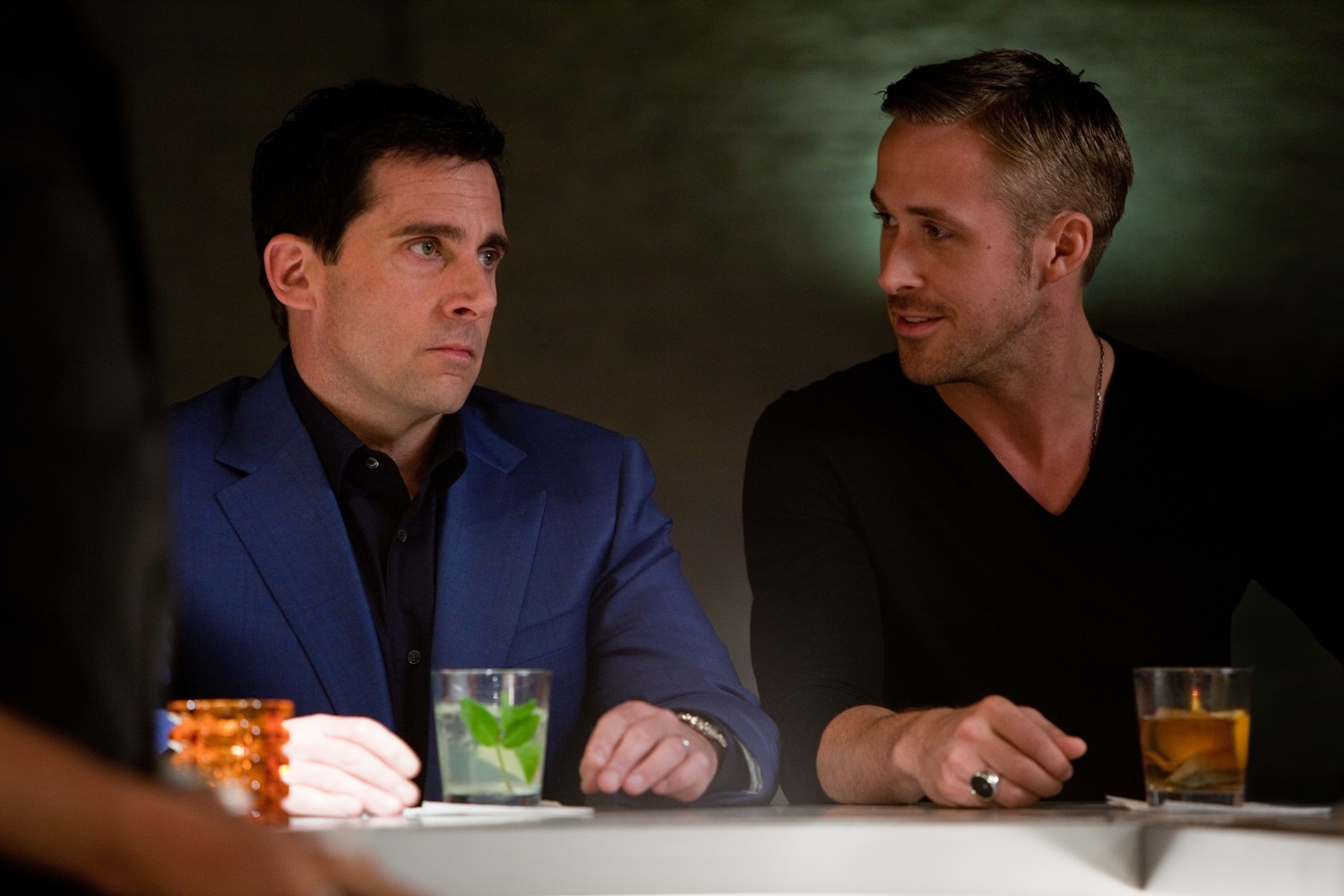
A nice ensemble “bromantric” comedy. Steve Carell plays the schlub husband thrown over by the “wife in mid-life crisis” Julianne Moore after she flings with an office colleague. Despondent, Carell retreats to the local singles bar to lick his wounds, where the charming, suave ladies man Ryan Gosling takes him on as a project, ala’ Henry Higgins. Carell is soon quite the ladies man himself but still pining for his wife, while Gosling learns the merits of deeper love with the electric but gawky Emma Stone.
There are some glitches: Carell’s sad-sack/nice guy routine is getting a bit stale; the friends of the broken-up Carell and Moore and Stone’s lame-o boyfriend are ridiculously stock and unrealistic; Carell’s 8th grade son is a little too cloying and hip; and Moore is reprising her flustered role in last year’s excellent The Kids Are Alright.
Still, this is cute and mostly funny, and Gosling, who I have been very hard on for his work in The Ides of March (confused) and the wildly overrated Drive (catatonic) is the engine. His repair work on Carell provides some of the best scenes, and he and Stone have very convincing chemistry.
Also, Marisa Tomei plays a one-night stand who ends up being a teacher of Carell’s son. Tomei just keeps getting better and better looking and more charming to boot. She can be very dark, as she’s shown in The Wrestler and Before the Devil Knows You’re Dead, but she’s also a deft comedienne, as she showed here and in Cyrus.
Midnight in Paris – 1 star

The movie starts off trying your patience with an overlong introduction of clarinet music and scenes of modern Paris. We are then introduced to American screenwriter Owen Wilson and his nagging, dispiriting fiancee, Rachel McAdams. Wilson is nervous and nasally and a noodge. McAdams is flat out hostile to Wilson. The idea that these two would ever be engaged is absurd. I kid you not, McAdams says to Wilson, “You always take the side of the help.” So, Wilson is married to a monster, doesn’t seem to know it, and yet, Allen wants us to care about him.
Worse, McAdams travels with her ugly American parents, who are (gasp) Republicans, distrustful of the French and country club obnoxious.
Allen makes the modern so unpleasant you can’t wait for Wilson to be transported to the 1920s. Sadly, we have to go to the 1920s with Wilson. And he’s doing Woody Allen, but whinier. He meets F. Scott Fitzgerald, Cole Porter, Ernest Hemingway, Salvador Dali, and Gertrude Stein says, “I was just telling Pablo . . .”
The greats are condescending, self-satisfied characters and they lord their superiority over all. Allen does the same thing, hiding it in his puny, nebbish persona, so his portrayal of them makes sense.
This movie is terrible. Perhaps Allen can still make a good picture. Match Point (2005) was a revelation and Vicky Christina Barcelona (2008) was charming, but he’s about done, and the nomination of this movie as best picture is ridiculous. The nomination as best screenplay is an affront. Perhaps Allen’s digs at Bush and The Tea Party explain it, but if not, and the Academy wanted to give him an unwarranted accolade, isn’t that why the Irving Thalberg award was created?
Some gems: “How long have you been dating Picasso. I can’t believe I’m saying that.”
Hemingway: “Have you ever shot a charging lion . . . Who wants to fight!”
“I wouldn’t call my babbling poetic, though I was on a roll there.”
“500 francs for a Matisse? I wouldn’t mind getting five or six.”
“The present is unsatisfying because life is unsatisfying.”
Yeesh.
There are some funny moments when Wilson lapses into Seinfeldian chatter and the folks from the 1920s look at him funny. Adrien Brody is a hoot as Dali. The movie is also very pretty.
That’s not enough, notwithstanding the Academy and a 93% rating on Rotten Tomatoes.

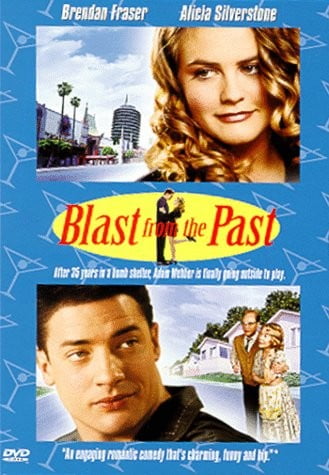
Blast from the Past – 2 stars

Brendan Fraser plays a 35 year old man mistakenly vaulted in a bomb shelter with his parents (Sissy Spacek and Christopher Walken) since the early 60s. Now, he’s out in modern L.A., and he’s wearing a windbreaker and calling black people “Negroes.”
While Fraser is pretty funny, and Walken and Spacek are properly “kooky” as conservative parents who took to the fallout shelter and never came out during the Cuban Missile Crisis, this romantic comedy lags. Alicia Silverstone, as the love interest, is dull and plump, a bad actress with weak comic timing (didn’t she come and go in a hurry?). Dave Foley, of “Kids in the Hall,” plays Silverstone’s gay, advice-dispensing roommate, but he’s forced, and he’s given none of the snappy patter of a Cam or Mitchell from “Modern Family” (and if you needed someone to play the gay roommate from “Kids in the Hall”, why not Scott Thompson?)
In the end, fish-out-of-water can only get you so far.
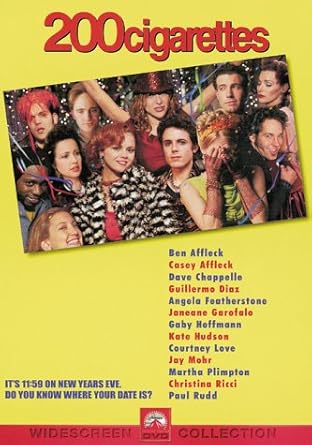
200 Cigarettes – 0 stars

From IMDB: “A collection of twentysomethings try to cope with relationships, loneliness, desire and their individual neuroses.”
Oh goodie.
A ponderous picture about one New Year’s Eve in the early 1980s and the intersection of a bunch of New Yorkers in the city on that night. They chatter and say cute things and go on and on about the meaningless of it all. They also over-emote and incessantly navel-gaze.
They started making these ensemble/group hug/chit chat/why are we here? movies after the insidious The Big Chill which spawned the terrible Reality Bites.
Nothing is funny – save one Janeane Garafolo line (“These matches are disappointing me”) and one Ben Affleck attempt at a pick up line (“How do you like your eggs in the morning? Scrambled or fertilized?”). Other than that, the film is awful. Everyone is bad, but special merit for over-the-top histrionics goes to Christina Ricci, Martha Plimpton, and Paul Rudd.
The director, Risa Ramoan Garcia, wasn’t given another film to helm for 11 years. He has, however, paid the bills as a casting director for CSI.
The writer, Shana Larsen, never wrote another movie.
Enough said.