Archive

Comedy


image

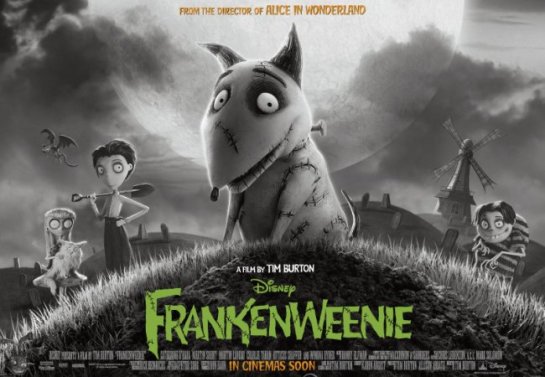
Tim Burton goes back to his roots (this is a remake of  Burton short film from 1984) with this clever and sweet story of a boy whose beloved dog is killed by a car.  Inspired by his science teacher, the boy brings the dog back to life, but does so in the midst of a heated science fair competition.  His classmates use his same scientific methods, and soon, the town is overrun by monsters brought back to life by the irresponsible kids.

Burton uses stop action animation, the same technique used for Coraline, and Burton’s own Corpse Bride and The Nightmare Before Christmas.  The process is well tailored to the macabre, old-timey haunting and rich in texture, especially in black-and-white, which evokes classic horror films.

I have two minor criticisms.  First, there is a subplot where the science teacher is run out of town because of his influence on the children. It’s a little too contemporary and feels a bit like an unfair shot in the culture wars, especially off putting when, in fact, the neanderthal townsfolk who feared the teacher are seemingly vindicated – the kids damn near destroyed the town.

Second, the ending feels forced, as if the test audiences couldn’t bear the downer of a dead pet.  So, the dog lives, which is pleasing, but contrary to what I thought was a well-developed theme about love and loss and the limits of science. In that way, I suppose Frankenweenie is hopelessly, sadly modern.

image

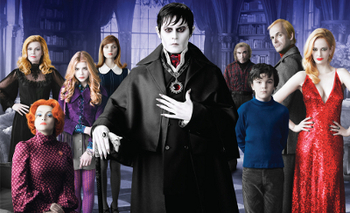
Tim Burton’s Dark Shadows starts out with a crisp recap covering how Barnabas Collins (Johnny Depp), the scion of a Maine fishery and lord of the manor at Collinsport, was laid low by a spurned scullery maid witch (Eva Green) and cursed to a life buried in the ground as a vampire. 200 years later, he is unearthed by a construction crew building a McDonalds.  Very thirsty, he slaughters them all, and heads on down the road to his manor to reestablish the family’s supremacy.  So far, so good.  Burton’s economical use of flashback harkens to Coppola’s Bram Stoker’s Dracula, and this looks to be a lot of fun.

It is not.  Barnabas in 1972 is rather a bore, and Burton does just about everything you’d expect Dennis Dugan to do as a director.  Barnabas marvels at electricity, commands the demons in the TV to show themselves, reads and quotes from Eric Segal’s Love Story and watches Scooby Doo and observes that it is a very bad play.  None of it is funny.

Nor is any of it engrossing.  Green now runs the town as the executive of a lead cannery, low ambition indeed for such a powerful woman, and Barnabas challenges her – by opening a competing cannery.   In the meantime, Barnabas has a series of lame encounters with the surviving Collins’s, who include a droll Michelle Pfeiffer as the matriarch, a wasted Jonny Lee Miller as her brother, a couple of pointless kids (Chloe Grace Moretz and Gulliver McGrath), Burton’s wife Helena Bonham Carter as a live-in psychiatrist, and Jackie Earle Haley as groundskeeper Willie.

There is also a love interest (Bella Heathcote), the boy’s nanny, for whom we have to suffer a second, less interesting flashback showing that she was institutionalized when she was a child because she commiserated with ghosts.

One gets the sense Burton knew this was a hopeless mess and found himself desperately piling on more and more visual wonder and absurdity in the hopes of saving the picture.  Hence, Barnabas has a ball for the town and arranges for Alice Cooper to perform (allowing him to say that she is the ugliest woman he has ever seen); Carter tries to transfuse the vampire blood out of Barnabas and then just decides to give him a blowjob; Barnabas and Green have a hate mating and fly about the room and up and down the walls, destroying everything, but at least breaking the tedium; and inexplicably, Moretz turns out to be werewolf.  There are also two musical sequences, the tactic of the lazy.

We eventually limp to a lengthy showdown between Collins and Green that is all Robert Zemeckis.  Statues come to life, ghosts intercede, and millions are spent wowing us with spectral visions.  All wasted, making you nostalgiac for the one-take, live-to-tape format of the original soap opera.

There is a hint at the end a sequel may be forthcoming, though with a production budget of $150 million and a domestic take of about half that, we may be spared.

Th signature achievement of the reign of John Hughes.  During his run, Hughes wrote and/or directed the following teen dramedies– Pretty in Pink, Sixteen Candles, The Breakfast Club, Weird Science, Ferris Bueller’s Day Off, Some Kind of Wonderful, Uncle Buck and Career Opportunities.

Hughes offered a certain corporatized schmaltz and sentiment, and there are worse Hollywood epitaphs.  Hughes also provided a silly, devil-may-care ethos for affluent suburban high schoolers (Hughes grew up middle class in tony Grosse Pointe, Michigan) and he could deliver a bravura screwball scene, such as Ferris Bueller’s rock out during a Chicago parade or John Candy crashing a teen party in Uncle Buck. At the end of his films, a trite lesson was always learned, and opposites always came together for a hug of understanding.

Nestled in this treacle, however, was a bit of nastiness fully realized in The Breakfast Club.  A group of kids – the geek (Anthony Michael Hall), the jock (Emilio Estevez), the weirdo (Ally Sheedy), the hood (Judd Nelson), and the “it” girl (Molly Ringwald) – all must spend a Saturday in detention together.  It becomes a group therapy session, and the archetypes – initially hostile to each other – soon find solidarity in their hatred of the school administrator (Paul Gleason) and the fact that it appears they each have something in common – an oppression at the hands of their cretinous parents.  Nelson is burned by cigarettes (given the school, one presumes Dunhills); Hall is so pushed to succeed academically he has contemplated suicide; Estevez is also driven by his overbearing father, and his torture is so great he actually starts to punch himself ; and Ringwald explains her homelife thusly when asked if she can go to a party:

                            CLAIRE
I don’t know, my mom said I was [grounded] but my dad told me to just blow her off.
                           ANDREW
Big party at Stubbies, parents are in Europe.  Should be pretty wild…
                           CLAIRE
Yeah?
                          ANDREW
Yeah, can you go?
                           CLAIRE
I doubt it…
                         ANDREW
How come?
                           CLAIRE
Well ’cause if I do what my mother tells me not to do, it’s because because my father says it’s okay.  There’s like this whole big monster deal, it’s endless and it’s a total drag.  It’s like any minute… divorce…
                            BENDER
Who do you like better?
                            CLAIRE
What?
                            BENDER
You like your old man better than your mom?
                            CLAIRE
They’re both strict.
                            BENDER
No, I mean, if you had to choose between them.
                            CLAIRE
I dunno, I’d probably go live with my brother.  I mean, I don’t think either one of them gives a shit about me…it’s like they use me just to get back at each other.


Hall adds: “…I don’t like my parents either, I don’t…I don’t get along with them…their idea of parental compassion is just, you know, wacko!”

Then it is the jock’s turn:  “Um, I’m here today…because uh, because my coach and my father don’t want me to blow my ride.  See I get treated differently because uh, Coach thinks I’m a winner.  So does my old man.  I’m not a winner because I wanna be one… I’m a winner because I got strength and speed.  Kinda like a race horse.  That’s about how involved I am in what’s happening to me.”

Cue the tough, doing his own impression of his house:  “(as his father) Stupid, worthless, no good, God damned, freeloading, son of a bitch, retarded, bigmouth, know it all, asshole, jerk!  (as his mother) You forgot ugly, lazy and disrespectful.”

The jock rejoins, explaining that he taped a classmate’s ass together.  Why?  “I did it for my old man…I tortured this poor kid, because I wanted him to think that I was cool. He’s always going off about, you know, when he was in school… the wild things he used to do . . . it’s all because of me and my old man.  Oh God, I fucking hate him!  He’s like this…he’s like this mindless machine that I can’t even relate to anymore…’Andrew, you’ve got to be number one!  I won’t tolerate any losers in this family…Your intensity is for shit!  Win.  Win!  WIN!!!’  You son of a bitch!  You know, sometimes, I wish my knee would give…and I wouldn’t be able to wrestle anymore.  And he could forget all about me…”

Just to make sure we get the message, Gleason is the biggest prick in the world, an amalgamation of every insecure, bullying teacher in the continental United States.

There’s not a genuine moment in the picture nor a hint of deviation from its blame-shifting orthodoxy.

Hughes has always included some of this foolishness – the parents in Uncle Buck are too committed to their jobs, Alan Ruck’s father in Ferris Bueller’s Day Off cares more for his sports car than his son.

But The Breakfast Club’s attack on the cruel, neglectful parents is the primary theme of the picture and Hughes uses it to portray these five kids (three of whom do appear to be sh**heads of the highest order) as victims.

Look, children can be obnoxious, and teens doubly so, but there is perhaps nothing more unpleasant than encountering a self-pitying teen who bemoans his vaunted station just as he nears the age when lesser forebears were jumping into a hot LZ in Vietnam.

Hughes died recently of a heart attack.  He was a bit of a recluse in his later years.  I wonder if the stereotype of the suffering, whining rich kid he presented in The Breakfast Club contributed to his distress, either because he was prescient and had to live with it or he felt he had a hand in cementing the mold.

In a Vanity Fair piece after Hughes’s’ death, David Kamp wrote “As hoary as it sounds, The Breakfast Club spoke to a generation.”

Unfortunately, it appears they were listening.

All good things . . . Whit Stillman lost his patience and made a lazy film. Rather than allowing us to cozy up to his affluent young characters, understand their milieu, and then enjoy their erudite yet innocent banter, he dispensed with development and jammed the quirky kids right down our gullet.

A transfer student to a tony private liberal arts college is identified by a trio of society girls who decide she needs their counsel and guidance. All four negotiate a lampoon of a Seven Sisters campus replete with neanderthalic frat boys, sneering campus journalists, and neurotic coeds.

There is no subtlety to this picture. The characters aimlessly drift into various Stillman exchanges, waiting their respective turns to say something Stillmanesque, like, “Do you know what’s the major problem in contemporary social life? The tendency to always seek someone cooler than yourself.”

There is more cleverness than that, but little intelligence, warmth or draw. Like Kubrick’s Eyes Wide Shut, which proved Kubrick probably had not had a sexual relationship in decades, Stillman seems too far removed from youth to master even a very broad comedy about young people.

And broad it can be. When one of the girls runs away to sort out her feelings after she finds her boyfriend has cheated on her, she goes to a low-rent motel. “Were you at a Motel 6?” her friends ask. “The Motel 4 – it’s even cheaper.”

Stillman has achieved bad Woody Allen. Not much fun, especially when he takes us out of Manhattan.

The film is often amusing, but the characters, never particularly realistic in Stillman pictures, are cartoons. Worse, every actor knows Stillman, and they’ve brought their Stillman A Game. The dialogue is stilted and even charmless. Oh for Chris Eigeman, who last I saw, stole a scene in HBO’s “Girls.”

The movie borders on a Whit Stillman spoof, though that really can’t be, at least until we get a proper David Mamet spoof.

He also cribs from his own work. A character has a fascination with a dance craze as social movement, just like a character in The Last Days of Disco. When you’ve only made 4 films, this is bad news.

It is no recommendation that it ends with two dance numbers.

Whit Stillman films are similar to Woody Allen films if you dispense with the angst and replace older urban New York Jews with younger urban New York prep school/deb type WASPs.  Also, toss out the whole “big notion” premises of death, morality and faith and replace them with passing fashion, pop culture, and functional philosophy.  And since Stillman does fewer films than Allen, listening to the witticisms of attractive scions of varying degrees of wealth as they contemplate their navels is neither grating or played out.

Stillman directed two prior films, Metropolitan and Barcelona, the former dealing with New York City private high school kids and the latter taking two of those characters and transplanting them to liberal, carnal Spain.  If you’ve seen Metropolitan and Barcelona, this is similar in tone, content and style.  However, this one is a bit more fun loving and free, as it chronicles the fall of disco in New York City through the eyes of several fresh out of college young urban professionals (though the moniker of “yuppie” is hotly debated) who negotiate their first jobs (publishing house, advertising, prosecutor’s office, environmental law firm) during the day and cruise the disco at night.  It’s also a little more personal.  Even though Stillman has a usual ensemble cast, which thankfully includes the brilliant Chris Eigeman, in this film, Chloë Sevigny is our primary guide and with her we suffer the perils and awkwardness of casual sex for an intellectual frump in the 80s.  It is painful indeed to watch her seduction tecnhiques, which includes a breathless, “There’s something really sexy about Scrooge McDuck.”     

As in all Stillman films, the conversations that meld college bull sessions and comparative literature courses are the gems, such as this back-and-forth on Lady and the Tramp

marjorie nugent

Richard Linklater offers the story of Bernie Tiede (Jack Black), a gay mortician who companions a significantly older woman, Marjorie Nugent (Shirley MacLaine) and then, in a fit of rage and exasperation at her domineering ways,  shoots her in the back and stuffs her in a freezer, pretending she is still alive (not ala’ Norman Bates).  Tiede is the town Robin Hood, the town being Carthage, Texas, and in many ways, Carthage is the star of the film.  Linklater uses very few professional actors, instead interspersing the dramatic narrative with interviews of real-life Carthage citizens, almost all of whom are squarely on the side of Tiede, and almost all of whom are hilarious.  To them, Nugent was a nasty, wicked old wretch and Bernie Tiede was the man who bought you a nice gift, sang the beautiful song that escorted a loved one to the hereafter, directed the town play or just gave you a nice wave everyday.  And he was driven to it.

Of course, in the presentation, Linklater neglects a few ugly details of the real life Tiede (not all of the vast sums he spent of Nugent’s wealth went to charity), but it appears the basic premise is true – Tiede was well-loved and Nugent well-hated (her own nephew observed, “‘Bernie’s not the first one who thought about killing her.  He’s just the first one who went through with it”).

Black is mesmerizing as Tiede, hilarious, hapless and harried, but uncontainably sweet and just a  little guilty (even before the murder).  MacLaine is effective as an old witch and Matthew McConaghey is amusing as the dogged D.A.  But the stars are the real people of Carthage, who Linklater neither mocks or mythologizes, wisely letting them be.

My only criticism is the choice to make Tiede so sympathetic.  Black does a great job in keeping him from being saccharine, with occasional flashes of guilty pleasure at his newly found wealth, but Linklater keeps away from any real dark heart, opting for a feel-good film.  Which is fine, but I think it could have remained feel-good and still been a little more revealing.

In my house, we have a few Christmas rituals, including a slate of television shows and movies we must watch on or near the holiday.  The shows are sacrosanct; “A Charlie Brown Christmas” and “The Grinch.”  The movies have always included such staples as A Christmas Carol (the George C. Scott version) and A Christmas StoryIt’s a Wonderful Life tends to be seen bi-annually, and it can be watched at Thanksgiving.  The most recent additions have been Elf and, of course, that holiday heartwarmer, Die Hard

My boy and I gave A Very Harold & Kumar Christmas its audition.  Harold and Kumar are much funnier than Cheech and Chong, and in this third installment of their stoner oeuvre, a baby gets stoned, does coke, and ecstacy; Neil Patrick Harris attempts to pleasure himself on an unsuspecting chorus girl who he is massaging (the joke? Doogie’s Howser’s homsexuality is really just a ruse to take advantage of vulnerable women); the 3D is used mostly for the shooting of bodily fluids at the screen; Harold gets his penis stuck to a cold pole ala’ A Christmas Story; and then he shoots Santa in the head.

Let’s just say it’s on the bubble.

Splash put Tom Hanks on the map as a leading man, though he was not yet filled-in and substantial.  Instead, Hanks was mannered in the way an actor can be after a long stint on a sitcom (Hanks was one of the Bosom Buddies from 1980 to 1982).  The film was also Ron Howard’s biggest feature, and its success would launch his career as the director of competent, workmanlike, earnest and generally dull films.

Hanks plays a love-phobic NYC businessman (derived from a childhood trauma – he fell off a Cape Cod ferry and encountered a mermaid).  In the depths of despair over his romantic failures, he returns to Cape Cod, falls in the water again, and is again rescued by the mermaid, now grown up (Daryl Hannah), who follows him to New York.  She is pursued by a cruel scientist (Eugene Levy), captured and probed to the point of sickness (ala’ E.T.) and then is busted out by Hanks, his brother (John Candy) and a repentant Levy.

Almost 30 years later, it’s a shock to see such a callow and obnoxious Hanks.  His voice is whiny, his character churlish and childish, and he seems too much the boy for the part, light as it is.  Perhaps because a mermaid has no experience with men, she just presumed Hanks was a good catch (ba-dump) but he is not.  He’s aggravating and surprisingly unfunny.

The same cannot be said for Candy, who steals the movie as the heavy, schmoozing, hard drinking,  yuk-yukking brother, excited to have one of his letters printed in Penthouse.  Levy is also good as the nerdly, bitter scientist, and Hannah is appropriately innocent and glowing as the fish-out-of-water.

It’s a cute movie, no more, but it ends in an uninentionally ridiculous fashion.  Hanks jumps in the water, making the choice to live the rest of his live with Hannah under the sea (he cannot, for reasons unexplained, ever return to land).  The credits roll and Hanks and Hannah swim the ocean as she shows him her world.  She has a big fin, he does not (when she was on land, when dry, she had legs and what goes along with them when they meet, and they were able to have a lot of sex).  Her world is murky and humdrum.  “See, this is the ocean floor.  And there is a conch.  And there are some fish.”  And what will Hanks eat?

Image result for Splash hanks underwater

“This was a poor choice.”

Two dumb Southerners vie for a North Carolina congressional district, one a Democrat (Will Ferrell), a randy Bill Clinton wannabe, and one a Republican (Zach Galifinakis), who is essentially Ned Flanders. But they are of the same bent, using appeals to God, country, morality, patriotism and the like to sway the voters, who, being Southern, are borderline mentally retarded.  After an unscrupulous campaign that features baby punching, grudge wife screwing and near-maiming, we are all served a lesson in civics.

There are a few very funny gags — Ferrell accidentally leaves a message for his mistress on a phone answering machine while an unsuspecting family is having dinner; Galifinakis uses a book (“Rainbowland”) Ferrell wrote in the second grade to suggest Ferrell is a socialist because, in Rainbowland, everything is free; the baby punching; and Ferrell’s tortured rendition of The Lord’s Prayer at a debate.  But much of it is derivative, either of earlier Ferrell vehicles or the fim itself.  Worse, Ferrell so over-relies on his own brand of wild man antics that you can feel the air release from the movie.  Quite something when it clocks in at a mere 90 minutes or so.  When Ferrell engages in the gibberish-spouting freakout scene, I’m reminded of the story about the late Chris Farley, who once shoved a pool cue up his own ass to get yucks. Ingenuity or desperation? You make the call.

To compensate, we get some political instruction, presumably from producer Adam McKay, who must actually believe that vehicles created for the delivery of fart jokes will also suffice for ideological lessons (he did the same thing in the seminal Ferrell pic The Other Guys, which ended with a primer on the evils of TARP).  In this movie, the Citizens United Supreme Court case is actually cited, and stand ins for the Koch brothers (John Lithgow and Dan Aykroyd reprise the roles of Ralph Bellamy and Don Ameche from Trading Places) are wasted when provided with no funny material. There’s also much that is not funny, including a gag where an Asian housekeeper is made to talk black . . . again and again.