Archive

70s

I recently devoured Quentin Tarantino‘s Cinema Speculations, wherein he recounts his childhood and the succession of films his mother’s boyfriends would take him to see when he was a kid. Most of the films he discusses are ones you probably shouldn’t take a kid to see.

When my mother and father got divorced, I was six years old and my father was supposed to take us every other weekend for two nights. That arrangement became a little less frequent over the years, and by later grade school, he was taking me and my brother on a Saturday day and an overnight. We would spend the weekend with him at his apartment and pretty much do the same thing every time: go shopping, do his errands, look for stereo equipment, maybe spend an hour or two at his law office, go Putt Putt golfing, and then to Shakey’s Pizza in Rockville or The Charcoal Grille in Bethesda. Dinner was from Swanson’s, so you got a entree’, two sides, and a dessert.

And movies. We went out to the movies a lot. Or, we stayed in Dad’s apartment, where he had a special key that was hooked up to some kind of internal cable system, and we could watch close to first-run movies there instead of going out. Or just catch what was on TV.

My father loved movies, he loved to talk about movies, he lived for movies. So much so that he would go through a certain kabuki with me where he would let me take a look at The Washington Post and ask what I wanted to see. I would pick a Herbie the Love Bug and he would say, “Nah. I heard about this good movie.” And then, like Quentin Tarantino with his mother’s boyfriends, you went to see a lot of dark, heavy, violent flicks, like The Laughing Policeman, The Silent Partner, Death Wish, or The Taking of of Pelham One Two Three. Or the remake of Farewell My Lovely, Night Moves, or The Eiger Sanction.

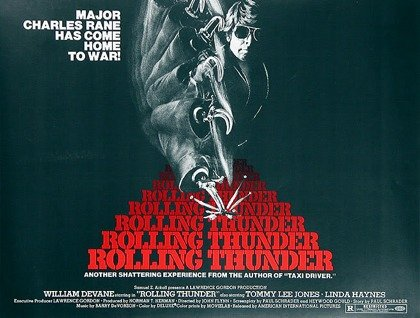
And Rolling Thunder. Which I noticed was available, and, as I couldn’t sleep anyway, I watched last night

Tarantino’s book has an entire chapter on the film, one of Paul Schrader’s first screenplays after Taxi Driver. Major Charlie Rane (William Devane) and Sergeant Johnny Vohden (Tommy Lee Jones) return to Texas after seven years of brutal captivity in a North Vietnamese prison camp. The adjustment is fraught, and even greater tortures are brought to bear on Devane, who is being treated by an Air Force psychiatrist (the just recently deceased Dabney Coleman) in his attempt to readjust. Tragedy ensues. Devane snaps. What follows is a classic 70s revenge flick.

The film travels wonderfully. There is a crisp foreboding to Devane’s return. While San Antonio welcomes him with marching bands and celebrations, and he is reunited with his long suffering and loving wife and the son who he last saw as a baby, Devane is damaged, and beneath the cheery gleam of a welcoming Texas, there is rot and danger. His son has anxiety issues. His wife has found another man (Devane says to her evenly, “you’re not wearing a brassiere” to which she replies, “oh, no one wears them anymore”). He cannot sleep in the house, preferring a cot in the garage.

So much is done well in the lead-up to the Death Wish-ian payoff, it goes unnoticed because, after all, this is a shoot ’em up, just desserts pic. Per Tarantino: ““This opening thirty minutes is a grippingly detailed character study, and by the time it’s over the audience doesn’t just sympathize with Charlie Rane, we really do understand him. Apparently better than anybody else in the film. It’s a much deeper depiction of the casualties of war than the [other movies of that era].”

I remember watching the film with my father. It is engrossing, both subtle and visceral, like a lot of pictures we saw together. It is also wildly inappropriate, also like a lot of pictures we saw together. I had trouble wrapping my head around something horrible that happens to Devane; not a spinning, vomiting Linda Blair kind of visual, but a brutality so smartly connected to a mundane part of the household, it just traveled with me, and probably not in a good way. Even last night, I fast-forwarded.

But on Sundays, when we were dropped off, I would not tell my mother about any of these movies, because I felt me and my Dad had this thing, this bond, and it was cemented in our little secret, Jujufruits and Junior Mints in hand.  And perhaps we did, although I’m probably mythologizing it. After all, my father needed to have something to talk to me about. Or at a minimum, just a two hour break from my babbling.

The picture is currently on Amazon Prime. Nostalgic for me but it really holds up.
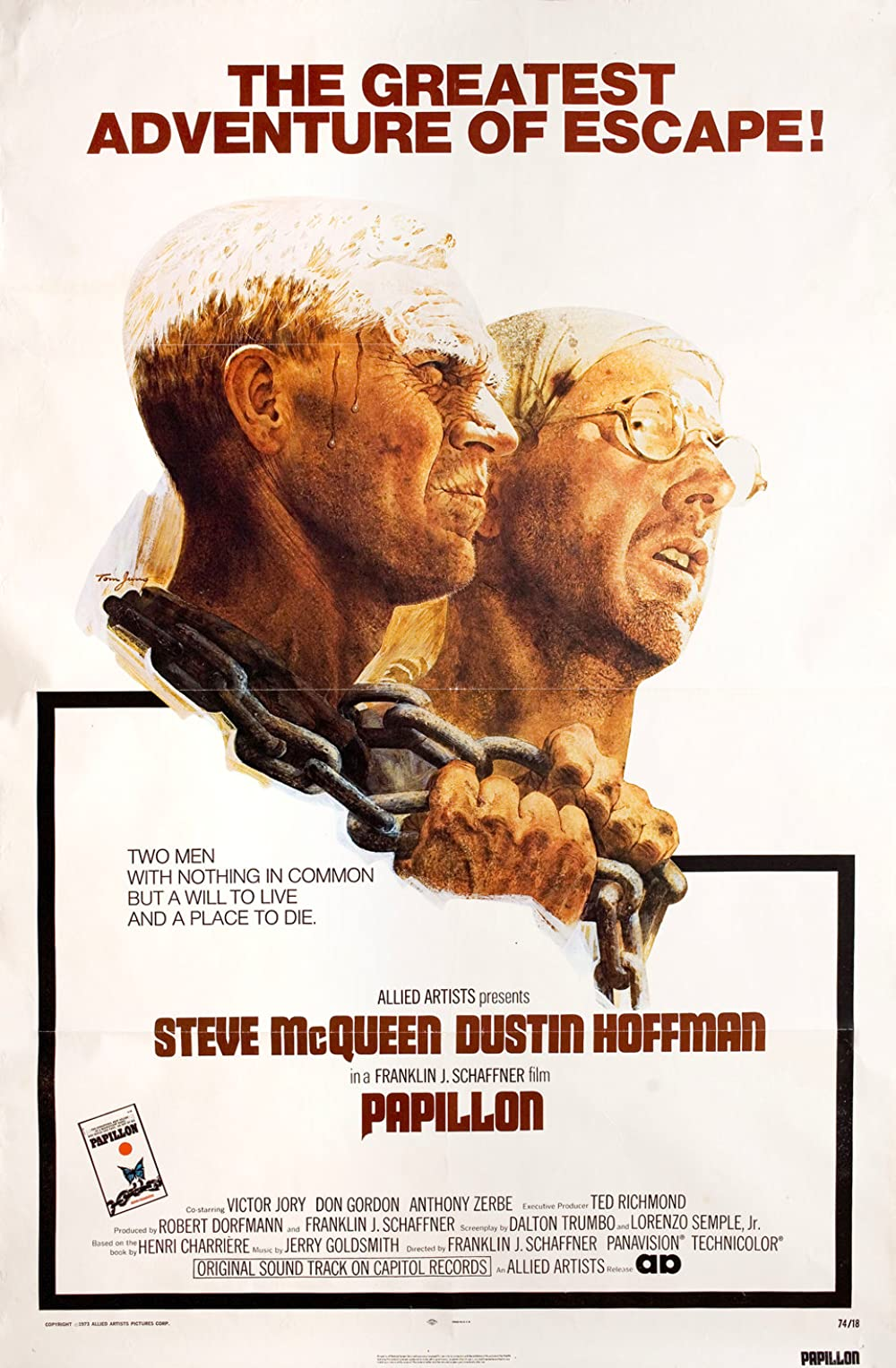
Franklin Schaffner’s (Patton) big-budget adventure/escape flick is competent, professional, well-acted (even if Steve McQueen and Dustin Hoffman have no interest in playing French people) and occasionally imaginative, particularly McQueen’s dream sequences as he fights solitary confinement and near-starvation. McQueen is the title character, sent to French Guiana for killing a pimp, where he meets the bespectacled Hoffman, a forger whose only protection is the ability to bribe officials. Their relationship deepens as McQueen, the Cooler King of The Great Escape, naturally attempts escape again and again here.

You may like the flick or not, but it is noteworthy for one scene, below. That crocodile has its snout wired shut and sure, it is drugged to the gills, but those are two massively bankable stars messing with a real crocodile. Nuts!


On MAX (formerly HBO Max).

Filmvetter has gaps. Many gaps. Truffaut, Godard, and Bergman come to mind.

And, until now, John Cassavetes.

I knew that Cassavetes was an influential filmmaker. Martin Scorsese credits two films that most informed his career: Orson Welles’ Citizen Kane and Cassavetes’ Shadows.  Quentin Tarantino also cites Cassavetes, which is strange, for, as one writer observed, Tarantino makes films “in which almost no element comes from life,” whereas Cassavetes’ work is infused with realism. Others who refer to his work include Jim Jarmusch, Hal Hartley, and the aforementioned Godard.

But to me, Cassavetes was the nasty, cynical guy in The Dirty Dozen and the husband in Rosemary’s Baby. 

Until I saw this picture, currently available as part of the Criterion Collection on HBO Max.

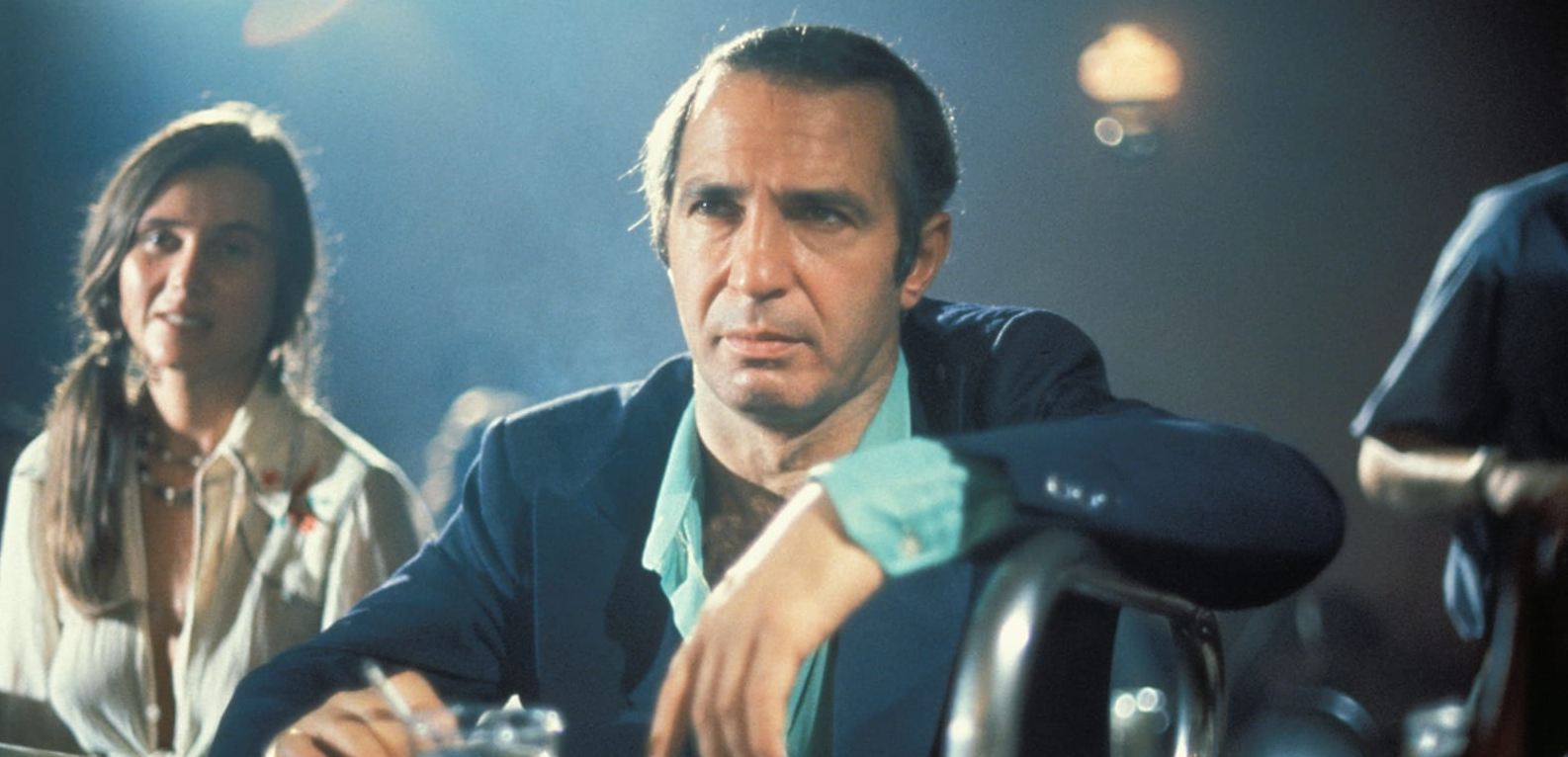
Ben Gazzara (“Cosmo”) plays a strip club/cabaret owner in Los Angeles, when showing some thigh and breast still required the trappings of a “show”. His stage girls are his children, and he is a small fish in a big pond. He just doesn’t know it. Until his big shot routine results in a sizable gambling debt to the local mob, who decide to absolve him of the “loan” in exchange for lethal services.

The film is visceral and immediate yet leisurely.  Cassavetes brings you right in on the actors, often letting the dialogue of others register on the one. I was reminded of Boogie Nights and the long take on Mark Wahlberg right before the drug heist, but while that was showy, if effective, Cassavetes’ style is anything but. Instead, it feels natural, almost a controlled improv. Cassavetes gave his actors maximum room, eschewing the Strasberg Method as tired and narcissistic.  Per Matt Zoller Seitz, reviewing Ray Carney’s Cassavetes on Cassavetes: “Among other things, Cassavetes hoped to offer young actors an alternative to the Method, a sensory- and memory-centered approach that was taught, in personalized form, by Actors Studio founder Lee Strasberg (whose students included James Dean, Robert Duvall, Robert De Niro, Elia Kazan, Shelley Winters and many others). Variants of the Method encouraged actors to draw heavily on their own experiences and feelings, and to treat hesitancy and inarticulateness as gateways to truth rather than obstacles to clear expression. A number of Method actors personalized this approach and had great success. But Cassavetes felt that the Method, and Strasberg’s Studio in particular, had become a different sort of factory, and he was ‘…resentful about the power the Studio exerted over casting directors, which he felt was what had held him back early in his career,’ Carney writes. ‘He was scornful of what he called the guru aspects of the Studio and pointedly described his and Lane’s school as anti-guru. He felt that the Method was more a form of psychotherapy than acting, and believed that although figures like (Montgomery) Clift, (Marlon) Brando and Dean had had a salutary effect on acting in the late ’40s and early ’50s, by the mid-’50s the Method had hardened into a received style that was as rigid, unimaginative and boring as the styles it had replaced ten years earlier. The slouch, shuffle, furrow and stammer had been turned into recipes for profundity. The actor filled the character up with his own self-indulgent emotions and narcissistic fantasies…Normal, healthy, extroverted social and sexual expression between men and women dropped out of drama. Inward-turning neuroticism became equated with truth. The result was lazy, sentimental acting.’”

There is none of that in this film, which feels so authentic as to be revolutionary. The picture is riveting, grounded, and wholly personal, with an L.A. devoid of the well-know landmarks, not purposefully omitted but rather, naturalistically absent. Cassavetes sets up a noir-ish crime pic, but perhaps bored with the endeavor, detours repeatedly into Cosmo’s crisis of identity.

Gazzara is captivating. Cassavetes trains in on Cosmo’s every conceit when playing the big man. Cosmo’s descendant is none other than Burt Reynolds’ Jack Horner in Boogie Nights, a semi-proficient pornographer who makes himself father to the talent and creates his own world, one where he is Fellini. Similarly, Cosmo treats his girls like perpetual prom dates and tells the patrons in his seedy club, “I’m the owner of this joint. I choose the numbers, I direct them, I arrange them. You have any complaints you just come to me and I’ll throw you right out on your ass.”

When his powerlessness is revealed, Cassavetes lingers on Cosmo’s doubt and his insistence on maintaining the veneer of control and aplomb reveals a hollowness that progressively evinces during the film. But there is also decency and honor, one that becomes difficult for even the mobsters to ignore.

Savaged by the critics at the time, a classic.

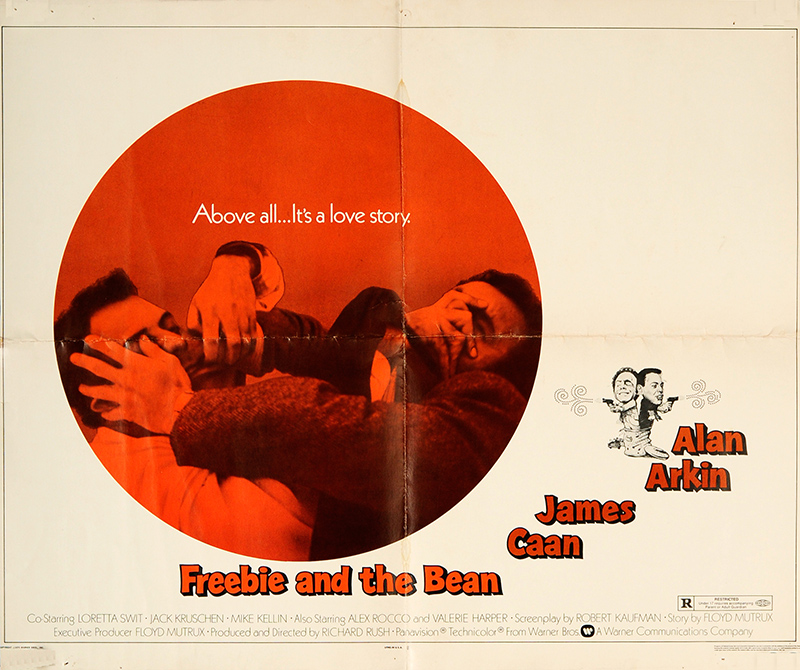
Another of the 70s flicks my Dad took me to when I was probably way too young  I remember being so jazzed at the back-and-forth between the manic Alan Arkin and wisecracking, nattily dressed James Caan, two San Francisco detectives trying to take down a mob boss. To make things cooler for a 9 year old, the violence was hilarious yet brutal, the dialogue scabrous, and the car chases relentless and in great supply.

Would it hold up 50 years later?

Yes, and how. Quentin Tarantino has raved, “nothing short of a masterpiece…absolutely brutal…part of the way the film worked was for you to laugh at the brutal violence and then feel bad about yourself for laughing.”  That is too much praise, but not by much. Caan and Arkin are a scream, very natural, yet way, way out there in terms of chemistry, perhaps riffing before it became standard, but fully committed, never lazy. I remember cracking up with Dad in the theater and after paying $2.36 for the rental on Amazon this weekend, I laughed out loud a half dozen times and smiled throughout.

It’s a strange duck of a picture, a flimsy cynical story giving way to an entertaining buddy cop yarn (clearly echoing The Odd Couple). Director-writer Richard Rush allows for very long takes of Arkin and Caan needling each other and then, there’s absolute chaos, followed by sweet scenes between Caan and his gal and Arkin and his wife. You get the sense that tonally, no one is steering the ship, and Arkin has remarked that he never really knew what kind of movie Rush was trying to make. Still, Rush makes it more seamless than it has a right to be. Good fun through and through, and The Nice Guys owes a lot to this picture.

Also, wildly offensive. For those keeping count, Arkin of European Jewish descent plays Hispanic (he is “the Bean” – get it?), as does Valerie Harper (“Rhoda”). The script is littered with politically-incorrect jibes that would likely result in a campus protest these days, and the treatment of the villain would require the calling in of the National Guard. So, gird your loins.

On Amazon Prime.

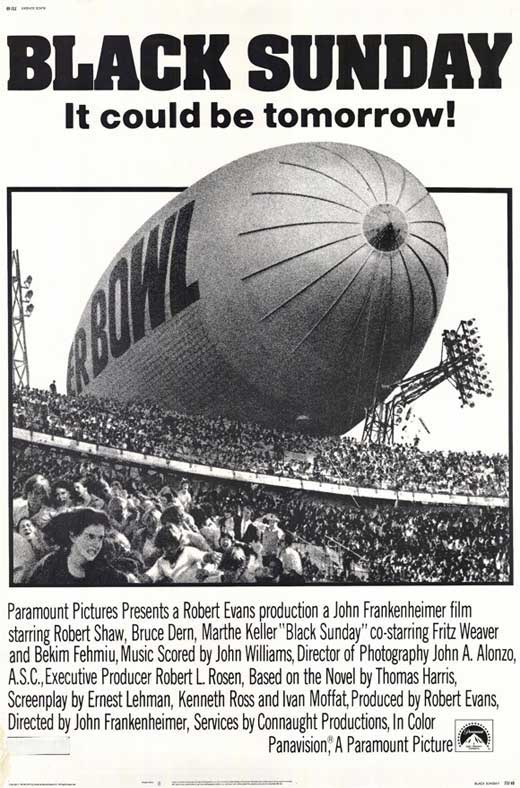
John Frankenheimer (The Manchurian Candidate, Ronin) handles this thriller with crisp professionalism. Proof? My wife, who loathes 70s films, came in for the last 25 minutes and was riveted. I even had to pause to get her up to speed on who was who and what was going on.

Granted, Frankenheimer has some pretty ingenious material to work with – Palestinian terrorists intend to fly the Goodyear blimp into the Super Bowl where they will detonate a massive bomb that will disperse shards of metal for maximum carnage (the film is adapted from Thomas Harris’ only non-Hannibal Lecter book).

The driven mastermind is Martha Keller (so driven because the Israelis have destroyed her entire family) and the psychologically impaired stooge is Bruce Dern (a former POW flyer in Vietnam, stripped of rank for “breaking”, now working for Goodyear flying the blimp). Robert Shaw is the relentless Mossad agent hot on their heels, guilt-ridden because he had a shot at Keller but let emotions engender mercy.

There is a little too much Dern and Keller relationship stuff, and in particular, Dern and his mental breakdowns/quirks, and the film could’ve been cut easily by 20 minutes.  But there is much to like here, and in particular, Frankenheimer does the madness of public violence great justice.  His insistence in showing just how many innocent people actually get killed if criminals and cops decide they’re gonna’ shoot it out in the streets is welcome, as evidenced by a thrilling Miami Beach sequence.

But the coolest facet is the fact that the NFL let them film the movie at the actual 1977 Super Bowl between the Dallas Cowboys and the Pittsburgh Steelers, and the Goodyear people let them use the actual blimps, almost otherworldly in these days of image consciousness, risk-aversion, and fear of offense. Frankenheimer may have had Goodyear over a barrell. In one of his biographies, Frankenheimer recounted that he helped persuade Goodyear to let him use its blimps because if not, the production would rent a large blimp, paint it silver-and-black, and people would think it was the Goodyear blimp anyway.

The impact truly heightens the tension when we see Shaw and FBI Man Fritz Weaver running around the Orange Bowl past Tom Landry, Franco Harris and even this guy…

Okay, not the real Jimmy Carter, but this is the only shot of him in the film, and though it’s very quick, it is a testament to Frankenheimer’s desire for verisimilitude.

Solid. On a subset of Prime, MGM+.

Gritty New York City 70s films hold a special place in my heart because my father took me to the theater to see them when I was very, maybe too, young. He had a great way of asking what movie you wanted to see, and then when you picked something age-appropriate like Herbie The Love Bug, he would just say, “No. We’re going to see this.” And off to The Seven Ups or The Laughing Policeman you went. I suspect he just went through the motions of giving you a choice hoping he could get a twofer, seeing a movie he wanted to see and having you actually hit upon the same thing.

If nothing good was out, we watched a lot of these pictures at his apartment, sharing a bowl of candy corn.

I was never very disappointed to have a Disney film vetoed by my Dad.  I was nine or ten years old and I was drinking in the likes of Serpico, Death Wish, and The French Connection, which introduced me to the hellscape of New York City, so different from my own suburban enclave. Throw in some other New York City pictures that offered more complicated themes, like Klute, and the Big Apple seemed even more foreign and forbidding.

The experience could be disorienting. After all, I was watching Jane Fonda fake an orgasm but didn’t know what a call girl was or what exactly she was faking. But it was such a rush and a privilege, something we shared that really wasn’t transferable to anybody else. I mean, I couldn’t really tell kids in my fifth grade class about Dog Day Afternoon.

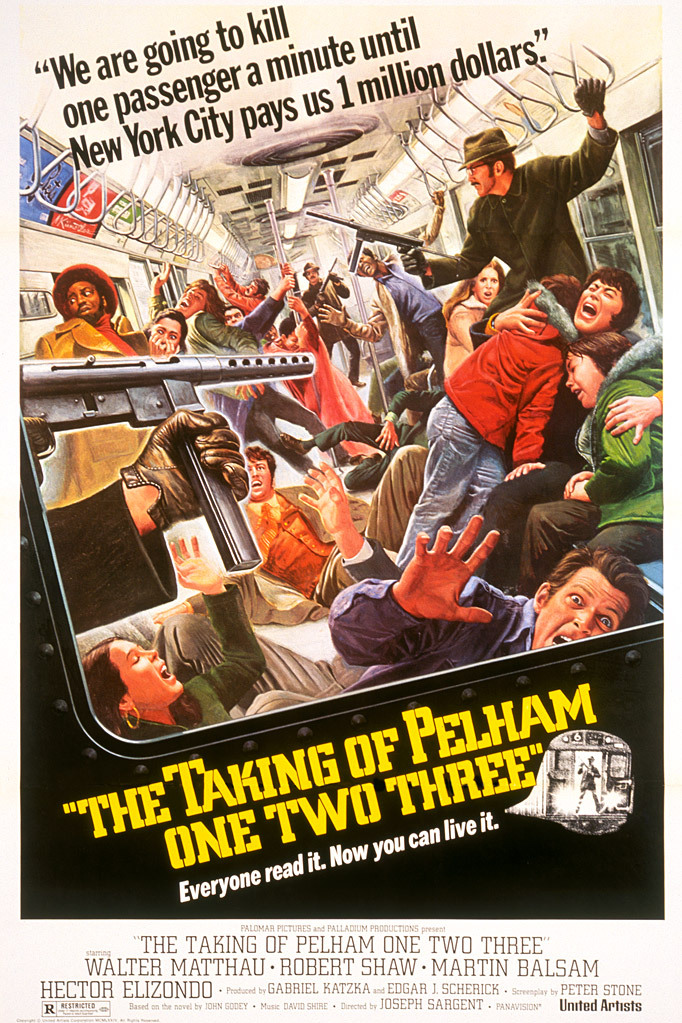
For me, the best and most accessible of these pictures was The Taking of Pelham One Two Three. I think my father agreed. From the beginning notes, a frenetic, jazzy David Shire score, the city translates musically as a haphazard mess of a place where anything can happen. In the space of 15 minutes, you’re introduced to four hijackers of, of all things, a New York City subway train, their hostages, and every sort of New York City bureaucrat, from the mayor all the way down to the weathered Transit Authority Inspector Garber (Walter Matthau). To a person, every politician, cop, administrator, dispatcher, and train driver is cynical, a little bit “Not my department” lazy, obnoxious, and yet, grudgingly heroic in their ability to work in such a fucked up place. They constantly deride, yell at, and ride each other, but there is a fundamental professionalism in their banter, and when they are put to the test by an exacting master criminal with a plan (Robert Shaw), there is something noble about their efforts. Unlike the feeble and mincing bureaucrats of Dirty Harry’s San Francisco, these folks are simply too harried and put-upon to bother with any kind of agenda, be it liberal, conservative, or something in between.  They’re just working stiffs doing the best they can and to a character, they are shockingly well fleshed out even with little dialogue. Add an entire subway car filled with all the denizens of New York City – the pimp, the prostitute, an old Jewish man, non-English speaking immigrants, a mother and her two bratty boys, early feminists, a drunk, a hippie – and the picture becomes a model in drawing characters both strongly and economically.

An example: Shaw has asked for $1 million to be assembled in 60 minutes. He tells Matthau that for every minute he is late with the dough, he’ll kill a hostage. You watch the entire city machinery lurch into action to meet the deadline, including two cops who are tasked with driving the money from the bank to the subway station. They are given a few lines as they wait for the payoff funds, and yet, I became so interested in them, when they crashed their police car trying to make time, I fretted about their fate even though the story couldn’t allow for any resolution.

And as a caper film, you’re not gonna get much better than this. I remember gripping my seat, but I can’t remember whether we were in the theater or at home on the couch. Joseph Sargent, a workmanlike director who fought in the Battle of the Bulge, keeps everything moving while the picture remains funny yet taut, and then dizzying, almost as if patterned on the runaway subway train that closes the film. When you get comfortable, he snaps you back to attention with shocking violence and the expressed terror of the hostages. 

Opening credits here, featuring Shire’s unforgettable, commanding soundtrack.   

Currently on Showtime.  And if you’re seeing Denzel Washington and John Travolta, you’re watching the godawful remake. Bail out. 

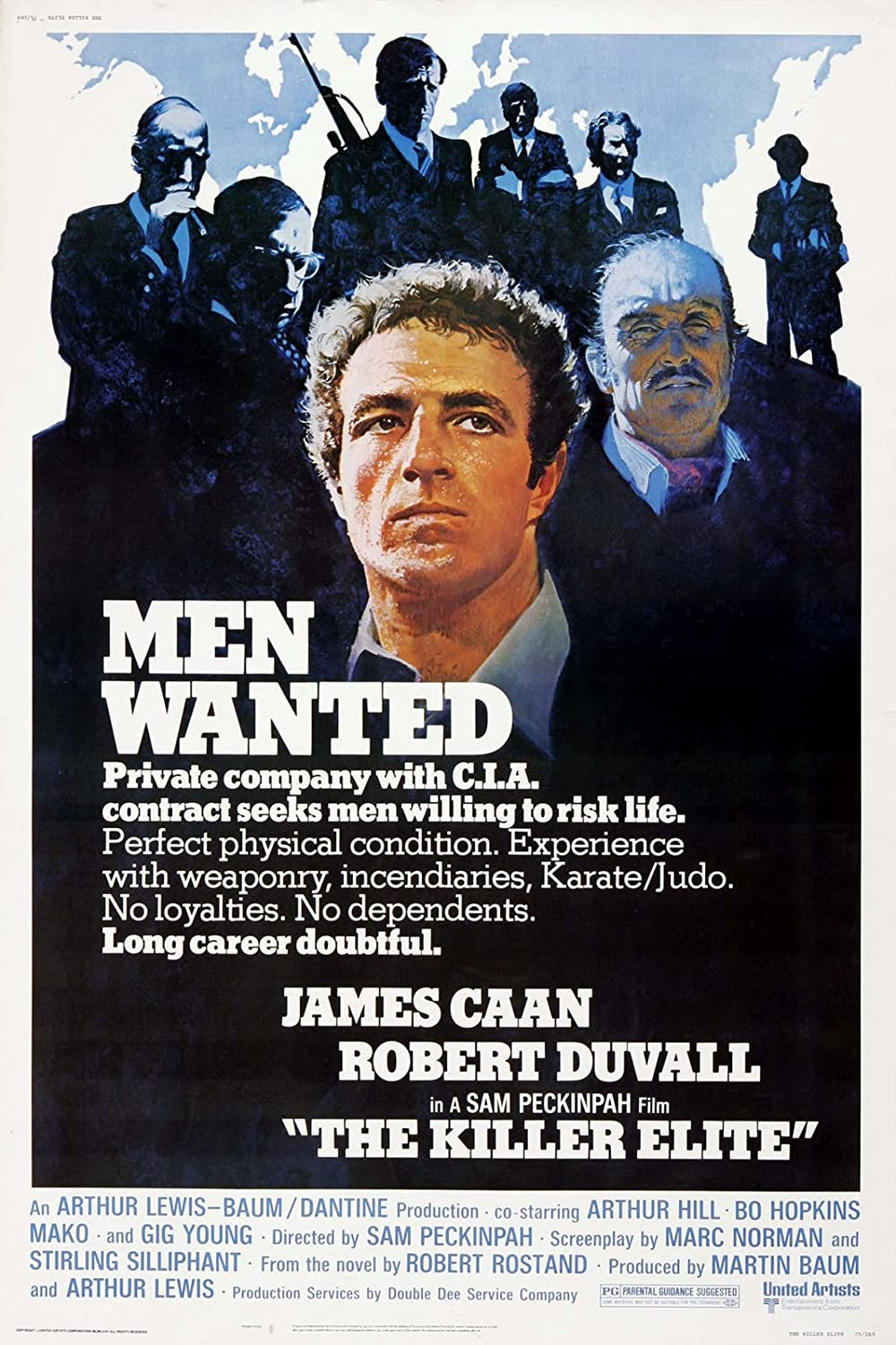
Pretty much terrible through and through. The best part of the film is the first 20 to 25 minutes, which focus on a macho friendship between professional contract killers Robert Duvall and James Caan. Caan is double-crossed, and then goes through an arduous rehabilitation after he is shot. After dogged sexual harassment of his nurse, he does garner a girlfriend/caretaker in the bargain, but soon, he is drawn back in by his corporate sponsor. Caan assembles a small team (Burt Young, Bo Hopkins) and takes on a contract to protect a would-be revolutionary (Mako) from an unknown Asian country. What follows is a blocky, ridiculous shoot ‘em up, marred by laughable cynical intrigue, schizophrenic tone, and mystical Eastern mumbo-jumbo.

Both Duvall and Caan were a few years off The Godfather, so perhaps the studio thought that would be enough, With Sam Peckinpah at the the helm, what could go wrong?

A lot. Peckinpah melds ninja warriors attacking men with guns, and ala’ The Wild Bunch, much of it is in slow motion. The result is a comic slaughter, one that seems only to be missing the Benny Hill soundtrack. At one point during one of these turkey shoots, Caan and Young are actually cracking up.

And as noted, there are Asians, so there is the obligatory honorable fight to the death with samurai swords.

The script is a mess, a mix of tough guy patter, platitudinous observations on “the Man” and the virtue of a cause, and verbal slapstick. Caan seems to be laughing through the entire endeavor, and it’s hard to blame him.

In the plus column, 70s San Francisco is a kick, and the final shootout is filmed in the Suisun Bay US Navy graveyard with hundreds of mothballed ships. The feel is spooky and the visual awe-inspiring.

I regularly monitor the streaming services for late 60s and 70s flicks. I may have seen them on regular rotation growing up on the 4 o’clock movie. Or my father may have taken me to the theater on his semi-regular weekend visits. Some are solid pictures, enhanced by my own nostalgia. Some are complete and utter poop. Mr. Majestyk is in the latter camp.

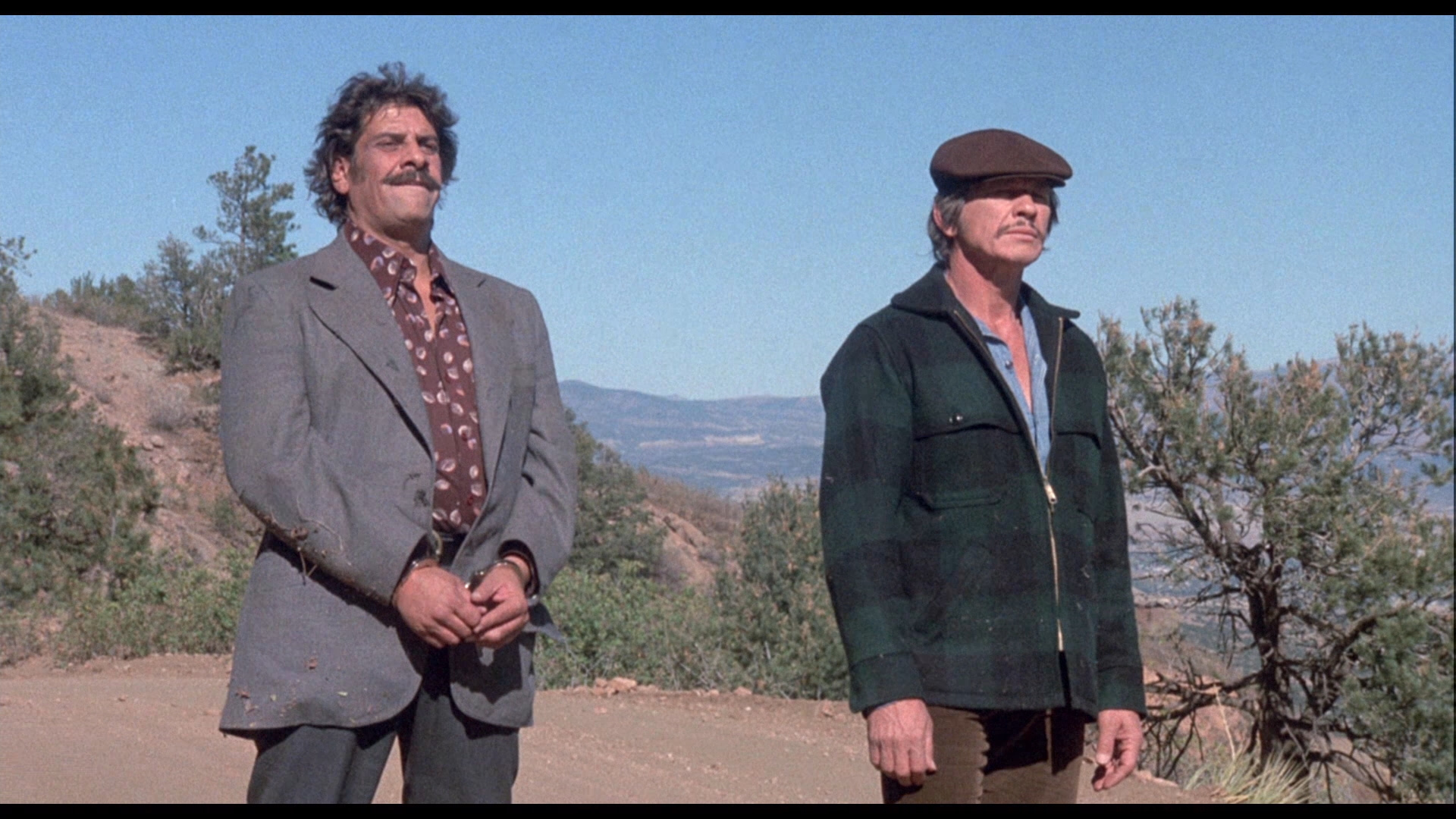
Charles Bronson, who squinted through an inordinate amount of theses paychecks through the 70s (Telefon, Breakout, Love and Bullets), plays a Vietnam Vet who just wants to be left alone to chisel the hourly wage down for his immigrant work force and pick watermelons. Alas, local Colorado thugs who want the work for white bums (so they can take a portion of their wages) intercede, Bronson messes them up, and soon, he’s in jail, where he meets and elicits the ire of a hitman (The Godfather‘s own Virgil Solozzo, Al Lettieri, who overacts inversely proportional to Bronson’s napping). Leaden car chases, nonsensical shootouts and wooden dialogue (penned by Elmore Leonard, no less) ensue.

The picture is clearly influenced by Billy Jack, the independent film made a few years prior on a shoestring which racked up a surprisingly healthy box office. Billy Jack is also not very good, but at least it had some camp value and the virtue of originality.

Charles Bernstein’s score is an elongated intro for a Mannix or Banacek. Maybe a McCloud. Gruesome horn, spinet and wah wah guitar. I suppose it is fitting because there is not an episode of one of those shows that is as dumb and listless as this picture.

Though if machine-gunning watermelons is your thing, this one is for you.

Meditative and deliberative, Director Karel Reisz gives us entree’ into the world of Axel Freed (James Caan), college literature teacher by day and degenerate gambler by night. Though it may be too much of a throwback for some, writer James Toback paints an anguished and multi-faceted portrait of a moth perpetually drawn to flame, a man who has internalized his addiction as a statement of freedom, verve and iconoclasm. However, Caan seems to sense he is a fraud, and as the film progresses, he gets himself into the kind of trouble where his family and not even his sympathetic bookmaker (a young, manic Paul Sorvino) can help.  It is here where the heart of the picture beats.  You watch Caan agonize, humbled, and then terrified as the wise guys become menacing rather than an ornament to his cool. Soon, there is a dawning, if not the expected one.

Caan is unsympathetic yet engaging, and he is always a star. He’s the grandson of a furniture magnate, and his mother is a doctor, and when things get very bad financially, he always has them as a crutch, an out, making his consort with flashy thugs and the more dangerous element of 1970s New York City a bit of a conceit. No matter what he wagers, his philosophizing about risk and chance is just so much b.s. because he high wires with a net.

But his net are people of substance – an up-by-your-bootstraps Lithuanian immigrant and a physician tending to the poor – and you can see his shame in comparison. It is Caan’s mother who, when bailing him out, reminds him of where his money is going, into a criminal element that preys on the weak.

It nags him, but he seems to revel in slumming, which includes his relationship with his Texas girlfriend, a very good Lauren Hutton, a good time gal who has been around the block and down into the sewer with an addict before. Her revelation of that journey and her eventual, limp, exhausted rejection of a spiraling Caan are piercing.

Caan is compelling as a self-deluding addict desperate to survive his debts and his own moral rot (he was struggling with cocaine when he made the picture). Toback smartly gives us the opportunity to watch him teach. Caan seems like a really good professor of literature, which is important because there has to be some “there” there in which to invest. When I heard they remade this film with Mark Wahlberg, I assumed the script was revised so he was a high school shop teacher.

Jerry’s Fielding’s soundtrack is spot on, evoking the dread and juice of gambling.

The ending is a bit rushed, but otherwise, this is a solid picture and a worthy third of the triple feature of California Split and Mississippi Grind. On Amazon Prime.

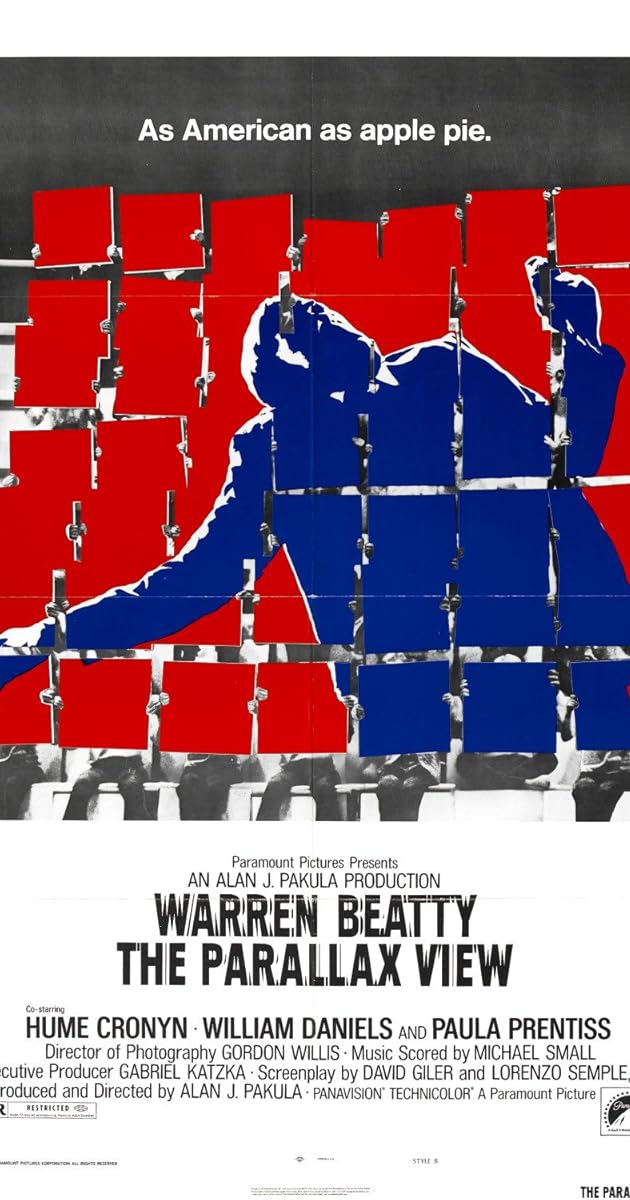
The Parallax View (1974) - IMDb

A regional reporter (Warren Beatty) stumbles on not so much a plot as an institutionalized corporate conspiracy of assassination.  The closer Beatty gets to the source, the more he realizes that what he initially deemed ludicrous is in fact a chilling reality.  

Alan Pakula’s paranoid thriller was probably more relevant upon its release.  With the shooting of JFK in ’63, Malcolm X in ’65, RFK and MLK in ’68, George Wallace in ’72 (a mere 2 years before the picture’s release), political assassination was preeminent in the mind of your average filmgoer.  And no one does paranoia quite a well as Pakula (Klute, All the President’s Men, Presumed Innocent). 

The picture is creepy and certainly makes the viewer feel anxious,. In particular, the movie potential assassins are required to watch in order to gauge their suitability/brainwash them is in and of itself overpowering.

But the film suffers from two significant handicaps.  First, the Beatty character is a cypher.  He is dogged and cynical, but he is invested with no backstory, motive or any other compelling feature.  Given how things turn out, this may be part of the message, but it makes for some stifled yawns as we travel his route to dawning.  Second, the plot is a mess.  Sure, I fully understand an assassination corporation maybe knocking off a true existential political threat once a decade. The Parallax Corporation, however, kills two United States senators and attempts to kill a third, in the space of three years, and even when they have done the good work of pinning it on a brainwashed loner stooge (the corporation’s m.o.), they threaten their entire operation by wiping out potential witnesses after the deed.  I’m not talking one or two witnesses.  After the film’s opening a scene (a gripping assassination on top of Seattle’s Space Needle), nine “witnesses” (it’s not clear they actually see anything) are taken out, a number extraordinary enough that Beatty is drawn in to dig deeper. In the final assassination, a sniper takes down a senator in front of an entire marching band.  That is going to be one helluva cleanup.

This is no way to run a railroad.