Archive

4 stars

Lasse Hallstrom’s film about a Maine orphanage and the maturation of one of its residents (Tobey Maguire) is a beautiful and sentimental picture notable for strong performances by Michael Caine and a score of child actors, and exceptional performances by Maguire and Delroy Lindo. Filmed in Maine and Massachusetts, the film’s score is as heart-tugging as its locale (in orphanages, children leave, die and undergo numerous ordeals, so be prepared). Nonetheless, with the exception of one or two scenes, Hallstrom is restrained in his depiction of the life of a Maine obstetrician and orphanage director who also performs illegal abortions (the film is circa 1940s).

Maguire, an orphan twice-returned, becomes Caine’s protege, but as with all young men, Maguire leaves the orphanage to see the world (or more of Maine) himself. Caine wants him back to carry on his work. Maguire wants to find out about life, and does.

Nothing happens here that you don’t expect to happen, but everything is so well-paced and finely acted, the film works even in the face of your foreknowledge.  Maguire, whose unrelenting wistfulness and glistening eyes can seem manipulative, is an apt choice to play a young man who has always done rather than felt – he has not yet formed his own identity through experience.  Such a role can be easily butchered.  Think a young Robin Williams, the naif who stares at wonderment at all he sees. This is Maguire’s sweet spot and he nails it.

Delroy Lindo, as the crew boss of a group of migrant apple pickers, is commanding. Lindo has an ability to convey so much in one chosen look – violence, confusion, pride – that you find yourself studying rather than watching him. Caine won best supporting actor, and he is, as usual, very good.  But Lindo was overlooked.

The film is unabashedly pro-choice in outlook. I did not find it at all preachy, but a significant thematic rift between Caine and Maguire centers on the issue, and there is no question as to where the filmmakers come down. This may not be the kind of thing you want in a film, but the forthrightness is not offputting.

Finally, while I was uplifted by the film, I was also completely undone and what I perceived as a beautiful but painful story, others may find schmaltzy and overt.  Rachel Portman’s original score is almost unfairly touching.

It was kismet that just after watching 1982’s 48 Hours, I’d stumble onto a modern Irish buddy cop picture.  Brendan Gleeson (Boyle) is an Irish policeman in Connemara, content to do his duty while occasionally lifting recreational drugs off of car accident victims or engaging call girls dressed as policewomen for their pleasures.  The FBI, in the form of Don Cheadle (Everett) arrives and they require Gleeson’s assistance in stopping a drug shipment and the brutal gang (led by Mark Strong and Liam Cunningham) facilitating it.

Much more comedic and wry than 48 Hours, The Guard does set up Gleeson as the racist.  When briefed by Cheadle and shown pictures of the white gang, Gleeson goes wide-eyed and says, “I thought only black lads were drug dealers?”  When Cheadle upbraids him for being a bigot, Gleeson responds, “I’m Irish, sure. Racism’s part of my culture.”  But the stronger dynamics are the Cheadle as fish-out-of-water line and a little of Gleeson’s Oscar to Cheadle’s by-the-book Felix.  Gleeson has no real enmity behind his racism and uses it merely to probe Cheadle.  Their interplay gets funnier as they get to know each other.

Best is the depiction of Ireland, which is not so much whimsical as hilariously casual. Gleeson finds some guns meant for the IRA and when delivering them to their contact (the idea of confiscation is never considered), seems bemused that the organization still exists.  The presumption is that almost all the police are on the take, and Gleeson’s explanation as to why he cannot assist Cheadle in the canvassing of potential witnesses to a murder is pitch perfect:

BOYLE:  So what d’ya have planned for the day?

EVERETT:  Well obviously we don’t know who killed McCormick or why. There was no useful forensic evidence found at the crime scene, so I thought we might start by canvassing the area around where the body was discovered. See if anybody heard anything, something they might have thought was relatively insignificant, but which in light of the murder may have a far greater importance. I mean, when I caught that sonofabitch Tyrell Lee Dobbs it was a result of something as seemingly inconsequential as a laundry mark, if you can believe that. The guy had a personal hygiene issue that was almost pathological. The other thing to consider is that McCormick was probably in the process of reconnoitering drop-off points all along the coast. Our friends Sheehy, Cornell and O’Leary are no doubt in other parts of the country doing exactly the same thing. So I’ll liaise with Inspector Stanton and Detective Moody, have them and their men start a coordinated push in all the relevant locations…

He trails off, realizing that BOYLE is concentrating on his food and is not listening to him.

EVERETT:  Sergeant?

BOYLE: I’m sorry, you lost me at “we”.

EVERETT:  We. You and I.

BOYLE:  It’s my day off. Did I not say?

EVERETT:  It’s your day off.

BOYLE:  I’ve had it booked a good while. Ask Stanton.

EVERETT:  We’re investigating a murder and the trafficking of half a million dollars in cocaine–

BOYLE:  Half a billion dollars.

EVERETT: –half a billion dollars in cocaine, and you’re telling me it’s your day off?

BOYLE:  Twenty-four hours won’t make any difference.

EVERETT: Twenty-four hours won’t make any difference

BOYLE:  They’re always saying it does, on those cop shows on the telly, but it doesn’t. Not in my experience, anyways. And why are you always repeating everything I say?

There is also a side story showing Gleeson taking care of his mother (Fionnula Flanagan) in the latter stages of her cancer that is sweet but not distracting.

Finally, the trio of bad guys have a running discussion of philosophy and culture that is Joycean yet Tarantinoesque. It’s rare you’re introduced to crooks in the midst of the following discusssion:

SHEEHY: –Schopenhauer.

O’LEARY:  I’d say Nietzsche.

SHEEHY:  Nietzsche. You haven’t even fucking read any Nietzsche.

O’LEARY:  I have, too. Ah…The Antichrist.

SHEEHY:  Quote me something, then.

O’LEARY:  “What does not kill me–”

SHEEHY:  Ah, for fuck’s sake. Every child knows that one.

CORNELL: Bertrand Russell.

SHEEHY: Bertrand Russell. Will you listen to him. The fucking English. Everything has to be fucking English. Name your favourite philosopher, and lo and behold, he’s fucking English.

CORNELL: He’s Welsh.

SHEEHY: Hah?

CORNELL: Bertrand Russell was Welsh.

SHEEHY: Bertrand Russell was Welsh?

He considers whether or not to take issue with CORNELL’s statement, but then accepts it might be true.

SHEEHY:  You know I never knew that. I didn’t think anybody interesting was Welsh.

CORNELL: Dylan Thomas?

SHEEHY: Like I said, I didn’t think anybody interesting was Welsh.

O’LEARY: “You will not get the crowd to cry Hosanna until you ride into town on an ass.” Nietzsche.

SHEEHY and CORNELL look blankly at O’LEARY. Then —

SHEEHY: Yeah that’s a good one.

CORNELL: Good quote, yeah, nice one.

You might think it showy and contrived, but it’s not. 

 

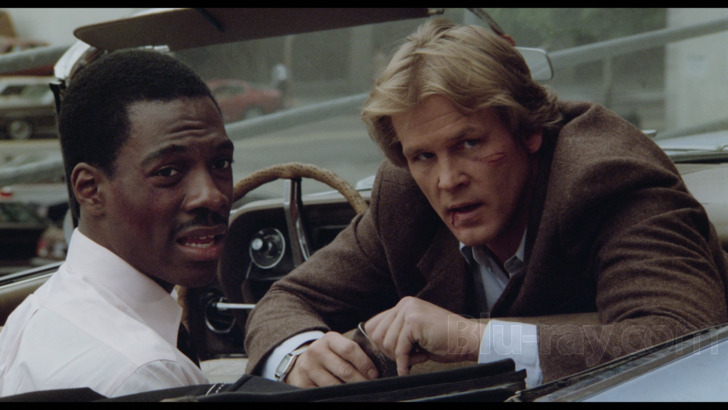
48 Hrs. Blu-ray (Remastered | Paramount Presents #19)

Eddie Murphy kinetically debuts as hustler Reggie Hammond, released from prison for 48 hours under the brutal watch of Detective Jack Cates (Nick Nolte) to hunt for Hammond’s ex-partners, who have gone on a cop-killing spree in San Francisco. The film catapulted Murphy to stardom. It was also the first picture to feature a Saturday Night Live comedian in a raw, crime story and stands as one of the better “buddy cop” pictures ever, though Murphy is really only deputized.

Yes, Murphy is very funny, sometimes side-splittingly so, but he does not treat every scene as an opportunity to do a bit or schtick.  He picks and chooses his moments, trusting in the story directed and mostly written by Walter Hill (The Long Riders). Murphy has one virtuoso scene, when he poses as a cop to roust a redneck bar, but even there, where he puts a knife to a man’s face and tells him, “I’m your worst fu***** nightmare, I’m a ni**** with a badge”, he’s in keeping with the picture’s tough tenor. Nolte’s Cates is brutal, unpleasant and an unrelenting racist, almost shockingly so, given our current advanced ethos, yet, they bond in a manner that feels authentic. Given we’re dealing with tough cops and criminals, the racial dynamic is not off-putting.  It just adds to the tension.

I was also surprised by the gritty brutality of the movie. The body count is high, but rather than explosions and elegant slo-motion, Hill takes more of a Sam Peckinpah approach. The shootings are bloody and awkward, not stylized. And the bad guys – Albert Ganz (James Remar) and Billy Bear (Sonny Landham) – are scary bad.

James Horner’s original music (he’s been nominated 5 times and won for his scoring of Titanic) is apt, a moody mix of jazz and Asian chimes.  Hill also uses San Francisco to his full advantage, mixing the grimy feel of Bullitt and Dirty Harry with a little early 80s glitz.

It has a few weaknesses. Annette O’Toole, for whom I have had my own weakness since Robby Benson’s One on One, is wasted as Nolte’s long-sufferring gal.

And the finale, where Cates and Hammond just “play a hunch.” is a bit lazy.

Still, an uproarious, and assured flick, much more than it seems.


Related image

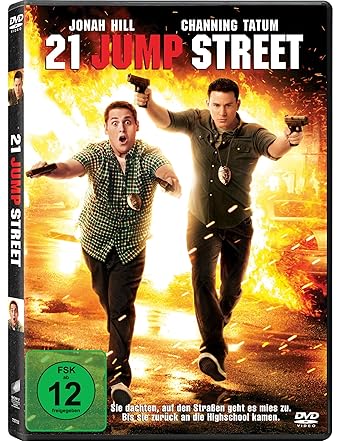
A successful parody of both high school teen flicks and buddy-cop movies (ala’ Hot Fuzz).  A blast of a picture, made better by strong chemistry between Jonah Hill and Channing Tatum.  Hill was the high school geek, Tatum on the top of the social totem pole, but after graduation, they both ended up on the police force, with dreams of car chases, shoot-outs and slo-mo explosions.  Instead, they are assigned as bike patrolmen, and after they screw that up, they are shipped off to the Jump Street division, where their youthful faces land them back in high school, undercover, to break up a drug ring.

So far so good, though not much beyond the formula.  But the material is elevated during their second stint in high school, where Tatum finds himself the geek.  Aggressive jocks, immediate put-downs and a hierarchy are out; tolerance and peace are in; and the main drug dealer (played by James Franco’s brother, Dave, in a very funny, emo/enviro turn) cleaves to the cooler Hill, leaving Tatum as the odd man out.  Hill basks in a high school popularity he always craved, leading to a great exchange where Tatum screams at Hill, “You’re in too deep” after he finds that Hill is filling out college applications in the hopes of matriculating at Berkeley with Franco.

Which brings me to Tatum, who I had unfairly classified as a graduate of the Josh Hartnett school of lobotomized acting.  Indeed, to watch Tatum play Roman period, as he attempted in The Eagle, was cringe-inducing.  But as Clint says, “A man has got to know his limitations.”  Tatum redeems himself and steals this picture with great timing and unexpected sensitivity.  He is also getting very good reviews for Steven Soderbergh’s Magic Mike.

A high school boy (Aaron Johnson, who played a young John Lennon in Nowhere Boy) decides he will simply purchase an outfit and proclaim himself a super hero.  One modest success leads to a knife-in-the-belly and being run over by a car, but he does not lose heart, and returns to the streets with steel-reinforced bones.  Soon, he’s a web-hero, attracting not only the attention of cruel mob boss Frank D’Amico (Mark Strong) and his wannabe son (Christopher Mintz-Plasse) but of the more accomplished super-duo, Big Daddy (Nicholas Cage, doing an Adam West impression), and Hit Girl (Chloë Grace Moretz), Big Daddy’s foul-mouthed, lethal 10 year old daughter.

Funny, clever, and hyper-violent, this is a comic-book movie that engages rather than slams you into a stupor.    Yes, we get some nice, brutal, inspired fight scenes.

But we also get the softer, gentler side of super hero bonding

This is a fun, smart documentary that chronicles the fall of George Lucas in the eyes of his fans and mines their conflicted attitudes towards a man they belove yet revile.  At root, it’s a story about how gods disappoint.

The social impact of Star Wars can be overstated (one fan references Shakespeare), but there is no denying that Lucas’s 1977 film was revolutionary not only in how it changed movie entertainment, but in its creation of a legion of fans dedicated to its ethos.  They just don’t just love Star Wars; they revere it and deem it participatory in their lives.  They wear the outfits, make their own film homages (the clips of these movies are the highlight of the documentary), buy the toys and products and countless DVD releases, and endlessly debate the impact of the film.  And the nature of its creator, who once gave them sun and now provides only darkness.  This goes beyond Spock ears.

The first third of the documentary shows Lucas’s rise from geeky auteur, hostile to the Hollywood machine, to corporate titan, overseeing not just Star Wars but the technical transformation of Hollywood films in general.  And then the fun begins. First, Lucas re-envisions his Star Wars trilogy.  He brightens things up, adds some more incredible effects, and best (or worst, if you’re an acolyte), changes a few scenes.  The ensuing furor is atomic.  Fans are particularly incensed that Lucas changed the character of Han Solo, who in the original picture shot a bounty hunter point blank, but in the “re-envisioning” returned fire only after the bounty hunter shot first (the bounty hunter missed from 2 feet, a failure that makes fans apoplectic).  As one disgruntled fan notes, “It’s as if Martin Scorsese cut out some killing from The Departed because he realized he had an 8 year old son.”

As fun as the collective kvetching is over that change, the roil becomes greater when the fans attack Lucas’s decision to erase the first cut of the trilogy.  I did not know this, but you can’t get a DVD of the original movies.  Lucasfilms even intimates that the original prints are destroyed.  And boy does this make the Star Wars fans nutty.  They point to the hypocrisy of Lucas’s opposition to Ted Turner’s colorization of black-and-white films and say, collectively, “Aha!”  You can almost see Lucas in a dark room, on a throne, wickedly chuckling at their discomfort.

While the outrage over Lucas’s authoritarian control over his original work is pitched, the response to the release of his execrable second set of films is a hilariously bitter pill.  Oh, did these folks want to love those films, having waited sixteen years for them. And their recollections of how they felt when they realized the pictures sucked are almost heartbreaking.  One fan explains that he saw The Phantom Menace over a dozen times hoping he would just get it.

The documentary is really made by the fans who gave the interviews. Their love is pure, their hostility to a Jar Jar Binks poetic, and yet, they all seem to have a good sense as to how ridiculous they look as grown ups incensed, and even enslaved, by George Lucas.

Ridley’s Scott’s prequel to the Alien series fares much better than troubled installments 3 and 4 (which were not directed by Scott).  It does so without reliance on the now famed Alien monster or creation of another “haunted house in space” where the crew is picked off one-by-one.  Instead, Scott’s film opens with an ambitious recreation of the demise of our creators (or, at least, our forefathers).  In 2089, two scientists (Noomi Rapace and Logan Marshall-Green) deduce that disparate human societies with no connection and at different intervals in the world’s history communicated with another species (or is it?) from space.  So off they go, with another crew on an epic journey to discover from whence we came.  A cool Charlize Theron is in charge of the vessel Prometheus, but the ship is helmed by the down-home Idris Elba and it is guided by an android, David (Michael Fassbender).  They find what they are looking for but it is not what they thought, and Alien is born.

For what could have been a ponderous big idea picture, this movie is very tight, and if never quite as horrifying as Scott’s first movie, it is tense, scary and moody.  The feel is enhanced by a brooding, foreboding Marc Streitenfeld score.  Moreover, the characters feel gritty and realistic and each adds nice touches to roles that could otherwise have been stale.  Elba’s Stephen Stills-liking captain of the ship is an old soul; Theron’s corporate master hides a sense of humor; and Fassender, to whom one of the scientists makes a Pinnochio-reference, is half-boy in wonderment and half-efficient, emotionless machine, a worthy addition to the fine line of Alien androids who came before:

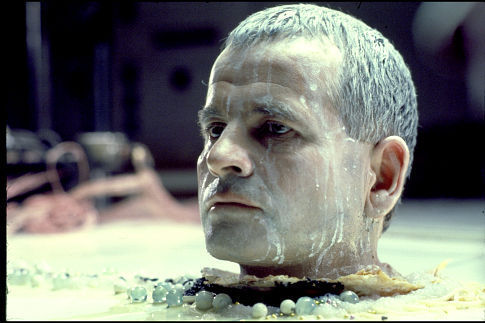
Alien (1979)

Ian Holm

Lance Henriksson

Scott also cleverly borrows from his own Blade Runner in the portrayal of David, who doesn’t possess Rutger Hauer’s maniacal desire to find his creator but does show more than a passing interest in the subject matter.

The script provides some explanation for why we started creating androids who are more than automatons:

Charlie Holloway: David, why are you wearing a suit, man?

David: I beg your pardon?

Charlie Holloway: You don’t breath, remember? So, why wear the suit?

David: I was designed like this, because you people are more comfortable interacting with your own kind. If I didn’t wear the suit, it would defeat the purpose.

Charlie Holloway: Making you guys pretty close, huh?

David: Not too close I hope.      

Scott bites off a little more than he can chew by adding an unnecessary twist at the end, and thereby rushing some scenes that could have been better developed.  It also has a few silly notes, like throwing in Rapace’s inability to get pregnant and having Rapace tell a crewmember he can’t bring a weapon because the mission is scientific . . . and he complies.  Come on!  Doesn’t he know that in space, no one can hear you scream?

Otherwise, it’s a very good picture, enhanced by the 3D.

The Shining (film) - Wikipedia

First things first.  I took my son to see The Shining at the American Film Institute Theater in Silver Spring, Maryland (they are running a Jack Nicholson retrospective).  The theater is ornate and massive and brings back the feel and style of the old movie house.

But not even the hallowed ground of a theater honoring film can persuade people to behave in a respectful fashion during a movie.  We had two fools in the front who found particular dramatic scenes funny and laughed and laughed and laughed . . . and laughed some more.  We also had two couples to our right who presumed if a character wasn’t talking, that was their cue to talk.  Stanley Kubrick films have long stretches of no dialogue.

Going to films is more and more difficult given the crude behavior of movie patrons, who cannot shut th f*** up, are now eating full meals during the show, and are otherwise oblivious to anyone around them.  Worse, those who are quiet, including myself, are often forced to simply accept the noise.  I have interceded a few times.  It has worked less often than not, because if you correct a young person in public, apparently, that is a humiliation too great to endure, and what follows is aggression and louder “I paid my ticket” talking.  Now, I’ve made the film less enjoyable for additional rows.

Okay.  To the movie.  Kubrick’s picture is methodical and creepy,  It opens abruptly with an aerial shot of Jack Torrance (Nicholson) driving for his interview at the Overlook Hotel to an ominous electronic score (think John Carpenter).  Torrance gets the job as the hotel’s winter caretaker, where he esconces his timid wife (Shelly Duvall) and his son (Danny Lloyd), who has the ability to see visions and occasionally communicate with like-talented people (i.e., he “shines”) such as the hotel’s head chef, Scatman Crothers.  Danny’s ability is also telling him that the Overlook Hotel is dangerous, a fact Crothers confirms.  Soon, the hotel insinuates itself into Torrance’s mind, turns him against his family, and he goes berserk.

The film is very scary, often terrifying.  Kubrick gives us the time to get to know the family, and all is not well:  Torrance has had recent problems with drink, injuring Danny in the process.  He is also a condescending prick, which in turn makes his wife more jittery, which in turns makes Torrance angrier and more removed.  With this fodder, the spirits of the hotel work themselves on Nicholson.

The imagery is unforgettable, be it Danny riding his big wheel (tracked by stedicam) through the halls of the Overlook, only to bump into gruesome visions, or the forbidding snow-covered hedge maze, the locale for the final scene.  Lloyd is very good:  he is withdrawn but sweet, trying to deal with a wretched home life and an amazing but confusing gift.  Duvall, whose performance has been criticized as annoying (she was nominated for a Razzie), is, in fact, very annoying, but it is a great performance nonetheless.  She is trying to hold the family together, as Nicholson is trying to destroy it, and her worry feeds his suspicion.  The hotel has to work on something; it has to find an “in” to get to Nicholson, which it does through Duvall, who is nervous and peppy and cloying.  Obviously, she doesn’t deserve to be murdered.  But the spirits of the hotel don’t need to much to convince Nicholson.

The only partial negative is Nicholson.  He’s very good as a man driven to insanity, but the performance has two faults.  First, Nicholson does not show much to recommend him when he has full sanity.  He’s superior and sarcastic and he doesn’t connect with his family.  As such, when he is enticed by the hotel, there’s not much of  struggle there.  He’s ready to fix them up right and there really was no question.  Second, there are too many “Heeeeeeere’s Johnnies” in his performance.  Nicholson goes so over-the-top that he becomes cartoonish.  Still, it’s a minor criticism and presumes the necessity of a struggle for Nicholson’s soul.

Flawless (1999)

An engaging and surprisingly even picture about a simplistic, homophobic ex-NY cop (Robert De Niro) living in the same apartment building as a drag queen (Phillip Seymour Hoffman).  De Niro has a stroke and needs the drag queen’s assistance as a voice coach (she teaches singing) so he can learn to talk again.  This is two fish, different waters.  You’ve seen it.  But through the skills of Hoffman and De Niro, it works really well, and review of the picture allows a meditation on Hoffman.  I remember him as the spoiled rich fink in Scent of a Woman, the unfortunate thief in the remake of The Getaway and the dunce with a badge in Nobody’s Fool.  Even in such small roles, he resonated.  Soon came absolutely indelible and brilliant supporting turns, as the closeted and adoring fan of Dirk Diggler in Boogie Nights and rich visiting playboy Freddie Miles who smells a rat in The Talented Mr. Ripley.  Leads came next, including a best actor Oscar for Capote, but Hoffman is in the club with Duvall and Hackman – he can play the lead, but he’s more often better in support or ensemble, be it the outrageous Lester Bangs in Almost Famous, the chilling priest in Doubt, or the stubborn manager Art Howe in Moneyball.  He’s pitch-perfect and makes everyone around him better.

His role here is actually a very different character for Hoffman.  He’s flamboyant, wildly emotional and central.  These are easy roles to botch, but Hoffman communicates both the external vamp and internal insecure deftly (his hysteria as his boyfriend abuses him is particularly touching).  He’s very moving, and De Niro (who is also good as the disabled grump) does not get in his way.

I cover the first two pictures here: www.filmvetter.com/2012/04/30/paranormal-activityparanormal-activity-2-4-stars/

Nothing new to report, except that installment three is even scarier.  One particular trick of note:  while trying to capture the “ghost” on videotape and cover two rooms, our hero puts a camera on an oscillating fan, so it goes from left to right and back again slowly.  Brilliant.  Everytime you get that vantage point, you’re terrified of what will be in frame.