Archive

4 stars

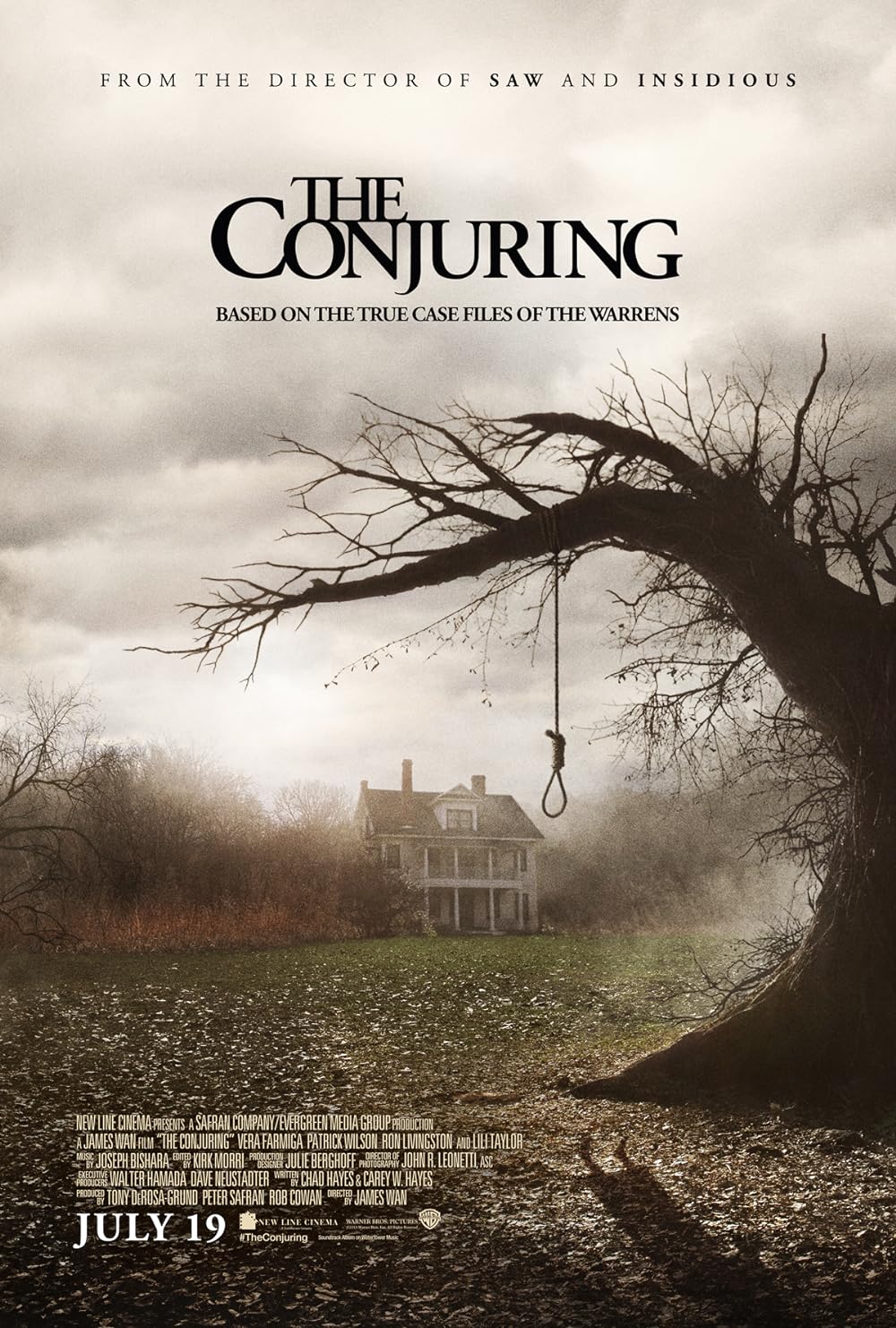
The Conjuring (2013) - IMDb

The plot is simple.

House.  Haunted. Evil involved.

An old-fashioned, creepy mash up of The Amityville Horror and The Exorcist, the film opens with rare restraint, and it remains for the most part intelligent and taut. When it gets going, like director James Wan’s prior, impressive Insidious, it can freak you the hell out.

Two minor criticisms.

While Vera Farmiga (as the medium who, along with her demonologist husband Patrick Wilson, makes a living of studying/expelling ghosts) is very eerie and committed, the actual homeowners (Ron Livingston and Lili Taylor) seem a bit too calm and even dull.  Livingston, of Office Space fame, is really no more than a smirk, a smaller budget’s Ryan Reynolds, and the haunting of his home and terrorizing of his children comes off as humdrum to him.  Wilson is similarly uncommitted, and two characters included for presumably comic relief, a sheriff and student who assist in monitoring the house, make little impression.

The movie also seems rushed.  20 more minutes devoted to uncovering the history behind its malevolence would have been well spent. Instead, Farmiga has its entire history laid out like she Googled it. The movie, however, is set in 1971, when there were no search engines. Not even Ask Jeeves!

Delbert Grady. | Meme Generator

Based on a real house and incident, if not quite a true story.

World War Z Zombies GIF - WorldWarZ Zombies Click GIFs

This is a gripping, dystopian roller coaster ride, intelligent but not dense. Marc Forster, who showed action skill in Quantum of Solace, opens with an enthralling scene.  Brad Pitt, wife Mireille Enos, and two daughters are stuck in downtown Philadelphia traffic as a fast-moving rabies epidemic sweeps the city, and by fast, I mean that people are transformed into frenetic, vicious predators 10 seconds after a bite. Complete societal breakdown follows, but Pitt, who has experience as a U.N. global crisis expert, is extracted and tasked with investigating the source in an effort to combat the epidemic.

There are some ragged connections as Pitt goes from the U.S. to South Korea to Jerusalem to Cardiff, but his journey is packed with thrills and terror. Better, there is none of the preaching and sophistry so typical in modern dystopian films. Screenwriter Matthew Michael Carnahan (State of Play), with an assist from a couple of the writers of Lost, stays focused on moving the story forward and avoiding cliche’, showing no interest in the standard “what have we done?” crapola. I kept waiting for the suits to show, explaining that things just got out of hand when the military tried to weaponize and/or the evil corporation tried to monetize. Thankfully, they did not.

Forster’s judicious use of CGI is also to be commended. While the digital monsters of I Am Legend became less terrifying the more you watched them up close, Forster only uses CGI in broad scope, to show the mass of humanity infected, moving almost as an ant colony. Up close, real people play these very gruesome zombies, and they are frightening.

Finally, the film embodies an “every man for himself” quality that is refreshing and eschews the hackneyed twin of “what have we done?”, the dreaded “what have we become?”  When an 18 wheeler tries to make his escape from Philadelphia at high speed, crushing innocents left and right, Pitt pulls his car into the lane opened up to escape, marveling at his good fortune.  When the authorities, ensconced in a naval ship, believe Pitt has died in his efforts, his family loses their most favored civilian status and are evacuated to the more dangerous site of a refugee camp in Nova Scotia.  This is the moment when a bad screenwriter would have penned Enos’ “how could you?” speech to the chastened authorities.  Instead, she stoically accepts the verdict.

Finally, the set piece, and there are several, are finely drawn.  The scene in the airplane is particularly memorable.

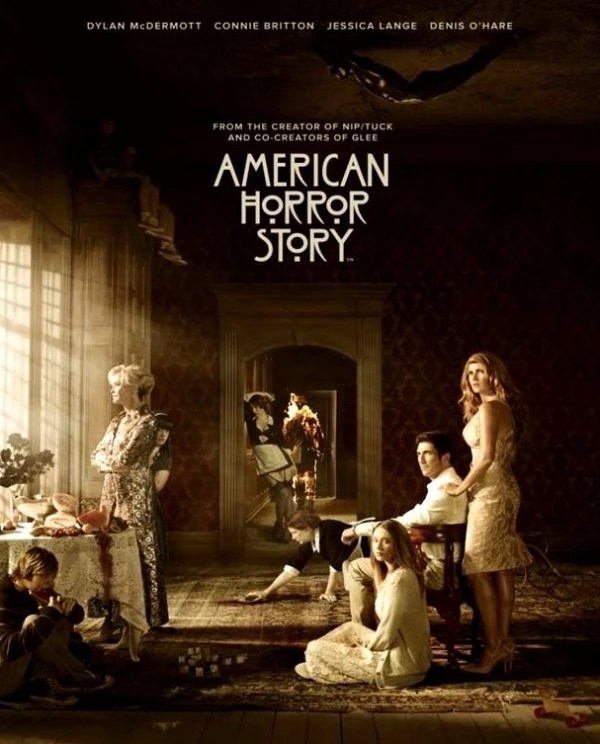
Who would have expected this creepy gem to have come from Ryan Murphy and Brad Falchuk, writers and producers of Glee?   Available on Netflix streaming, this 12 episode ghost story is frightening, well-paced, extremely well-acted and on occasion, darkly funny.

The set-up is familiar. Husband and psychiatrist Dylan McDermott and wife Connie Britton flee Boston for LA with their teenage daughter (Taissa Farmiga) after McDermott’s long-term affair with a younger woman (Kate Mara) is revealed. They, of course, find the perfect home at the perfect price, save for an overbearing neighbor (Jessica Lange) who is more than a little tied to the house. It is soon revealed the home is the resting place of numerous decidedly restless ghosts.  It’s even a stop on an L.A. “Murder House” tour.

The writers overcome the central problem of any haunted house yarn by first emphasizing the financial duress of the inhabitants (they don’t have the resources to live elsewhere) and then, when anyone in their right mind would live in a cardboard box rather than stay, credibly demonstrating that each family member is possessed in different ways by the ghosts who haunt the place.  It sometimes feels like too much of a stretch, and all the balls in the air can be an obvious distraction, but these are nits.  

The series is also graced with a plethora of strong character actors, too many to name, but a few notables include Eric Stonestreet (Modern Family), Zachary Quinto (Star Trek), Frances Conroy (Six Feet Under), Dennis O’Hare (Michael Clayton, True Blood), Morris Chestnut (Boyz n the Hood) and Mara (House of Cards). These characters – tied to the house but with differing agendas – provide the backbone of the series. 

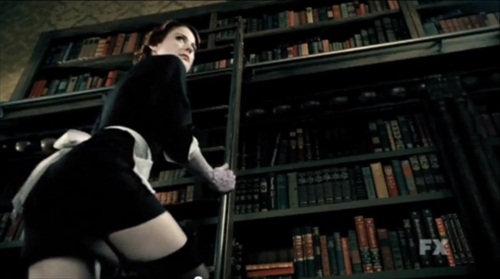
It’s also clever. For example, Frances Conroy plays the housekeeper, and to Britton, she appears as a stern but reliable partner in the bitter war she is having with her husband.

But to McDermott, the housekeeper presents as a much younger Alexandra Breckenridge, posing a larger problem for the straying husband


An example of the perverse humor – when Farmiga catches her father in a compromising position with the cleaning lady, she sees Conroy, not Breckenridge.


This Guillermo del Toro produced ghost story is scary, judiciously using the shock techniques of The Woman in Black, and intriguing, developing an actual mystery behind the horror.  First time director Andres Muschietti is confident, evoking the creepy feel of The Ring, and Jessica Chastain and Nikolaj Coster-Waldau (Jamie Lannister in Game of Thrones) are convincing as the caretakers of two girls found abandoned in a Virginia cabin 5 years after their father (Coster-Waldau’s brother) absconded with them and disappeared. Upon discovery, it turns out the girls have been adopted by a new, more sinister force. A little more patience and exposition prior to the gripping finale, and less of a CGI bonanza during that finale, could have made this a horror classic. As it is, it’s pretty damn good.

Was John Wayne being an old Green Beret stick-in-the-mud when, after seeing High Plains Drifter, he wrote to its director and star Clint Eastwood, “This isn’t what the West was all about. That isn’t the American people who settled this country”?

Wayne was never a lover of nuance, and he had little patience for depicting the darker side of the American psyche, as is evident from his evaluation of another film: “High Noon was the most un-American thing I have ever seen in my whole life. The last thing in the picture is ol’ Coop [Gary Cooper] putting the United States marshal’s badge under his foot and stepping on it. I’ll never regret having run [screenwriter Carl Foreman] out of this country.”

Eastwood second directorial effort was released in 1973, and he wasn’t interested in Wayne’s myth.  It was a time of callous selfishness and a vicious appraisal of the institutions so revered by Wayne, hardly the environment for an uplifting Western about the strong stock of the frontier.

Eastwood’s story of a drifter returning incognito to the town that ran him out via a brutal whipping is assured (he was clearly taking mental notes when directed by Sergio Leone and Don Siegel with this bizarre, even trippy revenge flick).  It is also supremely cynical.  Nearly everyone in the town is guilty of either directing the whipping or standing by when it happened, frauds and cowards all, and these villains unwittingly give Eastwood a run of the place so he’ll protect them from the very same thugs (newly released from prison) the town set on Eastwood. Eastwood enjoys the power, as well as sticking it to townsfolk for their hypocrisy, per this exchange with a preacher upbraiding Eastwood for evicting people from the town hotel:

PREACHER
You can’t turn all these people out into the night. It is inhuman, brother. Inhuman!

EASTWOOD
I’m not your brother.

PREACHER
We are all brothers in the eyes of God.

EASTWOOD
All these people, are they your sisters and brothers?

PREACHER
They most certainly are!

EASTWOOD
Then you won’t mind if they stay at your place, will ya?

PREACHER
All right, folks, let’s go. Put your bags here. Friends, don’t worry. We shall find haven for you in our own homes… and it won’t cost you one cent more than regular hotel rates.

But let’s not dismiss that old fuddy duddy Wayne out of hand.  High Plains Drifter is also groundbreaking in a different, uglier way. Eastwood’s character rapes a woman in the first 15 minutes of the film, yet his status as the anti-hero is none the worse for wear. While she was a complicit bystander in his whipping, even cheering, when she tries to shoot Eastwood (and misses), he asks, “I wonder why it took her so long to get mad?” to which a character replies, “Because maybe you didn’t go back for more.”

Compare and contrast Wayne: “I want to play a real man in all my films, and I define manhood simply: men should be tough, fair, and courageous, never petty, never looking for a fight, but never backing down from one either” and you can better understand his distaste.

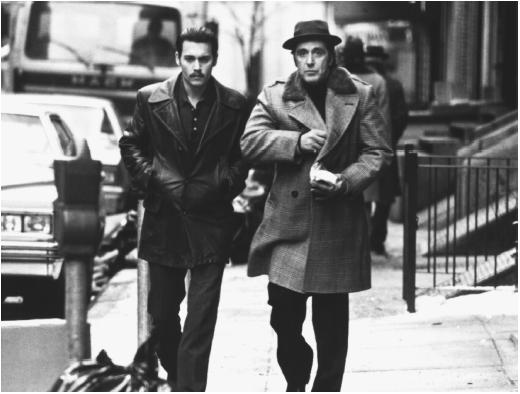
A year or so before The Sopranos, Mike Newell’s Donnie Brasco offered a glimpse of the series with this sharp, “deep cover” mob flick, alternatively brutal and funny, and at the end, touching. Donnie Brasco (Johnny Depp) is actually FBI agent Joe Pistone, who goes undercover to break a mob crew led by Michael Madsen. His entree is provided by a lower-level made guy, Lefty (Al Pacino), who vouches for Donnie, shows him the ropes, and, as Donnie loses his moorings and allegiances (to both the FBI and his suffering wife, Anne Heche), becomes a father figure.

Paul Attanasio’s (Quiz Show, Disclosure, and several episodes of Homicide: Life on the Street) script is tight and playful. We get harrowing scenes where Donnie is conscripted to dispose of a body via hacksaw or merely nearly found out:

These scenes are followed by amusing vignettes of what mobsters do on vacation in Miami (water slides, burying colleagues in sand, bad tennis) or the everyday humdrum of the criminal life, stealing boxes of steak knives or parking meters.  Attanasio even includes a wry stab at marriage counseling between Depp and Heche. David Chase would do the same thing for Tony and Carmella Soprano a few years latter, to similar tragicomic effect.

As Donnie becomes enmeshed in his crew, the audience becomes invested in their survival, if not from the FBI, from rival mob crews. Depp sells this kinship very effectively. This was one of his first major dramatic roles and he shows a depth and darkness that is highlighted by Heche’s increasing frustration and anger. Tempering both performances is a rare restrained turn by Pacino, who becomes Donnie’s family. It is always a treat to see an older Pacino performance that shelves histrionics.

There are a few weaknesses. The Heche-Depp marriage, rocky as it is, seems too indomitable for reality, and Depp’s introduction into the crew seems a tad effortless. But this is a picture every bit as strong as the best of The Sopranos episodes.

Detropia on iTunes
This documentary doesn’t chronicle the decline of Detroit so much as provide a pastiche of the city’s current plight through the eyes of union workers, street folks, a bar owner, a video blogger, and various other denizens. While there is a faint whiff of class warfare, mainly dramatized by juxtaposing the opulent Detroit opera house (subsidized by the auto companies) with the rundown bleakness of the surrounding area, the thrust of the documentary is visual rather than thematic or political. The regular haunts and isolated neighborhoods are shot in extended, mournful stretches, the people are captured reminiscing in their natural element, and the depiction of the old abandoned structural dinosaurs of the city evokes dystopian films and the work of Yves Marchand and Romain Meffre.

Tim Burton hasn’t declined so much as remained spotty.  Last year’s Frankenweenie was in his animated wheelhouse, but his two previous films were the excessive and dull Alice in Wonderland and the truly awful and unfunny Dark Shadows.  Before those films, however, was Burton’s first live musical, Sweeney Todd: The Demon Barber of Fleet Street, a rich, dark rendition of the Stephen Sondheim stage musical.  Burton maintains the macabre edge of the play, infuses it with his trademark visual trickery, but wisely doesn’t screw with its heart, an entire story mostly sung, rarely spoken.

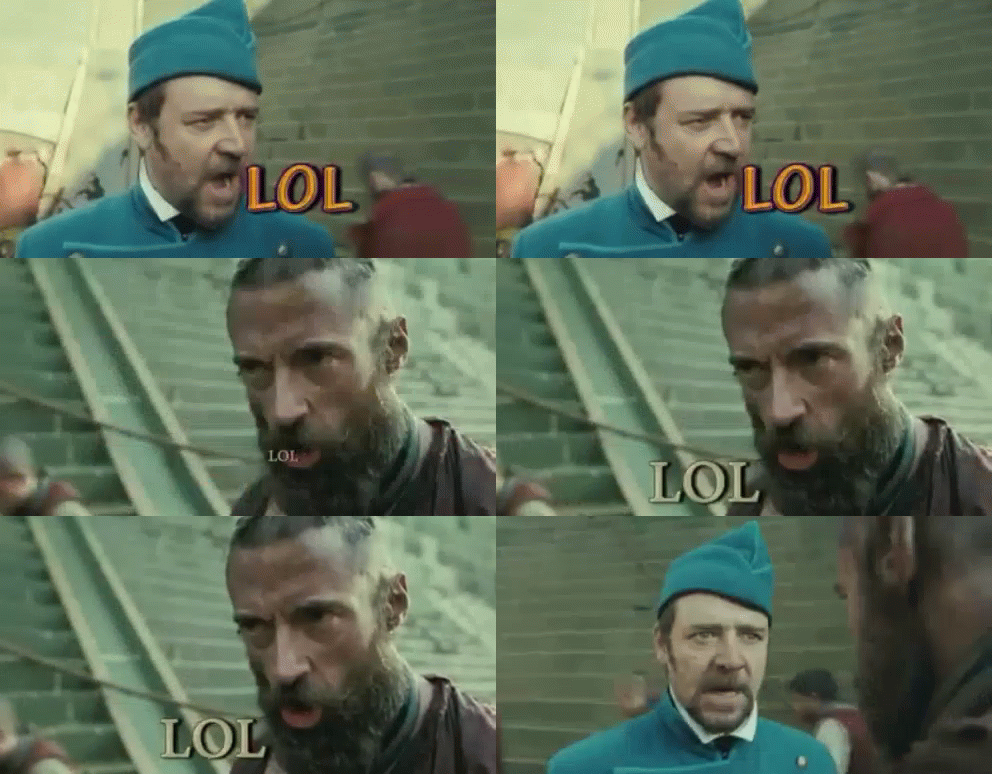
Johnny Depp and Burton’s wife, Helena Bonham Carter, are not great singers, but they are great actor/singers (Depp took singing lessons and was nominated for Best Actor), a feat Russell Crowe could not accomplish in Les Miserables, as is evident in “My Friends.”

Les Miserables Lol GIF - Les Miserables LOL Laughing Out Loud - Discover &  Share GIFs

Speaking of Les Miserables, Depp and Bonham Carter are quite good, but they need merely convey anger, sarcasm, and bloodlust. If I’m going to knock Crowe, I have to laud Anne Hathaway and Hugh Jackman whose first numbers, sung live on set (using live piano accompaniments played through earpieces), are perhaps the most moving in musical film history.

Depp and Bonham Carter are ably supported by a moving Edward Sanders as Tobias Ragg and a hilarious Sasha Baron Cohen as the competing barber, Pirelli.

One nit is the unnecessary bloodiness of the throat cutting, which was accomplished with a mere splash of red in the stage play. It’s discordant. Another is inherent in the play, which is so dark as to be dispiriting.

Frank Langella lives alone in the country a few hours from New York City.  He is slowly succumbing to Alzheimer’s, functional but slipping, and at first, appears to be little more than a forgetful, petty thief of decorative soaps sold in the town’s gift shop.  When his son (James Marsden) brings him a robot for company and guidance, we learn that Langella was once a second story burglar who did two stints in prison.  He loathes the robot until he learns it has no conscience.  A friendship develops, and soon, the robot is acting as his accomplice in a jewel heist.

The movie is clever, often touching, and a bit subversive.  There is a hilarious section where Langella’s anti-robot daughter (Liv Tyler) visits.  Horrified at her father’s reliance on the robot, she turns it off, only to surreptitiously turn it on when she wants the house cleaned.

Though the film is set in the not too distant future, the credits are accompanied by clips of the work robots are currently doing (or being designed to do) for humans, and the future is now.

Co-written by Jay Baruchel (of Knocked Up and Tropic Thunder) and Evan Goldberg (writer of Superbad and Pineapple Express), this comedy has a Judd Apatow feel and a direct lineage to Slap Shot. Seann William Scott (Doug Glatt) plays a dim but lovable lunk in Canada who is recruited as a goon by the Halifax franchise after he dismantles an out-of-control hockey player who jumped into the stands. He soon finds his purpose, his love, and his destiny, in the form of the greatest enforcer of all, Ross Rhea (Liev Schreiber).  In the process, he coalesces a fractured club.

This is a clever meld of sports schmaltz and sharp, crude comedy, unfairly overlooked. Scott is supremely disciplined in playing a sweet dolt. We get none of his smirk from the American Pie movies, which makes his elevation from the ranks of security guard and bouncer to hockey hero touching and sweet. When his love interest (Allison Pill) runs up to him crying after breaking up with her boyfriend, he asks “Did you just see Rudy?” and you believe the question is sincere. When Pill, a hockey player groupie, tells him, “You make me wanna stop sleeping with a bunch of guys,” he replies, “That’s the nicest thing anyone’s ever said to me” and it seems so.

The hockey itself is not particularly realistic but, like Slap Shot, director Michael Dowse handles the speed, fluidity and violence of the game well and largely for comedic effect.  Goldberg and Baruchel even include their own version of the Hansen brothers, two Russian jokesters who plague the team’s insecure goalie.

Great fun.