Archive

4 stars

Tim Burton hasn’t declined so much as remained spotty.  Last year’s Frankenweenie was in his animated wheelhouse, but his two previous films were the excessive and dull Alice in Wonderland and the truly awful and unfunny Dark Shadows.  Before those films, however, was Burton’s first live musical, Sweeney Todd: The Demon Barber of Fleet Street, a rich, dark rendition of the Stephen Sondheim stage musical.  Burton maintains the macabre edge of the play, infuses it with his trademark visual trickery, but wisely doesn’t screw with its heart, an entire story mostly sung, rarely spoken.

Johnny Depp and Burton’s wife, Helena Bonham Carter, are not great singers, but they are great actor/singers (Depp took singing lessons and was nominated for Best Actor), a feat Russell Crowe could not accomplish in Les Miserables, as is evident in “My Friends.”

Les Miserables Lol GIF - Les Miserables LOL Laughing Out Loud - Discover &  Share GIFs

Speaking of Les Miserables, Depp and Bonham Carter are quite good, but they need merely convey anger, sarcasm, and bloodlust. If I’m going to knock Crowe, I have to laud Anne Hathaway and Hugh Jackman whose first numbers, sung live on set (using live piano accompaniments played through earpieces), are perhaps the most moving in musical film history.

Depp and Bonham Carter are ably supported by a moving Edward Sanders as Tobias Ragg and a hilarious Sasha Baron Cohen as the competing barber, Pirelli.

One nit is the unnecessary bloodiness of the throat cutting, which was accomplished with a mere splash of red in the stage play. It’s discordant. Another is inherent in the play, which is so dark as to be dispiriting.

Frank Langella lives alone in the country a few hours from New York City.  He is slowly succumbing to Alzheimer’s, functional but slipping, and at first, appears to be little more than a forgetful, petty thief of decorative soaps sold in the town’s gift shop.  When his son (James Marsden) brings him a robot for company and guidance, we learn that Langella was once a second story burglar who did two stints in prison.  He loathes the robot until he learns it has no conscience.  A friendship develops, and soon, the robot is acting as his accomplice in a jewel heist.

The movie is clever, often touching, and a bit subversive.  There is a hilarious section where Langella’s anti-robot daughter (Liv Tyler) visits.  Horrified at her father’s reliance on the robot, she turns it off, only to surreptitiously turn it on when she wants the house cleaned.

Though the film is set in the not too distant future, the credits are accompanied by clips of the work robots are currently doing (or being designed to do) for humans, and the future is now.

Co-written by Jay Baruchel (of Knocked Up and Tropic Thunder) and Evan Goldberg (writer of Superbad and Pineapple Express), this comedy has a Judd Apatow feel and a direct lineage to Slap Shot. Seann William Scott (Doug Glatt) plays a dim but lovable lunk in Canada who is recruited as a goon by the Halifax franchise after he dismantles an out-of-control hockey player who jumped into the stands. He soon finds his purpose, his love, and his destiny, in the form of the greatest enforcer of all, Ross Rhea (Liev Schreiber).  In the process, he coalesces a fractured club.

This is a clever meld of sports schmaltz and sharp, crude comedy, unfairly overlooked. Scott is supremely disciplined in playing a sweet dolt. We get none of his smirk from the American Pie movies, which makes his elevation from the ranks of security guard and bouncer to hockey hero touching and sweet. When his love interest (Allison Pill) runs up to him crying after breaking up with her boyfriend, he asks “Did you just see Rudy?” and you believe the question is sincere. When Pill, a hockey player groupie, tells him, “You make me wanna stop sleeping with a bunch of guys,” he replies, “That’s the nicest thing anyone’s ever said to me” and it seems so.

The hockey itself is not particularly realistic but, like Slap Shot, director Michael Dowse handles the speed, fluidity and violence of the game well and largely for comedic effect.  Goldberg and Baruchel even include their own version of the Hansen brothers, two Russian jokesters who plague the team’s insecure goalie.

Great fun.


The exploration of the Tarantino oeuvre ended last night as me and the boy watched Tarantino’s opus (I will not subject my son to Death Proof from Grindhouse or Tarantino’s contribution to Four Rooms unless he’s really bad). Pulp Fiction is audacious in its break with continuity and vibrant in dialogue.  The film is essentially a series of riffs (and nobody riffs better than Samuel Jackson and Christopher Walken) or two person sketches. A stunning follow-up to Reservoir Dogs, the movie is a pop culture totem, demonstrating Tarantino’s love for kitsch as well as his sharp ear for a modern, urban, tough guy patter, Spillane-meets-Quisp.

Almost all of the performances are brilliant.  I’ve criticized Tarantino’s reclamation projects, but his insistence on JohnTravolta (over Daniel Day Lewis) was exactly right.  In the words of Tarantino’s agent, at the time, “John Travolta was at that time as cold as they get.  He was less than zero.” But Tarantino would not budge, and as hit man/enforcer Vincent Vega, Travolta is just the right amount of cool and introspection to Jackson’s ferocity. When the boss’s wife (Uma Thurman) mistakes his heroin for coke and overdoses, Travolta snaps out of his own drug-induced laze and, in one of many comic but harrowing scenes, becomes electric. The performance is artful, it resulted in an Academy Award nomination, and it resurrected his career.

If there is a criticism, it is of one vignette, after Jackson and Travolta accidentally shoot a man’s head off in their car. They need to get off the street, and end up at the home of one . . . Quentin Tarantino. Even the introduction of “The Wolf” (Harvey Keitel), a Mr. Fix-It who arrives to assist the stranded duo, cannot save this halting sequence or Tarantino’s amateurish acting. Rank has its privileges, but this particular hubris was detrimental.

But that’s a minor bump in the road in this highly engaging and original flick.  Related — The Pulp Fiction Oral History:  Uma Thurman, Quentin Tarantino, and John Travolta Retrace the Movie’s Making.

The first half of Stanley Kubrick’s Full Metal Jacket, based on Gustav Hasford’s novel The Short Timers, is flawless. Marine privates Joker (Matthew Modine), Leonard Lawrence (Vincent D’Onfrio) and others are trained with their class at Parris Island by their Lord and Master, Marine Gunnery Sergeant Hartmann (R. Lee. Ermey). Kubrick depicts the indoctrination and transformation of Marines in a manner that is tragi-comic, lyrical and, at the end of training, deadly. Penned by Kubrick, Hasford, and Michael Herr (Dispatches), the dialogue has the stamp of authenticity (Hasford and Ermey were Marines and Ermey, first hired as a technical advisor, had actually been a drill sergeant at Parris Island during the Vietnam war). The process of creating cohesion and toughness is brutal and efficient, and its unsparing nature produces effective warriors, but it also damages the fragile D’Onofrio.

The second half opens with a concise commentary on the problems of an occupying army, memorably introduced by the sultry voice of Nancy Sinatra. Despite such promise, the film becomes less engaging. Modine is sent to Vietnam as a correspondent for Star and Stripes and he wants desperately to get in “the shit.” He does, during the Tet Offensive, and what he sees is the hard killers from Parris, broken, unmoored and wreaking havoc. The film plays out as a series of barely connected set pieces, which is in stark contrast to the single-mindedness of the first half.

I strongly recommend Matthew Modine’s diary and Herr’s Vanity Fair piece on Kubrick.

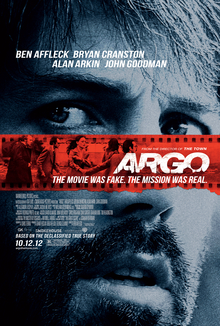
Argo (2012 film) - Wikipedia

The pace is brisk, the acting for the most part superb, the feel genuine, and the final act white-knuckle. Ben Affleck’s tale of the clandestine evacuation of 6 Americans hiding in Tehran after the storming of the American embassy is almost as incredible as the actor’s improbable rise as a director after a long plummet from the heights of A list actor.

What is true is that 6 Americans made it out of the U.S. embassy into the hands of Canadian embassy personnel and that a fake sci-fi movie was created as cover for their exit posing as the film crew. That’s about the sum total of what is accurate in this movie.  Affleck takes this nifty premise and constructs a gripping yarn around it, one that is lessened only a little by Affleck’s leaden acting as CIA operative Tony Mendez and a shopworn and unnecessary theme built around his family woes. Affleck’s handling of the storming of the embassy (which was very accurate) and the tense escape via the airport (a near complete concoction) is assured, and the creation of an Alan Arkin Hollywood producer for comic effect is savvy.

After Gone Baby Gone, The Town and this film, Affleck is a top 5 director. Imagine that.

A 6 year old girl, Hushpuppy (Quvenzhané Wallis) lives in functional squalor in a poor, bayou fishing community – The Bathtub – cut off by a levee in Louisiana. What passes for the comminity’s teacher tells her that one day, the ice caps will melt, the Bathtub will be swamped by water, and prehistoric beasts will roam the earth. As a storm comes, most of the inhabitants evacuate, except for Hushpuppy, her disturbed father, and some boozing stragglers and abandoned kids. They create a floating bar, a drunken, drifting haven, but their world is dying around them.

This is a mystical, beautiful picture, told primarily through the eyes of the girl, who speaks to her dead mother and imagines beasts marauding her world. The breakdown of her surroundngs after the flood, the fevers of her own imagination, and her introduction to civilization (they are forcibly evacuated) is gorgeous and moving and Wallis’s fierce maturity is captivating.

This is a real life fable (“a passionate and unruly explosion of Americana”, per A.O. Scott) with barely a semblance of a plot, so beware – it does meander. But it is rightly nominated for a Best Picture Oscar, as is Wallis for Best Actress. Her confident, self-possessed performance is one of the strongest child turns I’ve ever seen. The non professional actor Dwight Henry (he’s a New Orleans baker who read for the part during down time and reluctantly took it because he was starting a new business) is also noteworthy, giving a raw, jarring performance. Filmed on location, the film’s rendering of nature reminded me of Terence Malick, but unlike Malick, first- time director Benh Zeitlin connects with actors as well as his surroundings. I’ve never seen a film quite like it.

Ted Movie Review – New Bedford Guide

For better or worse, Seth MacFarlane is our Academy Award host this year. It almost has to be better given Billy Crystal’s snooze-inducing Borscht Belt performance last year and the train wreck that was stoner James Franco and clueless ingenue Anne Hathaway the year before. MacFarlane is the force behind numerous animated television shows, the best of which is the occasionally funny but mainly awful Family Guy, an outlet for easy shots and pro forma crudity still outclassed by the tired old Simpsons and never, ever near the same class as the brilliant South Park. So, I’m no fan. But I am hopeful. MacFarlane is a gifted mimic and I watched him on a recent Saturday Night Live. He was surprisingly deft and his impression of swimmer Ryan Lochte was nothing short of brilliant.

Ted is MacFarlane’s creation, a live teddy bear wished for by a young Mark Wahlberg. Wahlberg is all grown up and he and Ted remain roomies, even as Wahlberg hits year four with his luminous girlfriend, Mila Kunis. Kunis wants commitment and maturity, Ted and Wahlberg smoke dope all day and watch TV, and things come to a head when, after an anniversary dinner, the live couple come home to find Ted with a passel of hookers.

There are a few clunker lines, but for the most part, this is a very funny, very crude (Ted’s come-on to a grocery store checker is waaaaay over the top) and surprisingly sweet story of a boy and his childhood pal. I say “surprisingly” because I would have expected MacFarlane to be a little more daring. He comes close, such as a scene in the end where, after Ted has gone through a harrowing ordeal and appears to have died, he wakes up but appears to be impaired. Is Ted going to come back as a mentally disabled stuffed bear?

That’s MacFarlane – and Ted – in a nutshell.

Hitman Joseph Gordon-Levitt seemingly has the simplest job in the world.  A crime syndicate in the future sends bound targets back in time to a field, where “loopers” like Gordon-Levitt kill and dispose of them.  The loopers get paid in silver until one day, an older version of a looper is sent back to be killed by his younger self.  Strapped to that older version is a pile of gold, the final reward.  When the older Gordon-Levitt is sent back, he is Bruce Willis, and not unexpectedly, Willis thwarts his own execution, and the fun begins.

A blast of a movie, and upon scrutiny, for a time travel film, it does pretty well from a logic standpoint (though some disagree). What matters, however, is that the logic holds up well enough to allow you to be carried away by writer/director Rian Johnson’s fresh and intricate script and his nifty vision of two futures.  The Terminator, for example, was so riveting, you didn’t have the chance to think, “Hey.  Why didn’t Skynet send the Terminator back in time to the hospital where John Connor was born?  Aren’t babies easier to track down and execute?”

Gordon-Levitt is uncanny as a young Willis (they’ve even altered the contours of his face to cement paternity), Willis is gruff Willis, and Emily Blunt (the Brit fashionista assistant in The Devil Wears Prada) is surprisingly convincing in a tough gal role.  Jeff Daniels is a good choice as an off-beat heavy, and Noah Seegan and Garret Dillahunt impress in small roles as the men tasked to hunt Gordon-Levitt and Willis down.  The standout performance, however, belongs to child actor Pierce Gagnon, who manages to be terrifying and then sympathetic.

Johnson’s 2005 noir high California school flick – Brick – was similarly inventive.  Johnson is not exactly prolifiic, but if Looper is the norm, I can wait.

Christopher Nolan’s last entry to his Batman trilogy closes the story out in satisfying fashion and even leaves room for the rise of Robin (Joseph Gordon-Levitt) should Warner Brothers need a fiscal stimulus in the future. The story is the same as the prior two pictures. A reluctant Bruce Wayne/Batman (Christian Bale) is drawn back into the fray when his beloved Gotham City is threatened. This time, the threat comes from Bane (Tom Hardy), a muscular beast who wears a mask not unlike a greyhound. Much like The Joker, Bane seeks to test the mettle and morals of Gotham.  Bane’s appeal is Occupy Wall Street on steroids. The city is shut down and isolated by a moving nuclear device controlled by Bane, and as its time runs out, the new masters judge the rich and powerful (the villain Scarecrow plays Robespierre) while Bane’s henchmen and at least a certain portion of the citizenry pillage their apartments.

This is actually the most interesting part of the movie, begging the question, “Why does Batman dig this fickle town so much?” Unfortunately, less time is devoted to the occupation’s class warfare and the internal de-evolution of Gotham and too much to Batman’s angst, Alfred’s (Michael Caine) regret that Bruce did not have a normal life, and some corporate skullduggery that is . . . eh. The movie is also a bit too solemn. I applaud the darker, starker vision of Batman and his story, but we are, in the end, talking about a man who dresses up like a bat. With the exception of a few smart quips from Catwoman (a lithe Ann Hathaway), the movie is largely humorless.

Still, the action is first-rate and the big finish does not disappoint.