Melancholy, compelling and lyrical, one of the best films of the year, whether you like folk music or not.
Davis, a folk singer in 1961 New York City, is in crisis, his aspirations undermined by his uncomfortable and unwilling status as a solo act, a less than capable manager, and his own selfishness. The film is his journey to the realization that it is not to be (not that he lacks talent) just at the advent of Dylan. As club owner F. Murray Abraham tells him after an audition that is heartfelt, impressive and inapt, “I don’t see a lot of money here.” Davis made his way to Abraham via a harrowing trip to Chicago where he not only abandons something he has come to love, but may well have killed it. During the trip, he is harangued by a junkie jazz musician (John Goodman) whose takedown of folk as elemental is just another dagger in Davis’s ambition. Soon, Davis becomes too weary to pretend he can be successful, to flop on yet another couch, or to play local celebrity for well-meaning patrons on the upper West side.
The Coen brothers possess an attention to detail that serves the film exceedingly well. Their depiction of 1961 Greenwich Village and the folk scene feels just right, and the travails of Davis, a local Simon who has split with his Garfunkel and become more gritty, take the viewer back in time. Like David Chase’s Not Fade Away, the milieu is drab, smoky and intimate, and the music is at the forefront, but nostalgia is replaced by an elegiac feel and the Coen brothers’ signature dark humor. This is not a film about an unheralded legend, or something as corny as Chase’s paen to rock, but about art as work.
As for Davis, Oscar Isaac is anything but a character you champion. But he can sing and play and he embodies the sadness of having just enough talent. He is also loosely based on a real folkie, Dave Van Ronk.
If there is a weakness, it is Carey Mulligan as Davis’s bitter lover. She is so angry and one-note you feel pity for Davis when you should not. As she gets older, Mulligan is also strangely morphing into a replica of Katie Holmes.
Jack Nicholson and Helen Hunt won Oscars in this James L. Brooks comedy about a cantankerous romance writer with OCD (Nicholson) and a worn-out, single mother waitress (Hunt) who meticulously serves him at the only Manhattan diner at which he will eat. Nicholson is a holy terror, complaining “there are Jews at my table” when it is occupied. At home, he is no better, throwing the dog of his gay artist neighbor (Greg Kinnear, who won a best supporting actor Oscar) down the trash chute. But Nicholson is soon drawn into the world he loathes out of necessity. Hunt has to leave her job because of the health of her son, and Kinnear is beaten into a wheelchair by local thugs, which leaves Nicholson to take care of his dog. The man has to eat, and he bonds totally with the pooch, so soon, he is arranging for medical treatment for Hunt’s child and acting as support for Kinnear. In the process, he and Hunt begin a relationship that is halting at best.
This picture can be riotously funny, and Nicholson gets all the good lines, including my favorite.
If I have a problem with the movie, it is Hunt’s character. Her harried waitress is overbearing, self-pitying and often bullying, and her demand for control is every bit as off-putting as Nicholson’s knee-jerk rudeness and his fear of cracks on the sidewalk. Yet Brooks denies us any judgment of her – she is presented as plagued, but somehow noble. Mind you, Hunt’s performance is excellent, but her character is unpleasant without the benefit of making me laugh, and my teeth are always set on edge during her scenes.
A fitting choice on the 50th anniversary of President Kennedy’s assassination, Parkland is a sober, gripping recreation of that event through the eyes of his Secret Service detail, the FBI office in Dallas, the medical staff at Parkland Hospital, Abraham Zapruder and Oswald’s family. It is hard to achieve verisimilitude on such a well known event, but director Peter Landesman does just that in his handling of detail. It seems unbelievable that the Secret Service would entrust the 8mm film shot by Zapruder to his care even as they desperately sought local facilities to develop the film, but it was his property, that’s exactly what they did, and the discussions over the disposition of the footage are fascinating. There is also an incredible frenzied argument between the Dallas medical examiner and the Secret Service staff over control of the body, which Landesman handles without judgment, and while it just seems incredible that Vice President Johnson is walled off in a hospital file room behind a barricade of guns while the medical staff works on the president, that too is a true fact not oft reported.
These touches are enhanced by determined performances from Billy Bob Thornton, Paul Giamatti, Colin Hanks, Zach Effron, Marcia Gay Harden, Mark Duplass and others. The scene where Kennedy’s aides and the Secret Service have to remove seats from the plane and jam the casket into the passenger area is particularly and deeply affecting.
The primary criticism of this film is that it lacks cohesion, that it somehow didn’t communicate something broader. Actually, that was its strength. The characters do not strive to communicate anything more than having to deal with a horrific event as best they can, and Landesman focuses on their plight, not on a deeper meaning to the event. The assassination itself is enough to provide the context, and in an era when each of these bit players in a national trauma would likely be on cable news within minutes, the self-restraint of the picture underscores the self-restraint of the times.
The closest I came to smelling Hollywood was when they wheeled Oswald into the same emergency room as Kennedy and the senior nurse pushed him to another, saying, “He’s not going to live or die in here.” It was artistic license, but it was appropriately chosen.
A minor nit – Texas Governor John Connally, also struck by rifle fire, was taken to Parkland as well, and it would have been interesting to have covered even in a small way his treatment while the hospital staff worked so desperately on Kennedy.
Alfonso Cuaron’s first feature since 2006 (Children of Men) is both a traditional, seat-of-your-pants thriller and a meditation on isolation and impending death. In the latter category, it more than succeeds. I saw it at an IMAX theater in 3D, and in an era of distraction, I’ve never seen such rapt attention given a film. The stillness of space transported the theater, and understandably so. The visuals are jaw-dropping, and Cuaron depicts space in such a unique manner, both expansive and claustrophobic, the viewer feels lost and vulnerable in the great unknown. At the end, the audience breathed a collective sigh of relief, satisfied but a little antsy to get out on the street. For once, the technological wizardry of Hollywood was employed in sync with the other elements of a film, rather than as it primary recommendation.
Now, I am sure even a lowly NASA intern might look at the technical specifics of the plot and chortle. Astronauts Sandra Bullock and George Clooney are working on a space station when debris from a destroyed satellite not only rips through their command but through near every satellite and space station in a line, as if all were posted on the same space highway. The catastrophe leaves them dislocated, and the only way back home is to propel themselves from the U.S. station to a Russiain one to a Chinese one, improvising along the way. Interestingly, of all the leaps the audience has to take, I was most confident you can’t use a fire extinguisher as a jet pack, but dammit if Bullock didn’t do just that, it seemed perfectly plausible while I was watching it, and it is “theoretically possible“. Regardless, niggling about what could and could not happen in real life is an indicator that you should have seen Captain Phillips.
If I have a criticism, it is on the meditation aspect, and even then, it is minor. Not that the film wasn’t well-written. Bullock’s journey from helpless to frantic to resigned to resistant is compelling, and she has collected some gravitas as she’s aged, transforming from spunky to flinty. Clooney, however, is badly miscast. His wisecracking, country music listening solid leader is formulaic, and he communicates a sly grin in even the most dire of circumstances. You need more than a really strong turn as Dennis Quaid in the role.
Still, at 90 minutes, the film doesn’t dawdle, and as solely a visceral joy, it’s one of the best pictures of the year.
Guillermo del Toro’s fairy tale is a rebuke to the taming of the Brothers Grimm. His story of a young girl, Ofelia, is set at the tail end of the Spanish Civil War. She has just been brought to the camp of her new father, Nationalist fascist Captain Vidal, by her pregnant mother. The former is a sadistic, obsessive-compulsive, suicidal and the latter is simply desperate to have found a protector in the new Spain. Ofelia escapes to the nearby woods of Vidal’s headquarters, and a world of faeries, fauns and monsters who give her arduous, often terrifying tasks that offer her majesty in a fairy tale land.
Unlike del Toro’s The Devil’s Backbone, the films’s forerunner, the war makes a more pronounced, visceral appearance. Vidal is cartoonishly vicious, obsessed with the birth of his son and a new Spain, bent on torture and extermination not just of his enemies, but of those who would infect the future. It borders overkill, but with with half of the deaths in the war attributed to executions and murder of the defenseless, the depiction is apt. The fate of Vidal’s son is del Toro’s rebuttal.
The film is visually stunning (it won Oscars for art direction, cinematography and makeup) and movingly juxtaposes the brutality of the war with Ofelia’s hidden place. But del Toro doesn’t make Ofelia’s choice easy. Her fantasy world can be every bit as treacherous and horrifying as the war she seeks to escape. In particular, Pale Man, who guards the quarry of Ofelia’s third task, is one of film’s most frightening visions (and has a gait similar to that of Mama, the spook in del Toro’s last film).
Joseph Gordon-Levitt directed, wrote and stars in this surprising romantic comedy about a New Jersey working class lothario who prides himself on an ability to bed the most beautiful girls at the clubs (the “dimes”) but maintains a more personal, lasting relationship with on-line porn. When the dimiest of dimes, Scarlett Johannson, comes between Levitt and his smut, he is forced to make a choice, with the assistance of an older friend, Julianne Moore.
The picture starts out fresh and funny, getting the most out of Levitt’s conundrums and fetish, but it takes a sweet and slightly deeper turn as he comes to realize the degenerative, asocial impact of his choices. Gordon-Levitt is a winning performer, and even as a slightly dim palooka, you invest in him. Johannson and Moore are also strong in support. In fact, the entire cast is sharp, save for Tony Danza and Glenne Headley doing a louder, less capable Robert De Niro/Jackie Weaver from Silver Linings Playbook.
In some ways, this movie appears to be the last thing a teen should watch, especially a younger one. It is crude and deservedly R rated. But I’m going to recommend it to my high school freshman son and senior daughter because it is original and clever and, as importantly, because it communicates a positive lesson about sex and love in a world where, well, you have porn stars wondering why they just aren’t accepted and the medical community searching for yet another clinical addiction.
The World’s End, the third installment of Director/Writer Edward Wright and Writer/Lead Simon Pegg’s Three Flavours Cornetto trilogy, melds their two prior comedies. There is the apocalyptic vision of Shaun of the Dead, as a troupe of 40-something high school mates (led by Pegg) take another shot at an epic pub crawl, only to learn that their pastoral hometown as been infiltrated, not by zombies, but by robots. There is also the town itself, which has become a sterile, cookie-cutter environment, not by the hand of the secret community beautification cult of Sandford, as in Hot Fuzz, but by aliens. All three films feature the great buddy tandem of Pegg and Nick Frost, Wright’s Abbott and Costello, but in The World’s End, Frost is the responsible member of the duo (a barrister, if you can believe it), until Pegg’s jabbering and the tenacity of the robots transform him into an unstoppable robot-killing machine.
These are great joy ride films, with inspired action sequences punctuated by some very funny lines. Forced to choose, I’d have to put Hot Fuzz at the top, if only for the best movie shootout ever, the beginning of which is below:
Backstory: after The Monsterand Will Will Kill, the film world has been anticipating Will Larroca’s third feature, House of Blood. I can report that principal photography began today.
But that’s not the news. Apparently, Larroca had been secretly working in Europe over the summer . . . on a psychedelic musical: The Hugginns Movie. He was not happy at all with the results, shelved the entire project and has been litigating to have his name taken off of it. Still, a copy has now been made public and is setting up roots on the Internet.
Two words: mind blown. I don’t understand Larroca’s objections, and I know auteurs can be idiosyncratic, but if he deems this a failure, I can’t wait for the film he deems worthy.
From third through about sixth grade, I suffered night terrors. I was also an intrepid sleepwalker. The former malady evinced itself in my waking up, eyes wide open and fully cognizant of my surroundings, but in abject fear. That fear sent me running to the place I deemed safest. At home, it was my mother’s room, though my brothers made great sport in waylaying me as I sped down the hall screaming. If I spent the night at a friend’s house, their parents were also at risk. That I was invited back after one of these episodes is a testament to their patience and generosity. Crying and screaming, I’d burst through the door and launch myself onto their bed, hands covering my face. Something was after me, I couldn’t look at it, and I could only be coaxed out of the nightmare by soothing words and television. I watched a lot of Johnny Carson growing up.
During that same time, on other occasions but less frequently, I would sleepwalk. However, I didn’t confine my travels to the house. Instead, I would get out of bed and walk around the neighborhood. I recall the misty feel, the trance-like state, and the absolute inability to stop myself. I’ve often wondered what someone would have done had they seen me out at 2 am, on a cold December morning, ambling around like a zombie in my pajamas. But I was never spotted, always ending up in my own bed. The only proof of the occurrence was my vague recollections, dirty and/or bloody feet and the times I started the evening at a friend’s house down the block, only to be listed as AWOL by his mother in the morning. My mother would see the front door wide open, and find me in my own bed.
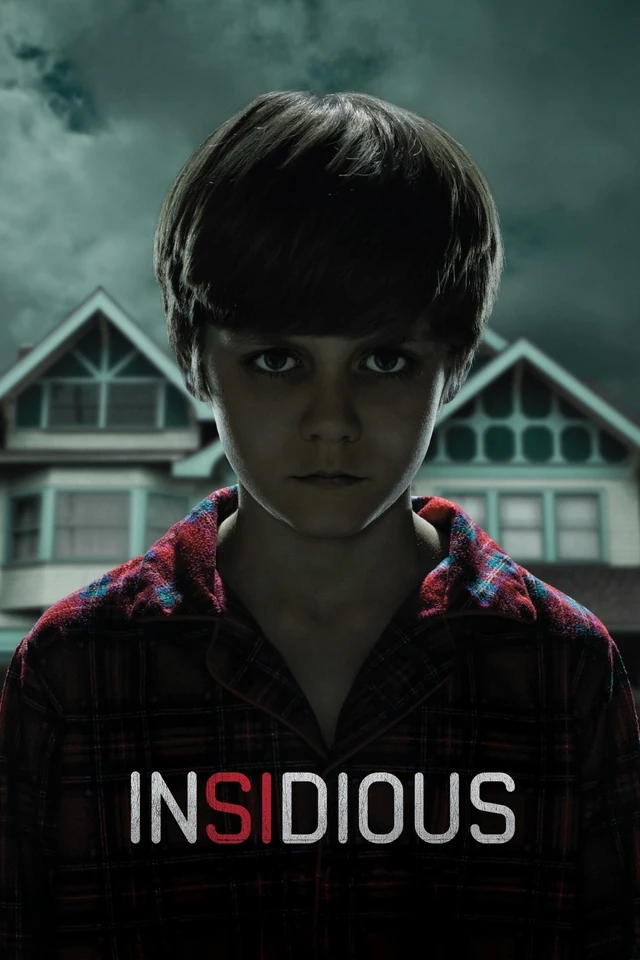
Insidious uses the realm of sleep to create (or, in my case, re-create) a terrifying world where, presumably, children like me go when afflicted. The son of Rose Byrne (Bridesmaids) and Patrick Wilson (Little Children) sleepwalks to the attic, bumps his head, and falls into an inexplicable coma. Only, it is not a coma. Instead, he has drifted into what is later explained as “The Further,” a dream-state that is unfortunately populated by the restless dead, who hope to capture the boy simply because they thirst for his life, and more dangerous demons, who want his body to re-enter the world and wreak havoc. Modern medicine fails, the less-conventional expert steps in, and away we go. It is revealed that Wilson suffered night terrors as a boy, and the unwanted attentions of this particular demon as a child:
Wilson is sent in to get his son.
Director James Wan’s (Saw, The Conjuring) world is creepy (the two demons in particular); the scares are initially restrained, but plentiful, and meted out in increasing doses; and the acting first-rate. As the mother, Byrne is sympathetic and appropriately destabilized, and Wilson plays the father as truly scared and vulnerable – he is gripped by initial cowardice and denial; he does not want to go back to the world that so plagued him as a child. The medium (Lin Shaye) is compelling and her two researcher assistants provide necessary comic-relief without being obtrusive – this is the same set-up as Poltergeist minus the over-the-top “This house is cleeeeeeeeeeeeaaaaan” nonsense.
The film’s primary strength is its patience. As Wan explains:
Between ‘Saw’ and ‘Paranormal Activity’, along with the ‘Blair Witch Project’, it’s been proven time and time again that the scariest movies are ones that are made outside of the studio system, where you have the control to say, “You know what? I’m not going to open the movie with a big, scary action set piece. I’m just going to slowly build characters and get you sucked into the family, get you liking the characters before things start to happen.”
If there are weaknesses, they are slight: the set-up is very derivative, the middle third is rushed, the revelation of Wilson’s demon in childhood photos is too overt, and Barbara Hershey (as Wilson’s mother) is wasted. To amp up the intrigue, Wan should have used Hershey in flashback, a helpless single mother trying to cope with her spooky son.
A funny, cynical 80s movie that holds up well, unlike, say Splash. While Dan Aykroyd is obtrusive and over-the-top as the snooty Philadelphia financier who, in the service of a sociological inquiry/$1 bet, is framed as a thief and drug dealer by his financial titan bosses and replaced by the homeless Eddie Murphy, John Landis’ picture overcomes his scene-chewing. Well, Murphy does. He is electric and inventive, Jamie Lee Curtis voluptuous and winning, and as the scheming Wall Street chieftains Duke and Duke, Ralph Bellamy and Don Ameche are having such fun it is infectious.
LANDIS: The most remarkable story, casting wise: I thought, ‘Well, I need someone who was a movie star in the ‘40s, who never has never really played a villain, and I was thinking, ‘Hey, what about Don Ameche?’ And the casting woman said, ‘Don Ameche’s dead.’ And I said, ‘I don’t think so, I would know if Don Ameche is dead.’ And so we called the Screen Actor’s Guild, and his residuals were being sent to his son in Phoenix, Arizona. And I thought, ‘Well that’s not a good sign.’ And he didn’t have an agent, and I thought, ‘Shit, goddamm, who else could we get?’ when one of the secretaries said, ‘I heard you’re looking for Don Ameche.’ We said ‘Ya.’ She said, ‘I see him all the time walking on San Vicente in Santa Monica.’
So I called information, and I said, ‘I there a Don or D Ameche on San Vicente in Santa Monica?’ And there was! So I called him. And you know he has that unmistakable voice, and you realize, Don was a huge star, in the late ’30s, definitely a big star in the ’40s — I mean he was Alexander Graham Bell for chrissakes! — a major star in the ’50s, Broadway star, radio star, movie star, television star.
And I said, ‘Mr. Ameche?’ ‘Yeeessss…?’ ‘My name is John Landis, I’m with Paramount Studios, and I’m making a film and I’d like you to consider a part.’ So I had a script sent over. ‘And could you please read this and can you come in tomorrow?’ And he said, ‘Yes.’ Would you like us to send a car?’ He said, ‘No no, I can drive.’ I said, ‘Great.’
And he came in and was prepared to read for me. I was so shocked. I said ‘You don’t have to read for me.’
He hadn’t made a movie in 14 years, he’d been doing dinner theater.
While we were shooting later in Philadelphia — he was so wonderful — I said, ‘Don, may I ask a question? How come you haven’t worked in 14 years?’ And he said, ‘Well, nobody called!’