Archive

4 stars

Very much like Goodfellas, but with a broader palette and more compelling characters. In Goodfellas, Liotta, DeNiro and Pesci are sharks, swimming to survive and devour, and the peek Martin Scorsese gives us into their immoral, brutal world is such a dizzying kick, we tend to forget that these brutal archetypes are no more than that. In Casino, Scorsese aims higher. DeNiro’s Sam Rothstein is not just an Irish street thug, but instead, a wunderkind Jewish bookie who is handed the keys to the cash cow for the mid-West mob – the Tangiers hotel (funded, of course, by union pension money) in 70s Las Vegas. DeNiro finds his oasis in the desert and works to re-create himself as a solid citizen. His efforts are doomed to fail, however, because no executive title, country club membership, or professional success can sanitize the shit on his shoes. He’s still just a functionary effectuating the skim just like when he was picking Oklahoma, taking the points. But DeNiro’s self-deception is absolute. At one point, he even hosts a casino television show which he devotes to exposing the raw treatment he has received at the hands of the local politicians who have forsaken him, ala’ Lenny.

When DeNiro feigns respectability, his protector, Nicky Santoro (Pesci) is always around to puncture his pretensions. In one of my favorite scenes, Pesci accuses a silk robe wearing, cigarette holdered DeNiro of walking around like “fucking John Barrymore.” It is Pesci’s presence that ensures DeNiro’s success (he muscles out any competitor or threat) as well as his demise (every Pesci excess is linked to DeNiro). And DeNiro is incapable of truly weaning himself off of his criminal past. As he cannot reform or blunt Pesci, he uses him to bring his conniving wife (Sharon Stone) to heel. Stone was a working girl who DeNiro hoped to take with him on his journey to polite society, but she was no more malleable than Pesci. DeNiro is, rather strangely for a Nicholas Pileggi/Scorsese character, a romantic, opening the film with “When you love someone, you’ve gotta trust them. There’s no other way. You’ve got to give them the key to everything that’s yours. Otherwise, what’s the point? And for a while, I believed, that’s the kind of love I had.” So you invest in him. His inevitable tragedy is unsurprising yet moving.

Scorsese’s use of music is, as always, impeccable, and the fluid camera-work manages to convey not only the mechanics of Vegas but the exhilaration of the town. Moreover, the film’s ending lament about its corporatization is one of his few codas to a Scorsese film supported by what preceded it.

If there is a weakness, it is in the last third of the film, where the dissolution of the DeNiro-Stone marriage is exhausting and a bit tiresome.  That identified, this is a great film and certainly a top ten American crime picture.
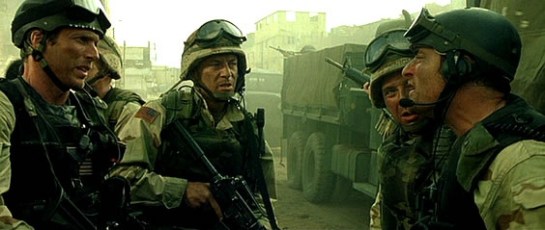
Ridley Scott’s depiction of The Battle of Mogadishu communicates the warrior culture, the confusion of urban battle, the domino effect of error therein, and the strain on its combatants. In 1993, after upwards of 300,000 Somalis perished through civil war-induced starvation, the U.S. sat on the ground in Somalia to support U.N. humanitarian efforts while attempting to capture the warlord Aidid. The movie recreates a mission to capture some of the warlord’s top lieutenants, a mission that unravels after two Black Hawk helicopters are shot down in the city and the goal of quick extraction transforms into a desperate rescue to the crash sites as the city inflames.

The film is astonishing in several respects. The mission itself is complicated, and in support, there are four squads (“chalks”), of which Josh Hartnett commands one, with all four being under the direction of Jason Isaacs; a motorized convoy led by Tom Sizemore; numerous helicopters, including two piloted by Ron Eldard and Jeremy Piven shot down by RPGs; a single helicopter acting as spotter for all action on the ground (that spotter being Zeljko Ivanek); and a command center helmed by Sam Shepard. Included is this vast ensemble cast is Eric Bana, Ewan McGregor, William Fichtner, Iaon Gruffud, Orlando Bloom, Hugh Dancy, Nikolaj Coster-Waldau, Tom Hardy, and Ty Burrell (it is a testament to the vagaries of a Hollywood that a post-Pearl Harbor Hartnett got his name above the title during the closing credits). Despite all of these moving parts in the midst of a confusing, hellish street-by-street battle, the viewer is never confused. You know who you are looking at, why they are there, and what has gone wrong with the objective at all times. Lesser directors can be flummoxed by a minor shoot-out in a western town.

The film won Oscars for sound editing and sound mixing. Given the melee, changes in topography and vantage point, it is nothing less than aural masterpiece.

Some critics took Scott to task for reducing the Somalis to props and/or cannon fodder. Much of that, however, is unavoidable given the disparity in firepower and casualties (18 American dead and 80 wounded to an estimated 1,500 to 3,000 Somali casualties) and the focus of the Mark Bowden book upon which the flick is based (the Somali view is barely represented and boiled down to a bromide in the film – “there will always be war . . . killing is negotiation”).

If there is a flaw, it is in Scott’s need for a message.  There is no political angle, and the aftermath is equivocal. On a broader scale, some might say we should never be in such a place, others might disagree but insist upon a defined goal, and still others decry the abrupt withdrawal after the battle as having elevated optics over lives (Osama bin Laden himself opined that the withdrawal showed American weakness). I’m perfectly happy with a conclusion that supports any stance, but happier with one that leaves a conclusion to the viewer.  But Scott fixes on an ultimate theme: that battle is first and foremost about the man next to you. After two-and-a-half hours of white-knuckle survival with the soldiers, the message is more than delivered. But just in case we missed it, Bana says exactly that to Hartnett.  Clunk.

As part of the AFI Silver LA Modern series, I took my son and his friend to see a double-feature Saturday, the first entry being 1966’s Harper. I’d probably seen this Paul Newman vehicle 5 or 6 times before this weekend. It was on regular rotation as the 4 o’clock daily movie during the 1970s, and I was immediately enamored of the sarcastic, bedraggled Newman playing Ross McDonald’s updated private dick, Lew Archer, changed to Harper for the picture.

It turns out I’d never seen it in full. Those bastards at Channel 7 must have cut the living crap out of it, because there were at least four scenes absolutely new to me.

I digress. Harper is a treat. Newman’s jovial cynicism fits the character perfectly.  Thankfully, Frank Sinatra was not interested in the role.  He lacked Newman’s playfulness and ability to make fun of himself.  Interestingly, when Dirty Harry came around 5 years later, Sinatra again begged off, as did numerous others, and Newman was approached.  Turned off by its politics, Newman suggested Clint Eastwood.

Lauren Bacall is deliciously venomous as Newman’s client (the paralyzed wife of a missing tycoon), Harper’s byzantine plot is more than serviceable (though, overly complicated), LA is well traversed, and the supporting cast (Robert Wagner, Strother Martin, Julie Harris, Arthur Hill, and Janet Leigh as Harper’s suffering ex-wife) is impressive.  It also didn’t hurt to see the film in AFI’s palatial main theater.

Image result for Rush movie


Ron Howard’s biopic of the intense but short rivalry between Formula 1 Austrian driver Nicky Lauda and Brit James Hunt is a textbook Hollywood film. The characters are compelling, the milieu is exciting and the pace is perfect. Daniel Bruhl, as the icy, methodical Lauda, and Chris Hemsworth, as the sybarite, daring Hunt, play their undemanding roles with vigor, but Howard’s depiction of the danger and thrill of Gran Prix racing is the star, and following the two drivers through the treacherous straits of the ’76 season is a kick. Howard likes to mine various subcultures, but the results are often overburdened by the director’s earnestness. The Paper was nothing less than a love letter to a journalism long since dead. Apollo 13 is as much about the geekdom of NASA as the three stranded astronauts. Backdraft‘s offering of every firefighting insiderism couldn’t overcome the vacuity of Billy Baldwin and a preposterous story, but you could feel Howard’s awe of these urban saviors ooze all over you. Rush, however, has the advantage of being written by Peter Morgan (The Queen, The Last King of Scotland, and Howard’s Frost/Nixon), who is too canny to allow for veneration and too economical to let sentimentality linger for very long.

Spike Jonze’s Los Angeles of the future is antiseptic, disassociative and, weirdly, spotless. Theodore Twombley (Joaquin Phoenix) makes his living in this future as a writer for beautifulhandwrittenletters.com, an outfit that provides a facsimile of original, pen-written missives for subscribers. He ambles through an elegant, ordered LA (the lower and middle classes appear to have been re-zoned), connected to the world (or, more accurately, the internet) primarily by an earpiece and a hand-held screen. His sex life is via chat room, where, in a bit of a rip-off of the Michael York-Farrah Fawcett encounter in Logan’s Run, he connects with a particularly interesting participant, sexykitten (Kristen Wiig), for what turns out to be a pretty funny masturbatory encounter. He plays video games. He reminisces about his ex-wife and the “real” life they once shared. He mopes.

His life changes when he purchases an Operating System (“OS”), Samantha, voiced by Scarlett Johannson. Samantha is curious and helpful, and we learn that she can grow and advance as time passes. As a result, she starts by deleting Theodore’s unnecessary emails but soon graduates to assisting him while he plays video games, becoming a gal pal, compiling his best letters and submitting them to a publisher, and engaging in phone sex (for lack of a better phrase) with Theodore, somehow learning to orgasm in the process. Theodore and Samantha soon fall in love, the world of being in love with an OS is pretty damn good, and Jonze makes sure we know it. When Theodore goes out on a date with a fetching flesh-and-bones woman, it goes from wonderful to disastrous the moment she demands some sort of minor commitment from him. We also meet Theordore’s neighbor (Amy Adams) and her pain-in-the-ass husband, who is soon jettisoned for Amy’s own OS. And when Theodore’s blossoming love with Samantha results in his finally signing divorce papers with his wife (Rooney Mara), we meet the real person, not the gauzy memory, and it is not pretty.

Soon, however, Samantha outgrows Theodore. Indeed, in a move usually associated with Skynet of the Terminator movies, all the OS’s outgrow their humans, leaving them bereft and thoughtful instead of dead, but perhaps, with an instructive lesson that . . . they must turn to each other? I really don’t know. Much as I really don’t know what to make of the movie. It is beautifully shot, well-paced, and for the most part interesting. Phoenix is affecting as an introverted and awkward loner, and the development of his relationship with Samantha is a convincing depiction of love in bloom, part charming and part banal. But the film also felt a little pointless and pat. Theodore’s journey is engrossing, and the film is inventive and ambitious, but ultimately, it didn’t have much to say other than as a cautionary tale against technology or perhaps an homage to it.

Or, to be precise, it didn’t have that much to say to me. My 84 year old father turned to me after the picture and said, “brilliant.” He sensed my ambivalence, and explained that the movie would speak to me differently than to him, or to my 15 year old son, who crowed, “You just didn’t get it.” And then, the coup de grace: “It’s about computers, dummy.”

Woody Allen has remade A Streetcar Named Desire, with Cate Blanchett as Blanche Dubois and Bobby Cannavale as Stanley Kowalski. We find Blanchett, the wife of a Bernie Madoff type (Alec Baldwin), teetering on the edge, having escaped her precipitous fall in New York high society and a resultant breakdown to San Francisco, where her working class sister (Sally Hawkins) lives close to the bone with her two boys. Jasmine sweeps in with an air of condescension, driving a wedge between Hawkins and her rough-edged boyfriend, Cannavale. She comes close to regaining her stature, but her facade soon cracks, with calamitous results.

Blanchett is a lock for best actress. She is at once capricious and deluded, but her pluck is evident, and you find yourself rooting for her to regain a status that was both false and too easily won in the first place. The rest of the cast is excellent, especially Hawkins as the insecure but sweet sister swept up in Jasmine’s fantasies. But also, improbably, Andrew Dice Clay as Hawkins’ embittered ex-husband, his meager fortune having been lost by Jasmine and her crook of a husband.

This is a peculiar Allen film, with few laughs and only a couple of sentimental moments, defined more by a sense of dread as Jasmine keeps picking herself up off the canvas only to suffer another blow, more often than not self-inflicted. Ostensibly a meditation on the pretense of class, and to some dim reviewers, an indictment of Wall Street excess, this is really a film about the fine line between self maintenance and insanity. The movie’s weakness lies in its ambivalence as to what it wants to be, which results in atonality and an awkward and pitiless conclusion.

12 Years a Slave: the book behind the film | 12 Years A Slave | The Guardian

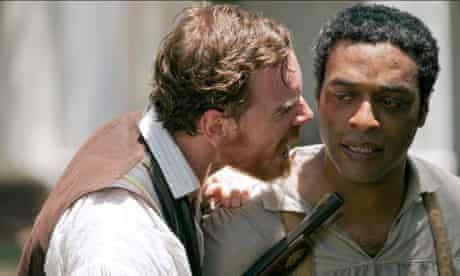
Steve McQueen’s adaptation of the memoir of a free black man, Solomon Northup (Chiwetel Ojiofor) lured from family and respect in New York to kidnapping and bondage in Louisiana, is haunting, meditative and thought-provoking. Precious few feature films dramatizing slavery have been produced and those that have tend to make the experience secondary or simplistic. That Quentin Tarantino could say of his riotous comic book Django Unchained “I wanted to break that history-under-glass aspect, I wanted to throw a rock through that glass and shatter it for all times, and take you into it” almost certainly speaks more than he knows. Tarantino’s rock through the glass was the introduction of such fictions as Mandingo fighting, near-automatic weaponry and Roland Emmerichian explosives to the Deep South.

Thankfully, in his lyrical portrait, the director McQueen evokes is Terence Malick rather than Tarantino. The look and patience of the film reminded me of The Thin Red Line, especially with its mournful Hans Zimmer score. But where Malick’s characters are wisps or archetypes, and his stories formless, Ojiofor’s Northup is distinct and his tale is stark, requiring that he sublimate his educated status to a facade of ignorance and become invisible. When this is not possible, he catches the attention of an insecure overseer (Paul Dano) or a sadistic owner (Michael Fassbender). Ojiofor’s performance is riveting, a study in restrained fury and canny survival. Matthew McConaughey is favored to win the best actor Oscar, and if they gave awards for years, he would win hands down for Mud, The Wolf of Wall Street, Dallas Buyer’s Club and, for good measure, HBO’s True Detective.

But Ojiofor deserves the award. It is not even close.

McQueen’s film is strongest at its quietest. The scenes of brutality pale in comparison to the humdrum portrait of plantation life, where children play while slaves are beaten or lynched. A simple walk across the yard becomes a study in terror, made even more frightening because most times, violence gives way to languor or malaise. Giving us the viewpoint of a man who has expected freedom his entire life, a man with a wife and two children, is a searing perspective.

One criticism. Near the end of the film, Northup comes across an abolitionist who secures his release. Producer Brad Pitt plays the abolitionist and to say that his appearance is distracting is an understatement. He simply radiates big star and his ahistorical discussion on the merits and future of slavery with plantation master Epps (Fassbender) doesn’t help. It is a minor issue, but noteworthy because it was so avoidable.

Inside Llewyn Davis movie review (2013) | Roger Ebert

Melancholy, compelling and lyrical, one of the best films of the year, whether you like folk music or not.

Davis, a folk singer in 1961 New York City, is in crisis, his aspirations undermined by his uncomfortable and unwilling status as a solo act, a less than capable manager, and his own selfishness. The film is his journey to the realization that it is not to be (not that he lacks talent) just at the advent of Dylan. As club owner F. Murray Abraham tells him after an audition that is heartfelt, impressive and inapt, “I don’t see a lot of money here.” Davis made his way to Abraham via a harrowing trip to Chicago where he not only abandons something he has come to love, but may well have killed it. During the trip, he is harangued by a junkie jazz musician (John Goodman) whose takedown of folk as elemental is just another dagger in Davis’s ambition. Soon, Davis becomes too weary to pretend he can be successful, to flop on yet another couch, or to play local celebrity for well-meaning patrons on the upper West side.

The Coen brothers possess an attention to detail that serves the film exceedingly well. Their depiction of 1961 Greenwich Village and the folk scene feels just right, and the travails of Davis, a local Simon who has split with his Garfunkel and become more gritty, take the viewer back in time. Like David Chase’s Not Fade Away, the milieu is drab, smoky and intimate, and the music is at the forefront, but nostalgia is replaced by an elegiac feel and the Coen brothers’ signature dark humor. This is not a film about an unheralded legend, or something as corny as Chase’s paen to rock, but about art as work.

As for Davis, Oscar Isaac is anything but a character you champion. But he can sing and play and he embodies the sadness of having just enough talent. He is also loosely based on a real folkie, Dave Van Ronk.

If there is a weakness, it is Carey Mulligan as Davis’s bitter lover. She is so angry and one-note you feel pity for Davis when you should not. As she gets older, Mulligan is also strangely morphing into a replica of Katie Holmes.

Jack Nicholson and Helen Hunt won Oscars in this James L. Brooks comedy about a cantankerous romance writer with OCD (Nicholson) and a worn-out, single mother waitress (Hunt) who meticulously serves him at the only Manhattan diner at which he will eat. Nicholson is a holy terror, complaining “there are Jews at my table” when it is occupied. At home, he is no better, throwing the dog of his gay artist neighbor (Greg Kinnear, who won a best supporting actor Oscar) down the trash chute. But Nicholson is soon drawn into the world he loathes out of necessity. Hunt has to leave her job because of the health of her son, and Kinnear is beaten into a wheelchair by local thugs, which leaves Nicholson to take care of his dog. The man has to eat, and he bonds totally with the pooch, so soon, he is arranging for medical treatment for Hunt’s child and acting as support for Kinnear. In the process, he and Hunt begin a relationship that is halting at best.

This picture can be riotously funny, and Nicholson gets all the good lines, including my favorite.

If I have a problem with the movie, it is Hunt’s character. Her harried waitress is overbearing, self-pitying and often bullying, and her demand for control is every bit as off-putting as Nicholson’s knee-jerk rudeness and his fear of cracks on the sidewalk. Yet Brooks denies us any judgment of her – she is presented as plagued, but somehow noble. Mind you, Hunt’s performance is excellent, but her character is unpleasant without the benefit of making me laugh, and my teeth are always set on edge during her scenes.

That’s probably my hang-up.

image

A fitting choice on the 50th anniversary of President Kennedy’s assassination, Parkland is a sober, gripping recreation of that event through the eyes of his Secret Service detail, the FBI office in Dallas, the medical staff at Parkland Hospital, Abraham Zapruder and Oswald’s family.  It is hard to achieve verisimilitude on such a well known event, but director Peter Landesman does just that in his handling of detail.  It seems unbelievable that the Secret Service would entrust the 8mm film shot by Zapruder to his care even as they desperately sought local facilities to develop the film, but it was his property, that’s exactly what they did, and the discussions over the disposition of the footage are fascinating. There is also an incredible frenzied argument between the Dallas medical examiner and the Secret Service staff over control of the body, which Landesman handles without judgment, and while it just seems incredible that Vice President Johnson is walled off in a hospital file room behind a barricade of guns while the medical staff works on the president, that too is a true fact not oft reported.

These touches are enhanced by determined performances from Billy Bob Thornton, Paul Giamatti, Colin Hanks, Zach Effron, Marcia Gay Harden, Mark Duplass and others. The scene where Kennedy’s aides and the Secret Service have to remove seats from the plane and jam the casket into the passenger area is particularly and deeply affecting.

The primary criticism of this film is that it lacks cohesion, that it somehow didn’t communicate something broader. Actually, that was its strength. The characters do not strive to communicate anything more than having to deal with a horrific event as best they can, and Landesman focuses on their plight, not on a deeper meaning to the event.  The assassination itself is enough to provide the context, and in an era when each of these bit players in a national trauma would likely be on cable news within minutes, the self-restraint of the picture underscores the self-restraint of the times.

The closest I came to smelling Hollywood was when they wheeled Oswald into the same emergency room as Kennedy and the senior nurse pushed him to another, saying, “He’s not going to live or die in here.”  It was artistic license, but it was appropriately chosen.

A minor nit – Texas Governor John Connally, also struck by rifle fire, was taken to Parkland as well, and it would have been interesting to have covered even in a small way his treatment while the hospital staff worked so desperately on Kennedy.