Archive

3 stars

Image result for The Normal Heart HBO

Ryan Murphy’s (Glee, American Horror Story) adaptation of Larry Kramer’s semi-autobiographical play about the outbreak of AIDS in New York City circa 1981 is a mixed bag, often poignantly moving but more often numbingly repetitive. The film does not shy away from the cruelties of the disease and the inaction that followed its introduction, echoing the source material, an urgent polemic written before there was even a test and the disease was called GRID (Gay Related Immune Deficiency).  It is an activist story for a perilous time (the play was produced in 1985) and the immediacy of the stage.  Under Murphy’s direction, Mark Ruffalo, as New York City writer Ned Weeks, is largely utilized in a series of stem winders and broadsides against the Koch and Reagan administrations, the insouciant gay community and in particular, his fellow board members of a nascent advocacy and care group. Weeks’ passion is noteworthy but by the end of the picture, you fully understand the frustration of his compatriots.  His tactics (a combination of haranguing, attacking and outing) are such that they can’t get a hotline set up without Weeks sneering or warning about the next Dachau (Kramer himself would end up being instrumental in the founding of Act Up, which was decidedly more confrontational and, to be fair, effective).  A missed opportunity of an actual exchange, for example, is the fact that Weeks is affluent, making his offering of the livelihoods of all of his co-activists (one of whom is in the military) a rather cheap and easy proposition.  This factor is unexplored beyond a toss-off comment.

Ruffalo is joined by several other notables (including Julia Roberts as a doctor on the frontlines and Taylor Kitsch as his more measured activist friend), all of whom have their own speeches, all movingly delivered but all awkwardly stagey.  When they occur, we are meant to listen respectfully to the sermons, which are heartfelt, often spoken to bigots and/or bureaucrats (poor Dennis O’Hare, who, after this and Dallas Buyer’s Club, is a cottage industry of unsympathetic pencil pushers in AIDS dramas) or screamed at the heavens, and wholly devoid of nuance.  As noted by Frank Rich in his review of the play back in 1985, “the playwright starts off angry, soon gets furious and then skyrockets into sheer rage . . . Some of the author’s specific accusations are questionable, and, needless to say, we often hear only one side of inflammatory debates. But there are also occasions when the stage seethes with the conflict of impassioned, literally life-and-death argument. … The writing’s pamphleteering tone is accentuated by Mr. Kramer’s insistence on repetition – nearly every scene seems to end twice – and on regurgitating facts and figures in lengthy tirades. Some of the supporting players … are too flatly written to emerge as more than thematic or narrative pawns. The characters often speak in the same bland journalistic voice – so much so that lines could be reassigned from one to another without the audience detecting the difference. If these drawbacks … blunt the play’s effectiveness, there are still many powerful vignettes sprinkled throughout.”  Murphy’s film is nothing if not faithful to Rich’s evaluation.

When Murphy moves away from the politics of the disease and human relationships, the picture is much stronger. The relationship between Weeks, who is reticent about intimacy and the gay world’s sybaritic nature, and his lover Felix, played by Matt Bomer, is an exchange that offers a view into the difficulties growing up and being gay. The scene where Ruffalo demands that his straight and supportive brother (Alfred Molina) accept that they are essentially the same is the best one of the film, as each character is given a  voice.  And The Big Bang Theory‘s Jim Parsons delivers a beautiful eulogy for a friend and by extension, for all the “plays that will not have been written, dances that will not be danced” that is heartrending. Sadly, these scenes are the exception rather than the rule, and the watching of The Normal Heart eventually lapses into a very unfortunate place for entertainment – duty, a film you “should” see rather than one you would necessarily want to.

The good: the clever set-up of the origins of the beast incorporated into the opening credits; Bryan Cranston, as the obsessed Area 51 type who devotes his life to revealing those origins and the threat; the avoidance of the evil military-industrial tropes that often infect disaster movies; the destructions of cities other than NYC and LA; an ominous, moody score; and the monster battles, which are realistic, haunting and classic instead of computer-dizzying, antiseptic and deadening. And at just over 2 hours, it is the perfect length.

The bad: the script is banal. Anything the scientists (a barely intelligible Ken Watanabe and an absolutely pointless Sally Hawkins) contribute is mush, and when they object to the military’s plan to lure other monsters from the Godzilla family with nuclear weapons (which the eat like Chicklets), Hawkins merely shakes her head, like, you know, come on . . . that’s soooooo crazy, and Watanabe produces the pocket watch his father carried . . . in Hiroshima.  Heavy.

Military commander David Staitharn is merely low grade concerned throughout, with an almost “Well, thank God this ain’t no 9-11” air about him.  Aaron Taylor Johnson (Kick Ass), in a role made for Channing Tatum, is as evocative as a hot dog bun sopped in tap water (The Atlantic’s Christopher Orr said it better: “As for Taylor-Johnson’s performance as Ford, the movie’s central human protagonist, it was so dutifully generic that I forgot it even as I was watching it. I have no lasting impression of him whatsoever”). There is also a child actor who is child actory, better utilized to sell Underoos than terror at the loss of his mother and/or father. Finally, this is Godzilla. I don’t need Seth Rogen toking on a bong and yukking it up, but this film has almost zero sense of humor, depicting a world that perhaps deserves a good stomping.


Will Larroca’s stock as a director has been as volatile as Nic Cage’s acting career. Though critically acclaimed in some quarters, his first picture, The Monster, was uneven.  It was followed up by a skilled but off-kilter homage, Will Will Kill. Thereafter, the word on the street was that he was working on a frightening script, House of Blood, which was even touted in promos by Larroca’s studio, PJ SmoothIson.

And then . . . Larroca was tied to a trippy, bizarre The Hugginns Movie, and then a weirdly religious but shockingly effective parable, Commandments Revamped. House of Blood disappeared from the trades, replaced by talk of production of an as yet untitled American gangster opus, which is rumored to start filming shortly.

And now, we have The Ballad of Chad Big Bucks, with Larroca clearly in front of the camera. But how much of him was behind it?  This seems like a production-for-hire, and while there is no shame in making a corporate buck (documentarian Errol Morris is the genius behind Taco Bell’s new “I am Ronald McDonald” ad campaign), it’s harder to discern where Larroca shows up on this endeavor, which is sold to us at the outset as someone else’s film.

Much of the good in Big Bucks clearly carries his stamp. The chase scene in the middle of the picture takes the fury and speed of Bullitt or The Seven Ups and turns it on its head. The super slo-motion is riveting, somehow making the violence of the action even more unbearable. I’ve watched the scene numerous times and find myself on pins and needles each one. Larroca’s use of the elements is also adept. The rain is borderline elegiac, and the operatic voiceover narrative, a sing-songy minstrel tune, brilliantly alternates between mournful and mocking. Finally, the film bravely ignores religious implication until the end of the picture, and it is still unclear whether Larroca is rejecting the idea of a higher power or endorsing it.

Much of the flick, however, is haphazard. What the heck is Spiderman doing at the outset?  What is occurring with the almost purposeful rough edits, where actors turn to and acknowledge the camera?  The line between the film story and filmmaking has always been malleable in Larroca’s films, but sometimes, sloppy is just that and no more. And why does the minstrel voiceover start screaming when the main protagonist is cycling in the streets ala’ Butch Cassidy & The Sundance Kid?  And would Jordan Belfort really be walking around a leafy suburb?  Larroca is clearly comfortable shooting in the same location, and there certainly are financial pressures in a young auteur using his own studio, but it’s time to leave his familiar surroundings and see the world.

While newcomer BGrimms is a standout (his anger and fall are heartbreaking), Larroca’s continuing fealty to Zeb Dempsey and Reid Brown is questionable. His devotion to these young actors is to be commended, but Brown’s mumblemouth approach (think Benicio del Toro in The Usual Suspects) has run its course, and Dempsey’s overacting compares unfavorably to the last films of Rod Steiger. One wants to see new faces as well as new places. Perhaps that’s why Larroca himself jettisoned his own persona in favor of homages to Nicolas Cage and Leonardo DiCaprio. The selections are apt, but the time has come for Larroca to move from parody to depth as an actor, and from provincial to worldly as a director.

We shall see what the summer brings.

Anchorman 2's Ron Burgundy: Five Funniest Viral Marketing Stunts - Variety

Seemingly improvised throughout, the sequel is alternately lazy and uproarious, but by the end, more the former. The Channel 4 news gang (Will Ferrell, Steve Carell, David Koechner, and Paul Rudd) have reunited, moving from San Diego to New York City, to take the helm of the graveyard shift on the first 24 hour cable news channel. Soon, Ferrell’s Ron Burgundy is back on top, discarding his friends, cementing his fall (he is even stricken blind), only to return triumphant.

In the first film, Ferrell’s bosses (Fred Willard and SNL alum Chris Parnell) held their own as comedians, contributing to the fun. Ferrell’s new boss is the sassy, Pam Grieresque Meagan Good, who is placed in the film for a painful scene where Ferrell visits her family and tries to “act street.” She’s not funny, but she’s not alone.  Harrison Ford, Drake, Kanye West, Tina Fey, Amy Poehler, Jim Carrey, Sacha Baron Cohen and others appear, most for a reprise of the first film’s news team rumble, but the melee is woefully disappointing. Gone are the unexpected trident and grenade, the scores from Star Trek and West Side Story, replaced by celebrities who just wanted in. Sure, Ford turning into a werewolf is pretty cool, and who doesn’t laugh at an unexpected minotaur, but these guys aren’t very funny.  And Liam Neeson and Marion Cottilard? Zzzzzzzzzzzzzz. Will Smith?  He wasn’t even funny in The Fresh Prince of Bel Air. Even Vince Vaughn’s return as Wes Mantooth is a little dull. Speaking of dull, Kristen Wiig as Steve Carell’s love interest is Sominex.

Director Adam McKay also tries to deliver a lesson about the degradation of the news. He usually appends his simplistic political tracts to the end of his goofy movies, so you could walk out of The Other Guys or The Campaign while the credits rolled and he lamented Wall Street greed or the Citizens United decision.

Other bits fare better, including Ferrell’s interactions with his young son and his bottle feeding of a baby shark; Carell’s panic at the loss of his legs on a green screen; and especially, the news team’s smoking of crack on the air.

The trend away from gore porn and toward chilling, moody scary movies remains welcome.  Oculus is a worthy fingers-over-the-eyes addition, in the mold of The Conjuring, and sporting a clever storyline that tracks, and intersects, the childhood trauma of two kids whose house was haunted by a spooky mirror and their attempts as adults to destroy it.  The execution is crisp and even ingenious, and the child actors (Annalise Basso and Garret Ryan) are superb.  As to the flaws, there is one, and it is a rather big one, but I can’t reveal it without telling too much.  Suffice it to say that it falls under the “Well, if X, then why the hell would they do Y?” variety.  It’s a testament to the skill of writer/director Mike Flanagan (born, I shi** you not, in Salem, Massachusetts) that I was able to shelve the issue and just sit back and enjoy the film.

After seeing Harper as part of the AFI Silver LA Modern series, me and my son watched Paul Newman’s follow-up turn as Ross McDonald’s P.I. in 1975’s The Drowning Pool.  Lew Harper finds himself in New Orleans in the middle of a scandal involving an ex-love (Joanne Woodward), a sleazy oil man (Murray Hamilton) and a protective local police chief (Tony Franciosa).  Newman again gives an infectious star turn as the cynical but funny private detective brought into to town by Woodward to get to the bottom of her being blackmailed.  When Franciosa is impressed by his $150 per day plus expenses rate, Harper explains that it isn’t all that much when you work four days a year.

But the picture lacks too many elements that made its predecessor so good.  New Orleans ain’t LA, and while there is a certain fish-out-of-water charm to Harper’s investigation, the setting feels off.  The score is also very cheezy, alternating between musical interludes worthy of a Mannix or Barnaby Jones and an annoying symphonic riff of Roberta Flack’s “Killing Me Softly”.   Worse, Joanne Woodward’s Louisiana drawl is borrowed straight from The Long Hot Summer.  She’s ridiculous in her theatrics and a terrible replacement for Janet Leigh as Harper’s love interest. Hamilton does his best to give his character some flavor, and an 18 year old Melanie Griffith is an alluring near-jail bait, but most everyone else is either histrionic or blah.

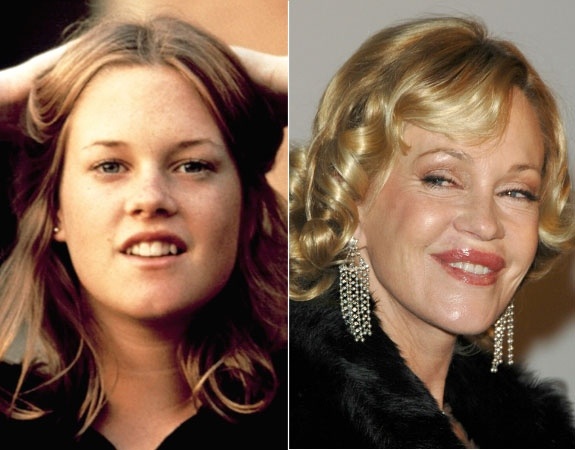
While Woodward is a step down, Griffith as the poisonous Lolita is a significant upgrade from Harper’s Pamela Tiffin.

And a reminder of the horrors of plastic surgery.

Point Blank was introduced by its presenter at the AFI Silver as “the most pretentious good film ever made.” The “good” discussion follows, but there is no doubt John Boorman’s tough noir picture is arty, almost to the point of distraction.

The story is simple: Walker (Lee Marvin) and his pal Reese (John Vernon, Dean Wormer from Animal House, in his film debut) make a score, Reese double-crosses Walker, takes his lady and his dough and leaves him for dead. Walker returns and with the help of his sister-in-law Chris (Angie Dickinson) works his way up the criminal syndicate that protects Reese to get his money.

This is a cold film. The characters are hollow, and Marvin is catatonic. The story is near non-existent and Boorman relies on showy and repetitive flashbacks that suggest portent and meaning but do not deliver. Boorman’s prior film, Having a Wild Weekend, was a romp in the mode of Help, featuring the Dave Clark Five, so his high-mindedness may have been itching to get out.

On the plus side of the ledger, the color and texture of the film are vivid, Boorman’s depiction of violence is jarring (in particular, a vicious brawl in a cacophonous soul club), many of Point Blank’s images are stunningly iconic, and the fractured timeline clearly influenced Quentin Tarantino, among others.

The virtues of Point Blank are more identifiable in its legacy than in the viewing. Except for the incomparable Dickinson.

Review: Captain Phillips (2013) – Empty Screens
Director Paul Greengrass is adept at action and tension, as proven by the Bourne films and United 93. His quick-cut, frenetic, hand-held style is distinct, and the viewer is drawn to the edge of his seat in short order. A drawback, however, is that characterization takes a back seat to drive. In the Bourne films, the character is a cypher. He doesn’t even know who he is, so backstory and motivation are easily jettisoned. In United 93, as players in a great national tragedy, the characters are already known to us, and the story is more about how institutions respond to great crisis than individuals.

Captain Phillips is about two men – Captain Richard Phillips (Tom Hanks) and the pirate who takes his ship, Abduwali Muse (Barkhad Abdi), but what Greengrass reveals about each man is minimal. The former is quiet and somewhat worried about the world in a generic way (we learn this in a brief ride to the airport with his wife, a completely wasted Catherine Keener), and the latter is poor and engages in piracy at the behest of powerful men. Armed with these facts, Greengrass rapidly recreates the hijacking of Phillips’ ship, his kidnapping and his eventual rescue by Navy Seals. It’s all very exciting, if repetitive, as Phillips regularly advises or redirects Muse. But the picture aims no higher. One can be thankful that writer Billy Ray (The Hunger Games) avoids the “you and me, we are not so different” twaddle that usually surfaces in culture clashes, but the tedium of Hanks’ New England accent constantly warning, “you don’t want to do that” isn’t an appreciable step up.

The film has been criticized as whitewashing Phillips’ actions, but in my review of the charges against him, I find they were leveled by members of his crew suing the company, and Phillips acted as a witness for the defense, so I’m inclined to chalk the lame allegations to self-interest.

Worse than any polishing of Phillips is the script’s failure to answer a question that nagged me throughout the film. The cargo ship has strict procedures, locks, hoses, 1-800 numbers to call, flares, all to ward pirates off.  Yet, it lacks a single gun or any armed personnel. Why? The writer needed to clue us in as to the reason for this omission, especially with the visual of such a small and undermanned skiff approaching a massive, modern behemoth of a cargo ship.

I mean, look at this —

I’m not saying guns should have been on the ship.  I don’t know.  But to not even address the issue in the script?  Huge mistake.

When I was in a college band in the 80s, I played on one LP. We recorded it in Richmond, VA over a hurried couple of days and had the audacity to call it Hits, one of many mistakes associated with the disc.  But the songs on the record were a marked departure from what the songwriter had written before. It soon became apparent (at least to me) he was under the influence of Big Star, if not melodically, in the bold choice of record name.  That said, it was a long time ago, and I may be making this all up.

Big Star would influence much better bands (The Replacements and REM, to name two) and Big Star’s first two records – #1 Record and Radio City – are, as affirmed by the critics and other interviewees in this documentary, mind-blowingly great.  Exhibit A–

The documentary, however, is merely good. While it does a creditable job of showing how the band, under the direction of Alex Chilton and Chris Bell, came together and missed its shot at the golden ring, its coverage of the aftermath is alternatively listless and revealing. Particularly surprising is the time given to the peculiarities of Chilton and Bell after Big Star failed to make it. Disappointing is the meager attention given to the actual music, and make no mistake, those first two records are seminal. Instead, the film spends an inordinate amount of time on, in the words of one contemporary, Chilton’s “self-absorption, self-focus, [and his use of ] drugs and alcohol.” The documentary whizzes by Big Star’s 3rd record but offers a lengthy exploration of Chilton at his worst, his foray into punk and then a gruesome endeavor called Panther Burns.

As for Bell, the film does better with his story after Big Star missed its shot. In the words of one interviewee, Bell just “lost interest in bands period. He just wanted to hear his songs not translated.” He also became a born again Christian, told his brother “you should do drugs. It takes away your sexual urges”, and eventually found himself working at a local restaurant. But Chilton reconnected with Bell, and the result was an astonishing single, I Am the Cosmos, that harkened back to the sound of the first two records.

Much of the weaknesses of the documentary are inescapable. Bell and Chilton are dead (Bell died in a 1978 car accident, Chilton in 2010 of a heart attack) and they were extreme introverts while alive. In their stead, however, the film does a great justice to the broad music community in Memphis. And it wisely ends true to the form in the last 20 minutes, with a host of acts providing testaments and tributes to the band and its influence.

Thirteen years later, Martin Scorsese has re-made Boiler Room, writer-director Ben Younger’s patient and understated Wall Street picture about a sweet kid (Giovanni Ribisi) who gets sucked into the easy cash of a penny stock chop shop run by crooked investment manager Tom Everett Scott. Scorsese’s picture is from the vantage point of Scott’s character, penny stock maven Jordan Belfort, and clearly, the guy who played the drummer in That Thing You Do wasn’t going to cut it as his lead. Enter Scorsese’s boy Leonardo DiCaprio, an able and unsurprising choice. But as I sat through this excessive, gaudy, and at too many times, repetitive extravaganza of the go-go 90s, I pined for the more muted touch of Ben Younger.

DiCaprio as Belfort is an aspiring stockbroker tutored by Matthew McConaughey (who is hilarious; what a year he’s having) but wiped out on 1987’s Black Monday. He reinvents himself by switching to penny stocks, where the clientele is working class, the investments not so much risky as ludicrous, and the broker commissions 50%. Soon, with a band of merry fuckups (including Jonah Hill, who walks a steady line between an ambitious man and a raging child), he is crazy rich. He is also a drug and sex addict of mythic proportions and his life is an endless bacchanal, until, like Ray Liotta in Goodfellas, he must pay the piper.

The Wolf of Wall Street apes Goodfellas and Casino in its exposition, showing us through voiceover or DiCaprio speaking directly to the camera just how the securities game works. But writer Terence Winter lacks interest in the mechanics, and many times, DiCaprio leers and tells us directly, “You don’t want to know this.”

The film deduces that what we really want to know is what it’s like to live a high-wire act where every desire is fulfilled, and then some. For the most part, the filmmakers are correct, but in depicting the excess, they overindulge in it. There are two too many orgies, drug crack-ups and the like and at times, the mind wanders. Worse, as in Casino with Sharon Stone and Robert De Niro, Scorsese wrongly presumes we are interested in the marriage of DiCaprio and his trophy wife (Margot Robbie), a union founded on lust, greed and advancement that doesn’t deserve the time given to dramatize its crack-up. Our interest in Robbie peaked on her first date with DiCaprio, when she alights from the bedroom naked save for thigh highs of her own design.

Despite these foibles, the film is often very funny, and when it hits strides, dizzying and infectious. It also does not labor under the burden of a heavy message. Oliver Stone would surely have had Martin Sheen arrive in the final chapter to lecture us about American greed. Hell, Adam McKay, he of titanic films that reach to the heart of who we are as nation, closed The Other Guys with a tutorial on the excesses of Bernie Madoff (but we would expect no less from our new Capra, the creator of not only Anchorman, but Step Brothers and Anchorman 2). Instead, Scorsese and Winter don’t provide a message as much as a testament to the tribal customs and loyalty of certain American subcultures (Winter wrote 19 episodes for The Sopranos) and the universal intertwinement of the American dream and gluttony. But really, this is a picture about how crazy shit can get when those who pray at the altar of the dollar are fueled by endless cash, and the result is both alluring and grotesque.

The cast is very good. DiCaprio gives such a muscular, physical, manic performance (his 1 mile trip from his country club to mansion while on too many Quaaludes is herculean) , he is a lock for a best actor a nomination, but the win will go to McConaughey for Dallas Buyer’s Club.