Archive

1 star

The World Is Not Enough is the worst James Bond film ever made, worse than even late bad-fashion, Roger Moore duds A View To a Kill or Octopussy .  As camp and aged as Moore became at the end, Pierce Brosnan proved to be something worse – tedious.  He’s got two moves: a smirk and grim displeasure.

Still, Bond films are rarely deep character studies, so how hard can one be on Brosnan?  At least we get beautiful sights, jaw-dropping stunts, good gadgets, a certain clever patter, Bond’s ingenuity, gorgeous women and intriguing villains with grand designs.

The World Is Not Enough has none of these things.  It is set almost exclusively in the drab former Soviet Union (see exciting Azerbaijan and Kazakhstan!); the stunts are pedestrian (another ski chase, a ho hum boat chase, more travel in an oil pipeline); the gadgets are routine (Bond can make his car come to him like a dog); the repartee’ is awful; and, worst of all, Bond is no longer ingenious – most things just drop into his lucky lap.

Unforgivably, the women are forgettable.  Sophie Marceau is grim and Denise Richards is so ridiculously Charlie’s Angels, she holds no interest – where the hell are Jill St. John and Barbara Carrera when we need them?
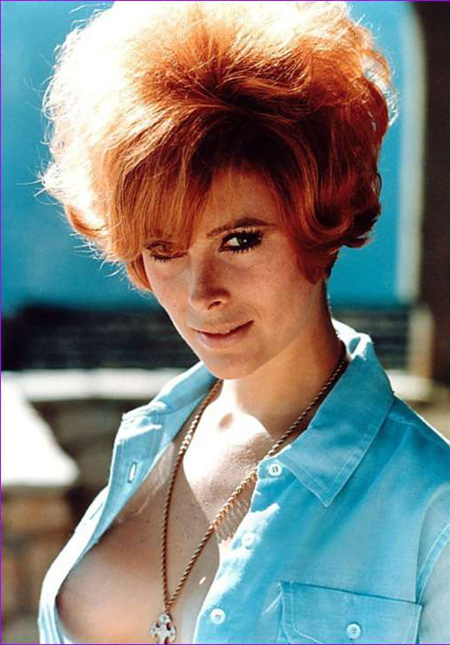
Now, that’s a Bond girl.

The villains have no design, other than financial mixed with some revenge (almost as bad as in Goldeneye, when the whole movie centered around Jonathan Pryce getting tv rights in China).  Worse, the picture is accompanied by a relentlessly cheezy Bond theme-meets-drum machine.

Finally, Bond is again emotionally involved with a woman (that’s two out of four for Brosnan), adding to the tiresome nature of the whole thing.  Bond’s attachment to a woman is rarely a good sign, On Her Majesty’s Secret Service notwithstanding.

Brosnan played the part one more time after The World Is Not Enough, demonstrating even more urgently that the Bond series needed a new face.  I had urged Jeremy Northam or Clive Owen, but the franchise knew better when it tapped Daniel Craig.

Stanley Kubrick’s last film opens with an affluent married couple – Tom Cruise, a doctor, and his wife, Nicole Kidman  – at a Christmas Party, during which he flirts with two models (and later revives the host’s prostitute girlfriend, who has overdosed) .  Meanwhile, Kidman gets tipsy in the hands of a mysterious foreigner who does his damndest to get her away for a quickie.  The experience leads to a later conversation, during which Kidman gets stoned and cruelly informs Cruise that she once was so overcome by desire for a stranger that she would have given away everything – husband, child, life – to be with the man.  Cruise is destabilized.  Stunned, he walks the streets of New York, bouncing from sexual odyssey to sexual odyssey.

Kubrick had no business making a film about modern sexual issues.  Having read a “Vanity Fair” piece on Kubrick shortly after his death, his disconnection with his subject matter is no mystery.  He appeared to have been a semi-recluse with no social skills, much less any romantic experience.  I was reminded of the incongruity of presumably celibate Catholic priests who advise young parishioners on marital issues.  Including sex.

Cruise and Kidman are like some 1950s couple dressed in 90s clothes.  After his wife’s revelation, Cruise is menaced by the recurring image of her being ravished by the stranger, as if a wife sharing her fantasy with her husband is some great cataclysm.  Yet, Cruise is strangely immune to the manner in which Kidman mocks and taunts him with her fantasy.  Her cold and unloving manner – she roils on the floor pointing at Cruise, doing her level best to castrate him with her secret – appears to be no problem for Cruise.  Rather, it is the image of someone sleeping with his wife that drives him batty.  As for Kidman, she’s just mean and icy. 

Then there is the plot, which is non-existent, thus making for a droning, tedious ride. Cruise does his best with what he’s given, and he is particularly effective early, when he performs the minuet of explaining to his wife why he would never bed the two models. She summarily shreds his rationale.  Kidman, however, is consistently awful throughout, forced to play drunk at the party, stoned during her humiliation of Cruise, and then, in a completely over-the-top bit, frightened by a sexual dream she experienced.  She hits all the wrong chords, her drunk being sloppy, her stoner being vicious, and her post-dream persona annoyingly overwrought.   This is a performance ruined by bad choices.

Kubrick’s other forays into the pastiche of modern sexuality are laughable.  The man who would get Kidman away for a tryst at the Christmas Party is an unintentionally hilarious Hungarian.  Any minute, you expect him to say, “I vant to suck your blood.”  Prostitutes who entice Cruise from NYC streets are Kate Moss hot, with hearts of gold to boot.  The famed orgy scene is chortle inducing (everyone wears goofy yet frightening masks).  I’ve seen more effective soft core on late night Showtime.

“ARE THERE ANY SNACKS AT THIS ORGY?”

If you were not inclined to laugh at certain parts, the film is accompanied by perhaps the most distracting soundtrack ever scored – a single note piano plinking that can destroy even the most stoic.

Visually, Kubrick is painfully reliant on one trick in his bag – an endlessly repetitive floating tracking shot.  On the plus side, he does make a passable New York City out of London.   But this was a bad way to go out. 

Image result for Hugo Scorsese

It won a slew of technical Oscars and was nominated for best picture, and it looks good. But it is  a long, hard slog. I’m certain there were quite a few kids who came out of this one realizing that 3-D ain’t all that.  I nodded off more than once. When I awoke, I was greeted with the same mundane dialogue and plodding story.

Martin Scorsese makes a Parisian train station the center of this “magical” tale of an orphan, a secret, and the movies, but after the magic of the imagery wears off, you’re still left with two hours of cloying depictions of the inhabitants of the station.

You’re also stuck with two of the least interesting child actors in film history.

This is the kind of children’s movie certain parents would love their children to love, along with trans-fatless cookies.  I’ll take Puss and Boots and Oreos any day.

The movie starts off trying your patience with an overlong introduction of clarinet music and scenes of modern Paris. We are then introduced to American screenwriter Owen Wilson and his nagging, dispiriting fiancee, Rachel McAdams. Wilson is nervous and nasally and a noodge. McAdams is flat out hostile to Wilson. The idea that these two would ever be engaged is absurd. I kid you not, McAdams says to Wilson, “You always take the side of the help.” So, Wilson is married to a monster, doesn’t seem to know it, and yet, Allen wants us to care about him.

Worse, McAdams travels with her ugly American parents, who are (gasp) Republicans, distrustful of the French and country club obnoxious.

Allen makes the modern so unpleasant you can’t wait for Wilson to be transported to the 1920s. Sadly, we have to go to the 1920s with Wilson. And he’s doing Woody Allen, but whinier. He meets F. Scott Fitzgerald, Cole Porter, Ernest Hemingway, Salvador Dali, and Gertrude Stein says, “I was just telling Pablo . . .”

The greats are condescending, self-satisfied characters and they lord their superiority over all. Allen does the same thing, hiding it in his puny, nebbish persona, so his portrayal of them makes sense.

This movie is terrible. Perhaps Allen can still make a good picture. Match Point (2005) was a revelation and Vicky Christina Barcelona (2008) was charming, but he’s about done, and the nomination of this movie as best picture is ridiculous. The nomination as best screenplay is an affront. Perhaps Allen’s digs at Bush and The Tea Party explain it, but if not, and the Academy wanted to give him an unwarranted accolade, isn’t that why the Irving Thalberg award was created?

Some gems: “How long have you been dating Picasso. I can’t believe I’m saying that.”

Hemingway: “Have you ever shot a charging lion . . . Who wants to fight!”

“I wouldn’t call my babbling poetic, though I was on a roll there.”

“500 francs for a Matisse? I wouldn’t mind getting five or six.”

“The present is unsatisfying because life is unsatisfying.”

Yeesh.

There are some funny moments when Wilson lapses into Seinfeldian chatter and the folks from the 1920s look at him funny. Adrien Brody is a hoot as Dali. The movie is also very pretty.

That’s not enough, notwithstanding the Academy and a 93% rating on Rotten Tomatoes.

John Frankenheimer’s Ronin was a primer on film car chases, equaling William Friedken’s set pieces in The French Connection and To Live and Die in L.A. and surpassing Peter Yates in Bullitt (though, The Seven Ups has the best car chase scene in film history).

In James Foley’s The Corruptor, you can see the worst car chase in all of film, a 25 mile per hour snorefest through the alleys of NYC’s Chinatown. One straight line, very low speed, back and forth, back and forth. One Adam 12 had wilder high speed pursuits.

The “chase” is indicative of Foley’s ineptitude with the action genre (Foley’s best work has been in the non-action category – Glengarry Glen Ross and After Dark, My Sweet. His principals – Mark Wahlberg and Yun Fat Chow – kill everyone in sight with handguns, loaded by their inexhaustible supply of clips. And if you are firing at Wahlberg or Chow with a machine gun, you will miss, but you will also break a lot of glass. Indeed, the opening action sequence is a shootout in a lamp and ceramic store.

So, the action is ham-handed and sadly, the script sucks. In a nutshell: Old vet meets young rookie, who has been assigned to Chinatown. Old vet tells young rookie, “You don’t change Chinatown. It changes you.” Or something like that, because Chow’s English is a little iffy, so the line may come across as follow: “Ru don chanse Chintown. It chanses ru.” Thereafter, we hear the patented “dow, dow, ding” of Chinese massage parlor music.

Chow’s principal strength is the ability to make his eyes go all crazy just before he’s about to shoot a bunch of guys.

Wahlberg, who can be effective when leashed very tight, merely sleepwalks through this muddle.

No matter the gravity of the historical event, be it the assassination of JFK or the Cuban Missile Crisis, Kevin Costner raises the hard question.

“What the hell kind of accent is that? Did Jim Garrison and Kenny O’Donnell have speech impediments?”

As to the movie, Thirteen Days is the historically inaccurate drama of the Cuban Missile Crisis told through the eyes of former JFK advisor Kenny O’Donnell, who most historians agree was more of a gofer and pal than a policy force. While it is not unreasonable to inflate the involvement of a tertiary character in historical drama, if you’re going to make stuff up, then do it smart. Make O’Donnell from Delaware, so Costner doesn’t have to butcher an accent. And make him interesting. As written here and played by Costner, O’Donnell is dull as dishwater, has poor political instincts and the temperament of a teen. Indeed, his primary motivation seems to be to have the Kennedys (as played by Bruce Greenwood and Stephen Culp) really, really like him (upon reflection, given the sycophancy surrounding the Kennedys, that motivation may be more in line with actual history than I surmised).

Blocky, uniform, anti-climactic, and predictable (it even uses black-and-white reverence to Camelot), you’d do much better with the classic teleplay The Missiles of October, which had William Devane as Jack and Martin Sheen as an angry, blustering Bobby.

Thirteen Days (2000) - IMDb

Cub-er, Cub-er, Cub -ah – er”

The only thing that recommends the film is Greenwood, who does a fine job conveying President Kennedy’s angst and his sense of isolation. Conversely, Culp’s Bobby Kennedy is portrayed as borderline stupid with impulse control issues (again, on reflection, maybe they got the history right there as well).

Even when the film does pick up a little speed (after all, it is the story of the nation on the brink of nuclear holocaust), Costner’s O’Donnell re-enters with his domestic issues and bizarre elocution, to grind it to a halt.

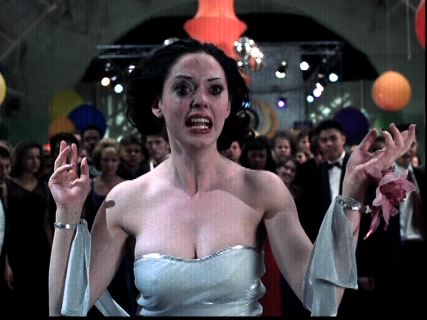
Jawbreaker. The hot chicks run the high school. The top hot chick is kidnapped by her three cohorts as a prank. She is accidentally killed in the process. The murder must be covered up. The veneer of high school politics is exposed in the process. And the queen bee (Rose McGowan) –

<

well, things go poorly for her.

This is a retread of the Winona Ryder-Christian Slater satire Heathers. Heathers, however, was funny. Jawbreaker is merely nasty, which is not all bad, but close. The film has a self-satisfied manner, constantly congratulating itself on its advanced perceptions of popularity and social standing, but never veering to far from the titillating trash it pretends to mock. I prefer the titillating trash without the condescension.

It does have a young Judy Greer who turned in a great performance as the cheated-upon wife in the Oscar-nominated The Descendants.

Matt Damon is a candidate for Senate in New York, pretty much a carbon copy of George Clooney’s presidential candidate in The Ides of March – smart, iconoclastic, liberal, not the kind of guy to admit he wouldn’t support the death penalty for the murderer of his wife. He finds his true love (Emily Blunt) before a big speech and then on a bus, and there is a real connection. But his path leads to higher things than true love. Sooooooooo . . . .

A bunch of angels (Anthony Mackie, John Slattery and eventually, ponderously, Terence Stamp) in ridiculous fedoras do all in their power to keep Damon away from Blunt and “on his plan.” And their power is impressive, except when it is not. So, they can freeze time and inject an idea into the mind of Damon’s campaign manager, but when Damon and Blunt are close, the best they can do is jam land lines and ensure that a cab won’t stop for Damon.

A decent premise (true love conquers all, even angels who have us on a predestined course) is destroyed by failure to let us in on the rules of what angels can do and cannot do (apparently, their powers are weakened near water, ala’ the aliens in Signs). Worse, the “Mad Men” hats the angels wear are actually powerful. They can open doors. Not in the “a well dressed man can get the right doors opened” way but in a “wearing this hat can get doors of teleportation to open.” And before you can say Ben Braddock, Damon is interrupting Blunt’s wedding.

Image result for Matt Damon The Adjustment Bureau hat

“How do I look in this? Really.”

Avoid.

Reese Witherspoon had to come from somewhere, so why not a high school socialite world remake of Dangerous Liaisons, with monied prep school Manhattanites in the roles of French courtesans?

The picture is neither adept enough to be engaging or camp enough to be funny. It also includes a cringe-inducing courtship between Ryan Phillipe (as Valmont) and Witherspoon. Phillipe, tasked to deflower the chaste Witherspoon (she is the daughter of the headmaster), becomes “totally infatuated” with her. Why? Because she makes him laugh. How? Because during a car ride, she made faces at him by sticking her tongue out and screwing her nose up and using her fingers on the top of her head to simulate the look of a lunatic/horned beast.

Oof.

Hollywood conceits come in many forms. In the Denzel Washington/John Lithgow film Ricochet, the screenwriter presumes he can replicate the idiom of the inner city. There is a scene with Washington, as the good black man who “made it out” and Ice T, as the bad drug lord who is still “in.” Their exchange is gussied up Shaft. The screenwriter even concluded the film with Washington saying “You can kiss my black ass!”

The screenwriter of Ricochet?

Steven E. de Souza (@StevenEdeSouza) / X

So, Hollywood’s sense of urban culture is lacking. But you’d think it would have a better handle on places closer to its heart, like suburbia. Think again. Hollywood sees the suburbs as a vast wasteland, a place for vacuity and the spawning of disgruntled screenwriters. Hollywood’s grasp on Maple and Main is no more firm than its grasp on “the ‘hood.”

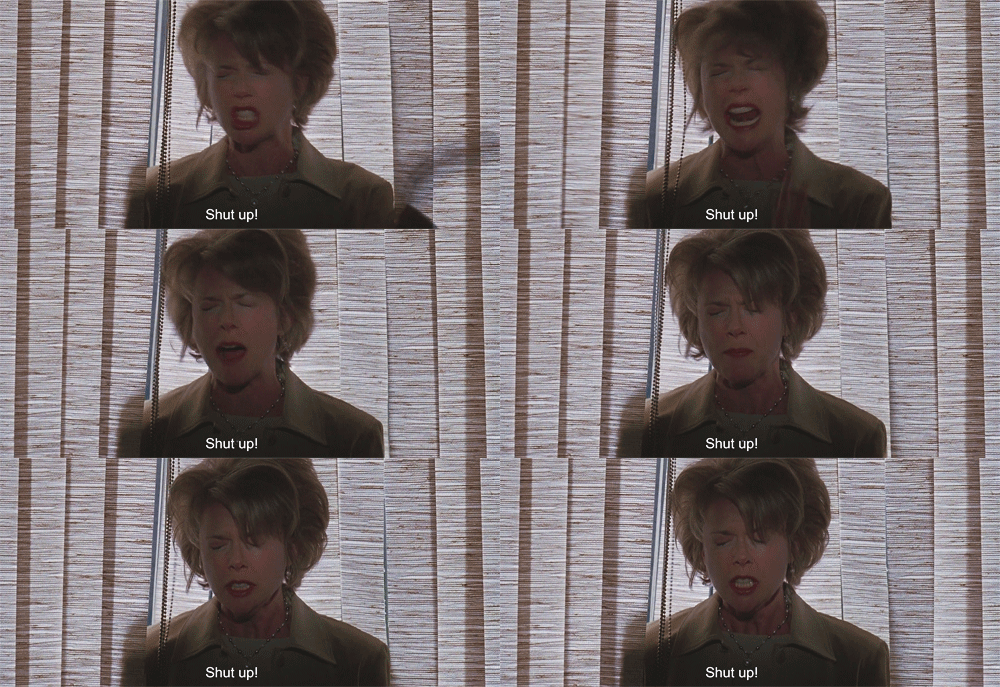
Which brings me to American Beauty, a false film of suburban decay. Kevin Spacey has a midlife crisis, though it really isn’t a true midlife crisis, because he is married to Annette Bening, and she is so cartoonishly gruesome that Spacey’s crisis seems less a subject of introspection than one of survival. Bening approaches her character as Martha Stewart on methampehtamine (and that’s the joke – get it? – because Martha Stewart is so insidious). She is so outlandish that any acting out on the part of her husband and daughter seems ho hum. And then there is the tranquilized housewife neighbor, and the homophobic (or is he?) Marine neighbor, and the disaffected, let-down teens. You’ve seen it all too many times to be touched.

What is good about the film? A few things. It ends tidy. Spacey plays decidedly above the material (though, being the only empathetic character, he is difficult to judge because you beg for his return during every one of his absences).

But what is bad is really quite awful. The characters are abused rather than drawn. The use of Bening as Mothra the Suburban Scene Eating Hydra not only minimizes most character reaction, but it seems cruel.

image

Bening is so demonized and dehumanized – all for the illumination of Spacey – that you pity her.