Archive

Historical

Image result for Saving Mr Banks

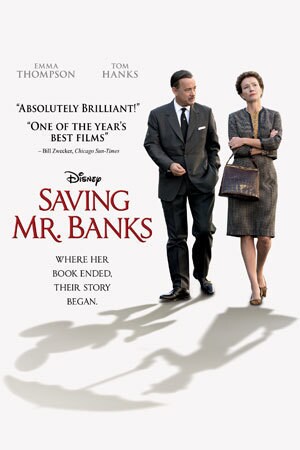
The writer of the Mary Poppins books, P.L. Travers, was apparently such a pain in the ass that, according to her grandchildren, she “died loving no one and with no one loving her.” As played by Emma Thompson, Travers more than fits this bill as she is whisked to Hollywood against her better instincts to be wooed by Walt Disney (Tom Hanks) in an effort to adapt her stories to the screen. Travers’ prickliness and exactitude with Disney and his team (Bradley Whitford, Jason Schwartzmann and B.J. Novak, all very good here) is the best part of the film. Unfortunately, director John Lee Hancock (The Blind Side) keeps interrupting the best part with flashbacks to Travers’ childhood, and in particular, her relationship with her whimsical, alcoholic father (Colin Farrell).

I understand the juxtaposition. The audience is supposed to learn what has embittered this awful woman. But you really don’t care (she’s such a witch that motivation is irrelevant), and you also begin to resent the interruption of the more interesting creation of a film.

Worse, the technique is cloying, leading to a sugary-sweet ending that has Disney melting the ice encasing Travers’ heart. In reality, Disney and Travers ended their relationship in acrimonious fashion, with Disney fed up with her stubborn nature, and Travers so offended she refused any further association between the company and her books. The disharmony is alluded to in the film, but it is near-blotted out by Travers’ copious tears as she undergoes a sort of catharsis at Grauman’s Chinese Theater.

Those were actually tears of fury.  From Travers herself:  “As chalk is to cheese, so is the film to the book. Tears ran down my cheeks because it was all so distorted. I was so shocked I felt that I would never write—let alone smile—again!”
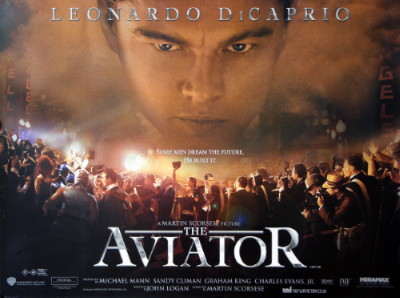
 

Martin Scorsese’s critically acclaimed biopic of the young-to-middle age Howard Hughes (Leonardo DiCaprio) has much to recommend it. It was the first role that established DiCaprio as a force, and in inhabiting the kinetic, driven and tortured character of Hughes, he was able to shuck off the callowness of his characters in Titanic (Jack London: Teen Wolf!), The Beach and Catch Me if You Can. His time to become a leading “man” had arrived (his attempt at a mature character in Gangs of New York was undermined by the garish nature of the picture, Daniel Day Lewis’s battering ram of a counter-performance and what appeared to be DiCaprio’s own discomfort in the role).

The film is also visually stunning. Scorsese is usually the king of movement in tight spaces, but the sky liberates his eye, and the scenes of flying (there are five) are vast and poetic, and for the ones that end in crashes, utterly thrilling.

When Scorsese is on the ground, the film does not suffer.  His glitzy pre-war Los Angeles, where the parties are populated by the likes of Errol Flynn (a jaunty Jude Law) and Ava Gardner (a tough, motherly Kate Beckinsale), are eye-popping.

Finally, the choices of Scorsese and screenwriter John Logan (Gladiator, Sweeney Todd, Skyfall) are adept. Rather than focus on the breadth of Hughes’s life, they opt to show him at his most vibrant, while giving ever-increasing glimpses of the madness that would grip and eventually consume him later in life. For an almost 3 hour film, it’s clear they could have shot for Hughes in the 70s, surrounded by a Mormon coterie and the madness that it protected. By skillfully giving us the symptoms, they economically finish the story.

So, what’s not to like? While DiCaprio and Alan Alda (playing Hughes’s nemesis, the slimy Senator Owen Brewster) were rightfully nominated, though they did not win, so too was Cate Blanchett as Hughes’s love interest Katherine Hepburn, and she actually took home the Best Supporting Actress statuette.

To call her performance cartoonish is a gross understatement.  It’s manic, ludicrous mimicry.


Not just historically inaccurate, but outright hostile to the facts, Mel Gibson’s Braveheart matches its puerile fantasy with cheezy romance, splatterfest battle scenes, and cartoonish characters (Patrick McGoohan plays King Edward Longshanks as Ernst Stavro Blofeld and Peter Hanley plays his son as if auditioning for La Cage Aux Folles). Then, there is the James Horner score that brings you back to the ye olde highlands of Busch Gardens. Naturally, like Robert Redford and Kevin Costner before him, the Academy honored an actor turned director with an undeserved Best Picture statuette. But Ordinary People and Dances with Wolves are merely pedestrian. Braveheart is bad through and through and often, excruciatingly so.

On the plus side, when you decide to rewrite history, you might as well give William Wallace a haircut straight out of Duran Duran.

Image result for braveheart

Hungry like the wolf for FREEEEEDOOOMMMMM!!!!!”

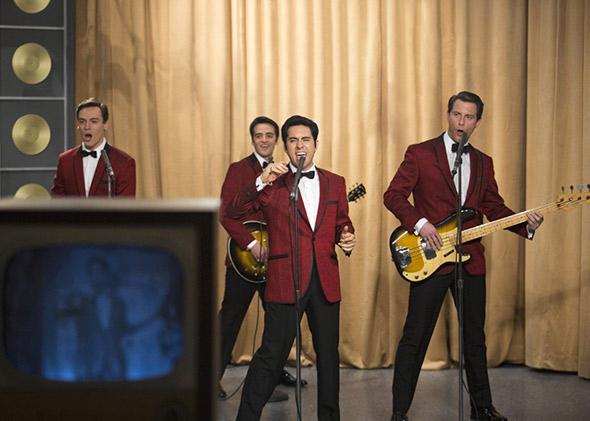
Jersey Boys, the movie, directed by Clint Eastwood, reviewed.
Having re-watched Walk the Line, I then took my son to go see Clint Eastwood’s Jersey Boys, the film version of the “smash!” Broadway hit chronicling the rise and fall of Frankie Valli and The Four Seasons. He liked the picture. I did not. Let me count the ways.

1)      You couldn’t pick a worse director for this project than Eastwood. Music needs to be shot with energy and verve. Clint’s camera work is fixed and unimaginative. Basically, he shot Frankie Valli much like he shot J. Edgar Hoover. Close up. Then farther away. Then a shot to an admiring audience.

2)      The performances mostly run from pedestrian to dreadful. In the latter category, John Lloyd Young as Valli sports a Broadway pedigree and little else. His “go to” move seems to be consternation, be it at the loss of a gig, $1 million or a daughter. Vincent Piazza (Boardwalk Empire) is so goombah you half expect him to hawk Ragu sauce.

3)      The film can’t decide on being a whimsical tribute to the Broadway show or a dark, cautionary tale on the perils of stardom. Tonally, it’s schizophrenic.

4)      One theme in particular – the omerta of tough Jersey guys – is severely undercut by the fact that these tough Jersey guys are about as scary as The Sharks and The Jets.   In West Side Story, no one was asking you to be scared of ballet dancing toughs; it was a fantasy, delivered in dance, where even the violence was poetic. Here, their bond and hardscrabble roots are important, yet the whole existence seems comedic and pleasant.

5)      134 minutes!!!

6)      The makeup here was worse, if that’s possible, than in J. Edgar, and I didn’t think that could be possible.

My son countered that I didn’t like the music and that queered the film for me. But I didn’t like the music in Dreamgirls, and that was a perfectly fine film.

If you want to see the antithesis of this picture, rent Tom Hanks’ That Thing You Do, which captures the excitement, fun and then, the letdown, of a one-hit wonder band.

So, why one star?  Filial loyalty and the very funny turn by Mike Doyle as producer Bob Crewe.

As biopics go, this one is near the top, a sprawling, textured story of fame, fall, passion and redemption that can’t avoid cliche’ but never nears cheezy.

Joaquin Phoenix doesn’t embody Johnny Cash so much as incorporate him into his own personality. His performance feels roots deep rather than technically proficient (see Jim Carrey as Andy Kaufman in The Man in the Moon for an example of the latter), enhancing your investment in Cash’s plight. Phoenix does all his own singing and his vocals are deeper and more frenetic than those of Cash (his live version of “Cocaine Blues” at Folsom Prison is more fevered and angry than Cash’s performance), but they feel real, especially when matched with Reese Witherspoon’s brassy bid as June Carter. James Mangold’s film is ostensibly the love story of Cash and Carter, but his attention to the music is the glue to the picture. The supporting players in the roles of Jerry Lee Lewis, Roy Orbison and Elvis are all musicians also doing their own singing. And the scene of Cash’s audition is notable not only for the tension and the dissertation on what goes into music people want to listen to, but for the riveting turn of Dallas Roberts as producer Sam Phillips. Talk about making the most of your one scene.

If there are weaknesses, one is self-inflicted and one is a related injury. Cash’s demons stem from the childhood trauma of his brother’s death, after which he felt unworthy and guilty. His father (Robert Patric) didn’t help when immediately after the funeral, he yelled at a grieving little boy, “he took the wrong son!” Now, perhaps this happened. But even if it did, the screenwriter has to jettison historical accuracy for good sense. It’s too incredible, too jarring, to believe. Worse, it became the centerpiece joke of the Walk the Line spoof, Walk Hard: The Dewey Cox Story.

The effect is much like that of Austin Powers on the prior James Bond films, changing them in your mind from occasionally fun and campy to wholly ridiculous. Another nit is the unfair treatment of Cash’s first wife, who is portrayed as so shrill and shrewish it feels unfair.

Image result for The Normal Heart HBO

Ryan Murphy’s (Glee, American Horror Story) adaptation of Larry Kramer’s semi-autobiographical play about the outbreak of AIDS in New York City circa 1981 is a mixed bag, often poignantly moving but more often numbingly repetitive. The film does not shy away from the cruelties of the disease and the inaction that followed its introduction, echoing the source material, an urgent polemic written before there was even a test and the disease was called GRID (Gay Related Immune Deficiency).  It is an activist story for a perilous time (the play was produced in 1985) and the immediacy of the stage.  Under Murphy’s direction, Mark Ruffalo, as New York City writer Ned Weeks, is largely utilized in a series of stem winders and broadsides against the Koch and Reagan administrations, the insouciant gay community and in particular, his fellow board members of a nascent advocacy and care group. Weeks’ passion is noteworthy but by the end of the picture, you fully understand the frustration of his compatriots.  His tactics (a combination of haranguing, attacking and outing) are such that they can’t get a hotline set up without Weeks sneering or warning about the next Dachau (Kramer himself would end up being instrumental in the founding of Act Up, which was decidedly more confrontational and, to be fair, effective).  A missed opportunity of an actual exchange, for example, is the fact that Weeks is affluent, making his offering of the livelihoods of all of his co-activists (one of whom is in the military) a rather cheap and easy proposition.  This factor is unexplored beyond a toss-off comment.

Ruffalo is joined by several other notables (including Julia Roberts as a doctor on the frontlines and Taylor Kitsch as his more measured activist friend), all of whom have their own speeches, all movingly delivered but all awkwardly stagey.  When they occur, we are meant to listen respectfully to the sermons, which are heartfelt, often spoken to bigots and/or bureaucrats (poor Dennis O’Hare, who, after this and Dallas Buyer’s Club, is a cottage industry of unsympathetic pencil pushers in AIDS dramas) or screamed at the heavens, and wholly devoid of nuance.  As noted by Frank Rich in his review of the play back in 1985, “the playwright starts off angry, soon gets furious and then skyrockets into sheer rage . . . Some of the author’s specific accusations are questionable, and, needless to say, we often hear only one side of inflammatory debates. But there are also occasions when the stage seethes with the conflict of impassioned, literally life-and-death argument. … The writing’s pamphleteering tone is accentuated by Mr. Kramer’s insistence on repetition – nearly every scene seems to end twice – and on regurgitating facts and figures in lengthy tirades. Some of the supporting players … are too flatly written to emerge as more than thematic or narrative pawns. The characters often speak in the same bland journalistic voice – so much so that lines could be reassigned from one to another without the audience detecting the difference. If these drawbacks … blunt the play’s effectiveness, there are still many powerful vignettes sprinkled throughout.”  Murphy’s film is nothing if not faithful to Rich’s evaluation.

When Murphy moves away from the politics of the disease and human relationships, the picture is much stronger. The relationship between Weeks, who is reticent about intimacy and the gay world’s sybaritic nature, and his lover Felix, played by Matt Bomer, is an exchange that offers a view into the difficulties growing up and being gay. The scene where Ruffalo demands that his straight and supportive brother (Alfred Molina) accept that they are essentially the same is the best one of the film, as each character is given a  voice.  And The Big Bang Theory‘s Jim Parsons delivers a beautiful eulogy for a friend and by extension, for all the “plays that will not have been written, dances that will not be danced” that is heartrending. Sadly, these scenes are the exception rather than the rule, and the watching of The Normal Heart eventually lapses into a very unfortunate place for entertainment – duty, a film you “should” see rather than one you would necessarily want to.

A game performance by Chadwick Boseman cannot overcome every sports, race, and mythic America trope or Harrison Ford’s schmaltzy Oscar-bait bid as Branch Rickey. Brian Helgeland’s script is a bore, and the performances feel like civic duty. If you want to watch a richer, more interesting baseball film with a numeric title, try Billy Crystal’s 61*.

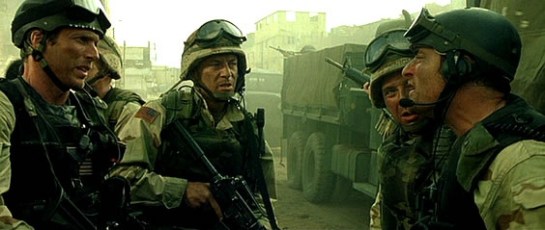
Ridley Scott’s depiction of The Battle of Mogadishu communicates the warrior culture, the confusion of urban battle, the domino effect of error therein, and the strain on its combatants. In 1993, after upwards of 300,000 Somalis perished through civil war-induced starvation, the U.S. sat on the ground in Somalia to support U.N. humanitarian efforts while attempting to capture the warlord Aidid. The movie recreates a mission to capture some of the warlord’s top lieutenants, a mission that unravels after two Black Hawk helicopters are shot down in the city and the goal of quick extraction transforms into a desperate rescue to the crash sites as the city inflames.

The film is astonishing in several respects. The mission itself is complicated, and in support, there are four squads (“chalks”), of which Josh Hartnett commands one, with all four being under the direction of Jason Isaacs; a motorized convoy led by Tom Sizemore; numerous helicopters, including two piloted by Ron Eldard and Jeremy Piven shot down by RPGs; a single helicopter acting as spotter for all action on the ground (that spotter being Zeljko Ivanek); and a command center helmed by Sam Shepard. Included is this vast ensemble cast is Eric Bana, Ewan McGregor, William Fichtner, Iaon Gruffud, Orlando Bloom, Hugh Dancy, Nikolaj Coster-Waldau, Tom Hardy, and Ty Burrell (it is a testament to the vagaries of a Hollywood that a post-Pearl Harbor Hartnett got his name above the title during the closing credits). Despite all of these moving parts in the midst of a confusing, hellish street-by-street battle, the viewer is never confused. You know who you are looking at, why they are there, and what has gone wrong with the objective at all times. Lesser directors can be flummoxed by a minor shoot-out in a western town.

The film won Oscars for sound editing and sound mixing. Given the melee, changes in topography and vantage point, it is nothing less than aural masterpiece.

Some critics took Scott to task for reducing the Somalis to props and/or cannon fodder. Much of that, however, is unavoidable given the disparity in firepower and casualties (18 American dead and 80 wounded to an estimated 1,500 to 3,000 Somali casualties) and the focus of the Mark Bowden book upon which the flick is based (the Somali view is barely represented and boiled down to a bromide in the film – “there will always be war . . . killing is negotiation”).

If there is a flaw, it is in Scott’s need for a message.  There is no political angle, and the aftermath is equivocal. On a broader scale, some might say we should never be in such a place, others might disagree but insist upon a defined goal, and still others decry the abrupt withdrawal after the battle as having elevated optics over lives (Osama bin Laden himself opined that the withdrawal showed American weakness). I’m perfectly happy with a conclusion that supports any stance, but happier with one that leaves a conclusion to the viewer.  But Scott fixes on an ultimate theme: that battle is first and foremost about the man next to you. After two-and-a-half hours of white-knuckle survival with the soldiers, the message is more than delivered. But just in case we missed it, Bana says exactly that to Hartnett.  Clunk.

Image result for Rush movie


Ron Howard’s biopic of the intense but short rivalry between Formula 1 Austrian driver Nicky Lauda and Brit James Hunt is a textbook Hollywood film. The characters are compelling, the milieu is exciting and the pace is perfect. Daniel Bruhl, as the icy, methodical Lauda, and Chris Hemsworth, as the sybarite, daring Hunt, play their undemanding roles with vigor, but Howard’s depiction of the danger and thrill of Gran Prix racing is the star, and following the two drivers through the treacherous straits of the ’76 season is a kick. Howard likes to mine various subcultures, but the results are often overburdened by the director’s earnestness. The Paper was nothing less than a love letter to a journalism long since dead. Apollo 13 is as much about the geekdom of NASA as the three stranded astronauts. Backdraft‘s offering of every firefighting insiderism couldn’t overcome the vacuity of Billy Baldwin and a preposterous story, but you could feel Howard’s awe of these urban saviors ooze all over you. Rush, however, has the advantage of being written by Peter Morgan (The Queen, The Last King of Scotland, and Howard’s Frost/Nixon), who is too canny to allow for veneration and too economical to let sentimentality linger for very long.

Review: Captain Phillips (2013) – Empty Screens
Director Paul Greengrass is adept at action and tension, as proven by the Bourne films and United 93. His quick-cut, frenetic, hand-held style is distinct, and the viewer is drawn to the edge of his seat in short order. A drawback, however, is that characterization takes a back seat to drive. In the Bourne films, the character is a cypher. He doesn’t even know who he is, so backstory and motivation are easily jettisoned. In United 93, as players in a great national tragedy, the characters are already known to us, and the story is more about how institutions respond to great crisis than individuals.

Captain Phillips is about two men – Captain Richard Phillips (Tom Hanks) and the pirate who takes his ship, Abduwali Muse (Barkhad Abdi), but what Greengrass reveals about each man is minimal. The former is quiet and somewhat worried about the world in a generic way (we learn this in a brief ride to the airport with his wife, a completely wasted Catherine Keener), and the latter is poor and engages in piracy at the behest of powerful men. Armed with these facts, Greengrass rapidly recreates the hijacking of Phillips’ ship, his kidnapping and his eventual rescue by Navy Seals. It’s all very exciting, if repetitive, as Phillips regularly advises or redirects Muse. But the picture aims no higher. One can be thankful that writer Billy Ray (The Hunger Games) avoids the “you and me, we are not so different” twaddle that usually surfaces in culture clashes, but the tedium of Hanks’ New England accent constantly warning, “you don’t want to do that” isn’t an appreciable step up.

The film has been criticized as whitewashing Phillips’ actions, but in my review of the charges against him, I find they were leveled by members of his crew suing the company, and Phillips acted as a witness for the defense, so I’m inclined to chalk the lame allegations to self-interest.

Worse than any polishing of Phillips is the script’s failure to answer a question that nagged me throughout the film. The cargo ship has strict procedures, locks, hoses, 1-800 numbers to call, flares, all to ward pirates off.  Yet, it lacks a single gun or any armed personnel. Why? The writer needed to clue us in as to the reason for this omission, especially with the visual of such a small and undermanned skiff approaching a massive, modern behemoth of a cargo ship.

I mean, look at this —

I’m not saying guns should have been on the ship.  I don’t know.  But to not even address the issue in the script?  Huge mistake.