Archive

Drama

image

There’s not one thing in Antoine Fuqua’s boxing rise-and-fall epic that even nears original, but cliche’ does not always have to be hackneyed, and through inventive camera work, all-in performances by Jake Gyllenhaal (as the Hell’s Kitchen boxer who loses it all) and Forrest Whittaker (playing the wise and world weary trainer), a captivating turn by the child actress playing Gyllenhaal’s daughter (Clare Foley) and expert pacing, assisted by a jumped up soundtrack, the thing works and works well.  There are problems. Gyllenhaal’s fall is a bit too protracted, and as hard as she tries to be working class, Rachel McAdams simply lacks the necessary grit.  They tried to dirty Amy Adams up in another boxing movie, The Fighter, and that too was a bridge too far.  These actresses don’t evoke the street, unless that street has a cul-de-sac.

David O. Russell’s American Hustle was an over-heralded, stream-of-consciousness mess, but it was nominated for Best Picture, and I was a huge fan of Silver Linings Playbook, so the watching of Joy was obligatory. It was not an altogether unpleasant experience given Russell’s command of the camera and his early sense of pace. Russell briskly lntroduces us to Joy Mangano, a little girl and then a young woman destined for great things, if only she weren’t consistently thwarted by her lunatic family, a coterie of misfits and weirdos so peculiar they veer into Tim Burton territory. Still, with her one big idea – a self-wringing mop – she perseveres to become queen of The Home Shopping Network, though her journey is an exhausting “one step forward, two steps back” ordeal so arduous, even Jennifer Lawrence’s pluck and a kick ass Rolling Stones song (“Stray Cat Blues”) can’t make the resolution tolerable. One gets the sense Russell knows his audience is bored, because he appears to get bored, veering off into a resolution so off-kilter (Lawrence faces down her business foe in Texas, cutting her hair and donning leather, after reviewing some documents in a “Voila!” moment) it is laugh out loud funny.

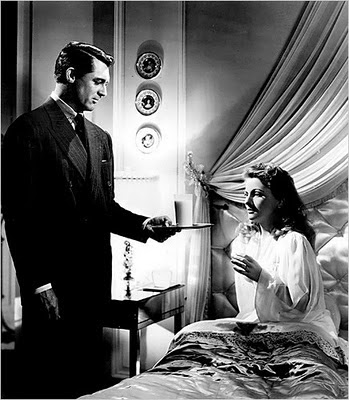
Image result for Suspicion Hitchcock

And those stars go to Alfred Hitchcock’s deft hand and Cary Grant’s irrepressible charm. Grant plays a society cad who gloms on to spinster Joan Fontaine, who impulsively marries him out of rebellion and passion. She soon learn Grant, charming though he may be, is a liar, a thief and a lay-about gambler, and his debts may be propelling him to more capital crimes. The essential tension, however, is wasted. The deck is so stacked against Grant that when he professes “it was all a misunderstanding”, you’re left disappointed at the expenditure of time and contemptuous of Fontaine, who just seems like a ninny. If Grant could not commit the capital crime, the studio sure did by insisting their star male lead could not play a wife murderer.

The film was nominated for Best Picture, Fontaine won Best Actress for her very delicate, frail but stagey performance which does not travel, and in an interview with Francois Truffaut, Hitchcock summed it up when he reported the actions of a producer who initially took every scene out that indicated Grant was a murderer, leaving a 55 minute product.

Anyone interested in Truffaut’s interviews with Hitchcock, enjoy.


Image result for shotgun stories

Anyone who watches movies knows that some of the greatest offerings of falsity come in the package of authenticity, and this is never more so than when a filmmaker takes his shot at rural or back home America. The pitfalls are many, and invariably, films about the small town succumb to oppressive nostalgia (Hoosiers), salt-of-the-earth worship (Promised Land), the presence of an impossibly attractive lead as he or she slums (Mel Gibson in The River, George Clooney in The Perfect Storm), cutesy “we’re jes’ folks” condescension (Passion Fish), amped up mythology (Out of the Furnace) or just plain old moronic messages, like money doesn’t buy happiness or home is where the heart is or safe sex is the best sex.

There are exceptions (Billy Bob Thornton’s Sling Blade, Carl Franklin’s One False Move, Debra Granik’s Winter’s Bone), but they are rare and they are not current. In Mud, Take Shelter, and this film, a story about two modern Arkansas families drawn into a violent confrontation upon the death of their shared patriarch, writer-director Jeff Nichols cements that he can translate the patterns, pace and feel of the small town like no other. The actors portraying the family members are natural and unburdened by archetype, and the town itself is not presented to you as a metaphor or cautionary tale, just a town.

What Nichols does with actors and setting he achieves with tone. The families are seemingly in as safe a place as you can be, but when their animosities surface, their very environment becomes foreboding, and the pressure mounts accordingly. As the calamities befall them, there are no revelations or Hollywood speeches or screenwriter dot-connecting. Nichols is content to let you be the judge of what it all means.

This was Echol’s first film, and that may explain its brevity (about 90 minutes). The result is some backstory that is a tad rushed, but nonetheless, this is a gripping, thoughtful picture.

image

Screenwriter Diablo Cody made a big splash with the clever Juno, and showed real growth with the acid Young Adult. But that was a while ago.  This trite stinker, in the mold of so many dramadies about the travails of rich families as they negotiate the perilous path of monied suburbia, is a massive step backwards.

Cody offers Ricki, a talentless front woman for a cover band who has come home to her estranged, affluent ex-husband and adult children after a long hiatus.  She chews with her mouth open, says dirty words, and attends a family wedding.

But hey, it’s Meryl Streep, so we’re okay, right?

Right?

Wrong.  Streep is just terrible, whether slumming as the hip cast-off or leading the worst bar band ever. She’s in-authentically grungy and gratuitously down-to-earth and when she visits her erstwhile family, led by the kind ex-husband (Kevin Kline), it is cringe-inducing, not because of the fish-out-of-water stuff (this is the kind of movie where the denizens of the tony enclave practically say, “Well, I never!”), but because there’s not a word of it that feels real.  There is no way Streep’s character would even be a distant cousin to these people, much less the former matriarch.

Kline has, of course, remarried a protective earth mother type who raised the abandoned children while Ricki honed her craft covering Tom Petty.  Others who Ricki abandoned include a nice son about to get married to the most stuck-up bitch imaginable; a fragile daughter who has had a breakdown because her marriage of three seconds failed (you’d think she’d been a captive of Boko Haram, so extreme is her distress); and a son straight out of gay central casting (he is furious because Ricki called his gayness a phase and voted for W . . . twice!)

All of which would be humdrum but bearable twaddle save for the fact that Ricki and her shit band play about 7 numbers in this picture, including a version of Wooly Boolie so bad we could have won the war on terror years ago had it been utilized at Guantanamo.

Worse, Ricki’s version of Springsteen’s My Love Will Not Let You Down starts more like a Quarterflash tune and ends with your head in a bucket.

After August: Osage County and this, I am not saying Streep is at that Pacino point, where she thinks she can just fart in a bottle and call it potpourri.

But she’s veering to the off ramp.

Least likely sentence I ever expected to write?  Rick Springfield, who plays the lead guitarist for the Flash and Ricki’s love interest, deserved better.


 

image

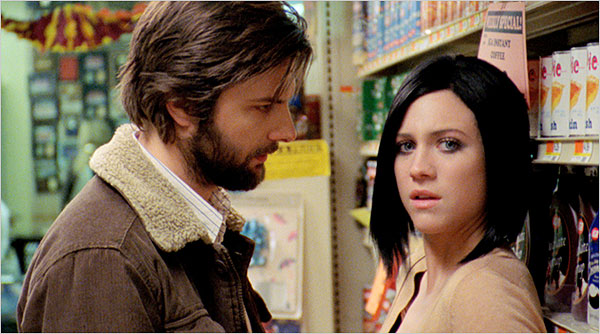
In the vein of “awful people who became awful because they suffered childhood trauma” family drama movies, this one is not half bad. That’s mainly due to Adam Scott, who is one of the more versatile and under-appreciated actors working today.  Scott plays the damaged, stuck in the hometown older brother who picks up his younger brother and the brother’s girlfriend from college and proceeds to fall in love with the latter. Scott is a depressive, an alternately cruel and then apologetic anti-hero, who maligns the girlfriend as a whore who will hurt his naive little brother. The problem is that she succumbs to his damaged entreaties, thus partially cementing his earlier uncharitable appraisal.

There is the obligatory childhood trauma and the big reveal, and it could all be so pat, except for Scott’s ability to communicate real suffering and writer-director Lee Toland Krieger’s insistence on taking these characters seriously instead of using them as charming archetypes to condescend to the audience. More to the credit, there is no wrap-up or deeper understanding. It starts messy and ends up hopeful but still messy, which is commendable.

There are problems.  The hometown is overpopulated by distinctive characters, the father (J.K. Simmons) is too seminal to be so underdeveloped and the hipster soundtrack is now so obligatory it borders on self-parody.  Still, a worthwhile watch on a rainy Saturday.  Thanks, Xmastime.

image

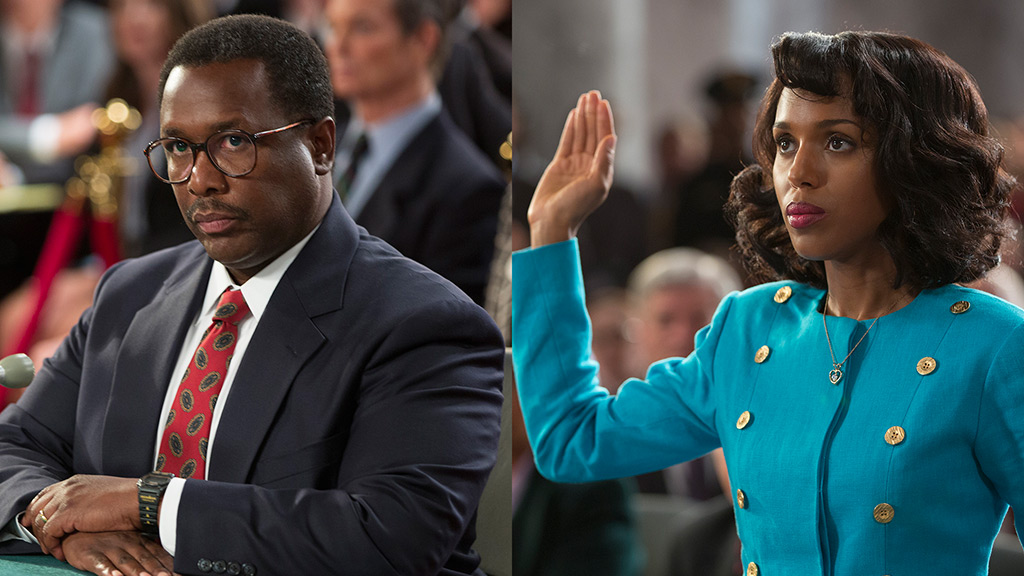
Execrable.  Anita Hill as Jesus Christ, Clarence Thomas as Impenetrable Sphinx, the story so stacked in her favor it’s a liberal wet dream. Then, there is this laughable coda where the hard charging female Kennedy aide says to the more judicious female Biden aide, “who’d you believe, him or her?” like any response other than “her” was possible given the hagiography that preceded the exchange.

Not only is the mythology laughable (apparently, Anita Hill will be replacing someone on currency sooner than we think), but the presentation is lackluster and vanilla.  It’s not Kerry Washington’s fault that Hill is so dull.  She’s written as nothing more than a platitudinous victim, and her emotional response to any given development is a self-pitying, dew-eyed disappointment in how mankind has failed her.  Wendell Pierce’s Thomas is no better, occasionally rising above catatonic, always in the corner, ruminating, obsessing, zzzzzzzzzzz.  The Democrats are hands-tied, decent truth-seekers, the Republicans hysterical street brawlers, not a scene surprising or enlightening.

It’s a shame.  The story of Hill and Thomas is, in the seams, the story of two people who worked together, she relied on him for advancement, but clearly developed a grudge at some point.  He said some Long Dong Silver shit to her, and then she, for whatever reason, took her shot at him on the eve of his confirmation, with the naively hopeful guarantee of anonymity.

And then wham!  She’s outed (a mere anonymous statement will not stop the Hope from Pinpoint, Georgia) and the process takes them both to places they never imagined they’d be, where he must play a hard race card against a cheap smear, and she must feign dramatic victimhood.  Their champions bloody and bruise the protagonists.

She tried a back alley stilleto and it wasn’t enough. He replied with a daylight, streetfront 2×4 and overcame.  They both became emblems of something larger, which, given the picayune roots of their antagonism, is the essence of the tragicomic.

Could have been a great movie.

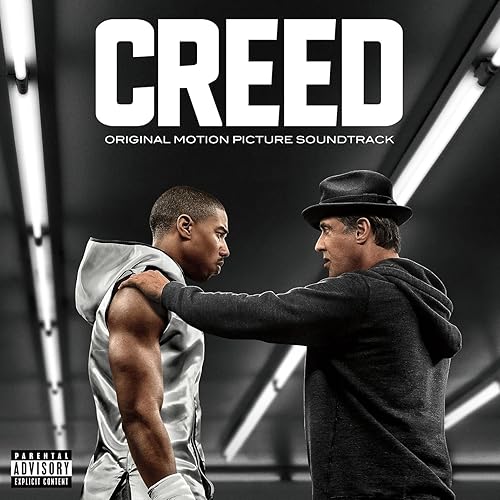
Image result for Creed

In the hullabaloo about the dearth of people of color represented as Oscar nominees, Creed was identified by some as a glaring omission, not only for director Ryan Coogler (Fruitvale Station) but actor Michael B. Jordan (Fruitvale Station, The Fantastic Four). Sylvester Stallone was also awarded a nomination for best supporting actor and the critics scored the film a 94% on rottentomatoes.

Everyone appears to have lost their fool mind. The movie – which chronicles the son of Apollo Creed as he vies for the title – veers between the deathly dull and the ludicrous. There are four – count ‘em, four! – montage scenes of Jordan training, one of which has him being chased down a Philly street in slo-mo by kids on dirt bikes and trikes, howling outside the window of Rocky, who looks embarrassed by the spectacle.  It’s one of the most bizarre images I’ve seen in a mainstream movie. You really have to see it to believe it. There are also some dizzying fight scenes. That’s all of the recommendations.

Jordan is given the thankless role of the young up-and-comer, plagued by the relationship he never had with his father. Except, he’s a rich kid, plucked from a group home by his mother (Phylicia Rashad) and well-ensconced at Smith Barney or some such firm. It is on the weekend he laces up and goes to Tijuana to box. Why? Who the hell knows? As played by Jordan, Adonis Creed is a medium cool dullard, drawn to Philadelphia to train with Rocky by sheer ennui. He doesn’t seem to care much, so why should we?

When he gets there, he finds ole’ Rock shambling about a restaurant. Rocky won’t train him, but then relents, and then Rocky doesn’t want Adonis to take the big fight prematurely, but then relents, and then Rocky gets cancer and won’t get treatment, but then relents. All this relenting is done in that same barely articulable monotone Stallone has honed over the years. I guess I can see how the protestors at the Oscars felt. If you’re gonna’ award Stallone for this phone in performance, how about all of us for the larger piece of shit?

Along the way, we get such gems as Rocky putting Adonis in front of a mirror, counseling, “That’s the toughest opponent you’re ever going to have to face.” There’s also a unpersuasive love story between Adonis and a Lisa Bonet look-alike – they emit as much spark as siblings.

Stinkeroo.

Steve Jobs [DVD]

It says a lot that director Danny Boyle and screenwriter Aaron Sorkin can hold your attention to a picture consisting solely of conversation. Yes, Sorkin and David Fincher did the same thing in The Social Network, but there, the characters were developing before your very eyes, and things were happening – a revolutionary product was being developed, friendships and rivalries were being established, complaints were being lodged, people were being screwed, and litigation was ongoing. Here, we meet Steve Jobs pretty much fully formed, at the peak of his first rise, as he launches the product that will result in his first fall, and he has already established the defining templates and themes for most of his relationships. He converses with his early collaborator and colleague (a surprisingly forceful Seth Rogen as Steve Wozniak), another colleague (Michael Stuhlbarg), his loyal lieutenant (Kate Winslet) his ex-girlfriend and mother of his child (Katherine Waterston), his CEO (Jeff Daniels) and his daughter (various actresses). With the exception of a few short flashbacks, we repeat these conversations at different points in Jobs’ life, and while the effect is pronounced with regard to the relationship between Jobs and his daughter, the rest is pretty much the same conversation (certainly, with Wozniak, Waterston and Winslet), and it takes all of the gifts Boyle and Sorkin can muster to maintain interest. That’s said, mine was maintained, and as Jobs, a man so driven and disconnected that he can freely renounce his paternity of a little girl to her face, Fassbender is in total control. There is a wonderfully written scene with Jobs and longtime friend and co-worker Stuhlbarg that demonstrates the wit of Sorkin while exhibiting the unique remove and iciness of Jobs. Jobs says “I don’t want people to dislike me. I’m indifferent to whether they dislike me”, Stuhlbarg tells Jobs he’s always disliked him, and Jobs responds “Really? I’ve always liked you a lot. That’s too bad.”

As with The Social Network, Sorkin has also shorn his dialogue of the cutesy, easy patter that often plagues his work (I counted one Sorkinism – where Fassbender smarmily asks Winslet why they haven’t slept together – and that was it). The film clicks and moves, but it does not pause to celebrate its own cleverness. Still, there is not a lot of meat on this bone.  I didn’t learn a great deal more about Jobs from conversation to conversation, nor was I made privy to his genius, unless that genius is solely derived from drive and calculation.

image

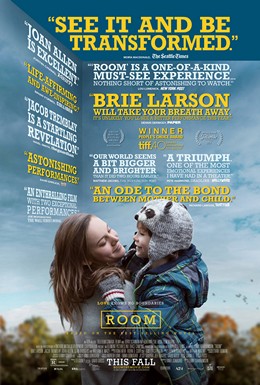
This is a beautiful film, filled with moments of despair, joy, and connection that occur not only between a mother and child, but between older parents and their grown up girl. As in the headlines, Brie Larson plays a woman who has been abducted as a teen and secreted away in the specially constructed back shed/room of her abductor’s suburban Ohio home. He visits regularly to rape her, an encounter she must endure without resistance because she has fathered his child, a little boy (Jacob Tremblay) who must stay hidden in the closet during these visits. When he leaves, she does her level best to raise the boy, who knows nothing of the world around him, a fact she must remedy when she concocts a plan for escape. When the boy is introduced to the world, it plays like a bird pushed out of the nest. You are utterly terrified for him. When he and his mother are back in her childhood home with her grandmother (Joan Allen), your fear becomes concern, at his acclimation and the mental health of his mother, who now has to tend to her long suppressed issues.

This is a film about connection, the rigor of parenthood, and the limits of love and blood. Larson’s determination, Tremblay’s resistance, Allen’s long-suffering courage, all feel immediate and real. There isn’t a hint of melodrama, which is rare thing given its true crime genesis. Larson is mesmerizing, the perfect balance of drive and fragility, and Tremblay delivers one of the most moving child performances I’ve ever seen. William Macy has a small role as Larson’s father, who has divorced Allen and who, in a painfully poignant scene, cannot bring himself to look at the boy, for all he sees if the product of his daughter’s tormentor. It missteps only once – Larson gives an interview to a journalist whose questions are so tasteless that it feels false – but even in this error, the filmmakers show Larson as flawed (you can see in her eyes that she knows she screwed up in agreeing to the exclusive) when in lesser hands we would have seen her resolute, rising against the opportunist reporter in righteous indignation.  One of the best of the year, and the failure of the academy to nominate Tremblay as supporting actor continues the real prejudice of those old fogies at Oscars, against the young.