Archive

Drama

image

Writer-director Greta Gerwig’s picture is assured, ingenious, and alternatively, hilarious and moving. A coming-of-age story that touches on the themes of leaving home and the mother-daughter relationship is not exactly original, but in Gerwig’s hands, it is fresh. Lady Bird (Saiorse Ronan of last year’s beautiful Brooklyn) is a Catholic school senior in Sacramento navigating her college choices, academic ennui, sexual inexperience, insecurity, and her family’s economic frailty, all while negotiating an increasingly strained relationship with her passive-aggressive (and sometimes, aggressive-aggressive) mother (Laurie Metcalf).

Gerwig stitches a narrative together with brisk and evocative vignettes, and her characters carry the nuance and surprise of real people. Lady Bird’s reach for popularity and desire for something beyond what she deems the stodgy and suffocating Sacramento might normally make her empathetic, but she is of her age, which means selfish and even cruel, in her ambition. This harsh light prevents the film from becoming maudlin. She’s a real girl and her world feels authentic. I watched the film with my wife and daughter, and their knowing glances and nonverbal communication throughout certified the truth of its nature.

I was reminded of different films at different times while watching Lady Bird. Gerwig’s command of pace and sharp timing evokes Wes Anderson’s The Royal Tenenbaums, shorn of his mannered style. Her strong portrayal of the bond of family and place also brought to mind last years’ incredibly under appreciated 20th Century Women. Finally, the mother-daughter dynamic on the eve of separation made me think of Nicole Holofcener’s Enough Said.

I don’t mean to convey that Gerwig’s picture is derivative, only exceedingly accomplished. These are great pictures for purposes of comparison.

This is one of the best of the year, and I expect nominations for best picture, best director and best original screenplay. At a time when Hollywood may very well want to go with films that are smaller and more pure, keep this one in mind when filling out your Oscar ballot.

image

Taylor Sheridan, the writer of Sicario and Hell or High Water, has turned in a stunning directorial debut melding his signature economy of dialogue with an accomplished feel for the ebb and flow of backcountry America and a lyrical visual style. The frozen mountains of Wyoming serve as the locale to a murder investigation where FBI outsider (Elizabeth Olsen) partners with a fish and game tracker (Jeremy Renner) and an Indian reservation sheriff (Graham Greene) to solve the rape and murder of a teen found in the snow.

Sheridan is the nephew of a former U.S. Marshal and a Texas sheriff, and as with his prior films, his replication of the patter of law enforcement feels as if he has spent much time at their knee. His characters avoid the bravado and cliche’ of many movie cops. They inhabit a matter-of-fact world, not cartoonish macho, but one that exudes a professional cynicism. Like Emily Blunt in Sicario, Olsen is not the standard female law enforcement officer who has to “prove” herself in a near-all male world. There is no overcompensation.  She just is.

The performances are understated and genuine, and Renner in particular well renders the pain of a haunted but determined man.

Sheridan is also deftly political, never overt but still seamlessly intertwining some of the cultural realities in rural American with the narrative.  It never gets in the way of the pace, and Sheridan’s handling of the thrill part of thriller is expert.  The crescendo to a violent explosion is damn near excruciating

One of the better films of the year, which admittedly ain’t saying much this year, but that shouldn’t be held against this picture.

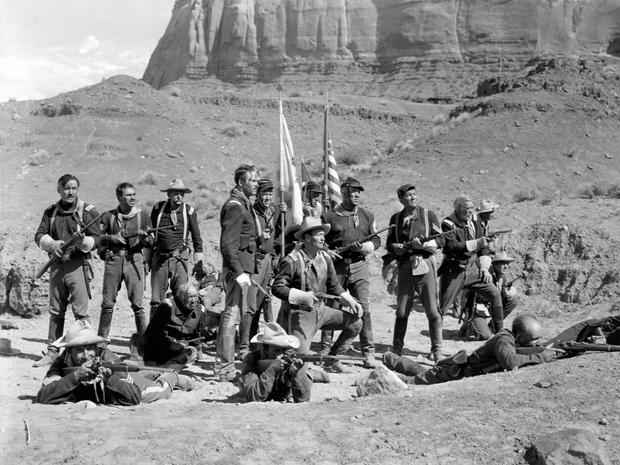
Image result for Fort Apache Monument VAlley

John Ford’s western, an extremely loose re-imagining of the Custer massacre, surprises in numerous ways.  The film has a heady sense of humor – the hard-boozing Irish of The Quiet Man are present, but not quite so cartoonishly so.  It again reveals that John Wayne was quite underrated as a dramatic actor.  But it is most unique in its melding of patriotic lore and bitter cynicism, ultimately concluding that the fraudulent propagation of patriotic heroism is at a minimum a necessary evil and perhaps even a critical component of the national ethos.  What matters, ultimately, is the myth.

It is also, of course, beautiful in its use of Monument Valley.

image

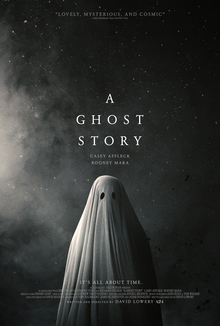
My first thought for a first sentence of this review was “I don’t get it.” But that was at about 1/4 of the way through this sparse (budget – $100,000) and ingenious film that unfolds at its own leisurely pace, with every scene building upon the last.

The story is simple. Casey Affleck and Rooney Mara are a young couple on the verge of a move from their home when Affleck dies in a tragic traffic accident. Rather than ascend to the hereafter, his ghost returns to the home. And that is where we find him. For all ages. Mind you, he is not in a CGI, wispy and elegiac form. He is wearing a sheet with two holes cut out for eyes.  And his rambler (not a creepy Victorian) is the place he haunts, throughout eternity.

Wordlessly.

The film is at first uncomfortable.  It’s hard to adjust to the low-tech representation of ghostdom, and writer director David Lowery’s penchant for lassitude tests, but soon, through the patience of the director and the stoic and sad nature of Affleck’s choice, you invest totally in his journey.

This is an art film. As such, it takes chances other movies would not dream of. Not all of its choices hit the mark, but by the end, it proves to be thoughtful, accomplished, and really intriguing.

I am stil not sure that I get it. But have been thinking and talking about it ever since watching. That alone merits high marks.


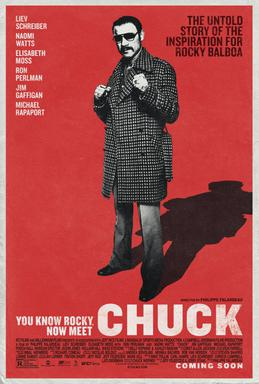
There’s nothing particularly bad about this biopic of Chuck Wepner, the Bayonne Bleeder, the fighter who went the distance with Ali (mainly as a human punching bag) and was the inspiration for Rocky.  Liev Schreiber gets to trot out his semi-lovable, Joisy-accented galoot, and at times, you actually feel bad for the guy, a palooka with a heart of tin who is given a taste of the big time and handles it poorly (drugs, booze, women, and perhaps most distressingly, disco).  But you don’t ever really develop an interest in him.

You’ve seen it all before, and even with the exertions of Schreiber, a pasty and portly Jim Gaffigan (as Chuck’s loyal and unctuous sidekick) and Elizabeth Moss (his suffering wife), you end up asking “to what end?”  Or, in Joisy parlance, “What the fuck?”

The film also makes a huge mistake by trying to recapture the Ali-Wepner fight, which feels as if it was held in a community rec center.

image

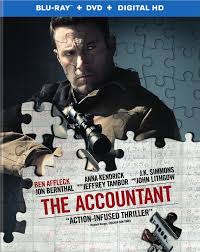
The premise of this movie, and the ensuing byzantine plot, are so audacious that it almost makes up for being such a slick piece of crap.

Ben Affleck is an accountant. But not your everyday accountant. He is autistic, but has had the more extreme manifestations of that condition beaten out of him by his rigid, military father. Accordingly, he can function, and function he does, rather highly. He has millions of dollars. He owns a Jackson Pollock. He has gold bullion. He can shoot a watermelon from a mile away.

He works in a strip mall as an accountant, but when he is not doing the books for local farmers, he is doing them for large, dirty multinational corporations while ratting out their wrongdoing to the Department of the Treasury.

The only really good things I can say about this movie are that it is watchable in an aghast, mouth-open kind of way. Affleck, playing a character who is struggling to convey emotion, appears to be on the verge of laughing out loud every scene. As every scene gets progressively funnier and funnier, his reserve becomes more impressive.

It’s not good but marginally entertaining.

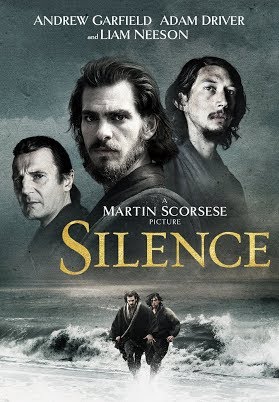
Silence Official Trailer (2016) - Paramount Pictures - YouTube

There are very few films that deal with the concepts of faith and even fewer that tackle religious faith.  Modern audiences probably could care less about religious faith, and Hollywood cares even less than the audiences, given the short shrift the town affords religion.  Though after Mel Gibson’s masochistic and extremely profitable The Passion of the Christ, Hollywood saw money in them thar’ hills and started to make treacly “miracles on earth” fare, serious engagement is rare.

The Apostle is one of the few films that actually explored the limits of faith and the working of religion in a modern context.  It is a masterpiece.  The Exorcist, another classic, is generally known as The Daddy of Shock Gore, but in fact, it is a deep and complicated story of hell on earth, and the perils of believing that such a hell doesn’t exist among us.  Most recently, Calvary fit the bill.  That’s about it.

Martin Scorsese has co-written and directed a fourth masterpiece, which has much in common with the prior three films. The Apostle gave us Robert Duvall as a fallen minister who has to rebuild from the ground up after having turned his back on his belief and his community.  The Exorcist, while ostensibly about the demonic possession of a little girl, is really about a fallen and broken priest (Jason Miller) and his own test of faith.  Similarly, Calvary offered Brendan Gleeson as a modern Irish priest living in his own Gethsemane, attempting to withstand the assault on faith by near every denizen of the town he serves.

Silence, which was almost entirely ignored by the the film community, centers on two 17th century Jesuit missionaries (Andrew Garfield and Adam Driver) who secret themselves to Japan in search of their mentor (Liam Neeson), rumored to have apostatized.  As is their calling, when they arrive, they immediately begin to minister to and convert Japanese peasants, for which the punishment is severe and faith-shaking.  Garfield wrestles with the consequences of his actions, and his discussions with the Japanese Inquisitor and his translator (Issei Ogata and Tadabanou Asano, respectively) are enlightening yet fraught with danger.  They are trying to break Garfield, who convincingly plays as a man of his time, showing all of the anguish and compassion attendant to his situation.  He is bedeviled even more by the appearance of his guide  (Yosuke Kubozuka) who consistently betrays him and other Japanese Christians, only to ask for confession, an absolution Garfield finds increasingly difficult to give.

This a gorgeous, meditative film, and Scorsese eschews his hallmark of dizzying and inventive camera movement for a simpler, more staid approach.  The effect is classic and contemplative.  Garfield, who was nominated for the overpraised Hacksaw Ridge, is mesmerizing.  One of the best from last year, and woefully overlooked (it received a nomination for best cinematography).

An unsettling and very smart film, writer-director Tom Ford (A Single Man) autopsies the relationship of Susan and Tony (Amy Adams and Jake Gyllenhaal) while recounting a murder story.  The former is seen in flashback, as Adams, a successful, chic but deeply unhappy art dealer, is presented with her ex-husband’s novel as a prelude to their meeting after a long separation.  That relationship blooms as most do – with fire, unwavering support and the feel of having found a soulmate.  It is eventually undercut by Gyllenhaal’s lack of sophistication, emotional instability and the fact that, as Adams’ patrician mother (Laura Linney) wickedly tells her, “he’s too weak for you.”  As Linney deliciously explains, “Come on, Susan. I know you think that we don’t care about the same things, but you’re wrong. In a few years, all these bourgeois things, as you so like to call them, are going to be very important to you, and Edward’s not going to be able to give them to you. He has no money, he’s not driven, he’s not ambitious. And I can promise you, if you marry Edward, your father’s not going to give them to you either.”  As Adams sits in her classy LA house, a living embodiment of her mother’s prediction, she awaits her reconnection with Tony and starts to read his book, an engrossing tale which ends in a chilling act of brutality that seems directed right at Adams.

The performances are astounding. Since Zodiac and through Nightcrawler, Gyllenhaal exudes a compelling mix of sincerity and if not menace, danger, it’s hard to take your eyes off of him.  Adams is properly fragile and haunted, with a lacquered face that evokes a cracking shell.  Linney’s one-scene turn is for the ages, and the contributions of Michael Shannon as a taciturn Texas lawman and Aaron Taylor-Johnson as his frightening quarry are riveting.

Ford has crafted an original, intricate form of noir that is unnerving and unmannered.  Likely not everyone’s cup of tea, but I can’t remember a film I’ve concentrated on as much as this one for some time.  It was one of the best from last year.

Image result for 20th Century Women

An affecting confluence of nostalgia and deep emotion born of human connectedness, this film presents as a standard coming of age tale, but it is a great deal more.  We find 15 year old Jamie (Lucas Jade Zuman) growing up in Santa Barbara in the late 70s with his idiosyncratic mother (Annette Bening, a mix of traditionalist and free thinker), who raises him in a home in which she rents out rooms to people who will eventually become instrumental in his upbringing.  Her cockeyed plan at the outset is to rely on one of her renters, a feminist photographer (Greta Gerwig), and an older neighbor teen (Elle Fanning) to teach her son how to be “a man.”

Bening beautifully renders a woman grappling with her own doubts, confusing times (she is referred to as a daughter of “the Depression” by her son as if she has an illness, and at one point she notes, “I think history has been tough on men.  I mean, they can’t be what they were, and they can’t figure out what’s next”), and the establishment of her own values (my favorite of her observations is “Wondering if you’re happy is a great shortcut to just being depressed”).

There are too many pitch-perfect, smart scenes to recount, but some merit mention, particularly the scene where the house handyman (Billy Crudup) who – having been deemed an insufficient role model because he and the boy do not connect – signs on as Bening’s guide to the culture, and in particular, punk rock. When Bening and Crudup, who is a bit of a hippie, attempt to dance,  first to Black Flag and later to Talking Heads, the result is a joyous rendering of representatives of two distinct tribes trying to understand the totems of a third.  The scene is almost as funny as when Gerwig insists that everybody at a house dinner party not only acknowledges her period, but says the word “menstruation” out loud.  And Fanning’s advice to the boy after he corrects a neighborhood kid boasting of his sexual prowess with a dissertation on the mechanics of the clitoris (for which he catches a beating) is both cruel and exceedingly wise.

In the wrong hands, this film would be a series of snappy vignettes, one more quirky than the next, and the result would likely have been cloying and unsatisfying.  But writer director Mike Mills never slums for your laughs or tears, and he stitches together the experiences of the characters seamlessly through the process of brief biographical snippets.  Better yet, he has a strong sense of what is authentic, and the film is loaded with grit and heart.

Some will accuse the picture of dragging, but I felt it simply took its time, allowing the feel to make the same deep impression as the dialogue, and nothing felt gratuitous.  One of the best from last year.