Archive

Comedy

A funny and wry comedy about an improv group in New York City that is splintered when one of its members makes it to “the show”, a stand-in for Saturday Night Live called Weekend Live. The elevation exposes fissures within the group, eventually sealing its doom . Nonetheless, through the process of promotion and disintegration, the members realize how integral the group is/was to their lives and how their involvement fits into their ambitions.

This is a sweet movie, written and directed by Mike Birbiglia, who also stars as one of the improv group members. Some of the drama is beyond the talents of the actors, almost all of them are immediately recognizable from some Comedy Central or other endeavor, and it is on occasion a little gooey. But, otherwise, this is good clean fun, bettered by a biting, almost cruel caricature of Lorne Michaels as the head honcho at Weekend Live.

Image result for The Lobster

I want to applaud and encourage ambitious filmmaking, and this picture is certainly an example of that.  A man (Colin Farrell) whose wife leaves him checks himself into a facility resembling a hotel, where he is given 45 days to find a new life mate amongst its other inhabitants.  If he fails to do so, he will be transformed into the animal of his choice. Hence, the title.

When the film stayed in the hotel, it maintained my interest. Writer-director Yorgos Lanthrimos creates an increasing feel of dread and desperation as the guests jockey for position, and while the picture is often the blackest of the black, there is comedy to be found.  But Lanthrimos attempts to mesh this strange land into a wider society, with loners (individuals who are as zealous about being single as the hoteliers are about coupledom) hiding out in the woods while the government enforces duos to such an extent that security personnel harass lone shoppers. The movie just gets darker rather and more exhausting, a chore rather than a delight.

It’s all too clever by half, and ultimately, casually cruel, to no real end.  Lanthrimos’ obvious talents are wasted on this lame social satire.

But don’t listen to me.  My tastes for this sort of thing are vanilla to an almost disabling degree, the critics adored it, and it cleaned up at Cannes.

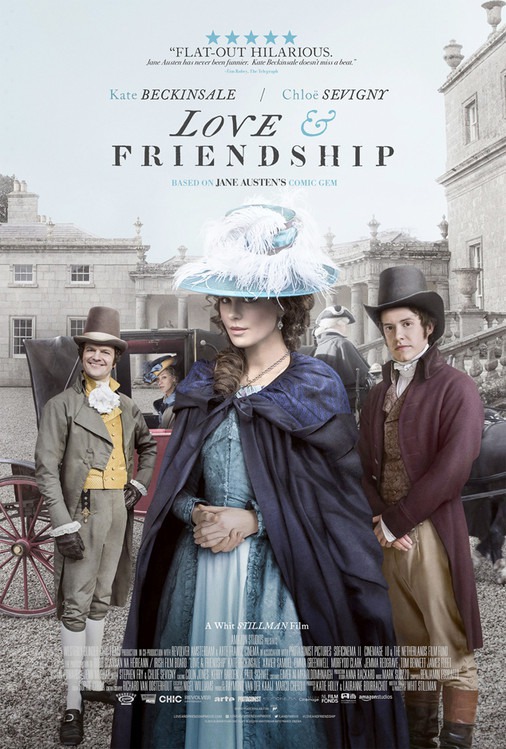
Jane Austen has been treated well and often by Hollywood, but – with the exception of the recently humorous but underwhelming Pride and Prejudice and Zombies – she has been treated with a reverence which also brings with it a certain torpidity.  How often have we seen that same dour, tortured Mr. Darcy; the loyal, suffering Elinor Dashwood; or the quick-witted but headstrong Elizabeth Bennet?  Don’t get me wrong.  I love them all, but their portrayals tend to be so bleeding earnest, and of the same stripe, that it begins to feel very rote.

Whit Stillman has written and directed three modern Austenian pictures- Metropolitan (essentially, Mansfield Park), Barcelona, and The Last Days of Disco.  When he gets his hands on an actual Austen short story, it is no surprise that Stillman shakes it all up with an original and witheringly funny adaptation.  Rather than dally with dialogue establishing the Austen archetype – handsome rogue, lovestruck hysterical wife, scheming social climber, etc . . . – he gives us the actors in poses, drawing upon the audiences’ presumed familiarity with Austen, so as to get the ball rolling more quickly.

And in the hands of the most vicious and hilarious of all Austen protagonists, Lady Susan Vernon (Kate Beckinsale), what a ball it is.  An elegant bloodsucker, Lady Vernon flits from household to household, leaving each in tumult as she wheedles her way into the most advantageous social position she can find.  Her dexterity when she encounters obstacle is noteworthy and her aplomb when thwarted is near winning.  In Beckinsale’s hands, Austen’s wit crackles, and the repartee is fast and furious.  I won’t ruin any of the fun, save to offer my favorite line from the film:  “Americans really have shown themselves to be a nation of ingrates, only by having children can we begin to understand such dynamic.”

Austen’s work always delivers us a fop, a fool, or both, but Beckinsale is almost upstaged by Tom Bennett who plays the unflappable, cheery, and utterly clueless James Martin, one of Lady Vernon’s many targets.  I laughed out loud in all of his scenes.

One of my top five for the year thus far.

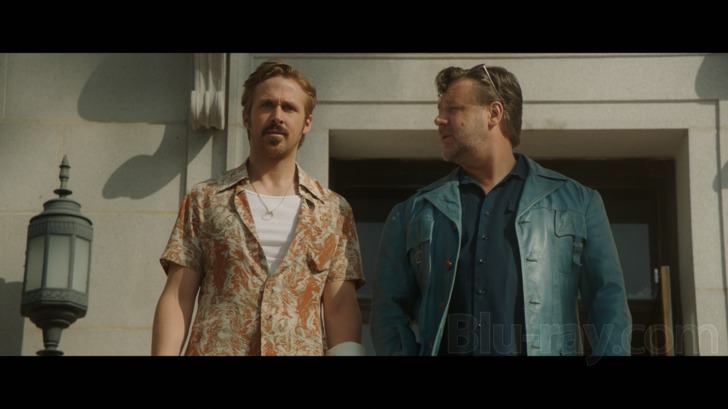
The Nice Guys Blu-ray Release Date August 23, 2016 (Blu-ray + DVD)

It sounds silly to say, but I’m compelled – they just don’t make movies like this anymore.  Shane Black’s (Kiss Kiss Bang Bang, Iron Man 3) noir-ish 70s buddy crime comedy pays homage to the genre by faithfully adhering to many of its precepts while updating the form in ways that are progressively more clever.  It’s late 70s LA.  Russell Crowe is a burnt out “enforcer” making his dough in the protection racket with brass knuckles and dogged determination.  Ryan Gosling is a private investigator rip-off artist with a drinking problem, a mouthy (but not precocious) pre-teen daughter, and an air of intelligence, if not actual smarts.  Crowe is hired to beat up the person or persons (one of whom is Gosling) looking for a young femme fatale, and the two team up as the semi-serious, but not really serious plot – which melds porno and corporate skullduggery – thickens.

The banter is first rate, the look primo, and the tone just right.  Black writes cynical yet hopeful, and while he makes all his station stops on time, the rides in between are a gas, made even more enjoyable by his crackling script and brilliant physical comedy.  Gosling is particularly adept at slapstick, giving Leonardo DiCaprio’s turn in The Wolf of Wall Street a run for its money.

The chemistry between Crowe and Gosling is so strong that I hope the broad hint of a sequel at the end of the film is genuine.  I was reminded of Nick Nolte and Eddie Murphy in 48 Hours , Alan Arkin and James Caan in Freebie and the Bean, and Robert DeNiro and Charles Grodin in Midnight Run.  These guys are having a blast together

Yet, Black never fully commits to the “buddy pic” requirements.  When Crowe, in a moment of reflection, reveals his tender side or Gosling seemingly rises to the occasion by exhibiting theretofore hidden mental gifts, the payoffs are unexpected and laugh out loud funny.  A dream sequence is inserted that is truly ingenious, and there are more than a few other moments when Black’s detours enhance the humor.   One of the best films this year.

Image result for Maggie's Plan

A charming, light romantic comedy about a young New Yorker (Great Gerwig) who has an affair with an older would-be fiction writer/academic (Ethan Hawke) married to an even more prestigious academic (Julianne Moore). Hawke leaves Moore for Gerwig, but Gerwig soon realizes she has upset the natural order of things. What follows is her “plan” to rectify her error, which is breezy, funny and blessedly bereft of skin-searing indictments about betrayal, trust and commitment. It drags a bit at the end, but ultimately, the film delivers as a sweet, semi-screwball slice of life. It’s also satisfying to see such a product from writer-director Rebecca Miller, whose The Ballad of Jack and Rose a decade ago was as heavy, dreary and miserable a film about relationships as you could imagine. Perhaps she’s in a better place.

Image result for Keanu cat

Key & Peale skit that goes on about an hour and 35 minutes too long, made even more tedious by the immobile camerawork of director Stephen Hawk . . . .er . . . Peter Attencio, whose resume’ consists of . . . directing Key and Peale episodes.

Alternative reviews, considered but rejected–

Kean-poo!

Keanu tell me if this movie sucks? Yes, I ke-an.”


Sisters - Rotten Tomatoes

Tina Fey’s foray as a film lead has been nothing short of disastrous. Other than the tolerable Date Night (where Steve Carell helped with the lifting), her movies have been execrable. Her attempts to re-brand the Liz Lemon character that served her so well for a time in 30 Rock have failed.  In Admission and Whiskey Tango Foxtrot, it was hard to determine what was less convincing: Fey’s stabs at being thoughtful or her attempts to fill the garters of a romantic lead.  For introspection, Fey rarely can provide more than a smirking Hamlet-lite, asking the audience “is this a macaroon I see before me?”  And when Fey is asked to fill the shoes of a sexual being, as she was In This is Where I Leave You (former high school loose girl) and this film (former and current), it’s like asking Richard Dreyfus to play Rocky Balboa.  Some of her limitation is attributable to run-off from the Lemon character, a neutered geek who substituted sex –which she approached as if it were vampirism – with food.  But Fey is many years away from that character, and the fact is, she simply exudes no sex.  Not appeal, interest or even curiosity.  In Whiskey Tango, which is ostensibly a romantic comedy, she could only bed Martin Freeman when she was near wasted, the coupling looking more like two cats in a bag, and the morning after, she looked at Freeman with the disgust of someone who “can’t believe they ate the whole thing.”

Yet, in Sisters, she’s supposed to be the wild, sexually adventurous one.

Oooph.

Fey’s other huge problem is that she is wholly unlikeable.  In 30 Rock, she was parceled out in little bits as part of an ensemble, and she made herself the butt of every joke, which was endearing and at times, very, very funny.  But she’s lost that gift and now, she’s re-presented as a different woman and no matter what she does, she comes off as condescending.  Indeed, Fey as corporate pitchwoman for American Express is damn near insufferable in a 30 second ad (her quippy, snide, self-absorbed shopper rings of the person who is most amused by their own cleverness) and that tells us all we should know about her freshness as a film actress.

It’s not just Fey, however, that sinks Sisters.  The film has no real humor; it’s just a “last party” flick where folks who aren’t even characters say things meant to be zany and hilarious.   The set-ups (drugs that look like sugar!  A glop of hair gel on the floor that will factor prominently later!) are asinine, and when Fey and her film sister Amy Poehler get in trouble, they riff.  The riffing is painful, and frankly, given Fey’s attacks on other comics who do not meet her exacting cultural standards, watching her “do black” (repeatedly) when she appears to be struggling is a strange mix of uncomfortable and satisfying.  I imagine she’ll avoid the pitchforks from the p.c. Brown Shirts, but she should step lightly.  They just took a pelt off of Lena Dunham!

The script, such as it is, has the odor of weak improv. Avoid this dog.

image

Paul Rudd lost his young son in an accident and compensates by taking a 6 week caregiving course for the disabled. His first client is a plucky, wheelchair bound Brit named Trevor, who suffers from muscular dystrophy and an over-inflated sense of his own cleverness. For example, to shock Rudd, he pretends he’s choking or having a seizure, a real gut buster. Rudd later pretends he has misplaced Trevor’s lifesaving medicines, so . . . relationship established.

Both parties learn life lessons, but to better cement them, they–

A). Make love
B). Take a road trip
C). Join a white supremacist sect
D). Enter into a suicide pact

Of course the answer is B), but the other answers would have made for a better film, for those options would not have resulted in their meeting bad girl hitchhiker Selena Gomez. How do we know she is bad? She–

A). Smokes
B). Curses
C). Is a white supremacist
D). Smokes while cursing

Oh, if it had only been C).

Gloppy, lazy, hackneyed gruel.

Nick Kroll is a pretty big deal in New York City until his Google-glassish innovation goes busto and he loses all his money and all the money of his so-called friends, so he seeks solace by retreating to the icky suburbs and his childhood home in New Rochelle, NY, currently inhabited by his harried sister (Rose Byrne), her swarthy, down-to-earth home builder husband (Bobby Cannavale) and their charmless 3 year old boy.  There, Nick becomes intertwined in their lives, much like Bill Hader in The Skeleton Twins, who went home to Nyack, NY after a trauma.  Kroll discovers Cannavale is having an affair, much like Hader’s sister Kristen Wiig in The Skeleton Twins.  Coincidentally, in The Skeleton Twins, Wiig was cheating on her husband Luke Wilson, who was also a blue collar guy, just like Cannavale.

Crazily, Kroll reveals the fact of the affair to Byrne, again, like Hader to Wilson in The Skeleton Twins.  And that results in a heartfelt discussion about how Kroll ran out when their mother was dying of cancer, and the discussion is reminiscent of the recriminations and regrets of Hader and Wiig about their father, also dead by suicide.   In The Skeleton Twins.

For a few easy laughs, the town is populated by faintly ridiculous folk from high school who Kroll can look down upon.  Much like Hader in The Skeleton Twins.  And there are places that inexplicably have Christmas lights up even though it is not Christmas.  Just like the town in The Skeleton Twins.

And Kroll grows, growth which is signaled by the fact he chooses the welfare of his sister’s son over his new job.

Just like James Caan in Elf.

Torture that at its best is mildly diverting.

Richard Linklater’s astute command of time and place is forever proven by his masterpiece, Dazed and Confused, which captured a Texas town’s high school circa 1976 in all its bell-bottomed, long-haired, keg-in-the-woods glory. Everybody Wants Some! ain’t Dazed and Confused. Focusing on a young college baseball player’s matriculation at a Texas college, Linklater appears to be satisfying an 80s-era checklist. Mud wrestling. Check. Disco. Check. Mechanical bull. Check.  “Get the Knack!” Check. And while Dazed and Confused gave you insight into the jocks, the stoners, the geeks, the parents, the coaches, the teachers and the townies, Everybody Wants Some! is limited to the hyper-male competitive environment of the baseball team, a group that parties hard, jumps on your Achilles at every opportunity, and challenges each other in all respects, when not dime-store philosophizing about winning, commitment, pot and “pussy.”

Yet, with all its flaws and limitations, I dug the movie. Linklater lovingly recreates the art of male bullshitting, which, granted, is not for everyone; the wonder of all the possibility of college; and the camaraderie of sports, all to an unabashedly “classic rock” soundtrack. it’s an acquired taste, and this is a very light film that at its best is merely charming, but I was smiling throughout.