Archive

Comedy

In 2016, Janicza Bravo wrote and directed one of the better entries for the TV series Atlanta, where the two black protagonists must negotiate their fraught relationship while enduring a bizarre Juneteenth party thrown by a wealthy couple, he, white and cluelessly solicitous, she black and protective of her status.

The party is unsurprisingly surreal.

The episode is bitterly funny and arch, but Bravo is hemmed in by the room, one that gets more claustrophobic as the tenuous couple try to hold it together.

With Zola, Bravo is unrestrained, and the result is a dizzying, frenetic, trippy After Hours-esque black comedy nightmare, one based on a real life 148-tweet thread about a trip a Detroit stripper took to Florida with another stripper named Jessica.

Opening line” “Y’all wanna hear a story about why me & this bitch here fell out? It’s kind of long but full of suspense.”

The film is about feel, specifically, the texture of an ill-advised road trip that has gone horribly wrong.  The characters are hilarious, but they are as much pinballs as people (one of the few weaknesses; it’s easier not to care about their plight). In Bravo’s hands, the curves and jolts just keep coming, though she occasionally slows the action so the main stripper and poorest of the decision makers (Taylour Paige) can almost get her bearings. Bravo is so technically adept, these parts of the film play exactly like the part of a rollercoaster where the car deaccelerates on a curve, and then, zoom. You’re off again.

The film sports an innovative montage sequence, strange local rituals (her Florida is the land of “Florida Man” without even mentioning him), and the cellphone as arteries, veins and lungs to modern dimwits. I feel like I missed half of it and want to take the ride again. But what I saw was totally engrossing and I often laughed out loud for as long as I had time.

Bravo’s talent is undeniable and will likely be expended on the next Marvel franchise, Dr. WeirdButt of the Multiverse.

On Hulu.

The French Dispatch (2021) - IMDb

Wes Anderson has always injected enough feeling and pathos into his films to temper their quirky veneer. In Bottle Rocket, we cheered for the ambitious loser, Dignan. In Rushmore, there were true relationships formed between Bill Murray, Jason Schwartzman and Olivia Williams, and to see them hurt, well . . . it hurt. In The Royal Tenenbaums, Anderson allowed for familial connections, and the payoff was a semi-reconciliation with a bear of father, Gene Hackman. Hell, even in the zany The Life Aquatic, there was something built between Cate Blanchett and Bill Murray.

There is no such emotional draw here. Rather, the film is a series of charming, amusing vignettes, four articles from the last issue of a fictional art and culture magazine.

As stories go, in Anderson’s hands, they are funny and often ingenious.

But untethered to anything other than his novel direction, they are also unengaging. The picture is brilliant to look at but lacks any depth or resonance.

Another fear. Anderson’s style, shorn of any real requirement of character, lends itself to the “Mamet-ization” of his films, where the cadence and form are so unique, the actors become victim to caricature. There is some of that here and it is a harbinger that should be heeded.

Licorice Pizza' Review: Blossoms & Waterbeds | We Live Entertainment

When I was in grade school, I had a crush on a girl in my class. I learned that she rode horses down at stables about 3 or 4 miles from my house. Such was my infatuation, and obviously unable to share my feelings in the unforgiving world of Catholic grade school, during the school year on the weekends, I would regularly take my bike down to where the stables were, an area completely unfamiliar to me in Rock Creek Park D.C., on the minor chance that I might see her. As a testament to my persistence, this behavior continued into the summer months. I never did see her, but I never lost hope, and I met scads of other people in my travels and got into many adventures.

Paul Thomas Anderson’s Licorice Pizza is a nostalgic delight, and watching the movie, I felt the feelings of that time. Not only did it touch this old crusty heart and its buried 5th grade crush, but it also evoked the freedom I had in the 1970s. I could do pretty much anything. My parents were tangential to my daily life. I was an unsupervised Huck Finn, floating from place to place and not expected to be seen until dinner time, if then.

I recently got together with a friend of mine (he was one of thirteen kids, I was one of five), someone who I grew up with through grade school and high school, and we were laughing about the stupid stuff that we did as rudderless vagabonds. One thing seems small, but if it occurred today, it would probably involve investigations, the police, and the local news jamming a camera in some guy’s face as he was hustled, handcuffed, to the paddy wagon.

My friend and I would regularly walk the streets and in to schools and buildings and any old place that had an open door (we’d also dig through trash, searching for the Holy Grail of a Playboy magazine or something cooler). As we ambled into one church school, we met a janitor, and we just started to walk around with him. We returned the next day and then most late afternoons to help him clean up, and then he would buy us a Coke or a candy bar from the machine. We didn’t know him and he seemed like a bit of a hippie. He didn’t think to say, “Get out of here, this is my job.” He was a pretty nice guy and there were no shenanigans. And for the life of me, I can’t remember why we stopped, but we probably just moved onto the next thing.

But that was standard. I had other grade school friends who would sing with me in front of the Hamburger Hamlet – and none of us could sing – hoping someone would throw us change. When one of their streets was blocked off for a traffic rerouting, at night, we would drape our bodies over the barricades as if we had been murdered, just to get people out of their cars when they hit the dead end. Stupid stuff, pre-booze. You were on your own and unfettered with no one to evaluate the logic or wisdom of your choices.

Licorice Pizza brought those days back. We are introduced to 15 year old child actor Gary Valentine (Cooper Hoffman) and 25 year old Alana Kane (Alana Haim), both of whom live in Southern California in the era of the oil embargo. Valentine is a minor celebrity, but his acting star is waning as he develops into the ungainly teen in all of us. He is, however, nothing if not persistent (he winningly describes himself as a “song and dance man”), and soon, after establishing a connection he believes is true love with Alana, he establishes a waterbed business and then a pinball palace, all with a troupe of young acolytes, including his brother, and mainly with the participation, if not direction, of Alana.

Theirs is a beautiful love story, mostly unrequited, with both protagonists suffering the pain of watching the other flirt or more with others. Gary is a mature 15-year-old, a fiercely independent romantic who loves Alana and at the outset, has no problem saying it. Alana is an immature young woman, constantly beleaguered by her surroundings and her family, who fiercely fights the fact that she is bound to Gary. When you see them hurt each other, and Thomas Anderson subtly places you in the frame, you watch their expressions when they see the other with someone else. Again, I was transported to my youth. I felt the pain when someone you really “loved” in grade school or high school hurt you, almost assuredly unconsciously, but sometimes, with purpose. Your armor wasn’t there, your “cool” undeveloped. It stung. A scene where Gary calls Alana knowing that she has been out on a date with his older friend, where his breathing communicates his anguish, is a beautiful and piercing reminder.

The film is a joy. A breezy, journey through 1973 Southern California, where Alana and Gary come to terms with their attraction, while essentially getting into adventures, including not only the aforementioned businesses, but run-ins with, of all people, Hollywood producer and former Barbra Streisand boyfriend Jon Peters (Bradley Cooper, demolishing his scenes) and who appears to be a very close facsimile to William Holden, Jack Holden (Sean Penn) (the film’s Jack Holden starred in the film The Bridges at Toko-San rather than The Bridges at Toko-Ri).

The look of the film is so spot on your jaw drops. Little things, like the old fancy neighborhood restaurant and pub, The Tale o’ the Cock, feel exactly like the restaurants and bars that populated my old neighborhood growing up, and I did not grow up in the San Fernando Valley. The dark wood, the wine bottle glass windows, the lattice. Perfect.

The performances are relentlessly good. Hoffman, the son of the late Philip Seymour Hoffman, has a presence that you could see in his father as early as Scent of a Woman and Nobody’s Fool. Haim, a member of the band Haim, it’s so raw and natural it may be difficult for her to expand. I’m just having difficulty seeing her in another role.

tt’s almost inconceivable, but this is the first film role for both actors.

The best film of the year and one of the best I’ve seen in some time.

Alternate title.

“I Am Smarter Than You.”

Adam McKay, the talent who brought you Anchorman and Talladega Nights, is indeed smarter than you and the cross he must bear is that he is cursed to live in a nation of Luddites and buffoons. If you chortle and nudge your partner knowingly during this ball of crap, and maybe even raise an “it’s funny because it’s so true” eyebrow, there is an 87% chance you have a “ If you are not appalled, you are not paying attention” bumper sticker on your car.  So, if you sport that message, or its kin (“Hate Has No Home Here”), this is a must watch!

Added bonus with McKay? Now, he’s not funny.

Two scientists, a clueless Leonardo DiCaprio and a droll Jennifer Lawrence, learn that a meteor is hurtling to earth. When they sound the alarm, every caricature of the fevered dreams of a rich Hollywood do-gooder is introduced, each dumber or more racist or venal or crass than the next, all in service to an obvious, endless sermon poorly masquerading as a black satire.

McKay is the whingy douchebag who used to tack on political messages to films like The Campaign, where Will Ferrell punched a baby and a dog, and The Other Guys, where Will Ferrell played a fastidious NYC detective who was given a wooden gun. It was a fey conceit you could overlook because it occurred during the credits and you were walking out of the theater after watching some boffo fart humor (and here, I kid not – McKay’s Step Brothers is a modern classic, and a lot of McKay’s earlier stuff is the creme de la creme of fart humor).

But now, after some success outside the realm of farts (The Big Short, Vice), he’s made his hobby the main course.

Cringe bad. On Netflix.

A mash up of You’ve Got Mail and Eddie and the Cruisers

Okay, not really. But kind of. Rose Byrne is a curator of the historical society in a small English seaside town, and she lives with her professor boyfriend Chris O’Dowd, whose primary passion is the work and life of an alt rock phenom of the 80s, Tucker Crowe (Ethan Hawke). Hawke went into hiding at the height of his underground fame, thus making him even more of an enigma and obsession for O’Dowd and like-minded fans. 

O’Dowd clearly loves Hawke more than Byrne, and his primary focus is on the blog he manages which is solely dedicated to his idol. In a fit of pique, Byrne posts a scathing review of Hawke’s work, and Hawke alights from his bunker to respond, thereby sparking an intimate long distance connection. 

To tell more would be a true spoiler. This is a charming, very funny, clever film. Byrne (the hardest working woman in pictures) is her winning self and O’Dowd painfully funny, but Hawke steals the film as the jaded, regretful but still hopeful former “star” (we are not talking David Bowie; think Jeff Tweedy, after the first two Wilco records, just disappearing). Chock full of wry observations on hero worship, the digital age, the concept of family, and intimacy.

I knocked this down half a point because Byrne has a sister who is just a little too “on” and the film ends rather abruptly.

On Amazon Prime.

My Favourite Christmas Movie - Home Alone

John Hughes produced and wrote this Christmas classic about a kid accidentally left “home alone” for the holiday. Hughes pushes the syrup, but this picture has more of Looney Tunes-Meets-Tarantino vibe.  What little Kevin (Macaulay Culkin) does to burglars Daniel Stern and Joe Pesci is waayyyyyyy beyond enhanced interrogation.  I had to leave the room more than once, such was the barbarity, but I did see Kevin shoot them point blank with a pellet gun (balls and forehead), burn their heads and hands, smash their faces with full swinging paint buckets and a hot iron, cut a rope line so they crashed into brick, and ice the stairs and litter the floor with tiny cars (resulting in perhaps permanent spinal injury to both men). He also placed sharp objects under the windows, and even a nail, which went through Stern’s foot.  I think variations of tar-and-feathering occur as well, and the kid even uses a live tarantula to terrorize the duo. 

Now, I’m generally a “stand your ground” guy; if you stick your fingers inside the facemask, you get bit.  But this is just too much.

When the mayhem is not in session, the movie is a little ho-hum.  Kevin is not that cute, his family are a coterie of monsters (except for his Dad, John Heard, Gonzaga alum and fittingly nonplussed by the abandonment of his child), and as with almost all John Hughes films, almost every adult is a moron or a cretin.              

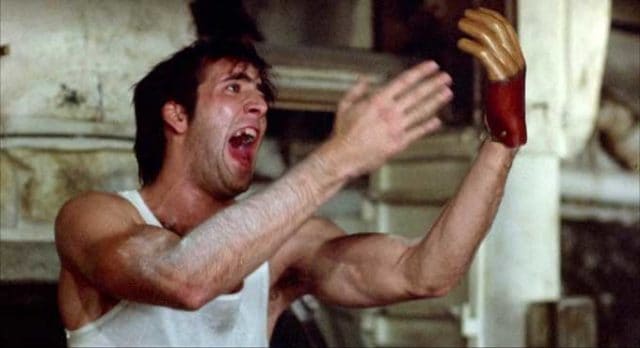
The Top Five Nicolas Cage Yelling Scenes in Movies

I had never seen this movie in its entirety, only clips (“MY HAND!!!!” and “Snap out of it”) or a few scenes.  It’s a charming film, made more so by funny and smart performances all around.  Every character, save for John (scene stealer) Mahoney, is an old country-linked Italian in 1980s Brooklyn, so I expected broadly comic, and there are some such scenes.  But for the most part, the film eschews “Mama Mia!” and instead, provides opportunity for Cher, Nicholas Cage (his weird instincts and passion are transfixing), Danny Aiello, Olympia Dukakis, Vincent Gardenia, William Hickey and others for a little introspection, some intelligent mugging, some surprising underplaying, and some truly tender moments. 

The picture feels almost like a long-running and beloved stage play.  I guess that makes sense, given it was written my renowned playwright John Patrick Shanley (“Doubt”).  Shanley snatched the Oscar for best original screenplay, and while I would have gone with Broadcast News, I’m okay with it. 

At 102 minutes, the film is also a shining exemplar of economy.  I laughed, I cried, and I didn’t need to go to the bathroom. 

Currently on Showtime.    

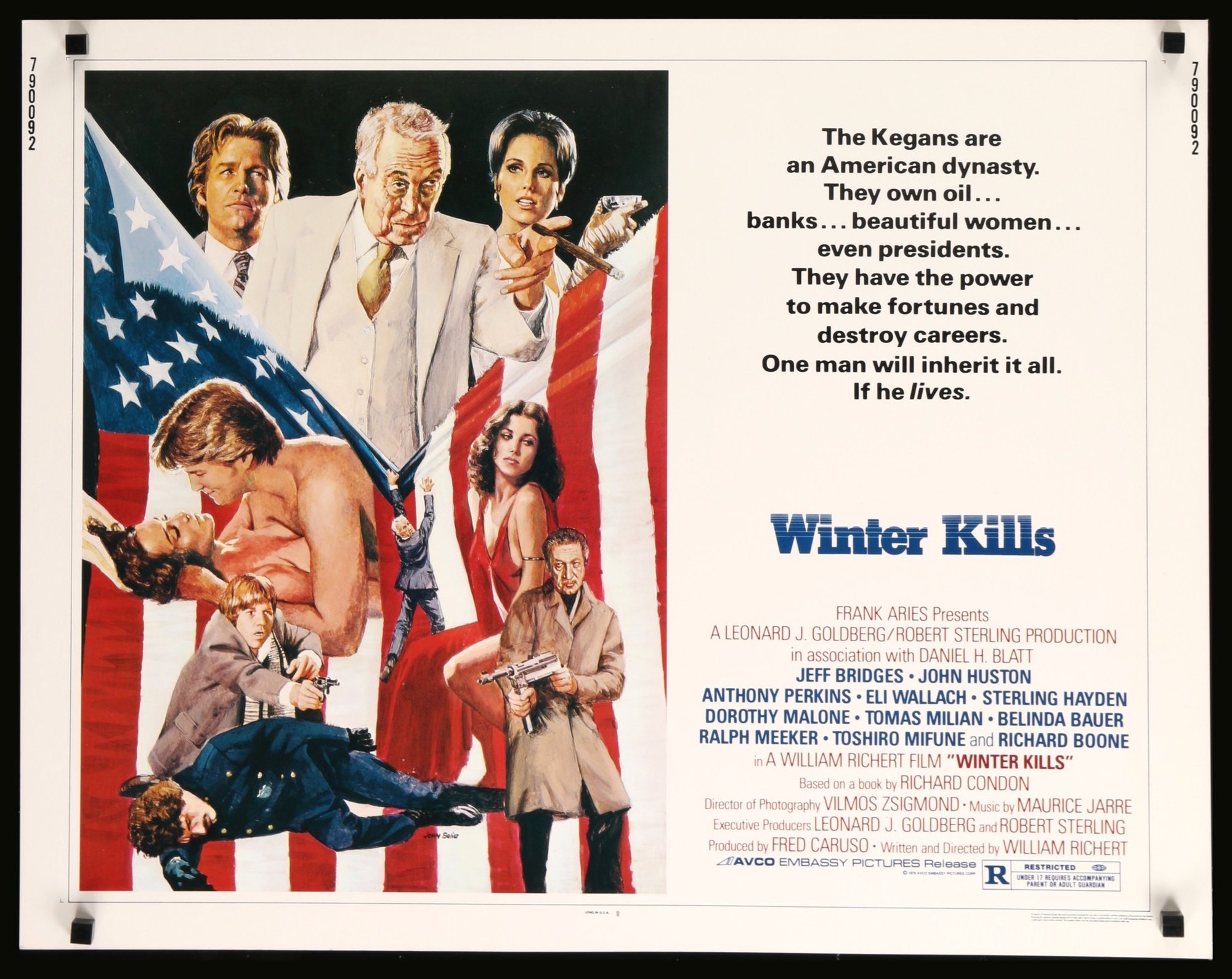
What a strange find on Amazon Prime. A 1970s black comedy with John Huston playing the Joseph Kennedy character and Jeff Bridges playing Bobby, if Bobby was sweet tempered and had no political ambitions after the death of his brother. Of course, this is not the Kennedys, but the Kegans, and little brother Bridges is swept up into a re-investigation of his half brother’s assassination after a lone gunman has been fingered by the equivalent of the Warren Commission. In essence, Bridges goes on a dangerous wild goose chase (egged on by his father, who hopes this will propel the son into heroism and political fortune) to find the real powers behind the killing, after a second shooter confesses.

The film is absurdist, and doesn’t really work as either a comedy or a thriller. But uneven as it is, you have to be somewhat in awe of its ambition. The rumor is that the Kennedy family was none too pleased with the feature back when it had the power to squelch it, but the film is so uneven, it likely didn’t need any opposition from the dynasty. Bridges is winning, and Huston is a gas as the corrupt, sybarite of a patriarch, and the whole thing is best when it is trippy.  Worth the time.  

D3FC856D-B9C5-43D3-AC05-FD8CE064E0CD

I don’t think that there is a series of movies I enjoy more. Like The Trip (to the North of England), and The Trips to Spain and Italy, taking a road sightseeing and culinary tour with Rob Brydon Steve Coogan is edifying and hilarious.

More than a travelogue, Michael Winterbottom’s films are studies in culture, cuisine and history, through the eyes of two very smart and silly narcissists, the kind of friends who probably only see each other once or twice a year but effortlessly fall into the same knowing patter. It is easy to settle in to watch their conversation and one-up imitations (both actors are skilled impressionists and constantly battle each other with competing bits).  Each man is the only important audience member.   Restaurant and hotel staff and lunch and dinner guests run the gamut from confused to overwhelmed to a tad put-off. However, as the films have progressed, Winterbottom increasingly allows family and romantic situations to enter, often with poignant results, particularly here. Beautiful film.