The Bone Collector is a thriller about a police detective (Denzel Washington) who is paralyzed. Unfortunately for New York City, a serial killer is on the loose and there is nothing Denzel can do except mentor a rookie cop during the investigation. The killer dwells in the NYC subway system, so naturally, the rookie cop must be sent in its bowels, with an earpiece and camera, allowing the bedridden Washington to see what she sees and thus guide her.
As implausible as that may seem, try this on for size – the rookie cop is Angelina Jolie.
Those lips, those cheekbones, that gun!
The choice was so inept that the scriptwriter actually wrote in the fact that she is an ex-model. You half expect her to start disrobing, ala’
Truly, Jolie’s character should set the teeth of all modern womanhood on edge. When she cries, all the men pat her on the back and tell her she is “terrific” (in fact, Mike McGlone and Denzel Washington actually call her “terrific” within 10 minutes of each other). And then she bucks up with a pretty smile. When she is upset, she huffs off the job, although she is a beat cop. But then the men drop by to see if she is “all right.”
For some reason (and I am guessing “those lips, those cheekbones!”) the men don’t say, “Hey. Where the hell are you going, you piece of sh**.”
Anyone with a rudimentary knowledge of movies and a brain stem will have this figured out in a jif. That said, New York City is very spooky in this film. It gave me that same creepy, flesh crawl I felt in “Ghostbusters II.” Hence the single star.
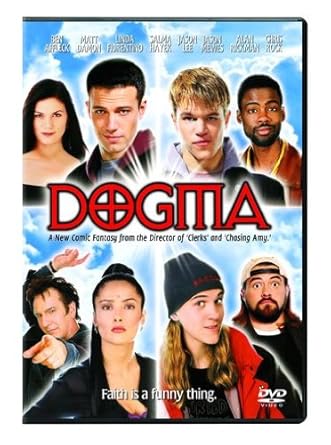
Prior to seeing Dogma, my dislike for Kevin Smith was pronounced. His “breakout” self-financed picture Clerks was wildly overpraised and when he got a big budget behind him, he produced varying degrees of crap. Mallrats showed that outside the confines of a convenience store, where camera movement is unnecessary, Smith was lost. Chasing Amy proved Smith a lame, unfunny writer, incapable of directing actors, preferring to let them exfoliate, flatulate and otherwise bleed all over his print.
Dogma sucks as well, but there are some pleasures in the sucking, because Smith has written a hit-and-miss lampoon on the perversities of Catholicism. Where he hits, he knocks it out of the park, as he plays fast and loose with the Bible in an effort to tell his modern fable (fallen angels trying to get back into Heaven; other angels, muses, apostles and assorted characters tryng to stop them). Smith also takes a few decent shots at the Pope, and offers a heartfelt tribute to true faith, all in the zany format of The Russians are Coming, The Russians are Coming . . .
Smith still does not direct actors, so the players in Dogma look like they are in home movies (Linda Fiorentino manages an entire film with a smirk and rolled eyes). But his laissez-faire approach is made less ruinous by crafty renderings of four angels (Matt Damon, Ben Affleck, Jason Lee and Alan Rickman) and the best performance to-date by Smith regular, stoner Jason Mewes. The movie is silly, but it is by far Smith’s best work. What followed was more crap (Jay and Silent Bob Strike Back, Jersey Girl, Zack & Miri Make a Porno, Cop Out), and Smith’s sensibility that his crap was actually awesome and the studios don’t “get” it and that’s what makes him awesome and everyone else not awesome.
Which leads to a biography of a director highlighting the following: criticism of Paul Thomas Anderson, as if Anderson were a peer; becoming so overweight he is kicked off of a flight for not having bought two seats; attacking Bruce Willis (“I had no f***ing help from this dude whatsoever”) because Willis did not work hard enough to promote the execrable Cop Out); an attempt to market his last cruddy picture “outside the system”; and retiring, at the ripe old age of 41.
Baseball season is upon us, so a review of a Sam Raimi baseball movie (?) is apropos. Raimi, whose credits include three Evil Dead movies, three Spiderman movies, and Drag Me to Hell, proves a strange choice to helm a love story-via-flashback, as an aging starter (Kevin Costner) thinks on his love life while trying to pitch a no-hitter.
I am no Costner-hater. He is limited but does what he does well – affable, with a flash of anger and occasional stoicism. Get him outside his comfort zone (Robin Hood, JFK, 13 Days) and you got problems. But he was a fine, goofy golfer in Tin Cup and as the sweet but violent and repressed killer in Open Range. Here, he’s Tin Cup but replaces goofy with taciturn.
Costner is not the problem. In fact, his time on the mound is compelling. But when he gets to thinking about that woman of his – Kelly Preston (wife of John Travolta, poor thing) – things go to pot. Preston is thin, harpy and jittery, and her pitch is, “you need to settle down with serious people like me instead of living the life of a little boy.” Her case is not strong. Even though she has a nice daughter (Jenna Malone), it does not seem conceivable that a good-time, easygoing jock like Costner would be enticed by her invitation. And thus, the movie is undone (and at 2 hours and 17 minutes, very trying).
Postcript: this is supposed to be a baseball movie, and while I understand that athletes get injured in the off-season performing everyday tasks, Raimi has Costner slicing his hand on a router. A pitcher making $15 million a year is not working in the shed with his Black and Decker (hell, he is likely contractually prohibited from self-gratification).
The film also has the manager putting guys up in the bullpen while Costner, who is at the end of his career, IS PITCHING A PERFECT GAME for a team no longer in the pennant race!
Paul Thomas Anderson’s opus chronicles the American porn industry in the late 70s via the story of a loose family of weaklings, caught up in the speed, confusion and excitement of sex, drugs and fleeting fame in the bleaching sun of Los Angeles (Anderson took some license here, as the porn industry started in San Francisco and NYC, but his film requires that feel of promise and wasteland that is LA).
The patriarch is porn director Jack Horner (Burt Reynolds), and the story revolves around his LA retreat, a gaudy ranch-styled haven for his coterie of misfits. There are the young rejects: porn star and mother Amber Waves (Julianne Moore), her teen charge Rollergirl (Heather Graham), studs Reed Rothschild (John C. Reilly) and Buck Swope (Don Cheadle) and lesser stars Jessie St. Vincent (Melora Walters) and Becky Barnett (Nicole Ari Parker); the film crew (William H. Macy, Ricky Jay and Phillip Seymour Hoffman); the money men, The Colonel (Robert Ridgely) and Floyd Gondolli (Phillip Baker Hall); and a host of hanger-ons (club owner Luis Guzman and troublemaker Thomas Jane).
Into this world comes Mark Wahlberg, a young kid who works at Guzman’s nightclub and comes to the attention of porn director Horner after Rollergirl has an encounter with him and reports back his massive endowment. Horner offers the boy a place in the family. Wahlberg becomes Dirk Diggler, porn superstar, escaping from a toxic home to the warm embrace of pseudo-stardom in fuck films. In the world of porn, he finds acceptance, friendship and a certain form of celebrity.
Diggler is based on famed porn star John Holmes, and while Anderson doesn’t take Dirk Diggler down Holmes’s exact path of The Wonderland Murders and AIDS, the trip tracks close enough. Hubris and drugs take Diggler from the safety of Horner and his new family to the street, where he ends up turning tricks, beaten by punks, desperate to score drugs and nearly murdered by a psychotic drug dealer (Alfred Molina).
To a person, these people are none-too-bright, but they cleave together in a life that mirrors celebrity, though it is gaudy and flimsy, glitz on the cheap. They briefly flourish in a fantasy world within a fantasy world, where their work is deemed art, and their talent is certified as genuine. Despite the self-delusion, Anderson shows how the family actually provides support to these outcasts never found elsewhere.
The film is visually audacious and features several flowing scenes without a cut for long stretches, including a 3 minute opening scene which introduces most of the characters. Anderson’s filming of two separate parties at the Horner house is boundless and reminiscent of Altman’s opening scene in The Player as well as Scorcese’s casino scenes in Casino. The effect meshes with Wahlberg’s entrance on the scene, as he steps into a world where he is the golden child. You see the wonder – beautiful young people drugs, a swimming pool! and despite better instincts, you become intoxicated along with Dirk.
The screenplay by Anderson is authentic and resonant, evoking David Mamet, but without the showiness. A prime example is the discussion between Horner and Floyd Gondolli on the changing business of porn:
The music by Michael Penn is evocative of the time as well, and the cuts chosen for each scene are spot on, from Andrew Gold’s “Lonely Boy” (revealing Amber Waves as a mother) to the Beach Boys “God Only Knows” providing the coda for the characters, to “Sister Christian”, which now serves as a sinister song, as used in the film’s most harrowing scene, much like “Stuck in the Middle with You” after Reservoir Dogs.
Finally, the performances are uniformly stellar. Julianne Moore was nominated for best supporting actress (she was beat out by Kim Basinger in LA Confidential, a great film and a fine performance, but still, Moore was robbed). Burt Reynolds was also nominated and rightly so. Interestingly, after seeing a rough cut of the movie, Reynolds fired his agent for casting him in Boogie Nights, but Burt’s artistic choices have never been stellar. Wahlberg stands out, exuding the perfect blend of charm, wonder, cluelessness and want. Anderson is lucky Leonardo DiCaprio turned down the role to work on a little picture called Titanic. DiCaprio’s a fine actor, but he’s a little too savvy and wary. Wahlberg was perfectly open, trusting and innocent. The scene where his mother berates him as worthless and stupid, forcing him out of the house, is heart-wrenching.
This is a classic film of America sprawl, ascent, decay, and fall. One of my favorites and one of the top 20 ever made.
An engaging and surprisingly even picture about a simplistic, homophobic ex-NY cop (Robert De Niro) living in the same apartment building as a drag queen (Phillip Seymour Hoffman). De Niro has a stroke and needs the drag queen’s assistance as a voice coach (she teaches singing) so he can learn to talk again. This is two fish, different waters. You’ve seen it. But through the skills of Hoffman and De Niro, it works really well, and review of the picture allows a meditation on Hoffman. I remember him as the spoiled rich fink in Scent of a Woman, the unfortunate thief in the remake of The Getaway and the dunce with a badge in Nobody’s Fool. Even in such small roles, he resonated. Soon came absolutely indelible and brilliant supporting turns, as the closeted and adoring fan of Dirk Diggler in Boogie Nights and rich visiting playboy Freddie Miles who smells a rat in The Talented Mr. Ripley. Leads came next, including a best actor Oscar for Capote, but Hoffman is in the club with Duvall and Hackman – he can play the lead, but he’s more often better in support or ensemble, be it the outrageous Lester Bangs in Almost Famous, the chilling priest in Doubt, or the stubborn manager Art Howe in Moneyball. He’s pitch-perfect and makes everyone around him better.
His role here is actually a very different character for Hoffman. He’s flamboyant, wildly emotional and central. These are easy roles to botch, but Hoffman communicates both the external vamp and internal insecure deftly (his hysteria as his boyfriend abuses him is particularly touching). He’s very moving, and De Niro (who is also good as the disabled grump) does not get in his way.
Gore porn (Hostel, Saw, etc . . . ) has taken over the scary movie market, and in that genre, the more grisly, authentic and perverse a killing, the better. There is never any question of escape for the protagonists. Almost all (if not all ) will be sacrificed, mutilated, or both so that a potential franchise is not suffocated in the crib.
Films that truly create a creepy sense of dread are dinosaurs. In The Exorcist, for example, none of William Friedken’s visual frights happen for nearly an hour. The head spinning, pea-soup vomiting and levitating all follow a rigorous exposition on the characters, the time, Catholic theology, medical inquiry and the growing mystery that surrounds a little girl who keeps getting sicker. There is no chance such a film in its current form would be greenlit today. The best Friedken could hope for would be an early shot of pea-soup vomiting followed by flashback.
Sue me, but I’m a fan of horror film foreplay, which explains my enthusiasm for this years’ The Woman in Black and the Paranormal Activity films (I’ve seen 1 and 2, but not the third installment). The premise is simple. Modern day characters live in homes haunted by demons. The story is recorded ala’ The Blair Witch Project (in the first Paranormal film, one of the residents starts with a handheld camera and when things get spooky, sets up a few security cameras to validate his claims of the supernatural at work; in the second film, after the house is ransacked, the owners also install internal security cameras, supplemented by a teenage daughter’s video journal).
The effect is chilling though very little happens for awhile. A hanging pot falls. Doors swing open. Shadows appear. And curious noises emit. In both films, however, the demon is aggravated even as we learn the source of its existence, and from there, things move with alarming speed. Adding to the fear is the use of unknown actors. Because they look like you in a wedding video or security cam, you feel more vulnerable.
Sure, some of their decisions are questionable. But when demons infest your house, you’re allowed a few bad decisions.
This boring, blaring, hackneyed remake of The Poseidon Adventure cost $160 million to make and made $181 million at the box office. It was nominated for a best visual effects Oscar, but I have questions:
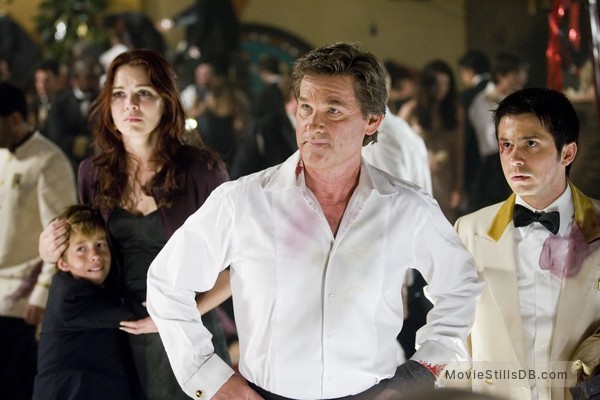
1. Who casts Kurt Russell as the former mayor of New York City? San Pedro, maybe. But The Big Apple? Look at this guy?
2. How good is Kevin Dillon? He walks right in as Johnny Drama from HBO’s “Entourage”, says “Look at me, I’m Mr. Lucky” and then he dies. $1 million?
3. Fergie is the singer. But she doesn’t sing “There’s Got to Be a Morning After.” Huge mistake.
4. I miss Shelly Winters. Why couldn’t she cameo? She died the year it was released, but still . . . .
5. I liked Andre Braugher as the new captain. But why he didn’t get to say “Oh My God” as the wave hit, like Leslie Neilson?
Clive Owen seemed such a natural choice to replace Pierce Brosnan as James Bond. His breakout performance in the small budget Croupier even had him sporting a tuxedo in a casino. But Owen passed, the role went to Daniel Craig, and “Bond was back!”
Except, Bond wasn’t back. Daniel Craig and the creators of his movies turned their collective backs on a bunch of Bond movie staples. Gone were the ridiculous gadgets, women named “Pussy” and “Goodhead”, painful puns and villains with designs to dominate and/or destroy the world. Admittedly, Mike Myers’s Dr. Evil killed the last trope, which is a shame, because I’m less interested in villains with mere monetary designs. But the advent of Craig signaled the death of a Bond audiences had come to know and tire of.
Instead, Craig brought us a hard, lean and rough Bond, a killer, but a smart, quick killer. It was noteworthy that the first chase scene in Casino Royale is not by car, plane or boat, but on-foot, a dizzying, physical sequence where Bond chases down one man. The suave and debonair is gone, as is evidenced by a drink order:
Like George Lazenby in On Her Majesty’s Secret Service, however, Craig is introduced as a Bond who falls in love. We see another side, briefly, and then thankfully (I prefer Bond unencumbered), we see what he will be going forward (we didn’t get that option with Lazenby, who apparently thought he had a brighter future than Bond had to offer).
Paul Haggis wrote Million Dollar Baby and Letters from Iwo Jima, and he won the Oscar for Best Screenplay for Crash. He also wrote Casino Royale, which is interesting, well-paced and modern as opposed to cute and campy.
Also gone are the bevy of beauties, with the Bond girl being, generally, the least dumb. Instead, we get a quick-witted Eva Green, who is a match for Bond intellectually and thankful that she lacks his innate brutality.
Best, Casino Royale brought back the gorgeous locales. Prague, Nassau, Montenegro and Venice are featured.
Beautiful and sumptuous, the picture marked the end of Terrence Malick’s 20+ year absence from film. Ostensibly about an offensive during the Guadalcanal campaign, the film follows Privates Bell (Ben Chaplin) and Witt (Jim Caviezel) as they are deposited on a Pacific island to take an enemy air base deep inland. They are accompanied along the way by Private John Savage, Sergeants Sean Penn, Woody Harrelson and John C. Reilly, Lieutenant John Cusack, Captains Elias Koteas and George Clooney, Colonel Nick Nolte, General John Travolta and a host of other young actors playing infantrymen.
The first time I saw this picture, the characters did not register. It seemed like a glut of talent working with limited space, and the result was disjointed and, at worst, high falutin’. I wrote:
Koteas and Cusack register, the former as a humanistic officer who cannot accept the slaughter of his men for a greater good and the latter as a brave underling who shows true leadership in a grave hour. Nolte is standard spit and scream (it is truly amazing how red he can make his face). Penn, Harrelson, Clooney, and Travolta are cardboard, and Reilly is given a short, hackneyed speech on how he has become hardened by the war. Savage in particular is really, really bad as a soldier who has cracked under the strain of combat. It’s hard to believe that Savage, so good in 1978’s The Deer Hunter, was revived for such histrionics 20 years later.
I was harsh and/or wrong. On re-viewing, most of the characters do register, and they often make lasting imprints with little screen time. Further, Malick’s use of the voice-over in their heads, which initially struck me as a distracting cheat, is much more than that. It’s an ambitious technique to not only get us in their minds practically (which, in combat, would likely be an inner monologue of “oh fuck, of fuck, oh fuck, oh fuck”) but philosophically as they wrestle inner demons and regrets while negotiating external hostility.
The film is lush and visually riveting, from the beauty of the ship cutting through the Pacific prior to disembarkation of its armed cargo (filmed directly down from the prow), to the stark image of a dismembered mine team, alone among the peacefully covered foliage (the first carnage the company witnesses) to the killing of two men by a Japanese sniper – they fall poignantly in the tall grass before the vista of a misty, impossibly beautiful hillside. Malick’s juxtaposition of the wonders of nature and the blight that is the intrusion of combat is jaw-dropping.
Hanz Zimmer’s score supports the sense of dread and beauty, intertwining the exotic of the island and the tick-tic-tick of the danger therein.
Malick does makes some fundamental errors that, I’m sure, seem niggling in the light of the ambition of the project. For example, Witt and Bell look alike and they kind of sound alike and when two men are running around in battle and doing voice overs, that becomes problematic. The cameo factor can also be distracting because actors are trying to make their mark in the short time allotted. As such, Travolta is weird as an ambitious general, and Clooney shows up at the end for a few lines (since you still haven’t seen Clooney until the end of the picture, you fear he may be pivotal and you have that much longer until the end).
Before The Hunger Games, and its depiction of a televised death match for teens, there was Network, perhaps the most prescient film ever made. Released in 1976, Network foreshadows the gruesome future of television as it slides nearer and nearer to county fair freak show. Caustic, incisive and at times frightening, if modern writers managed half of Paddy Chayefsky’s lines in Network, we’d all be better off for it.
The plot is simple. A network is going down the tubes and in order to save it, the reckless, soulless and brilliant Faye Dunaway is given free reign over programming. She forwards numerous efforts, the most popular being The Howard Beale Show, a nightly venue given to a network news anchor (Peter Finch) who is slowly going mad.
The script bogs down a bit in the last quarter, mainly, I think, because the medium of film does not handle monologues for two hours, and in between Chayefsky’s smart dialogue, this is essentially a film of well-delivered speeches.
The movie is filled with gems. Finch making his mark with an on-air nervous breakdown (“I’m mad as hell and I’m not going to take it anymore!”) or corporate titan Ned Beatty thundering to Finch that he has meddled with “the forces of nature” after one of his on-air screeds affects an oil investment. A scene that is unparalleled involves the activists from the Ecumenical Liberation Organization, a quasi-Symbionese Liberation Organization, upon which Dunaway is basing a “reality” show. These revolutionaries for the proletariat are soon perverted by the influence of TV and begin squabbling as to points and percentages off the back end. There are also wonderful pitch scenes for shows that in 1976 would have seemed outrageous, but would now be ho hum.
There are some weaknesses. The romance between Dunaway and William Holden, the old network bull, is unconvincing. It is easy to understand a older man-younger woman dalliance, but in this case, Dunaway plays as a frenetic shark. Her character freely admits she is a lousy lay and then demonstrates as much with Holden. Dunaway’s character is about power and moving up (when a young, non-powerful man kisses her shoulder, Dunaway’s sharp “Knock it off” tells you all you need to know), and the fact that Holden does not see it is problematic.
Perhaps it was Holden trying to understand the future, or he was waning and wanted a taste of youth. It’s possible that Dunaway, like televison, is empty but still capable of beguiling Holden for a time, like Beale’s viewers. But the relationship seems peculiar and off-kilter. That said, some of Chayefsky’s best lines are during their conversations, so the curious nature of the couple can be forgiven.
Network is deservedly ranked 64 on AFI’s Top 100 movies.

 Those lips, those cheekbones, that gun!
 Which leads to a biography of a director highlighting the following: criticism of Paul Thomas Anderson, as if Anderson were a peer; becoming so overweight he is kicked off of a flight for not having bought two seats; attacking Bruce Willis (“I had no f***ing help from this dude whatsoever”) because Willis did not work hard enough to promote the execrable Cop Out); an attempt to market his last cruddy picture “outside the system”; and retiring, at the ripe old age of 41.





 filmvetter