Archive

80s

https://i0.wp.com/ecx.images-amazon.com/images/I/51bfR0ArmlL._SL500_SS500_.jpg

A group of friends gets together to mourn the suicide of a contemporary. What is really being mourned, however, is their youth, which occurred during the 1960’s when they matriculated at college together.  What follows is a miasma of nostalgia, sound-tracked ironically by Motown (there is not a black, brown of tan face among them), as a group of super-successful people (even the drug dealer has a Porsche!) lament their transformation from their fantasy selves of the past (idealistic, war protesting, caring, would-be world changers) to what they have become (affluent, whiny, navel-gazing malcontents who rue their upper-tax brackets, nice homes and cars, and cushy lives).

Some offerings on their current state:

“Wise up folks. We’re all alone out there and tomorrow we’re going out there again.”

“It’s a cold world out there. Sometimes I feel like I’m getting a little frosty myself.”

“I’m sure we all think there’s a lot of good left in us.”

Only one character resonates, and then, but for a moment.  The drug dealer, William Hurt, eventually succumbs to the feel-good ooze and affirmation, but early on, as the unctuous Kevin Kline tries to connect, Hurt says one of the few adult things in the movie:

“a long time ago we knew each other for a short period of time; you don’t know anything about me. It was easy back then. No one had a cushier berth than we did. It’s not surprising our friendship could survive that.”

This moment of lucidity is soon overwhelmed by gloppy, poofty, self-congratulatory schmaltz, forever to be prefaced by “the soundtrack for a generation.”

Peace and love is easy to dispense in a gorgeous, multi-million dollar mansion, owned by Kline and his angelic wife Glenn Close.  So, in the ultimate sacrifice of a suburban queen, she offers Kline’s sperm to her college buddy, Mary Kay Place, who is desperate to get pregnant.  Said sperm is to be delivered by Kline in the natural act, who is dispatched in Dick Van Dyke’s pajamas to inseminate.

Close even stands in the hallway after delivering her gift, so proud of her selflessness she positively beams.

Throwback: 'The Big Chill' | Decider

My kingdom for sounds of hard, headboard pounding sex emanating from the bedroom (“You like that?” followed by “Oh daddy, give it to me”).  Or Kline coming out into the hallway and saying to Close, “Do you mind?  We’re fu*&ing in here.”

And then Close the Good becomes the Glenn Close from Fatal Attraction, killing everyone in the house.

Alas, it was not to be.

The movie makes a virtue of overt explication of what every character is thinking.  The audience cannot be trusted to intuit their banal, narcissistic whining masquerading as some kind of higher truth.  They must be told!

The Big Chill is made worse by the fact that it isn’t even original, but rather, Lawrence Kasdan’s big-budget version of John Sayles’s The Return of the Secaucus Seven.  The picture spawned a worse copycat, even more cloying and self-satisfied, Peter’s Friends.  If you wondered what The Big Chill would be like with Brits, wonder no longer.


Th signature achievement of the reign of John Hughes.  During his run, Hughes wrote and/or directed the following teen dramedies– Pretty in Pink, Sixteen Candles, The Breakfast Club, Weird Science, Ferris Bueller’s Day Off, Some Kind of Wonderful, Uncle Buck and Career Opportunities.

Hughes offered a certain corporatized schmaltz and sentiment, and there are worse Hollywood epitaphs.  Hughes also provided a silly, devil-may-care ethos for affluent suburban high schoolers (Hughes grew up middle class in tony Grosse Pointe, Michigan) and he could deliver a bravura screwball scene, such as Ferris Bueller’s rock out during a Chicago parade or John Candy crashing a teen party in Uncle Buck. At the end of his films, a trite lesson was always learned, and opposites always came together for a hug of understanding.

Nestled in this treacle, however, was a bit of nastiness fully realized in The Breakfast Club.  A group of kids – the geek (Anthony Michael Hall), the jock (Emilio Estevez), the weirdo (Ally Sheedy), the hood (Judd Nelson), and the “it” girl (Molly Ringwald) – all must spend a Saturday in detention together.  It becomes a group therapy session, and the archetypes – initially hostile to each other – soon find solidarity in their hatred of the school administrator (Paul Gleason) and the fact that it appears they each have something in common – an oppression at the hands of their cretinous parents.  Nelson is burned by cigarettes (given the school, one presumes Dunhills); Hall is so pushed to succeed academically he has contemplated suicide; Estevez is also driven by his overbearing father, and his torture is so great he actually starts to punch himself ; and Ringwald explains her homelife thusly when asked if she can go to a party:

                            CLAIRE
I don’t know, my mom said I was [grounded] but my dad told me to just blow her off.
                           ANDREW
Big party at Stubbies, parents are in Europe.  Should be pretty wild…
                           CLAIRE
Yeah?
                          ANDREW
Yeah, can you go?
                           CLAIRE
I doubt it…
                         ANDREW
How come?
                           CLAIRE
Well ’cause if I do what my mother tells me not to do, it’s because because my father says it’s okay.  There’s like this whole big monster deal, it’s endless and it’s a total drag.  It’s like any minute… divorce…
                            BENDER
Who do you like better?
                            CLAIRE
What?
                            BENDER
You like your old man better than your mom?
                            CLAIRE
They’re both strict.
                            BENDER
No, I mean, if you had to choose between them.
                            CLAIRE
I dunno, I’d probably go live with my brother.  I mean, I don’t think either one of them gives a shit about me…it’s like they use me just to get back at each other.


Hall adds: “…I don’t like my parents either, I don’t…I don’t get along with them…their idea of parental compassion is just, you know, wacko!”

Then it is the jock’s turn:  “Um, I’m here today…because uh, because my coach and my father don’t want me to blow my ride.  See I get treated differently because uh, Coach thinks I’m a winner.  So does my old man.  I’m not a winner because I wanna be one… I’m a winner because I got strength and speed.  Kinda like a race horse.  That’s about how involved I am in what’s happening to me.”

Cue the tough, doing his own impression of his house:  “(as his father) Stupid, worthless, no good, God damned, freeloading, son of a bitch, retarded, bigmouth, know it all, asshole, jerk!  (as his mother) You forgot ugly, lazy and disrespectful.”

The jock rejoins, explaining that he taped a classmate’s ass together.  Why?  “I did it for my old man…I tortured this poor kid, because I wanted him to think that I was cool. He’s always going off about, you know, when he was in school… the wild things he used to do . . . it’s all because of me and my old man.  Oh God, I fucking hate him!  He’s like this…he’s like this mindless machine that I can’t even relate to anymore…’Andrew, you’ve got to be number one!  I won’t tolerate any losers in this family…Your intensity is for shit!  Win.  Win!  WIN!!!’  You son of a bitch!  You know, sometimes, I wish my knee would give…and I wouldn’t be able to wrestle anymore.  And he could forget all about me…”

Just to make sure we get the message, Gleason is the biggest prick in the world, an amalgamation of every insecure, bullying teacher in the continental United States.

There’s not a genuine moment in the picture nor a hint of deviation from its blame-shifting orthodoxy.

Hughes has always included some of this foolishness – the parents in Uncle Buck are too committed to their jobs, Alan Ruck’s father in Ferris Bueller’s Day Off cares more for his sports car than his son.

But The Breakfast Club’s attack on the cruel, neglectful parents is the primary theme of the picture and Hughes uses it to portray these five kids (three of whom do appear to be sh**heads of the highest order) as victims.

Look, children can be obnoxious, and teens doubly so, but there is perhaps nothing more unpleasant than encountering a self-pitying teen who bemoans his vaunted station just as he nears the age when lesser forebears were jumping into a hot LZ in Vietnam.

Hughes died recently of a heart attack.  He was a bit of a recluse in his later years.  I wonder if the stereotype of the suffering, whining rich kid he presented in The Breakfast Club contributed to his distress, either because he was prescient and had to live with it or he felt he had a hand in cementing the mold.

In a Vanity Fair piece after Hughes’s’ death, David Kamp wrote “As hoary as it sounds, The Breakfast Club spoke to a generation.”

Unfortunately, it appears they were listening.

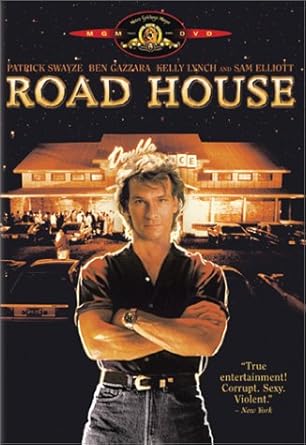
Image result for Roadhouse

A small town is run by the ruthless Ben Gazarra, who shakes down the local businesses to support his decadent lifestyle.  He lives in the gaudiest mansion, and he is surrounded by a thick, loyal squad of yokel goons.  He also has a few 80s trashy blondes in his coterie, like Julie Michaels–

Image result for Roadhouse Julie Michaels

Interesting note on Julie.  Roadhouse was her debut.  In her subsequent roles, these were the names of her characters:  Naran Anie, Professor, Professor (uncredited), Accident Victim, Accident Victim (uncredited), Sandy, Mom, French Patron (uncredited), California Blonde, California Blonde (uncredited), Pedestrian, Female Bar Patron #2, Barrista, Fashion Show Patron, Florist, Slutty Woman, Female Fan, Julie Mermaid mother, Harem Girl (uncredited), Groupie (uncredited), Female Club Goer, Maggie, Woman on Bike, Laundry Wife, Marilyn Monroe #2, Catherine Moore, Caitlin’s Sister, Frat Girl, Woman (uncredited), Vampire, Jane (uncredited), Catherine, Tami, Sillicate UC, Cage Dancer, Agent Elizabeth Marcus, Susan, Irene, Waitress, Waitress (uncredited), Amy Cutler, Freight Train, Susie Q, Cinnamon.

I digress.

One business won’t knuckle under to Gazarra – The Double Deuce.  Instead, bar owner Kevin Tighe calls in a zen master bouncer with a degree in philosophy (not joking – the script references that the professional bouncer has a degree in philosophy from NYU). That bouncer is Dalton (Patrick Swayze) who stands up to Gazarra, calls in a bouncer compadre (Sam Elliott), cleans up the bar and the town and says all of the following:

“Pain don’t hurt.”

“Nobody ever wins a fight.”

“My way… or the highway.”

“All you have to do is follow three simple rules. One, never underestimate your opponent. Expect the unexpected. Two, take it outside. Never start anything inside the bar unless it’s absolutely necessary. And three, be nice.”

“Take the biggest guy in the world, shatter his knee and he’ll drop like a stone.”

“You’re too stupid to have a good time.”

“It’ll get worse before it gets better.”

Roadhouse also features Kelly Lynch, the emergency room physician who patches Dalton up.

The year this picture came out, she was in Drugstore Cowboy. I wonder which film she is most proud of?  Regardless, I’ve had stitches like 5 times and there’s never a Kelly Lynch at the emergency room.  Ever.

By now, Roadhouse has become a cult classic, but when I saw it, I knew it was something special taken at face value, no sniggering. To this day, I can’t stop watching it.  It’s an awful film, and the inquiry should end there, but there is such earnestness in the effort that at 2 am, having just had 5 beers and a half bag of gummy bears, when Swayze says

“I want you to be nice until it’s time to not be nice.”

I’m like, “Hell, yea. Dalton. That’s some heavvy ass shi**!”

And now, every punch in the face in the movie!

I’m not much for sports hokum.  The elegiac bunk of The Natural, Field of Dreams, or even Any Given Sunday reveals more about the filmmakers’ insecurities than the game being played and the characters who play it.  But even I am not immune from hokum anchored by Gene Hackman and based on the true story of the 1954 Indiana state high school basketball champions from tiny Milan.

Hackman is the new coach with a dark past, bringing a fundamental style of play and stubborn ways to a cloistered small town that does not want him.  Barbara Hershey is the teacher leery of his influence.  Their conversations about what constitutes success are smartly written (she loathes the small town, plans the escape of her students and views Hackman’s” hoop dreams” as an anchor keeping young men from getting out).  Dennis Hopper is the alcoholic assistant coach, redeemed in the eyes of his player son as the team battles adversity.  David beats Goliath, and the music swells along with the heart.

The performances are all strong, and the casting of the fresh-faced team is perfect. The boys, town and milieu feel 1950s, as does the play, and the boys can play.  One only needs to watch the overrated White Men Can’t Jump to realize the foolishness of casting non-players; Woody Harrelson is passable, Wesley Snipes ludicrous.  The film is also chock full of inspiring and exciting vignettes as the boys march forward to victory. 

Hackman is commanding, in his sparring with Hershey, when he confronts the team’s star player, who is in the middle of a 1950s version of a holdout, and in his handling of the overbearing townsfolk.  I also like his simple, homespun speeches:

Ah, Bobby Knight.  

This one is better:

There are a few problems.  The love affair between Hershey and Hackman seems both improbable and awkward.  I no more want to see him kiss a younger woman than Tommy Lee Jones.  The score is also very 80s, stirring but techno infused.  But it’s still one of the better sports films made.

Splash put Tom Hanks on the map as a leading man, though he was not yet filled-in and substantial.  Instead, Hanks was mannered in the way an actor can be after a long stint on a sitcom (Hanks was one of the Bosom Buddies from 1980 to 1982).  The film was also Ron Howard’s biggest feature, and its success would launch his career as the director of competent, workmanlike, earnest and generally dull films.

Hanks plays a love-phobic NYC businessman (derived from a childhood trauma – he fell off a Cape Cod ferry and encountered a mermaid).  In the depths of despair over his romantic failures, he returns to Cape Cod, falls in the water again, and is again rescued by the mermaid, now grown up (Daryl Hannah), who follows him to New York.  She is pursued by a cruel scientist (Eugene Levy), captured and probed to the point of sickness (ala’ E.T.) and then is busted out by Hanks, his brother (John Candy) and a repentant Levy.

Almost 30 years later, it’s a shock to see such a callow and obnoxious Hanks.  His voice is whiny, his character churlish and childish, and he seems too much the boy for the part, light as it is.  Perhaps because a mermaid has no experience with men, she just presumed Hanks was a good catch (ba-dump) but he is not.  He’s aggravating and surprisingly unfunny.

The same cannot be said for Candy, who steals the movie as the heavy, schmoozing, hard drinking,  yuk-yukking brother, excited to have one of his letters printed in Penthouse.  Levy is also good as the nerdly, bitter scientist, and Hannah is appropriately innocent and glowing as the fish-out-of-water.

It’s a cute movie, no more, but it ends in an uninentionally ridiculous fashion.  Hanks jumps in the water, making the choice to live the rest of his live with Hannah under the sea (he cannot, for reasons unexplained, ever return to land).  The credits roll and Hanks and Hannah swim the ocean as she shows him her world.  She has a big fin, he does not (when she was on land, when dry, she had legs and what goes along with them when they meet, and they were able to have a lot of sex).  Her world is murky and humdrum.  “See, this is the ocean floor.  And there is a conch.  And there are some fish.”  And what will Hanks eat?

Image result for Splash hanks underwater

“This was a poor choice.”

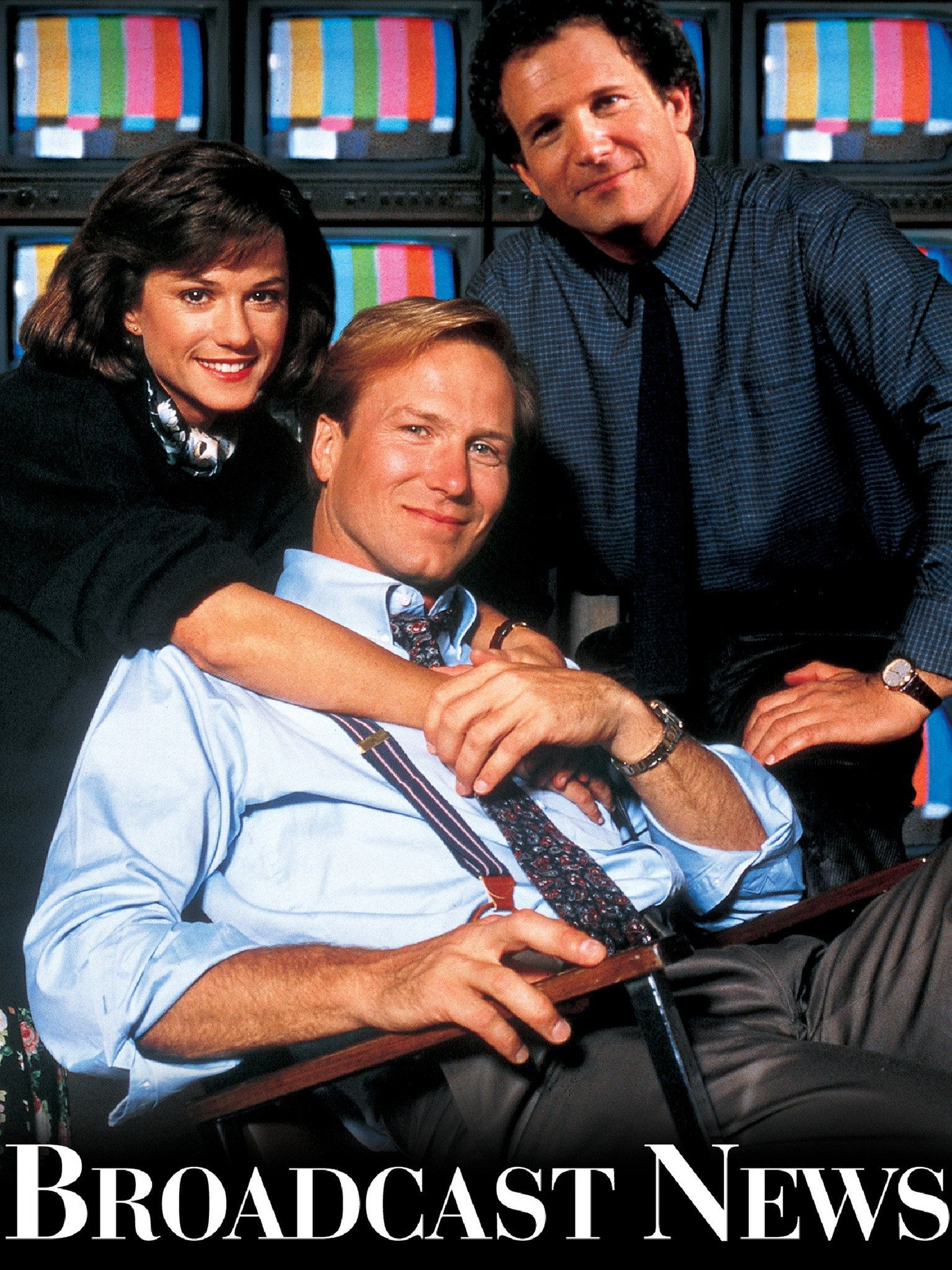
Broadcast News - Rotten Tomatoes

James L. Brooks has the ability to make you laugh out loud just before he brings a tear to your eye, a skill he has honed in Terms of Endearment and As Good as It Gets. His missteps (How Do You Know, Spanglish) still contain very funny dialogue, even if the whole doesn’t work.  But to be fair to Brooks, Paul Rudd, Reese Witherspooon, Adam Sandler and Tea Leone are not very formidable substitutes for Jack Nicholson, Shirley MacLaine, and Debra Winger.

In Broadcast News, Brooks melds a love triangle with a story about journalism and ethics that is prescient.  Holly Hunter is the producer of the Washington bureau of a major news network, Albert Brooks is a gifted but un-telegenic correspondent, and William Hurt is the new up-and-coming golden-boy, groomed to replace the current anchor (Jack Nicholson, in a hilarious cameo).  Hurt is attractive but shallow (as Brooks says, he is against everything Hunter is about).  But Hurt is also sweet and in his own way, genuine.  He fancies Hunter and when Brooks tries to anchor the weekend news in an effort to save his job, Hurt is there, giving him advice, some of which is excellent (“punch” a thought in each sentence) and some of which makes Brooks very uncomfortable (“Just remember that you’re not just reading the news, you’re narrating it. Everybody has to sell a little. You’re selling them this idea of you, you know, you’re sort of saying, trust me I’m, um, credible. So when you feel yourself just reading, stop! Start selling a little”).  Hunter becomes infatuated with Hurt, and as they grow closer, Brooks professes his long love for Hunter and reveals the ethical threat that is Hurt.

The picture is loaded with crisp, witty dialogue, and at its best, it evokes the great Grant/Stewart/Tracy v. Hepburn romantic comedies. The picture also injects something of substance (the deterioration of the news), not with the acid cynicism of Network, but gently, so as not to get in the way of the story and humor.

There is also great physical comedy, provided by Joan Cusack as a gawky assistant producer, and Brooks, who endures the great humiliation of flopsweat during his shot at anchor.  The scene is one of the funniest in film history.

The movie has one problem, but it is a big one.  Holly Hunter is so mannered and quirky that you simply cannot understand Hurt’s attraction to her, much less that of Brooks. Sure, the good looking neophyte might be intrigued by the neurotic but fascinating “other” ala’ Robert Redford and Barbra Streisand in The Way We Were.  But Hunter takes “odd” up several notches, and in many scenes, her facial expressions approximate her work in the live cartoon Raising Arizona.  Her temper is also so volcanic as to suggest mental illness.

Certain lines cannot be crossed in a romantic comedy.  I was reminded of the awful Hugh Grant-Sandra Bullock vehicle Two Weeks Notice, wherein Bullock has an attack of diarrhea on the highway and Grant has to commandeer a stranger’s RV so she can relieve herself.  This may work for Will Ferrell and Zach Galifinakis.  But no romantic lead can be shown in such an unflattering light.  Hunter does not sink to such depths here, but her portrayal does border on the grotesque and it detracts.

There is also the weakness of the import of Hurt’s great journalistic sin (he recreates a moment of emotion in an interview) .  There is no question – the act was unethical.  But in the context of some of the other stagey and easy shortcuts engaged in by Hunter and Albert Brooks, their high dudgeon (which is critical to the picture) rings hollow, and the film never gives them a comeuppance on this point other than Hurt’s rebuttal to Hunter after she accuses him of crossing the line — “It’s hard not to cross it.  They keep moving that little sucker, don’t they.”

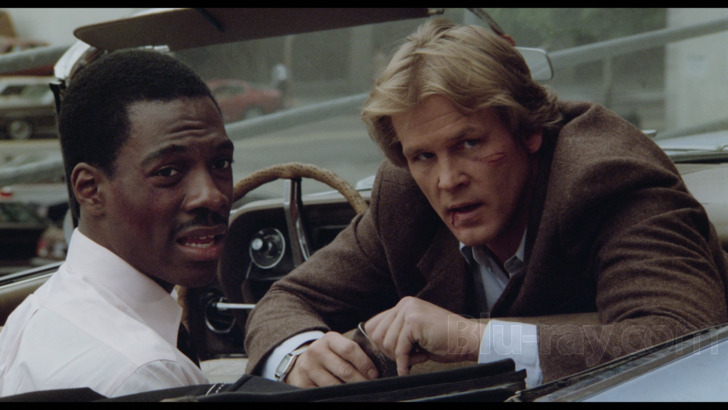
48 Hrs. Blu-ray (Remastered | Paramount Presents #19)

Eddie Murphy kinetically debuts as hustler Reggie Hammond, released from prison for 48 hours under the brutal watch of Detective Jack Cates (Nick Nolte) to hunt for Hammond’s ex-partners, who have gone on a cop-killing spree in San Francisco. The film catapulted Murphy to stardom. It was also the first picture to feature a Saturday Night Live comedian in a raw, crime story and stands as one of the better “buddy cop” pictures ever, though Murphy is really only deputized.

Yes, Murphy is very funny, sometimes side-splittingly so, but he does not treat every scene as an opportunity to do a bit or schtick.  He picks and chooses his moments, trusting in the story directed and mostly written by Walter Hill (The Long Riders). Murphy has one virtuoso scene, when he poses as a cop to roust a redneck bar, but even there, where he puts a knife to a man’s face and tells him, “I’m your worst fu***** nightmare, I’m a ni**** with a badge”, he’s in keeping with the picture’s tough tenor. Nolte’s Cates is brutal, unpleasant and an unrelenting racist, almost shockingly so, given our current advanced ethos, yet, they bond in a manner that feels authentic. Given we’re dealing with tough cops and criminals, the racial dynamic is not off-putting.  It just adds to the tension.

I was also surprised by the gritty brutality of the movie. The body count is high, but rather than explosions and elegant slo-motion, Hill takes more of a Sam Peckinpah approach. The shootings are bloody and awkward, not stylized. And the bad guys – Albert Ganz (James Remar) and Billy Bear (Sonny Landham) – are scary bad.

James Horner’s original music (he’s been nominated 5 times and won for his scoring of Titanic) is apt, a moody mix of jazz and Asian chimes.  Hill also uses San Francisco to his full advantage, mixing the grimy feel of Bullitt and Dirty Harry with a little early 80s glitz.

It has a few weaknesses. Annette O’Toole, for whom I have had my own weakness since Robby Benson’s One on One, is wasted as Nolte’s long-sufferring gal.

And the finale, where Cates and Hammond just “play a hunch.” is a bit lazy.

Still, an uproarious, and assured flick, much more than it seems.


The Shining (film) - Wikipedia

First things first.  I took my son to see The Shining at the American Film Institute Theater in Silver Spring, Maryland (they are running a Jack Nicholson retrospective).  The theater is ornate and massive and brings back the feel and style of the old movie house.

But not even the hallowed ground of a theater honoring film can persuade people to behave in a respectful fashion during a movie.  We had two fools in the front who found particular dramatic scenes funny and laughed and laughed and laughed . . . and laughed some more.  We also had two couples to our right who presumed if a character wasn’t talking, that was their cue to talk.  Stanley Kubrick films have long stretches of no dialogue.

Going to films is more and more difficult given the crude behavior of movie patrons, who cannot shut th f*** up, are now eating full meals during the show, and are otherwise oblivious to anyone around them.  Worse, those who are quiet, including myself, are often forced to simply accept the noise.  I have interceded a few times.  It has worked less often than not, because if you correct a young person in public, apparently, that is a humiliation too great to endure, and what follows is aggression and louder “I paid my ticket” talking.  Now, I’ve made the film less enjoyable for additional rows.

Okay.  To the movie.  Kubrick’s picture is methodical and creepy,  It opens abruptly with an aerial shot of Jack Torrance (Nicholson) driving for his interview at the Overlook Hotel to an ominous electronic score (think John Carpenter).  Torrance gets the job as the hotel’s winter caretaker, where he esconces his timid wife (Shelly Duvall) and his son (Danny Lloyd), who has the ability to see visions and occasionally communicate with like-talented people (i.e., he “shines”) such as the hotel’s head chef, Scatman Crothers.  Danny’s ability is also telling him that the Overlook Hotel is dangerous, a fact Crothers confirms.  Soon, the hotel insinuates itself into Torrance’s mind, turns him against his family, and he goes berserk.

The film is very scary, often terrifying.  Kubrick gives us the time to get to know the family, and all is not well:  Torrance has had recent problems with drink, injuring Danny in the process.  He is also a condescending prick, which in turn makes his wife more jittery, which in turns makes Torrance angrier and more removed.  With this fodder, the spirits of the hotel work themselves on Nicholson.

The imagery is unforgettable, be it Danny riding his big wheel (tracked by stedicam) through the halls of the Overlook, only to bump into gruesome visions, or the forbidding snow-covered hedge maze, the locale for the final scene.  Lloyd is very good:  he is withdrawn but sweet, trying to deal with a wretched home life and an amazing but confusing gift.  Duvall, whose performance has been criticized as annoying (she was nominated for a Razzie), is, in fact, very annoying, but it is a great performance nonetheless.  She is trying to hold the family together, as Nicholson is trying to destroy it, and her worry feeds his suspicion.  The hotel has to work on something; it has to find an “in” to get to Nicholson, which it does through Duvall, who is nervous and peppy and cloying.  Obviously, she doesn’t deserve to be murdered.  But the spirits of the hotel don’t need to much to convince Nicholson.

The only partial negative is Nicholson.  He’s very good as a man driven to insanity, but the performance has two faults.  First, Nicholson does not show much to recommend him when he has full sanity.  He’s superior and sarcastic and he doesn’t connect with his family.  As such, when he is enticed by the hotel, there’s not much of  struggle there.  He’s ready to fix them up right and there really was no question.  Second, there are too many “Heeeeeeere’s Johnnies” in his performance.  Nicholson goes so over-the-top that he becomes cartoonish.  Still, it’s a minor criticism and presumes the necessity of a struggle for Nicholson’s soul.