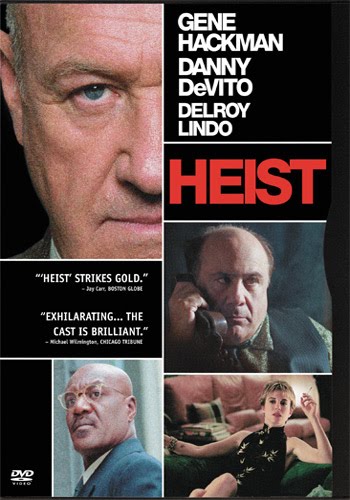
David Mamet-speak can be taken to parody.
But why bother when you have a David Mamet written and directed film that does it for you?

David Mamet-speak can be taken to parody.
But why bother when you have a David Mamet written and directed film that does it for you?
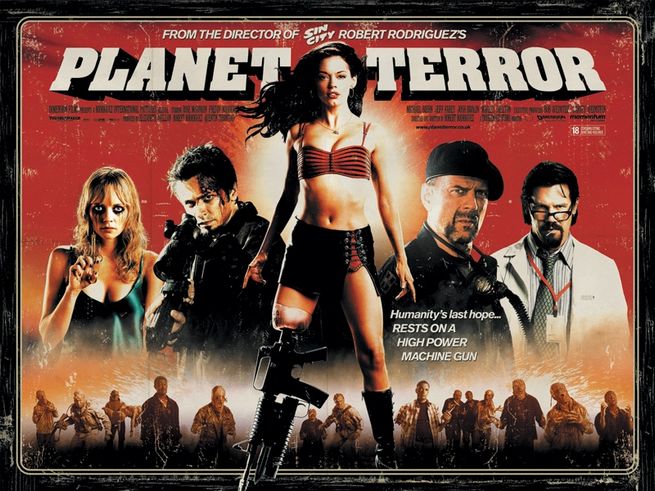
In evaluating Robert Rodriguez’s half of the Grindhouse double feature experiment/debacle with Quentin Tarantino, one has to remember that the insistence on an homage to 70s drive-in crap was an insurmountable mistake.
A small Texas town is beleaguered by zombies, created by a military experiment gone bad. All hell breaks loose. Not really funny and not at all terrifying, mostly boring, often disgusting. But in the ultimate structural pass, Rodriguez is not responsible for a lazy, uninteresting film, because he is patterning his movie on same. Along with Tarantino’s Death Proof, there are few greater examples of Hollywood hubris.
Entertainment Weekly called it “crazily funny and exciting tribute to the grimy glory days of 1970s exploitation films” that “will leave you laughing, gasping, thrilled at a movie that knows, at long last, how to put the bad back in badass”, proving that some critics will go to great lengths for fear of seeming uncool.
It was, however, kind of gutsy to cast a near midget (Freddie Rodriguez) as the strong, silent hero.
 My son makes me watch pieces of these Adam Sandler films now that they are on regular cable rotation, in what appears to be some kind of social experiment. I watch the movies, which masquerade as comedies, and I don’t laugh. My son watches me intently. If I do laugh, which is rare, he mocks me for having laughed. At the end of the endeavor, we shake our heads, and then, when we have time to reflect, we ponder larger questions:
Does Adam Sandler make the least funny movies ever made?
It’s hard to come to any other conclusion but yes. Add Bedtime Stories, Billy Madison, Click, Just Go With It, The Waterboy, Little Nicky, 50 First Dates, You Don’t Mess with the Zohan, Mr. Deeds, I Now Pronounce You Chuck and Larry, Bulletproof, Anger Management, and Big Daddy. There’s barely a laugh in any of them, though I am partial to some parts of Happy Gilmore, and The Wedding Singer was cute. But that was 1996 and 1998, respectively.
Does Sandler have any films that reflect well on what purports to be his talent?
Two. He was apt in Paul Thomas Anderson’s overlooked Punch Drunk Love, and Judd Apatow’s underrated Funny People was greatly reliant on his ability to play himself (a mega star comedian who makes crappy movies).
Is there a major star less deserving of his success?
I’m a fan of Clint Eastwood’s line in Unforgiven (“deserves got nuthin’ to do with it”), but, no.
Is there a major star more loyal to his pals?
No. If there is one thing consistent in Sandler’s films, other than being unfunny, it is the presence of his regulars: Allen Covert (15 Sandler films), Jonathan Loughren (13 Sandler films), Peter Dante (11 Sandler films), Rob Schneider (10), Blake Clark (9), Nick Swarsdon (8), Steve Buscemi (7) and Dennis Dugan (7 as actor, 8 as director). So, while his movies suck, he is certifiably a loyal and true friend.
Why is Sandler fascinated with sex and old women?
I won’t catalogue all the examples, but randy oldsters getting it on with folks 50 years their junior is heavy in his oeuvre. Sandler may have noticed it himself and course-corrected, because in That’s My Boy, he went the other way.
Which film goes the longest without eliciting a laugh?
Grown Ups, which is a little surprising, because Sandler is supported by a bevy of other semi-accomplished comedians. But there really isn’t a hearty laugh in this picture, and hooray! Part Two is in post-production.
Tim Burton hasn’t declined so much as remained spotty. Last year’s Frankenweenie was in his animated wheelhouse, but his two previous films were the excessive and dull Alice in Wonderland and the truly awful and unfunny Dark Shadows. Before those films, however, was Burton’s first live musical, Sweeney Todd: The Demon Barber of Fleet Street, a rich, dark rendition of the Stephen Sondheim stage musical. Burton maintains the macabre edge of the play, infuses it with his trademark visual trickery, but wisely doesn’t screw with its heart, an entire story mostly sung, rarely spoken.
Johnny Depp and Burton’s wife, Helena Bonham Carter, are not great singers, but they are great actor/singers (Depp took singing lessons and was nominated for Best Actor), a feat Russell Crowe could not accomplish in Les Miserables, as is evident in “My Friends.”
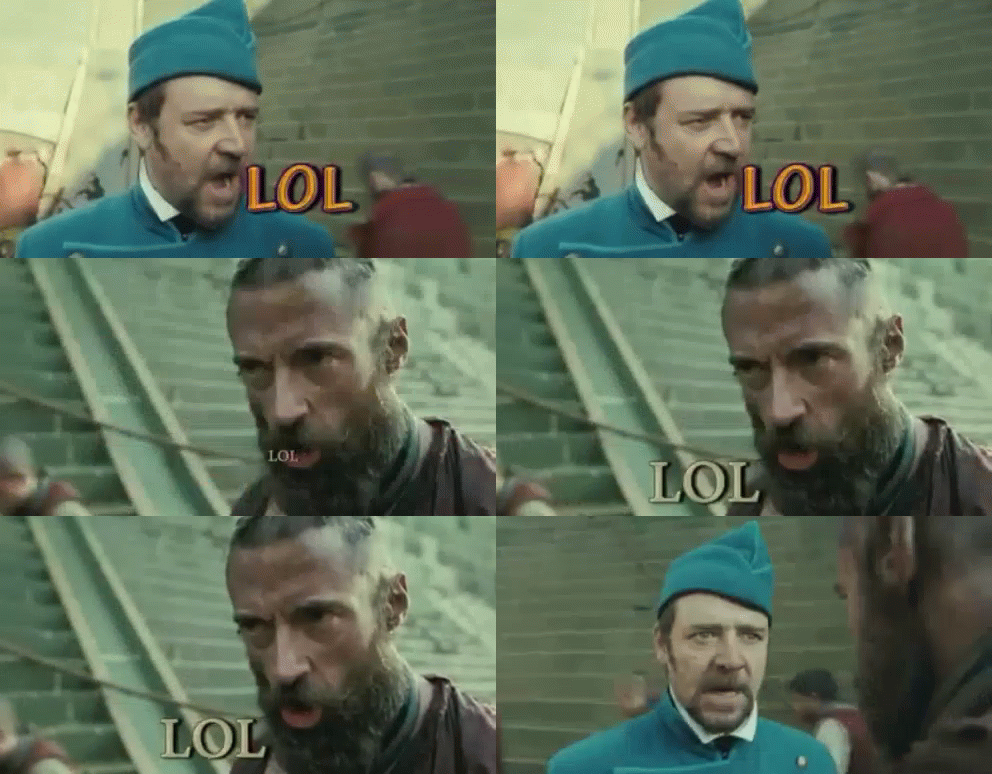
Speaking of Les Miserables, Depp and Bonham Carter are quite good, but they need merely convey anger, sarcasm, and bloodlust. If I’m going to knock Crowe, I have to laud Anne Hathaway and Hugh Jackman whose first numbers, sung live on set (using live piano accompaniments played through earpieces), are perhaps the most moving in musical film history.
Depp and Bonham Carter are ably supported by a moving Edward Sanders as Tobias Ragg and a hilarious Sasha Baron Cohen as the competing barber, Pirelli.
One nit is the unnecessary bloodiness of the throat cutting, which was accomplished with a mere splash of red in the stage play. It’s discordant. Another is inherent in the play, which is so dark as to be dispiriting.
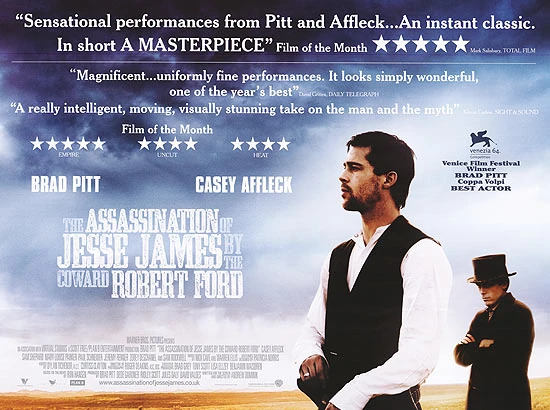
Andrew Dominic’s moody, elegiac picture melds Terence Malick’s imagery from Days of Heaven and Walter Hill’s sense of time in The Long Riders. As Ford, Casey Affleck is mesmerizing, and Brad Pitt’s depiction of James as a manic-depressive sociopath is chilling. Their performances are enhanced by Dominic’s sweeping, beautiful vistas (the film drew an Oscar nod for best cinematography) and a mournful score courtesy of Nick Cave and Warren Ellis.
A $30 million western without a single shootout (at least, one involving Jesse James) is destined to make a mere $3 million back domestic, but this film is more about hero worship, fame-seeking and insecurity than the violent exploits of the James gang. Affleck, who was nominated for best supporting actor, subtly communicates living in the shadow of Jesse James, traversing the path from awe for a legend, to anger over his idol’s coldness and indifference, to maturation and resolve as James becomes more suspicious, mercurial and dangerous. Ford’s likening of himself to James in the great killer’s presence, which can be found below, is startling in its honesty and vulnerability.
Affleck and Pitt receive strong support, including Jeremy Renner and Paul Schneider as feuding gang members, but as ever, Sam Rockwell near steals the picture as Charlie Ford, playing dumb but in truth, whipsmart and canny. Garret Dilahunt (Deadwood) is also resonant as a doomed and dim Ed Miller.
Upon first review, I wrote, “a glaring fault is an unnecessary voice over narrative, the voice being similar to that of David McCullough. The effect is redundancy and a PBS/History Channel vibe.” I also gently criticized the picture on its length. I recently saw it again and I was wrong on both counts. The voice over is not obtrusive nor is it merely aping what is happening on screen. Rather, it enhances the film’s tragic nature (this is a ghostly western and a movie about one of the first celebrity screw-ups) with an explanation as to how it fits historically and personally. And I was sorry to see it end no matter how long it ran.
This is a unique, accomplished period piece.

It is a testament to M. Night Shyamalan’s clout after The Sixth Sense that he could get such a deliberate and meditative film made. Bruce Willis is a Philadelphia security guard, an ex-jock in a crumbling marriage with Robin Wright. His son is overly attached to him, sensing in his father something special and perhaps dangerous. After Willis emerges from a horrific train wreck as the sole survivor, with nary a scratch, the son’s suspicions are confirmed by the appearance of a comic book aficionado (Samuel L. Jackson) who leads Willis to a great revelation. It’s an old movie, but to discuss it further substantively would be an injustice. Before Shyamalan became a slave to big twists and reveals that became increasingly ridiculous, from aliens who invade earth but for whom water is acid (Signs) to an eco-counterattack where trees make people commit suicide (The Happening), he could deliver some truly effective codas, and Unbreakable contains my favorite.
Great ending aside, the story is original and sophisticated, Shyamalan’s Philly locales are lovingly chosen and spooky, Willis is the perfect choice for a regular Joe who soon learns he is anything but, and Jackson projects brilliant obsession. The penultimate scene, where Willis tests his new incarnation, is one of the more frightening I’ve ever seen.
The studio and Shyamalan had to have been disappointed by the latter’s sophomore effort. While it did very well overseas, its domestic gross exceeded budget by only $15 million compared to The Sixth Sense‘s $250 million. But Shyamalan had to know that such a painstaking, personal film would not garner an expanding mass audience, even if the studio didn’t.
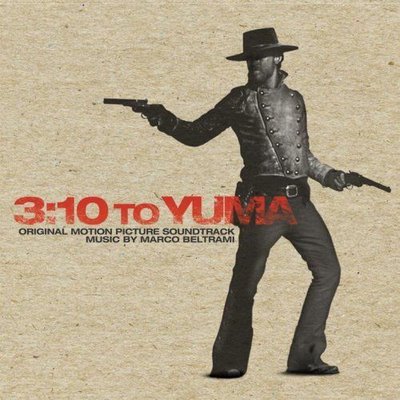
A barely competent remake, James Mangold’s follow-up to Walk the Line pits brutal and charming highwayman Ben Wade (Russell Crowe) against desperate and pitiful rancher Dan Evans (Christian Bale). Bale is scratching a living out of the barren Arizona earth, debilitated by a war injury, harassed by a businessman who wants his land for the railroad, and scorned by a 14 year old son (Logan Lerman) who thinks his father is a coward. When his path crosses with Crowe, Bale takes the high-paying gig of joining a crew ferrying Crowe to town and on the train to justice, harried the entire way by Crowe’s gang, led by Charlie Prince (Ben Foster). Unfortunately, Bale is so stolid he borders on dull, and Crowe’s lethal charm is in short supply, though he does have a moment seducing a local barmaid.
Mangold keeps the story crisply moving and his action sequences are first-rate. While the leads don’t shine, the support is strong. Foster’s serpentine, scary right hand is matched by the crusty and seemingly indestructible Pinkerton subcontractor Peter Fonda and the precise Dallas Roberts as the main Pinkerton and leader of the endeavor.
The film, however, is nearly undone by an implausible ending wherein Crowe and Bale bond through a series of mutual confessions (Crowe’s mom abandoned him, Bales was shot by his own man in the war, and Bales’s son is sick with tuberculosis) and Crowe repents, assisting Bale in his own ferrying to the hangman’s noose.

After taking my boy to Django Unchained, we started a concerted effort to watch the Tarantino catalogue. When he asked about the Kill Bills, I told him they were films made primarily for children, but were so violent, if cartoonishly so, that children probably shouldn’t be allowed to watch them. Of course, Tarantino is a visionary, having anticipated an audience of children of a wider breadth than I could have imagined, scads of 24 to 36 year old slacker geeks, still living in Mom’s basement, deathly terrified of footballs and baseballs and supervisors and real women, banking retirement on mint condition comic books, their only meaningful relationships having been 2 to 3 minute internet trysts with the various Jenna Jamesons cranked out of the San Fernando Valley with increasingly worrisome regularity.
This is their crack cocaine.
Volume 1 is stylish, meticulous, occasionally funny and inventive but a mostly tiresome abscess of a picture. As if any enjoyment derived from the first picture required penance, Volume 2 is that contrition.
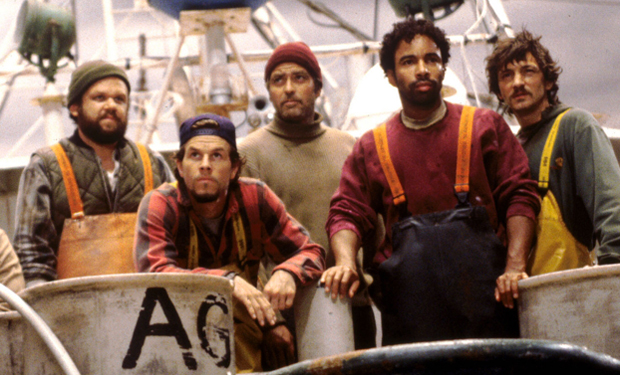
A Gloucester fishing boat captained by George Clooney goes out to get some fish and is soon in “the perfect storm.” Based on Sebastian Junger’s best-selling book about the fate of the Andrea Gail, the visuals are occasionally impressive but this is no Captain’s Courageous. The characters have a working class look but not the feel, and Clooney, who normally chooses well, is too damn dreamy to be the salty sea dog (he would have been better as the telegenic and wide-eyed meteorologist who captures the storm on his Doppler).
A better skipper would have been John Hawkes, the crewman furthest to the right above, who was nominated for an Oscar for Winter’s Bone and should be nominated again this year for The Sessions.
Junger’s book delved deeply into the precarious, brutal and chancy world of commercial fishing, but the script elects to show hard drinkin’, hard lovin’, misunderstood men of the sea while on land, and on the water, a boring band of brothers. The screenplay is either hackneyed or just plain dull.
Here’s a taste.
“This is the the moment of truth”
“Billy, you’re not gonna’ like this but I’m gonna’ say it anyway. You be careful.”
“I always find the fish. Always.”
“Last night was worth it. There’s nothin like sleepin’ with you… just sleepin’… lyin next to you… all warm and sweet… Me wishin’ the mornin’ would never end.”
“You just caught me on a good night. I’m doing what I was made to do – and I’ve got a feeling I’m going to do it even better this time.”
And when crew member John C. Reilly is about to drown, he doesn’t scream or panic. Instead, being a man of the sea, he says to no one in particular, “This is gonna be hard on my little boy.”
Hard on the audience as well, John.
There’s also a lot of forlorn women looking out the window for these good men of the sea (Diane Lane is completely wasted). Old Spice commercials are filled with greater verisimilitude.
Director Wolfgang Peterson made it to Hollywood on the strength of his gripping U boat drama Das Boot, but since then, he’s gone to sea twice, with The Perfect Storm and the even worse Poseidon.
He needs to stay on land.


Even Halle Berry cannot save the ridiculously coiffed, barely interested Pierce Brosnan in the last of his four Bond films (her love scene with Brosnan makes you uncomfortable, like watching your father dance to a pop song at a wedding). Shockingly, even though Austin Powers had been released five years earlier, this Bond film amped up the cheese, provided a cartoonishly mwahahaaa villain (Toby Stephens), an ice fortress, Duran Duran video slow-motion, enough sexual double entendres to shame Roger Moore, Halle Berry uttering the line “read this bitch!” to baddie Rosamund Pike, and perhaps the most laughable stunt in the series.
Bond gains entrance to the villain’s lair because a guard takes a leak at an inopportune time. You can hear the toilet flushing. Hilarious.
Daniel Craig arrived in the nick of time.
 filmvetter