Archive

2013

When I was in a college band in the 80s, I played on one LP. We recorded it in Richmond, VA over a hurried couple of days and had the audacity to call it Hits, one of many mistakes associated with the disc.  But the songs on the record were a marked departure from what the songwriter had written before. It soon became apparent (at least to me) he was under the influence of Big Star, if not melodically, in the bold choice of record name.  That said, it was a long time ago, and I may be making this all up.

Big Star would influence much better bands (The Replacements and REM, to name two) and Big Star’s first two records – #1 Record and Radio City – are, as affirmed by the critics and other interviewees in this documentary, mind-blowingly great.  Exhibit A–

The documentary, however, is merely good. While it does a creditable job of showing how the band, under the direction of Alex Chilton and Chris Bell, came together and missed its shot at the golden ring, its coverage of the aftermath is alternatively listless and revealing. Particularly surprising is the time given to the peculiarities of Chilton and Bell after Big Star failed to make it. Disappointing is the meager attention given to the actual music, and make no mistake, those first two records are seminal. Instead, the film spends an inordinate amount of time on, in the words of one contemporary, Chilton’s “self-absorption, self-focus, [and his use of ] drugs and alcohol.” The documentary whizzes by Big Star’s 3rd record but offers a lengthy exploration of Chilton at his worst, his foray into punk and then a gruesome endeavor called Panther Burns.

As for Bell, the film does better with his story after Big Star missed its shot. In the words of one interviewee, Bell just “lost interest in bands period. He just wanted to hear his songs not translated.” He also became a born again Christian, told his brother “you should do drugs. It takes away your sexual urges”, and eventually found himself working at a local restaurant. But Chilton reconnected with Bell, and the result was an astonishing single, I Am the Cosmos, that harkened back to the sound of the first two records.

Much of the weaknesses of the documentary are inescapable. Bell and Chilton are dead (Bell died in a 1978 car accident, Chilton in 2010 of a heart attack) and they were extreme introverts while alive. In their stead, however, the film does a great justice to the broad music community in Memphis. And it wisely ends true to the form in the last 20 minutes, with a host of acts providing testaments and tributes to the band and its influence.


My nephew recommended this picture and it was directed by Guillermo del Toro (The Devil’s Backbone, Pan’s Labyrinth). I feared I’d missed a hidden gem. Monsters come from beneath the ocean to get us, and we humans make big metal suits helmed by duos to fight them. This is Transformers (and Real Steel) for middle schoolers instead of mental defectives, scored bombastically, loaded with manly exchanges (“let’s gets this son of a bitch!”, “you can finish this”) and cast with the immediately forgettable (except poor Idris Elba, who I trust just wants to forget).

There is some cool CGI and at the outset, it poses as being cynically dystopian. Still . . .

Ryyyyyyyaaaaaaaaaan!!!!!! You owe me one dollar!!!!!!!!!!

Thirteen years later, Martin Scorsese has re-made Boiler Room, writer-director Ben Younger’s patient and understated Wall Street picture about a sweet kid (Giovanni Ribisi) who gets sucked into the easy cash of a penny stock chop shop run by crooked investment manager Tom Everett Scott. Scorsese’s picture is from the vantage point of Scott’s character, penny stock maven Jordan Belfort, and clearly, the guy who played the drummer in That Thing You Do wasn’t going to cut it as his lead. Enter Scorsese’s boy Leonardo DiCaprio, an able and unsurprising choice. But as I sat through this excessive, gaudy, and at too many times, repetitive extravaganza of the go-go 90s, I pined for the more muted touch of Ben Younger.

DiCaprio as Belfort is an aspiring stockbroker tutored by Matthew McConaughey (who is hilarious; what a year he’s having) but wiped out on 1987’s Black Monday. He reinvents himself by switching to penny stocks, where the clientele is working class, the investments not so much risky as ludicrous, and the broker commissions 50%. Soon, with a band of merry fuckups (including Jonah Hill, who walks a steady line between an ambitious man and a raging child), he is crazy rich. He is also a drug and sex addict of mythic proportions and his life is an endless bacchanal, until, like Ray Liotta in Goodfellas, he must pay the piper.

The Wolf of Wall Street apes Goodfellas and Casino in its exposition, showing us through voiceover or DiCaprio speaking directly to the camera just how the securities game works. But writer Terence Winter lacks interest in the mechanics, and many times, DiCaprio leers and tells us directly, “You don’t want to know this.”

The film deduces that what we really want to know is what it’s like to live a high-wire act where every desire is fulfilled, and then some. For the most part, the filmmakers are correct, but in depicting the excess, they overindulge in it. There are two too many orgies, drug crack-ups and the like and at times, the mind wanders. Worse, as in Casino with Sharon Stone and Robert De Niro, Scorsese wrongly presumes we are interested in the marriage of DiCaprio and his trophy wife (Margot Robbie), a union founded on lust, greed and advancement that doesn’t deserve the time given to dramatize its crack-up. Our interest in Robbie peaked on her first date with DiCaprio, when she alights from the bedroom naked save for thigh highs of her own design.

Despite these foibles, the film is often very funny, and when it hits strides, dizzying and infectious. It also does not labor under the burden of a heavy message. Oliver Stone would surely have had Martin Sheen arrive in the final chapter to lecture us about American greed. Hell, Adam McKay, he of titanic films that reach to the heart of who we are as nation, closed The Other Guys with a tutorial on the excesses of Bernie Madoff (but we would expect no less from our new Capra, the creator of not only Anchorman, but Step Brothers and Anchorman 2). Instead, Scorsese and Winter don’t provide a message as much as a testament to the tribal customs and loyalty of certain American subcultures (Winter wrote 19 episodes for The Sopranos) and the universal intertwinement of the American dream and gluttony. But really, this is a picture about how crazy shit can get when those who pray at the altar of the dollar are fueled by endless cash, and the result is both alluring and grotesque.

The cast is very good. DiCaprio gives such a muscular, physical, manic performance (his 1 mile trip from his country club to mansion while on too many Quaaludes is herculean) , he is a lock for a best actor a nomination, but the win will go to McConaughey for Dallas Buyer’s Club.

Inside Llewyn Davis movie review (2013) | Roger Ebert

Melancholy, compelling and lyrical, one of the best films of the year, whether you like folk music or not.

Davis, a folk singer in 1961 New York City, is in crisis, his aspirations undermined by his uncomfortable and unwilling status as a solo act, a less than capable manager, and his own selfishness. The film is his journey to the realization that it is not to be (not that he lacks talent) just at the advent of Dylan. As club owner F. Murray Abraham tells him after an audition that is heartfelt, impressive and inapt, “I don’t see a lot of money here.” Davis made his way to Abraham via a harrowing trip to Chicago where he not only abandons something he has come to love, but may well have killed it. During the trip, he is harangued by a junkie jazz musician (John Goodman) whose takedown of folk as elemental is just another dagger in Davis’s ambition. Soon, Davis becomes too weary to pretend he can be successful, to flop on yet another couch, or to play local celebrity for well-meaning patrons on the upper West side.

The Coen brothers possess an attention to detail that serves the film exceedingly well. Their depiction of 1961 Greenwich Village and the folk scene feels just right, and the travails of Davis, a local Simon who has split with his Garfunkel and become more gritty, take the viewer back in time. Like David Chase’s Not Fade Away, the milieu is drab, smoky and intimate, and the music is at the forefront, but nostalgia is replaced by an elegiac feel and the Coen brothers’ signature dark humor. This is not a film about an unheralded legend, or something as corny as Chase’s paen to rock, but about art as work.

As for Davis, Oscar Isaac is anything but a character you champion. But he can sing and play and he embodies the sadness of having just enough talent. He is also loosely based on a real folkie, Dave Van Ronk.

If there is a weakness, it is Carey Mulligan as Davis’s bitter lover. She is so angry and one-note you feel pity for Davis when you should not. As she gets older, Mulligan is also strangely morphing into a replica of Katie Holmes.

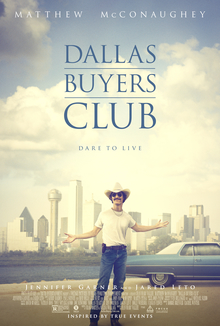
Image result for dallas Buyer's club
Matthew McConaughey’s transformation from wiry homophobic cowpoke to frail, determined AIDS survivor in mid-80s Texas is riveting, and he is ably supported by Jared Leto as a young transvestite who becomes his business partner (the business being the importation of non-FDA approved drugs for AIDS patients as an alternative to the toxic AZT). I expect Oscar nominations for both actors for their understated and moving performances, when showy and overwrought was to be expected.

The first half of the film paints a portrait of Ron Woodruff’s (McConaughey) fast living, his “I ain’t no homo” denial of his diagnosis, and his determination to stay alive and flourish, and your investment in his fate is total. But that leaves half a film, and unfortunately, the picture then stumbles. McConaughey makes the jump from survivor to advocate and soon, his finger in in the face of the FDA, the presumably corrupt dispensers of AZT at the hospital, Big Pharma, and yes . . . the system.

The institutional corruption and failure story has been done to death, and it carries a feel wholly distinct from what has come before – inauthenticity. I’ve read a great deal about Woodroof, and much of his tale is corroborated, but in that corroboration, there is no confirmation of the most Hollywoody of the film’s vignettes, such as his attacking the evil doctor in the hospital or his crashing of Big Pharma roll outs of AZT. Perhaps these things occurred, but even if they did, their depiction in the film is cheap and easy. As a historical aside, the availability and affordability of AZT was demanded most vigorously by Act-Up, and its therapeutic value was significantly greater than shown in the film.

There are other problems. Jennifer Garner, as the doctor who McConaughey charms to his side of the drug fight, is a fictional character. She never should have been drawn, or at least, she should have been cast with a more compelling actress. Garner is no match for McConaughey. She gamely tries to communicate empathy and dawning but musters mere wet eyes and wonder.

The bad guys (Dennis O’Hare and Richard Barkley) are stock, almost sneering suits and what Steve Zahn is doing in this picture as a 3 foot ridiculously mustachioed sheriff escapes me.

Otherwise, Dallas Buyer’s Club is a serviceable platform for McConaughey and Leto which eventually succumbs to its own good intentions.

The premise is about as plausible as Escape from New York. If crime can increase so much that Manhattan must be cordoned off as a separate, lawless prison, than the nation could establish a 12 hour period annually where its citizens can “purge” and commit any crime without punishment. The purge is a mix of a social reform (by allowing one night of consequence free crime, we have no other crime the rest of the year) and patriotic-religious act. But it occurs in 2020, and as bad as either Bush or Obama has been, I can’t see that kind of institution gaining traction so quickly. Frankly, it is unlikely the government could get the website for The Purge up and running in 6 years. In the end, the filmmakers don’t really invest much in the concept, and as my son remarked, “the problem with the movie is that you didn’t need The Purge to make it.” He’s right. When the killers looking to take advantage of their wild night surround the well fortified home of Ethan Hawke and his really stupid family (note to self; on Purge night, make sure your foolish son doesn’t get all Good Samaritan and lift the security gates), they may as we’ll be zombies or Manson family members or the bad guys in The Strangers or You’re Next. There is no reason to go high concept if you have no intention of exploring that concept.

Or maybe not. On a budget of $3 million, it made $64 million.

image

A fitting choice on the 50th anniversary of President Kennedy’s assassination, Parkland is a sober, gripping recreation of that event through the eyes of his Secret Service detail, the FBI office in Dallas, the medical staff at Parkland Hospital, Abraham Zapruder and Oswald’s family.  It is hard to achieve verisimilitude on such a well known event, but director Peter Landesman does just that in his handling of detail.  It seems unbelievable that the Secret Service would entrust the 8mm film shot by Zapruder to his care even as they desperately sought local facilities to develop the film, but it was his property, that’s exactly what they did, and the discussions over the disposition of the footage are fascinating. There is also an incredible frenzied argument between the Dallas medical examiner and the Secret Service staff over control of the body, which Landesman handles without judgment, and while it just seems incredible that Vice President Johnson is walled off in a hospital file room behind a barricade of guns while the medical staff works on the president, that too is a true fact not oft reported.

These touches are enhanced by determined performances from Billy Bob Thornton, Paul Giamatti, Colin Hanks, Zach Effron, Marcia Gay Harden, Mark Duplass and others. The scene where Kennedy’s aides and the Secret Service have to remove seats from the plane and jam the casket into the passenger area is particularly and deeply affecting.

The primary criticism of this film is that it lacks cohesion, that it somehow didn’t communicate something broader. Actually, that was its strength. The characters do not strive to communicate anything more than having to deal with a horrific event as best they can, and Landesman focuses on their plight, not on a deeper meaning to the event.  The assassination itself is enough to provide the context, and in an era when each of these bit players in a national trauma would likely be on cable news within minutes, the self-restraint of the picture underscores the self-restraint of the times.

The closest I came to smelling Hollywood was when they wheeled Oswald into the same emergency room as Kennedy and the senior nurse pushed him to another, saying, “He’s not going to live or die in here.”  It was artistic license, but it was appropriately chosen.

A minor nit – Texas Governor John Connally, also struck by rifle fire, was taken to Parkland as well, and it would have been interesting to have covered even in a small way his treatment while the hospital staff worked so desperately on Kennedy.

The central conceit of Ain’t In it for My Health, the documentary of The Band’s recently deceased drummer, Levon Helm, is that its subject is compelling enough to sustain interest in his daily chatter, visits to the hospital and scattered observations. It’s not.

Helm is closed off, we learn from a fellow musician, because “Levon’s got demons he’s struggling with over this whole Band legacy.”

If you dropped Fat Boy over Japan, I can see you struggling with demons over your legacy.  In contrast, it is tough not to juxtapose Helm’s bitterness with an excerpt from a recent article I read on Bob Dylan: “Now, though, he was out on his own – after eight years’ abstinence, just as rock touring reached new debauched depths. The Band had roadies take Polaroids of girls wanting to get backstage, poring over potential beauties like horse-traders. Cast-offs were handed to the crew.”

Still, I was game.  Helm’s issues with The Band and posterity’s treatment of same could be interesting.  Of Robertson, Manuel, Danko and Hudson, their travels and impact, Helms says that . . . . “the credits and the money” on the third Band record was a “screw job” (Robertson was the writer and got the royalties) and after that, well, it was pretty much all over.

That’s the whole of it.

Otherwise, Helm just broods and ambles and lounges amongst younger acolytes (including Billy Bob Thornton) and these scenes are interspersed with nature photography of Helm’s property in Woodstock, NY.  Near the end, surviving wives and girlfriends tell us that the real downfall of The Band was drugs and alcohol.

Mind. Blown.

On the plus side, there’s some nice old footage of The Band, some later footage of Helm who played live not long before his death, and the portrait of the musician at the end of his career, with cancer ravaging his voice, can be poignant

Frances Ha (2012) Review |BasementRejects

In the first ten minutes, you realize this is going to be a melange of a Woody Allen black-and-white paen to New York and Lena Dunham’s HBO sensation Girls. Dunham’s show is an entertaining but often frustrating characterization of four girls, post-college, making their way in the world of New York City via witty, self-satisfied rejoinders and copious infusions of cash from their parents. Loaded with self-esteem but no brightly discernible skill, Dunham’s quartet negotiate the shoals of a hip, ever-changing landscape while coming to the realization that every girl with a B.A. from Oberlin is not destined to be a smash in the literary and art worlds. It’s hard to like her characters, especially, Dunham herself, whose Hannah is so grotesque, self-involved and deluded that you’re often left cringing or sputtering in amazement. Or, at almost 50 years of age and closest in sensibility to her poor beleaguered parents on the show, I am.

Still, Girls is a solid work, surprisingly addictive, and it always elicits a great discussion that can range from generational rot to what the cool kids are into these days. I also credit Dunham with either knowingly or unknowingly crafting a sharp indictment of extended, subsidized adolescence, and despite her ridiculous persona as her star ascends, I think she knows it. Or she should.

If Girls were a quintet, the protagonist of Frances Ha, Greta Gerwig, would play the mopey, co-dependent would-be dancer. Unfortunately, Frances is not in the hands of Dunham, who could effectively compensate for Frances’s pathetic existence with humor or humanism. Instead, she’s in the hands of a filmic sadist, Noah Baumbach, whose characters are often so vile and/or degraded that you wonder if the point of the exercise is solely to make the audience feel better about themselves. As the divorcing parents in Baumbach’s The Squid and the Whale, Laura Linney and Jeff Daniels are positively toxic, as is Nicole Kidman’s abusive, miserable mother in Margot at the Wedding. Ben Stiller’s Greenberg is similarly noxious, though at least Baumbach offers some redemptive qualities near the end of that film.

The difference between those characters and Frances, however, is that they are in varying positions of power, whereas as a 27 year old Vassar grad who is as much a dancer as I am a power forward, Frances is at the mercy of her surroundings and singularly ill-equipped to handle them. You can feign amusement at her plight in the various uncomfortable situations Baumbach creates for her only so long before you feel guilty. Baumbach may have caught on to his excess, because in the last five minutes, Frances develops character, self-esteem and a place in this world for no apparent reason other than to avoid a mass suicide at the local cineplex.

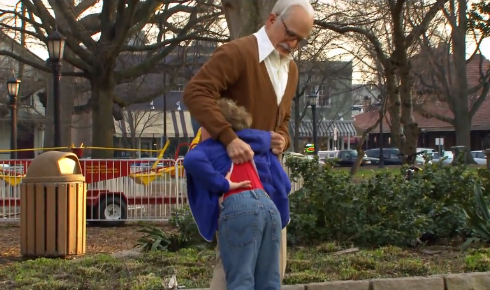
There is a difference in this installment of the Jackass series.   Creator Johnny Knoxville and collaborator Spike Jonze have given us an actual character. Instead of a gaggle of cut-ups and clowns crashing golf carts or defecating in showroom toilets, we have an old man (Knoxville in convincing makeup and prosthetics) who is recently widowed (in fact, his dead wife is in the trunk of the car) and whose daughter was just jailed.  The old man is forced to drive his grandson from Nebraska to North Carolina to drop him off with his deadbeat father, pranking merrily along the way.  Some pranks hit (his uninvited involvement in a male strip show and his being hurled through a plate glass window while astride a kiddie ride), some are okay (a malfunctioning bed that crushes him, a drunken trip thru a drive-up window in a shopping cart) and some are too uncomfortable or disgusting to recapitulate.

Ultimately, like Borat before it, Bad Grandpa is accidentally patriotic.  As bad as this grandpa acts, as much as he destroys and mucks up, the tolerance and kindness that greets him is noteworthy.  As Christopher Hitchens observed about Borat, whose hijinks were decidedly more cruel and condescending than Knoxville’s shock routine, “Americans are almost pedantic in their hospitality and politesse.

The patience of the prank-ees in Bad Grandpa is its strongest feature and, for that, we should be thankful.