John Woo is an action hack, a Chinese director of minor renown who came to America and never looked back, making several big concept explosion-fests, like Broken Arrow, Mission Impossible II, Windtalkers (a Pacific theater World War II film that looks as if it was filmed in the Hollywood Hills) and Paycheck, which was once thought to be the coda to Ben Affleck’s career. You can only lose people so much money before you get benched, and Woo’s Windtalker‘s had a worldwide gross of $70 million on a budget of $115 million. Paycheck merely broke even domestically and appears to have signalled the end of the line for Woo.

But Woo left something for us, a ridiculous, giddy gem, to show that he had come to America and contributed. Face/Off stars Nicholas Cage as master terrorist Castor Troy. John Travolta is his Javert, Agent Sean Archer. Archer catches Troy, and puts him in a coma, which is fair play given that Troy murdered Archer’s young son. But Troy planted a bomb somewhere in LA before sleeping his deep sleep, and only Troy’s brother Pollox (Alessandra Nivola) knows the location of the bomb.

What to do?

Well, you surgically remove the face of Castor Troy, put it on Sean Archer, Archer goes into the super-max prison where Pollox is housed and elicits the whereabouts of the explosive. Duh.

Except, when Archer is in prison with Troy’s face, Troy wakes up from his coma, forces the doctors to give him Archer’s face, kills everyone who knows about the whole “face/off” plan, keeps Archer in prison, and then reinstates “date night” with Archer’s wife (Joan Allen).

Furious, Archer escapes prison, and then . . . slo-motion doves:

This is an absurd, dizzying, very funny movie, tailor-made for two of the greatest over-actors of our generation. Great film. Road House great.

Horror Queers] The Villainous Cross-Dresser of 'Insidious: Chapter 2' -  Bloody Disgusting

This is certainly the summer of James Wan. The Conjuring cost $20 million and has thus far grossed $270 million worldwide, and Insidious 2 cost $5 million and opened at $41 million this weekend.

The Conjuring is a vastly superior film, but Insidious 2 is not altogether bad. It starts off halting and awkward, and its fealty to following up on Insidious is both admirable and clunky. We pick up on the story right after Josh Lambert (Patrick Wilson) has returned from The Further, having saved his son in the process.  As we learn at the end of the first film, however, it is not Wilson, but someone much more sinister who returned in his guise. The film then moves on three tracks – Wilson, in the house, a threat to his wife (Rose Byrne) and kids; his mother (Barbara Hershey) and her investigators, trying to identify the entity that has taken Wilson; and Wilson himself, stuck in The Further, helpless. This all takes some time to queue up, and the speed of it all makes the picture stilted. In particular, poor Byrne is reduced to actually having to try and convince Wilson of the continuation of the terror, and his “Oh, honey, you just have to ignore the evil!” rejoinders are unintentionally funny.

But once it gets rolling, the film regains its balance, delivering some very good scares along the way, and Wan’s weaving of Wilson’s childhood, the first picture and the events we are witnessing is pretty skillful.  To Wan’s credit, those scares remain bloodless and gore-free (although the film is too dimly lit).

The World’s End, the third installment of Director/Writer Edward Wright and Writer/Lead Simon Pegg’s Three Flavours Cornetto trilogy, melds their two prior comedies. There is the apocalyptic vision of Shaun of the Dead, as a troupe of 40-something high school mates (led by Pegg) take another shot at an epic pub crawl, only to learn that their pastoral hometown as been infiltrated, not by zombies, but by robots. There is also the town itself, which has become a sterile, cookie-cutter environment, not by the hand of the secret community beautification cult of Sandford, as in Hot Fuzz, but by aliens. All three films feature the great buddy tandem of Pegg and Nick Frost, Wright’s Abbott and Costello, but in The World’s End, Frost is the responsible member of the duo (a barrister, if you can believe it), until Pegg’s jabbering and the tenacity of the robots transform him into an unstoppable robot-killing machine.

These are great joy ride films, with inspired action sequences punctuated by some very funny lines. Forced to choose, I’d have to put Hot Fuzz at the top, if only for the best movie shootout ever, the beginning of which is below:

Backstory: after The Monster and Will Will Kill, the film world has been anticipating Will Larroca’s third feature, House of Blood.  I can report that principal photography began today.

But that’s not the news.  Apparently, Larroca had been secretly working in Europe over the summer . . . on a psychedelic musical: The Hugginns Movie.  He was not happy at all with the results, shelved the entire project and has been litigating to have his name taken off of it.  Still, a copy has now been made public and is setting up roots on the Internet.

Two words: mind blown.  I don’t understand Larroca’s objections, and I know auteurs can be idiosyncratic, but if he deems this a failure, I can’t wait for the film he deems worthy.

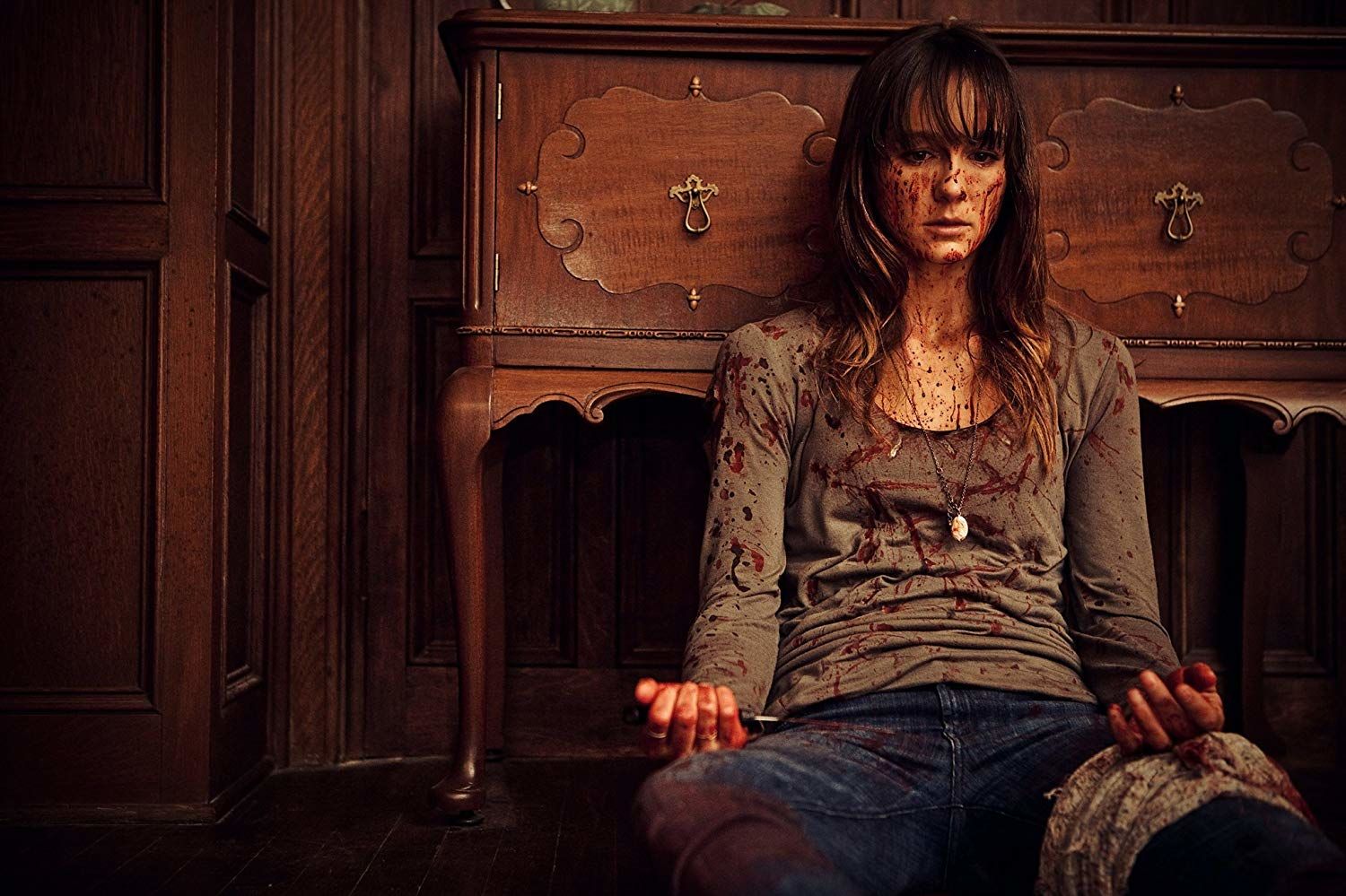
You're Next's innovative use of a household blender
Taken on it’s own terms, You’re Next is probably a 2 star film.  The story of a family of ten, terrorized and murdered one-by-one at a secluded reunion, is effective and frightening. The mystery, however, is easily deduced, and the killings themselves, which take up most of the film, are (with the exception of an inspired murder by blender) a pedestrian lot of slayings, stabbings and bludgeoning.

The film’s terms, however, are my objection. I was drawn to it by my son, who pointed out reviews noting pitch black humor, a play on the genre, a fresh twist,  etc . . . I was hoping for Scream or Evil Dead 2, but this is just an abattoir with an occasional wry exchange.

I would have given a great deal to have been at the studio screening of David Fincher’s Zodiac. I wonder who said first, “You mean, this movie is almost 3 hours and we never definitively learn whodunnit?”

The 1969-1970 Zodiac killings are unsolved and at least by serial killer standards, the Zodiac racked up a meager body count (only 5 victims are confirmed as by Zodiac’s hand).  Nonetheless, these narrative infirmities are more than compensated for by the killer’s panache.  Zodiac taunted the police departments of four different Northern California communities with letters to newspapers, including ciphers to be broken which promised to reveal his identity and wild threats (including one to shoot San Francisco kids as they left school buses). Like Jack the Ripper, the Zodiac wanted to lord his superiority over his pursuers.

Fincher takes the Zodiac case and uses it to dramatize exactly how such a crime burrows itself into the marrow of people, altering them profoundly. Jake Gyllenhaal is The San Francisco Chronicle cartoonist Robert Graysmith, who becomes obsessed with the killer the day his first letter to The Chronicle appears. Graysmith would eventually write the definitive book on the Zodiac, and as played by Gyllenhaal, he is sucked into the mystery to the near exclusion of all else. Robert Downey, Jr. plays Paul Avery, the Chronicle crime reporter who covered the case and received a threatening letter from the Zodiac. Avery had labeled the Zodiac a latent homosexual and the Zodiac wrote him a Halloween card warning, “You are doomed” (which resulted in the staff of The Chronicle creating buttons emblazoned with “I Am Not Paul Avery”).  Downey’s Avery is driven from The Chronicle, to drink and drugs and despair, exacerbated by his fear of the Zodiac. The two police officers assigned to the case are also damaged. William Armstrong (Anthony Edwards) eventually transfers to another division while Dave Toschi (Mark Ruffalo) is at one point accused of forging a Zodiac letter (he was cleared of all charges).  There are also the survivors. The Zodiac attacked 3 couples while they were alone and vulnerable, but two men survived, one of whom was the only living person to see the Zodiac. He is a shell, having escaped the country, found at the end of the film to provide one final clue.

The psychological study is encased in a meticulous yet accessible procedural. Screenwriter James Vanderbilt keeps myriad threads intertwined without sacrificing pace, no mean feat given a multi-jurisdictional crime reverberating in the worlds of the police and journalism.

Fincher re-creates those crimes in a manner that communicates their terror and the vulnerability of the victims without being sensationalist or gratuitous. Indeed, the most frightening scene is one where no violence is done. Five months after his last killing, the Zodiac killer pulled over a woman with her baby on a highway, letting her know her back tire was wobbly. He feigned assistance by tightening the lugnuts, but the wheel fell off immediately after she got back on the road. The killer came back, offered to bring her to a service station, but instead drove her around until she was able to escape into a nearby field with her baby (the connection to the Zodiac was made after he referenced the encounter in a letter to The Chronicle a few months later).

It’s hard to imagine that the director of the gruesome Seven made this picture, which is restrained, methodical and to my mind, infinitely scarier. Having to turn away and shut your mind off has less of an effect than when you cannot do so and you’re required to think.

This film has just recently been offered for streaming on Netflix so take advantage.

The opening scene, where our beleaguered protagonist Duncan (Liam James) has to endure a numeric assessment from his mother’s new boyfriend (Steve Carell, who deems Duncan a “3” on a 1 to 10 scale for his layabout ways) reveals a great strength and a great weakness of the film.  James, as an awkward, inward 14 year old dragooned to Carell’s beach house with his mother (Toni Collette) for the summer, exhibits all the hideous hallmarks of the age. He’s ungainly, goofy and paralyzingly shy.  Carell also keenly occupies his type – an exact, sly bully who masks his menace in the cause of trying to be a father figure.  Everyone time he says “hey, buddy”, it presages a cut, an attack, and therein lies the problem with this coming of age tale.  With Carell identified as a villain from the get go, little that occurs next is unexpected or fresh.

That said, the script, from the Oscar winning writers of The Descendants (Nat Faxon and Jim Rash, who also co-direct) is assured.  The story of Duncan’s growth under the tutelage of Sam Rockwell, a comic guru who runs the local water park, takes pity on Duncan, and gives him a job, is the heart of the picture, and their banter is really very funny and often surprisingly touching.  As Duncan’s mother loses herself in Carell’s world, we know  Carell must be slayed.  While we wait for that inevitability, however, Faxon and Rash have a blast with the water park and all of its quirky characters (including both Faxon and Rash, who are both very funny as well).  Carell’s coterie at the beach are also well written, if not fully developed, with Allison Janney delivering the lion’s share of the killer lines, most of which are directed at her own son, who has a wandering eye she insists be covered up by a patch.

There is triumph and happiness at the end of the picture, as you knew there must be, but with a little more care and guts, the writers could have made a great film.  Instead, in the middle, they so vilify Carell that they do lasting damage to the story.  Duncan goes on a boat trip and Carell forces him to wear a ridiculous life vest while the much younger kid with the wandering eye is unburdened.  The cruelty is too much.  It robs Carell of any chance of being anything but a caricature, demeans Collette, and is so humiliating to Duncan that you start to lose sympathy for the kid.  I don’t think Faxon and Rash wanted Carell’s numeric assignment to find purchase with the audience, but that’s what they risked.

This film is a similar to, but not as good as Adventureland.

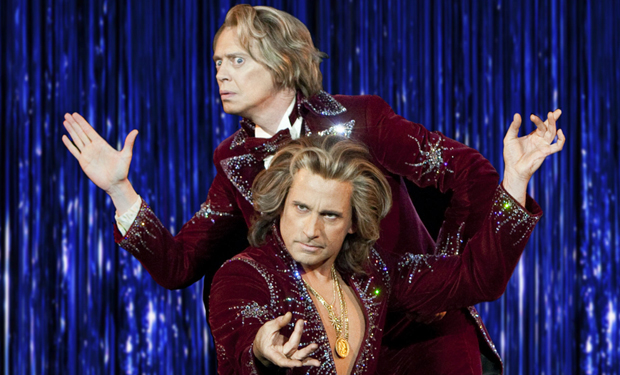
Image result for Burt Wonderstone

Not bad, not great, along the lines of Dodgeball, with a few good gags (in particular, Vegas magician Steve Carell freaking out 20 minutes after the start of his 7 day stunt stint in a box above The Strip).

This is a movie that answers the question: What would Michael Scott have been had he left Dunder Mifflin to become David Copperfield?

Two takeaways.

First, Jim Carrey plays Carell’s nemesis, and boy has he aged.  Cable Guy schtick doesn’t work so well from such a weatherbeaten vessel.

Second, I am a huge fan of Steve Buscemi.  He stood out in Miller’s Crossing, his dramatic work in Reservoir Dogs and Fargo was gritty, his season on The Sopranos was sublime, and his Nucky Thompson on Boardwalk Empire is rock solid.  But where did he get the reputation for comedic chops?  He’s been in 5 Adam Sandler vehicles, but having that on your resume’ isn’t exactly a recommendation.

Funny looking is not funny.

The excellence of writer/director Jeff Nichols’ Mud lies in its authenticity, confidence and reserve. As I watched this coming-of-age story about two boys, Ellis (Tye Sheridan) and Neckbone (Jacob Loffland), both of poorer Arkansas stock, and their involvement with a fugitive (Matthew McConaughey), I couldn’t shake what the film wasn’t – maudlin, simplistic or heavy-handed (i.e., like the template for so many “coming-of-age” stories about young boys, Stand by Me). While those two films have the Huck Finn story in their DNA, that’s where the comparison ends. Stand by Me needed a narrator to tell you what was of import and what was not in the adventures of their young male characters, and by the end of it, you felt thoroughly manipulated. Mud, however, requires no such crutch. The symbol of what is a man and father, what the divorce of his parents means to a boy, what young love is, and the heart of friendship, is depicted in a lifelike, piercing way. There is a wonderful scene where Loffland’s uncle, played by Michael Shannon, tries to impart some wisdom to Ellis, explaining in a deft but allegorical manner how Ellis needed to stay out of trouble and the nature of his responsibility to Neckbone, who is both a rock and a natural born follower. When Neckbone asks Ellis what they were talking about, Ellis shrugs and replies, “I don’t know.”

The performances are almost completely spot on, and Sheridan and Loffland should be shoo-ins for best actor and best supporting actor, but I’m certain they will be overlooked. That’s a shame, because they are at the ages where pure naturalism (for example, Quvenzhane Wallis in last year’s Beasts of the Southern Wild) cannot carry the day. These boys are making intuitive choices. Their interplay alone is mature and steady, and Sheridan’s scenes with a would-be girlfriend are heart wrenching. They will evoke your best friend from childhood, and you won’t need Richard Dreyfus intoning, “he was my best friend from childhood.”

McConaughey, who has bouts of phoning in roles with a quick smirk and a lazy drawl, delivers a much deeper performance here as the outlaw, desperate not only to escape the law but to reconnect with his true love (Reese Witherspoon). Nearly every other supporting character – from the rigid, recluse Sam Shepard to Ellis’s parents (Ray McKinnon and Sarah Paulsen), to Shannon (whose three scenes damn near steal the movie) – contributes in an effective, understated manner. If there is a weakness, it is Witherspoon, and she was not bad, she was just a little outclassed.

Nichols (Take Shelter) shoots the Mississippi River as a dream, and when the boys are on or traveling to and from the island where McConaughey is holed up, the feel is very Terence Malick. But when the boys are back home or amongst the townies, the look is bleached and tacky, further emphasizing the juice they get from their adventure.

Another kudo – when Hollywood deals with the non-urban, at its worst, you get a grotesque caricature, and at best, you merely get a sort of condescending ennobling, the hick version of “the magical negro” (usually wrapped up in a “you’re better than this place, Willie!”). There is none of that here. Instead, Nichols has written rounded, grounded, real characters.

It is perhaps unfair to use this picture as a club against Stand by Me. To the positive, it ranks up there with the equally excellent Sling Blade and One False Move and is thus far the best film of 2013.