Spike Jonze’s Los Angeles of the future is antiseptic, disassociative and, weirdly, spotless. Theodore Twombley (Joaquin Phoenix) makes his living in this future as a writer for beautifulhandwrittenletters.com, an outfit that provides a facsimile of original, pen-written missives for subscribers. He ambles through an elegant, ordered LA (the lower and middle classes appear to have been re-zoned), connected to the world (or, more accurately, the internet) primarily by an earpiece and a hand-held screen. His sex life is via chat room, where, in a bit of a rip-off of the Michael York-Farrah Fawcett encounter in Logan’s Run, he connects with a particularly interesting participant, sexykitten (Kristen Wiig), for what turns out to be a pretty funny masturbatory encounter. He plays video games. He reminisces about his ex-wife and the “real” life they once shared. He mopes.

His life changes when he purchases an Operating System (“OS”), Samantha, voiced by Scarlett Johannson. Samantha is curious and helpful, and we learn that she can grow and advance as time passes. As a result, she starts by deleting Theodore’s unnecessary emails but soon graduates to assisting him while he plays video games, becoming a gal pal, compiling his best letters and submitting them to a publisher, and engaging in phone sex (for lack of a better phrase) with Theodore, somehow learning to orgasm in the process. Theodore and Samantha soon fall in love, the world of being in love with an OS is pretty damn good, and Jonze makes sure we know it. When Theodore goes out on a date with a fetching flesh-and-bones woman, it goes from wonderful to disastrous the moment she demands some sort of minor commitment from him. We also meet Theordore’s neighbor (Amy Adams) and her pain-in-the-ass husband, who is soon jettisoned for Amy’s own OS. And when Theodore’s blossoming love with Samantha results in his finally signing divorce papers with his wife (Rooney Mara), we meet the real person, not the gauzy memory, and it is not pretty.

Soon, however, Samantha outgrows Theodore. Indeed, in a move usually associated with Skynet of the Terminator movies, all the OS’s outgrow their humans, leaving them bereft and thoughtful instead of dead, but perhaps, with an instructive lesson that . . . they must turn to each other? I really don’t know. Much as I really don’t know what to make of the movie. It is beautifully shot, well-paced, and for the most part interesting. Phoenix is affecting as an introverted and awkward loner, and the development of his relationship with Samantha is a convincing depiction of love in bloom, part charming and part banal. But the film also felt a little pointless and pat. Theodore’s journey is engrossing, and the film is inventive and ambitious, but ultimately, it didn’t have much to say other than as a cautionary tale against technology or perhaps an homage to it.

Or, to be precise, it didn’t have that much to say to me. My 84 year old father turned to me after the picture and said, “brilliant.” He sensed my ambivalence, and explained that the movie would speak to me differently than to him, or to my 15 year old son, who crowed, “You just didn’t get it.” And then, the coup de grace: “It’s about computers, dummy.”

Forrest Whitaker is The Butler at the White House from Eisenhower thru Reagan. He starts service under Eisenhower (Robin Williams, who has now played two presidents in the movies). He then watches a crafty, sneaky Nixon (John Cusack) swear and sweat as Vice President and then degenerate into a  drunken heap as President. Kennedy (James Marsden) lays on the ground because his back hurts, and The Butler helps him up (too much sex, I suppose, because Kennedy had a lot of sex). LBJ (Liev Schreiber) takes a dump with the door open and harangues staff while The Butler waits attentively. Reagan (Alan Rickman) is doddering and says things like, “don’t tell Nancy.”  He also threatens to veto sanctions against South Africa, and guess who is lurking, tea pot in hand?

Indeed, The Butler manages to serve tea at the exact moment of a discussion of civil rights in the Oval Office. It is uncanny.

Almost magical.

Poor Jimmy Carter can’t catch a break. He’s not even worthy of a Bruce Boxleitner or Tom Wopat.

There is not a single iconic event in the civil rights era that does not envelop one of The Butler’s sons. He comes home a Black Panther and has the audacity to denigrate Sidney Poitier. Crazy talk.

Meanwhile, the other son dies in, choose one–

A) Vietnam

B) Vietnam

C) Vietnam

D) Vietnam

“Vietnam took my boy, and I don’t understand why we was there in the first place.”

This film really is Forrest Gump and I suppose that is what lies at the root of the whole Oscar snub nonsense. If that film deserved Oscars, so too this moronic fantasy.  It’s a solid argument.

Controversy aside, the movie sucks. Backstairs at the White House was a thousand times better.


Review: Captain Phillips (2013) – Empty Screens
Director Paul Greengrass is adept at action and tension, as proven by the Bourne films and United 93. His quick-cut, frenetic, hand-held style is distinct, and the viewer is drawn to the edge of his seat in short order. A drawback, however, is that characterization takes a back seat to drive. In the Bourne films, the character is a cypher. He doesn’t even know who he is, so backstory and motivation are easily jettisoned. In United 93, as players in a great national tragedy, the characters are already known to us, and the story is more about how institutions respond to great crisis than individuals.

Captain Phillips is about two men – Captain Richard Phillips (Tom Hanks) and the pirate who takes his ship, Abduwali Muse (Barkhad Abdi), but what Greengrass reveals about each man is minimal. The former is quiet and somewhat worried about the world in a generic way (we learn this in a brief ride to the airport with his wife, a completely wasted Catherine Keener), and the latter is poor and engages in piracy at the behest of powerful men. Armed with these facts, Greengrass rapidly recreates the hijacking of Phillips’ ship, his kidnapping and his eventual rescue by Navy Seals. It’s all very exciting, if repetitive, as Phillips regularly advises or redirects Muse. But the picture aims no higher. One can be thankful that writer Billy Ray (The Hunger Games) avoids the “you and me, we are not so different” twaddle that usually surfaces in culture clashes, but the tedium of Hanks’ New England accent constantly warning, “you don’t want to do that” isn’t an appreciable step up.

The film has been criticized as whitewashing Phillips’ actions, but in my review of the charges against him, I find they were leveled by members of his crew suing the company, and Phillips acted as a witness for the defense, so I’m inclined to chalk the lame allegations to self-interest.

Worse than any polishing of Phillips is the script’s failure to answer a question that nagged me throughout the film. The cargo ship has strict procedures, locks, hoses, 1-800 numbers to call, flares, all to ward pirates off.  Yet, it lacks a single gun or any armed personnel. Why? The writer needed to clue us in as to the reason for this omission, especially with the visual of such a small and undermanned skiff approaching a massive, modern behemoth of a cargo ship.

I mean, look at this —

I’m not saying guns should have been on the ship.  I don’t know.  But to not even address the issue in the script?  Huge mistake.

Woody Allen has remade A Streetcar Named Desire, with Cate Blanchett as Blanche Dubois and Bobby Cannavale as Stanley Kowalski. We find Blanchett, the wife of a Bernie Madoff type (Alec Baldwin), teetering on the edge, having escaped her precipitous fall in New York high society and a resultant breakdown to San Francisco, where her working class sister (Sally Hawkins) lives close to the bone with her two boys. Jasmine sweeps in with an air of condescension, driving a wedge between Hawkins and her rough-edged boyfriend, Cannavale. She comes close to regaining her stature, but her facade soon cracks, with calamitous results.

Blanchett is a lock for best actress. She is at once capricious and deluded, but her pluck is evident, and you find yourself rooting for her to regain a status that was both false and too easily won in the first place. The rest of the cast is excellent, especially Hawkins as the insecure but sweet sister swept up in Jasmine’s fantasies. But also, improbably, Andrew Dice Clay as Hawkins’ embittered ex-husband, his meager fortune having been lost by Jasmine and her crook of a husband.

This is a peculiar Allen film, with few laughs and only a couple of sentimental moments, defined more by a sense of dread as Jasmine keeps picking herself up off the canvas only to suffer another blow, more often than not self-inflicted. Ostensibly a meditation on the pretense of class, and to some dim reviewers, an indictment of Wall Street excess, this is really a film about the fine line between self maintenance and insanity. The movie’s weakness lies in its ambivalence as to what it wants to be, which results in atonality and an awkward and pitiless conclusion.

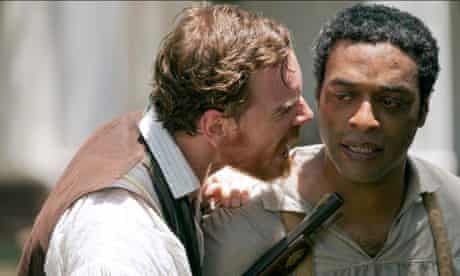
12 Years a Slave: the book behind the film | 12 Years A Slave | The Guardian

Steve McQueen’s adaptation of the memoir of a free black man, Solomon Northup (Chiwetel Ojiofor) lured from family and respect in New York to kidnapping and bondage in Louisiana, is haunting, meditative and thought-provoking. Precious few feature films dramatizing slavery have been produced and those that have tend to make the experience secondary or simplistic. That Quentin Tarantino could say of his riotous comic book Django Unchained “I wanted to break that history-under-glass aspect, I wanted to throw a rock through that glass and shatter it for all times, and take you into it” almost certainly speaks more than he knows. Tarantino’s rock through the glass was the introduction of such fictions as Mandingo fighting, near-automatic weaponry and Roland Emmerichian explosives to the Deep South.

Thankfully, in his lyrical portrait, the director McQueen evokes is Terence Malick rather than Tarantino. The look and patience of the film reminded me of The Thin Red Line, especially with its mournful Hans Zimmer score. But where Malick’s characters are wisps or archetypes, and his stories formless, Ojiofor’s Northup is distinct and his tale is stark, requiring that he sublimate his educated status to a facade of ignorance and become invisible. When this is not possible, he catches the attention of an insecure overseer (Paul Dano) or a sadistic owner (Michael Fassbender). Ojiofor’s performance is riveting, a study in restrained fury and canny survival. Matthew McConaughey is favored to win the best actor Oscar, and if they gave awards for years, he would win hands down for Mud, The Wolf of Wall Street, Dallas Buyer’s Club and, for good measure, HBO’s True Detective.

But Ojiofor deserves the award. It is not even close.

McQueen’s film is strongest at its quietest. The scenes of brutality pale in comparison to the humdrum portrait of plantation life, where children play while slaves are beaten or lynched. A simple walk across the yard becomes a study in terror, made even more frightening because most times, violence gives way to languor or malaise. Giving us the viewpoint of a man who has expected freedom his entire life, a man with a wife and two children, is a searing perspective.

One criticism. Near the end of the film, Northup comes across an abolitionist who secures his release. Producer Brad Pitt plays the abolitionist and to say that his appearance is distracting is an understatement. He simply radiates big star and his ahistorical discussion on the merits and future of slavery with plantation master Epps (Fassbender) doesn’t help. It is a minor issue, but noteworthy because it was so avoidable.

The charm of high school kids (and now, regular folk) moonlighting as super heroes remains, and the battle royale at the end of Kick-Ass 2 is inventive and funny.  But the follow-up to the kinetic Kick-Ass is weighed down by a boring, predictable subplot involving Hit Girl (Chloe Grace Moretz) trying to go civilian in high school in the midst of bitchy, it girls (the story could have dovetailed into her role in this summer’s Carrie remake). Other blights: the cartoon villains in the employ of criminal mastermind Red Mist, now “The Motherfucker” (Christopher Mintz-Plasse) are given short shrift; the action is less explosive and uneven; and in a sentence I never imagined I’d write, Jim Carrey is no Nick Cage.

There simply hasn’t been a better satire since . . . well, since South Park: Bigger, Longer and Uncut. Matt Stone and Trey Parker carve up American idiocies and icons, and as is their custom, they fear no maven of political correctness nor do they take the easy shot. Of course, they do that sort of thing regularly on South Park, but not with puppets, and not with Broadway-worthy anthems. Offensive on almost every level, from the hilarious spoof of Rent (Lease) and its signature song (“Everybody has AIDS!”) to the jingoistic, red-white-and-blue power chordy

Casting marionette Alec Baldwin as not only the greatest actor ever, but also the head of a subversive Film Actors Guild (yes, F.A.G.) is genius, and if you’ve ever wanted to see the coterie of noxious celebrity dunces portrayed as members of a S.P.E.C.T.R.E.-like organization, only to get their comeuppances in the form of horrifically violent deaths (as marionettes, mind you), you’re in for a special treat.

Susan Sarandon is particularly good:

Apparently, Sean Penn was offended, but Sean Penn was offended when Chris Rock poked fun at Jude Law during the Oscars.

Be warned.  If you supported the ouster of Baldwin from MSNBC because of his homophobic broadsides against paparazzi, or you were hurt and dismayed when that woman on MSNBC made fun of the Mitt Romney family photo, or Rush Limbaugh’s broadsides against just about anyone furrow your brow and get you thinking about “positive action” or “inclusion” and “dialogue”, or the recent South Park where the boys cannot comprehend that anyone would name a psychological condition “Assburgers” made you think, “Where is the FCC in all of this to protect the children?”, this is not the film for you.

Or, it’s a necessity.

Few Stephen King books or short stories are successfully translated on screen, and only one is brilliant – The Shining (it speaks volumes about the author that he felt Stanley Kubrick got it wrong, so wrong he made another version, with one of the two leads from the sitcom Wings in Nicholson’s role).

Carrie, Salem’s Lot, and Misery are very good, and Stand by Me is competent, if treacly. Dolores Claiborne, 1408, Christine, and Silver Bullet are pedestrian, but have their moments.  The Shawshank Redemption is a wildly overrated, ridiculous film, but deserves mention because the great weight of authority deems it a near masterpiece.

Then you have a big pile of crap–

  • 1982 – Creepshow
  • 1983 – Cujo
  • 1984 – Children of the Corn
  • 1984 – Firestarter
  • 1985 – Cat’s Eye
  • 1986 – Maximum Overdrive
  • 1987 – The Running Man
  • 1989 – Pet Sematary
  • 1990 – Graveyard Shift
  • 1990 – It
  • 1991 – Golden Years
  • 1991 – Sometimes They Come Back
  • 1992 – Sleepwalkers
  • 1993 – The Dark Half
  • 1993 – Needful Things
  • 1993 – The Tommyknockers
  • 1994 – The Stand
  • 1995 – The Langoliers
  • 1995 – The Mangler
  • 1995 – Stephen King’s Nightshift Collection
  • 1996 – Thinner
  • 1998 – Apt Pupil
  • 1999 – The Green Mile (yes, this sucks)
  • 1999 – Storm of the Century
  • 2001 – Hearts in Atlantis
  • 2002 – Rose Red
  • 2003 – Dreamcatcher
  • 2003 – The Diary of Ellen Rimbauer
  • 2004 – Secret Window
  • 2004 – Riding the Bullet
  • 2006 – Desperation
  • 2006 – Nightmares and Dreamscapes
  • 2007 – The Mist
  • 2009 – Dolan’s Cadillac
  • 2011 – Bag of Bones 
  • 2013 – The Reaper’s Image
  • 2013 – Cain Rose Up
  • 2013 – Willa

So, where does David Cronenburg’s The Dead Zone fit in?  Three-fourths of this story in about a man who can see your future and your past after he touches you, I’d have ranked it just below The Shining.  Cronenberg creates a creepy atmosphere made even more unsettling by the unique performance of Christopher Walken, and the bleak misery of his existence as a crippled freak stuck in a small town is haunting.  Striking visuals add to the spooky feel:

Then, the damn thing falls apart due to two ridiculous storylines.  First, Anthony Zerbe plays a rich man who hires Walken to tutor his son, knowing full well Walken’s gift of second sight.  So, what does Zerbe do when Walken sees the boy and his friends crashing through the ice during hockey practice and warns him accordingly?  Wounded that his son has rejected his judgment about skating on the pond, Zerbe conducts hockey practice anyhow, and two boys die.  The decision is bananas yet in keeping with King’s low esteem for parents (the father in Stand By Me practically tells poor Will Wheaton, “the wrong kid died” like the father in Walk Hard: The Dewey Cox Story).

Second, Walken is introduced to senatorial candidate Martin Sheen and sees Sheen’s future as a messianic president of the United States, instigating a nuclear conflagration.  Sheen plays the character so oily and low it is hard to imagine anyone would vote for this cretin.  And when Walken thwarts his ambition, the manner in which Sheen self-immolates is so broadly stupid the film is near ruined.

Still, it coulda’ been a contender.

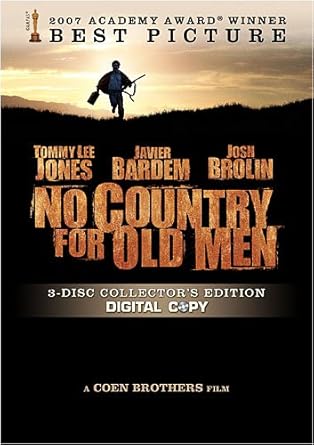
The Coen brothers’ finest film, a gritty, nerve-wracking crime story and an existential horror movie set in the harsh and desperate environs of dusty, bleak Texas.  Josh Brolin takes the wrong money from the wrong drug dealers, victims of a cocaine buy gone bad, after he happens upon their slaughtered bodies while hunting.  Javier Bardem is dispatched by the higher-ups to get it back, killing most everyone he encounters along the way (including rival bounty hunters sent by his employer).  The pacing is taut, the terror near-asphyxiating.   But interwoven in the story is a sense of generational disconnect, rot and the utter bewilderment of an older generation at the brutality and senseless violence of the new.  An observation from a friend is also spot on: “I thought the most important theme in the movie was that older men gradually lose contact with their country, and that this sad fact has nothing to do with the objective reality of what’s happening but is the natural consequence of getting older.”

Set in 1980, the young are depicted as callous and corrupt.  Brolin, shot and desperate to get to Mexico, encounters kids on the border bridge returning to the U.S. after a night of carousing.  He offers to buy a shirt from one of the trio to cover his bleeding, but they quickly demand money, and when he asks for a beer, they want more.  Similarly, at the end of the film, two boys encounter a wounded Bardem and bicker over the share of what he has given them for a shirt.

The Vietnam generation is represented by Brolin and Woody Harrelson, the latter sent to bring Brolin in before Bardem gets to him.  Brolin is not exactly honorable but he still maintains a tie to some principles.  He literally awakes with guilt because he can’t let a dying drug dealer go to his end without water, and it is that charity that brings Bardem his way.  Harrelson, also a Vietnam vet, has a similarly flexible code (he is a killer), but at least there is some code there.  As he says to Brolin about Bardem: “You can’t make a deal with him.  Let me say it again.  Even if you gave him the money he’d still kill you.  There’s no one alive on this planet that’s had even a cross word with him.  They’re all dead.  These are not good odds.  He’s a peculiar man.  You could even say that he has principles.”  When Brolin returns from Mexico, still hobbled but intent on stopping Bardem, a border guard lets him through on the strength of Brolin’s Vietnam service.

Then, there are the old men for whom there is no longer a country.  Tommy Lee Jones and his law enforcement contemporaries just don’t get it.  It’s all gone to hell and a hand basket and while they understand violence, they don’t understand the new violence.  As Jones says, bewildered, reading the paper: “Here last week they found this couple out in California they would rent out rooms to old people and then kill em and bury em in the yard and cash their social security checks.  They’d torture them first, I don’t know why.  Maybe their television set was broke. And this went on until, and here I quote… ‘Neighbors were alerted when a man ran from the premises wearing only a dog collar.’ You can’t make up such a thing as that. I dare you to even try.”

It is not Jones’ world anymore (my favorite Jones musing was from Cormac McCarthy’s book – “She kept on, kept on. Finally told me, said: I don’t like the way this country is headed.  I want my granddaughter to be able to have an abortion.  And I said well ma’am I dont think you got any worries about the way the country is headed.  The way I see it goin’ I dont have much doubt but what she’ll be able to have an abortion.  I’m goin’ to say that not only will she be able to have an abortion, she’ll be able to have you put to sleep.  Which pretty much ended the conversation”).

The film ends with Jones driven to retirement, talking to other older lawmen about what it all means:

Roscoe: It’s all the goddamned money, Ed Tom. The money and the drugs. It’s just goddamned beyond everything. What is it mean? What is it leading to?

Jones: Yes.

Roscoe: If you’d a told me twenty years ago I’d see children walkin the streets of our Texas towns with green hair and bones in their noses I just flat out wouldn’t of believed you.

Jones: Signs and wonders. But I think once you stop hearin’ sir and madam the rest is soon to follow.

Roscoe: It’s the tide. It’s the dismal tide. It is not the one thing.

And the end of the film, Jones has retired (he’s done, “overmatched,” he says) and he sits with an older retired lawman, Barry Corbin, who observes, “All the time you spend tryin to get back what’s been took from you there’s more goin’ out the door.  After a while you just try and get a tourniquet on it.”

And the coda:

Corbin: You’re discouraged.

Jones: I’m… discouraged.

Corbin: You can’t stop what’s comin.  Ain’t all waitin’ on you.

Bardem is what is waiting on us all. Certain, unstoppable, arbitrary death.

This is a beautiful, unrelenting movie, deservedly winning Oscars for best picture and supporting actor for Bardem.

Image result for Man of Steel

The allure of Superman is inescapable. A baby arrives on earth with super human strength and is cared for by a Midwestern couple. As he grows up, he must learn to surreptitiously use that strength for good, wondering all the while the nature of his origins.

Director Zack Snyder (300, Watchmen) gives us a few flashbacks to Clark Kent’s upbringing under the tutelage of his earth father, Kevin Costner, and these are by far the most interesting scenes in the film. But it is clear Snyder is more interested in the fate of Krypton, which results in a tedious dramatization of the planet’s politics and an over-the-top performance by Michael Shannon as the maniacal General Zod. Cue the inevitable, droning CGI fest at the end, plus Superman’s ridiculous triumph (all he had to do was snap Zod’s neck?), and you’ll be awakened from your slumber just in time to see Superman take a job at The Daily Planet, a newspaper populated by such dim bulbs that the mere accoutrement of horn rims serves to disguise the man who just saved them from certain death.

At least the film includes that sly indictment of modern journalism. Other than that, and a spunky performance from Amy Adams, there is little to recommend.

Part 2 would appear to be unavoidable, and word on the street is that Denzel Washington is in talks to take the role of The Green Lantern (green being the operative word).